Bolts, Grades, Materials and Standards

A Practical Engineering Guide to Correct Fastener Selection in Australia

Bolts are one of the most common engineered components on any project โ€” and also one of the most misunderstood.

In drawings they appear as a simple note:
M16 โ€“ 8.8 โ€“ GALV

Yet behind that small call-out sits structural capacity, fatigue life, corrosion resistance, inspection compliance, and legal responsibility.

Many engineering failures do not occur because a beam was undersized or a calculation was incorrect.
They occur because the wrong fastener type was selected for the application.

This article explains:

  • Bolt and nut property classes
  • Where each class should be used
  • Carbon steel vs stainless steel
  • Coatings and environment suitability
  • Structural vs mechanical bolting
  • Australian Standards governing fasteners
  • How to review and challenge incorrect selections โ€” especially when mentoring graduate engineers

1. The Three Different Worlds of Bolting

Most confusion exists because people think a bolt is simply a stronger or weaker version of the same item.

In reality, bolts exist in three different engineering systems:

SystemPurposeGoverning Standards
General Mechanical FasteningHolding components togetherISO / AS 1110 / AS 4291
Structural BoltingLoad transfer between steel membersAS/NZS 1252 / AS 4100
Corrosion Resistant FasteningSurvive environmentStainless / coatings standards

Using a bolt from the wrong system often creates hidden failures.


2. Bolt Property Classes (Metric)

Metric bolts are marked with numbers such as 4.6, 8.8, 10.9, 12.9

These numbers define material strength.

What the Numbers Mean

First number โ†’ Ultimate tensile strength (ร—100 MPa)
Second number โ†’ Yield ratio

Example:

8.8 bolt
800 MPa tensile strength
Yields at 80% = 640 MPa


Typical Bolt Classes and Their Uses

ClassStrength LevelTypical Applications
4.6LowLight brackets, sheet metal
4.8Lowโ€“mediumGeneral hardware
5.8MediumAutomotive covers
6.8MediumMachinery guards
8.8High tensileGeneral engineering & structural connections
9.8Higher tensileAutomotive mechanical
10.9Very high tensileMining equipment, heavy plant
12.9Ultra high tensileTooling, precision machinery

Important Engineering Concept

A stronger bolt is not always better.

Higher strength bolts:

  • are less ductile
  • tolerate less misalignment
  • fatigue faster in bending

Many failures occur when 12.9 bolts are used where 8.8 bolts were intended.


3. Nut Property Classes

Nuts are graded differently.
They must match the bolt strength.

Nut ClassSuitable Bolt
44.6
55.8
66.8
88.8
99.8
1010.9
1212.9

Critical Rule

Nut class must be equal or higher than bolt class first number

If not, the joint will strip before correct preload is reached.


4. Carbon Steel vs Stainless Steel

Many installations choose stainless assuming it is โ€œbetterโ€.

It is not stronger โ€” it is more corrosion resistant.


Mechanical Comparison

PropertyHigh Tensile Carbon SteelStainless Steel
StrengthHighMedium
Fatigue resistanceGoodLower
Vibration resistanceGoodPoorer
Corrosion resistanceDepends on coatingExcellent
Galling riskVery lowHigh
Torque capacityHighLimited

Stainless Grades

GradeEquivalent StrengthTypical Use
A2-50~5.8General hardware
A2-70~7.0Outdoor equipment
A4-80~8.8 tensileMarine / chemical

Important

Stainless steel often fails in structural joints due to:

  • lower yield strength
  • thread galling
  • relaxation under load

5. Coatings and Environment Suitability

Carbon steel requires corrosion protection.

CoatingEnvironment
Black oxideIndoor machinery
Zinc platedIndoor dry
Zinc passivateWorkshop conditions
Hot dip galvanisedOutdoor structural
Mechanical galvanisedStructural bolting
Dacromet / GeometMining & heavy corrosion

Engineering Impact of Coatings

Coatings change friction.

Friction changes preload.

Therefore torque charts must match coating type.

Incorrect torque values are one of the most common installation errors.


6. Structural Bolting vs Mechanical Bolting

These must never be confused.

Mechanical Bolting

Purpose: hold parts together

Failure mode: loosening

Structural Bolting

Purpose: transfer load through friction or bearing

Failure mode: structural collapse

Structural bolts require:

  • certified assemblies
  • controlled tightening method
  • inspection records

General hardware bolts must never be substituted.


7. Storage and Handling Requirements

Fasteners can degrade before use.

Problems Caused by Poor Storage

  • Coating breakdown
  • Hydrogen embrittlement risk
  • Rust under galvanising
  • Lost certification traceability
  • Incorrect torque performance

Recommended Storage Practices

Environment

Dry
Covered
Off concrete
Stable temperature

Handling

Keep manufacturer packaging
Do not mix batches
Record heat numbers

Stainless Steel

Must be isolated from carbon steel contamination.

Carbon particles embed โ†’ rust later appears


8. Australian Standards for Fasteners

Below is a consolidated list relevant to Australian engineering practice.


Mechanical Properties

AS/NZS 4291.1 โ€” Mechanical properties of bolts, screws and studs
AS/NZS 4291.2 โ€” Mechanical properties of nuts
ISO 898-1 / ISO 898-2 โ€” Referenced strength properties
ISO 3506 โ€” Stainless steel fasteners


Dimensions & Threads

AS 1110 โ€” Metric hex bolts & screws
AS 1111 โ€” Metric fasteners
AS 1112 โ€” Hexagon nuts
AS 1275 โ€” Metric screw threads
AS 1721 โ€” General purpose metric threads


Structural Bolting

AS/NZS 1252 โ€” High strength structural bolting assemblies
AS 4100 โ€” Steel structures design
AS/NZS 5131 โ€” Structural steel fabrication & erection


3D LiDAR scanning and 3D modelling service button โ€” laser scanner capturing a point cloud for engineering and CAD modelling
Mechanical engineering services

Corrosion Protection

AS/NZS 1214 โ€” Galvanised coatings on threaded fasteners
AS/NZS 4680 โ€” Hot dip galvanising
AS 2312.2 โ€” Corrosion protection guide
AS 1897 โ€” Electroplated coatings


Locking and Reliability

AS 4145.2 โ€” Locking devices for fasteners


9. Mentoring the Graduate Engineer

What To Do When the Selection Is Wrong

One of the responsibilities of senior engineers is not just checking work โ€” but teaching judgement.

A graduate will often select bolts by:

  • copying an old drawing
  • choosing stainless for safety
  • choosing highest strength available
  • assuming galvanised means structural

Rather than correcting immediately, guide the reasoning.


Questions That Help Them Learn

Instead of saying โ€œthat is wrongโ€, ask:

What load path is the bolt carrying?
Is it clamping, locating, or supporting?

What failure mode are we preventing?
Slip, fatigue, shear, corrosion, loosening?

Is the environment or the force governing selection?

Does the standard require a certified assembly?

What inspection method applies?


The Goal

Teach that engineering is not selecting a stronger component โ€”
it is selecting the correct component for the failure mode.


Hamilton By Design logo displayed on a blue tilted rectangle with a grey gradient background

Conclusion

Fasteners are engineered components.

Correct selection depends on understanding:

  • strength class
  • application type
  • environment
  • installation method
  • applicable standards

Most bolted joint failures occur not from calculation error, but from incorrect assumptions about what the bolt is meant to do.

Engineering quality is achieved when design intent matches real behaviour.
Name
Would you like us to arrange a phone consultation for you?
Address
3D CAD Modelling Australia service banner for Hamilton By Design
Finite Element Analysis (FEA) engineering simulation button
Mechanical engineering services

3D LiDAR Laser Scanning Services in Bahrain

Watercolour illustration of 3D LiDAR laser scanning in Bahrain showing engineers capturing an industrial site with a scanner and tablet, styled in Bahrain flag colours with Australian quality standards message.

3D LiDAR Laser Scanning Services in Bahrain | Australian Standards

Engineering Certainty Through Measured Reality

Bahrainโ€™s construction, industrial and infrastructure sectors are evolving rapidly. Successful projects depend on accurate knowledge of existing conditions rather than historical drawings or assumptions. 3D LiDAR laser scanning services in Bahrain provide that verified foundation.

Hamilton By Design delivers engineering-led 3D LiDAR scanning services in Bahrain, capturing complex facilities and structures with millimetre precision so that design, analysis and construction can proceed from fact.


Verification Before Calculation

Many Bahrain projects involve brownfield environments where documentation no longer reflects reality. Modifications, corrosion, settlement and incremental upgrades create risk for designers and contractors.

Terrestrial LiDAR scanning enables:

  • Objective measurement of existing assets
  • Accurate tie-ins for new works
  • Reduction of site variations
  • Shorter shutdown durations
  • Remote engineering collaboration
  • Reliable prefabrication

The scan is the backbone of the project.
The quality of the initial capture determines the ease of every task that follows. If the backbone is compromised, even simple engineering becomes difficult.


3D laser scanning services Bahrain visual showing LiDAR capture, point cloud workflow and Australian Standards compliance in watercolour engineering style.

Engineering-Led 3D LiDAR Scanning in Bahrain

Our services are not limited to data collection. We approach every Bahrain project as engineers first, ensuring the capture supports:

  • Structural and mechanical verification
  • Constructability and access reviews
  • Interface definition for fabrication
  • Maintenance and shutdown planning
  • Risk reduction for project teams

This perspective protects project managers, engineers, designers and fabricators from decisions based on assumption.


Tailored to Your Systems

Hamilton By Design delivers vendor-neutral outputs that integrate with your existing workflows.

We tailor Bahrain LiDAR deliverables to suit your:

  • CAD platforms
  • BIM environments
  • FEA and analysis tools
  • Engineering and asset systems

Our role is to provide accurate engineering information โ€” your team chooses the software.


Australian Quality โ€“ Across All Clients and All Climates

All 3D LiDAR laser scanning services in Bahrain are delivered in accordance with:

  • Australian quality expectations
  • Australian build standards
  • Proven engineering procedures
  • Consistent methodology across all climates

Our workflows are designed for heat, humidity, coastal exposure and heavy industrial environments common to Bahrain, providing defensible and traceable data for every client.


Sectors Supported in Bahrain

  • Oil & gas and process facilities
  • Ports and marine structures
  • Commercial and mixed-use buildings
  • Transport and utilities
  • Manufacturing and logistics
  • Heritage and architectural assets

Whether the requirement is a single tie-in or a full facility digital record, the principle remains the same โ€” measure first, then engineer.

Hamilton By Design logo displayed on a blue tilted rectangle with a grey gradient background

3D LiDAR scanning and 3D modelling service button โ€” laser scanner capturing a point cloud for engineering and CAD modelling
Mechanical engineering services

The Hamilton By Design Process

  1. Investigate โ€“ High-accuracy LiDAR capture on site in Bahrain
  2. Verify โ€“ Registration and quality assurance
  3. Design โ€“ Data prepared for your engineering workflow

This structured approach ensures Bahrain projects commence with measured reality rather than interpretation.


Engage 3D LiDAR Laser Scanning Services in Bahrain

If your Bahrain project requires reliable as-built information, Hamilton By Design can mobilise to capture, process and deliver engineering-ready data aligned with Australian standards.

Start your project with certainty, not assumption.

Contact Hamilton By Design to discuss 3D LiDAR laser scanning services in Bahrain.

Name
Would you like us to arrange a phone consultation for you?
Address
3D CAD Modelling Australia service banner for Hamilton By Design

AS 3990 Mechanical Equipment Steelwork | Walkways, Platforms & Conveyor Structures

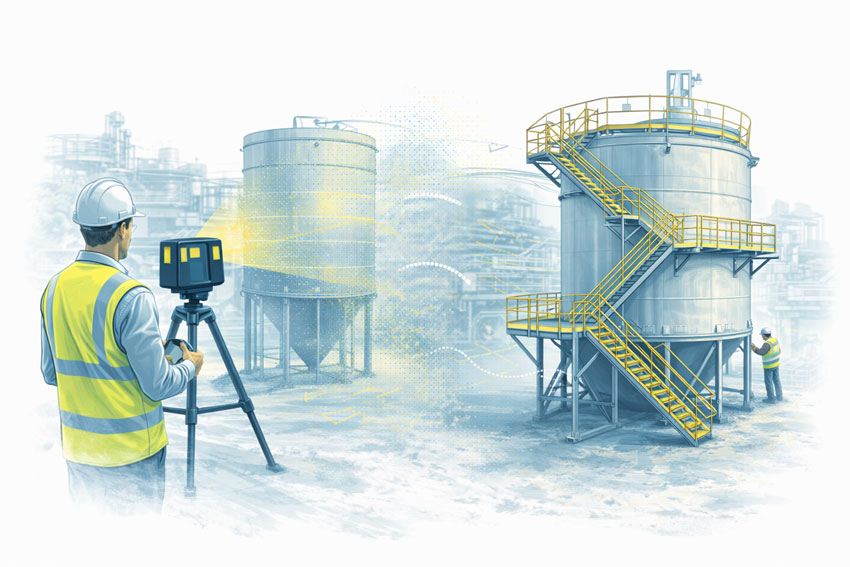
Engineer using LiDAR scanner to capture as-built tank steelwork, transitioning to compliant AS 3990 walkways and access platforms

AS 3990 โ€“ Mechanical Equipment Steelwork

Walkways, Conveyor Structures, Platforms and Gantries

Mechanical equipment steelwork is everywhere in industrial sites โ€” conveyor structures, access walkways, maintenance platforms, gantries and support frames. Over time, these structures are modified, loaded differently, repaired, and upgraded. Thatโ€™s where AS 3990 โ€“ Mechanical equipment โ€“ Steelwork becomes critical: it provides a framework for designing and verifying steelwork that supports mechanical equipment and associated access systems.

At Hamilton By Design, we help asset owners and project teams reduce risk by converting real as-built steelwork into engineering-grade digital models that can be checked, upgraded, and documented with confidence.


3D LiDAR scanning of industrial tank steelwork showing as-built condition and engineered walkways and stairs designed to AS 3990

When AS 3990 Steelwork Becomes a Problem in the Real World

Steelwork rarely fails because it was โ€œobviously wrongโ€ on day one. The most common issues develop gradually due to changes in loading, upgrades, corrosion, or incomplete documentation.

Common triggers we see on site

  • New conveyor drives, chutes, skirts, guards, or pull-wire systems added after commissioning
  • Extra services added: cable trays, hose reels, water lines, pipework, and supports
  • Walkway changes for access, maintenance, or guarding upgrades
  • Localised damage from impact, vibration, or operational fatigue
  • Corrosion or section loss in wash-down areas, coastal environments, or chemical exposure zones
  • Legacy steelwork with missing drawings or unknown load assumptions

If you canโ€™t prove what exists (accurately), it becomes difficult to prove compliance, fitness-for-purpose, or due diligence.


Key Engineering Risks with Walkways, Platforms, Gantries and Conveyor Structures

1) Design intent vs as-built reality

Many sites have steelwork that differs from drawings due to shutdown modifications or brownfield constraints. Small deviations in member size, connection detailing, or geometry can materially change structural performance.

2) Loads have changed โ€” but the steelwork didnโ€™t

A โ€œsimpleโ€ modification can add significant load: added services, heavier equipment, changed maintenance practices, or multiple personnel working in the same bay. These changes can push members or connections beyond the original assumptions.

3) Conveyor vibration and dynamic effects

Conveyor structures experience cyclic loading, start/stop effects, and vibration. Even if the structure looks acceptable, fatigue and resonance can become a long-term reliability problem โ€” particularly around drive stations, transfer points, and cantilevered platforms.

4) Connection adequacy often governs

Field-welded brackets, modified gussets, bolt slip, corroded fasteners, and non-standard connection geometry can become the weak link. Connection performance is frequently the true limiting factor in older or heavily modified steelwork.

5) Access and safety interfaces

Walkways and platforms often sit at the intersection of multiple requirements: safe access geometry, handrails, toe-boards, gates, and guarding. If access steelwork was modified without a proper verification step, the risk becomes both structural and safety-related.


What โ€œVerificationโ€ Looks Like in Practice

AS 3990 steelwork compliance is not just a box-tick. In a practical project environment, it means you can answer:

  • What steelwork exists right now (as-built)?
  • What loads and operational conditions apply today (not ten years ago)?
  • Are members and connections adequate under realistic scenarios?
  • What upgrades are required, and can they be fabricated to fit first time?
  • Can the asset owner document compliance and risk controls for governance?

Hamilton By Design supports this process by bringing LiDAR scanning + mechanical engineering + fabrication-ready outputs together under one roof.


How Hamilton By Design Helps (Our Typical Deliverables)

1) Engineering-grade 3D LiDAR scanning of steelwork

We capture accurate geometry of:

  • Walkways and access platforms
  • Conveyor stringers, trestles, and transfer towers
  • Gantries, monorails, and maintenance frames
  • Supports, bracing, ladders, stairs, and access interfaces

Related service:
3D Laser Scanning: https://www.hamiltonbydesign.com.au/3d-laser-scanning/

2) As-built CAD model for verification and design

We convert the scan into usable engineering outputs such as:

  • As-built 3D CAD models
  • Key dimensions, levels, and clearances
  • Interference checking and fit-up planning
  • Fabrication-ready drawings for retrofit steelwork

3) Engineering checks and upgrade design

Where required, we support structural verification and upgrade design using engineering workflows suited to brownfield assets.

Related capability:
SolidWorks FEA / simulation workflows: https://www.hamiltonbydesign.com.au/home/solidworks/solidworks-fea-simulation/


Where This Matters Most (Typical Applications)

  • Conveyor upgrades and transfer station modifications
  • Walkway widening, new stair access, and maintenance platform additions
  • Guarding upgrades, pull-wire additions, and access compliance programs
  • Corrosion repairs and local strengthening
  • Brownfield plant modifications with limited shutdown time
  • Audit readiness and engineering documentation clean-up

If youโ€™re working around conveyors, you may also find this relevant:
AS 1755 Conveyor Safety: https://www.hamiltonbydesign.com.au/as-1755-conveyor-safety/

And for safety leadership context:
Machine guarding lessons: https://www.hamiltonbydesign.com.au/machine-guarding-in-australia-a-decade-of-lessons-for-leaders-asset-owners-and-engineers/


Standards and Compliance Context (How AS 3990 Fits In)

AS 3990 typically sits alongside a broader compliance context depending on the asset and scope. In many industrial environments, it may interact with standards and guidance such as:

  • AS 1657 (fixed platforms, walkways, stairways and ladders)
  • AS 4100 (steel structures)
  • AS/NZS 1170 (structural actions / loading)
  • AS 1755 (conveyor safety and associated interfaces)

For official sources and governance context:

(Note: Always confirm the current revision and applicability of standards for your site, scope, and jurisdiction.)


Why Digital As-Built Matters for AS 3990 Steelwork

A verified as-built model reduces:

  • Upgrade risk and fabrication rework
  • Shutdown time lost to unexpected clashes
  • Safety risks from undocumented modifications
  • Compliance gaps during audits and governance reviews

It also supports โ€œfit-first-timeโ€ fabrication because designers, engineers, and fabricators are working from the same geometry โ€” not assumptions.


Talk to an Engineer About Your AS 3990 Steelwork

If youโ€™re planning an upgrade, responding to an audit, or unsure whether existing walkways, platforms, gantries or conveyor structures still meet their intended duty, we can help you quickly establish a reliable baseline.

Start with scanning, modelling, and engineering verification โ€” and build from facts.

Related service pages to explore:

Hamilton By Design logo displayed on a blue tilted rectangle with a grey gradient background
3D LiDAR scanning and 3D modelling service button โ€” laser scanner capturing a point cloud for engineering and CAD modelling
Mechanical engineering services

Our clients:

Name
Would you like us to arrange a phone consultation for you?
Address