Mechanical Design

Mechanical Design & Custom Equipment Layouts

Consulting-led mechanical engineering for real-world plants and equipment

At Hamilton By Design, we help owners, operators and project teams turn practical ideas into safe, buildable and reliable mechanical solutions.

Whether youโ€™re upgrading a brownfield plant, resolving a persistent reliability issue or planning a new process line, we provide consulting-led mechanical design and custom equipment layouts that are grounded in real site conditions and fabrication reality.


How we help

We work as an extension of your project or maintenance team to:

  • Define the problem clearly โ€“ capacity, reliability, safety, access, compliance or all of the above
  • Capture the real geometry โ€“ using drawings, site measurements and (where required) 3D LiDAR scanning
  • Develop mechanical concepts โ€“ multiple options, with pros/cons and constructability in mind
  • Engineer the details โ€“ materials, load paths, supports, fixings, wear protection, sealing and maintainability
  • Produce fabrication-ready information โ€“ so your fabricator and installers know exactly what to build and how it fits

We stay involved from concept through to installation support, so thereโ€™s one accountable engineering contact from start to finish.


What we design

Our team can assist with both discrete equipment and integrated plant layouts, including:

  • Chutes, hoppers & bins โ€“ new designs, flow improvements, wear-liner upgrades, debottlenecking
  • Conveyors & transfer stations โ€“ stringer and gantry layouts, transfer interfaces, guarding and access
  • Pump, pipework & slurry systems โ€“ skids, manifolds, spool arrangements, supports and maintenance access
  • Tanks, vessels & sumps โ€“ mechanical layout, nozzles, platforms, wear and corrosion allowances
  • Screens, crushers & feeders interfaces โ€“ infeed/outfeed modifications, support framing and maintenance envelopes
  • Maintenance access & safety systems โ€“ platforms, ladders, stairs, handrails, lifting points and handling solutions
  • General plant layouts โ€“ equipment positioning, clearances, access routes and tie-ins to existing plant

If it bolts down, rotates, carries load or moves material, we can help engineer it.


Our design approach

We treat every engagement as a consulting assignment, not just a drafting task. A typical workflow:

  1. Clarify objectives & constraints
    • Performance and throughput targets
    • Site standards, client specifications and applicable Australian Standards
    • Shutdown windows, installation constraints and budget
  2. Capture the existing situation
    • Review existing drawings and vendor data
    • Undertake site inspections
    • Apply 3D LiDAR scanning where high accuracy or complex interfaces are critical
  3. Concept development
    • Generate alternative concepts with different risk, cost and complexity profiles
    • Workshop options with your team to incorporate operator and maintainer input
    • Shortlist a preferred concept for detailed design
  4. Mechanical design & detailing
    • 3D modelling of equipment and layouts in SolidWorks
    • Connection details, wear areas, load paths and serviceability resolved
    • Integration with structures, civils and adjacent plant
  5. Verification & review
    • Hand calculations and/or FEA where appropriate for critical components
    • Formal design reviews with stakeholders and fabricators
    • Buildability, transport and lifting checks
  6. Documentation for fabrication & installation
    • Fabrication drawings, BOMs and cutting lists
    • GA drawings and layout plans
    • Installation notes and mark-ups for site teams

Typical deliverables

When you engage Hamilton By Design for mechanical design and custom equipment layouts, you can expect:

  • 3D models of equipment and plant layouts
  • Fabrication drawings and detail drawings suitable for workshop use
  • General arrangement drawings with clear dimensions and interfaces
  • Bill of materials and component lists
  • Marked-up layout plans and sections for installers and other disciplines
  • Supporting calculation packs and technical notes (where required)

Where this service adds value

Our mechanical design & layout services are particularly valuable for:

  • Brownfield upgrades & debottlenecking
    • Fitting new equipment into congested plants
    • Resolving recurring blockages, spillage or wear issues
  • Shutdown-driven projects
    • Designing with install sequences and crane/lifting limits in mind
    • Reducing surprises on the shutdown critical path
  • New process lines & plant extensions
    • Co-ordinating mechanical, structural and access requirements early
    • Avoiding late design clashes and rework
  • Safety & compliance improvements
    • Guarding, access and maintenance improvements
    • Bringing legacy equipment up to current standards

Why work with Hamilton By Design?

  • Engineer-led, not drafter-led โ€“ Your layouts are driven by mechanical engineers with hands-on plant experience.
  • Single-source accountability โ€“ From site capture to 3D model to fabrication drawings, you deal with one team.
  • Brownfield specialists โ€“ Comfortable working around existing constraints, legacy drawings and incomplete data.
  • Fabrication-friendly outputs โ€“ We understand workshops and installers; our drawings are prepared with them in mind.

Hamilton By Design logo displayed on a blue tilted rectangle with a grey gradient background
3D LiDAR scanning and 3D modelling service button โ€” laser scanner capturing a point cloud for engineering and CAD modelling
Mechanical engineering services

Ready to talk about your next mechanical design or layout change?

Whether you have an early idea, a recurring problem or a confirmed shutdown coming up, we can help you scope, design and document a solution that fits your site and your budget.

Get in touch with Hamilton By Design to discuss your mechanical design & custom equipment layout needs, or explore our other service pages for:

  • 3D CAD Modelling & Mechanical Drafting
  • 3D LiDAR Scanning for As-Built & Brownfield Engineering
  • Finite Element Analysis (FEA) & Mechanical/Structural Assessment
  • Industrial Machinery & Plant Systems Design
  • SolidWorks Sustainability Tools โ€” Environmental Impact & Material Optimisation

Weโ€™re here to help you move from concept to constructible, with confidence.


Our Clients

Name
Would you like us to arrange a phone consultation for you?
Address
Finite Element Analysis (FEA) engineering simulation button
Mechanical engineering services

SolidWorks Mechanical Design Services

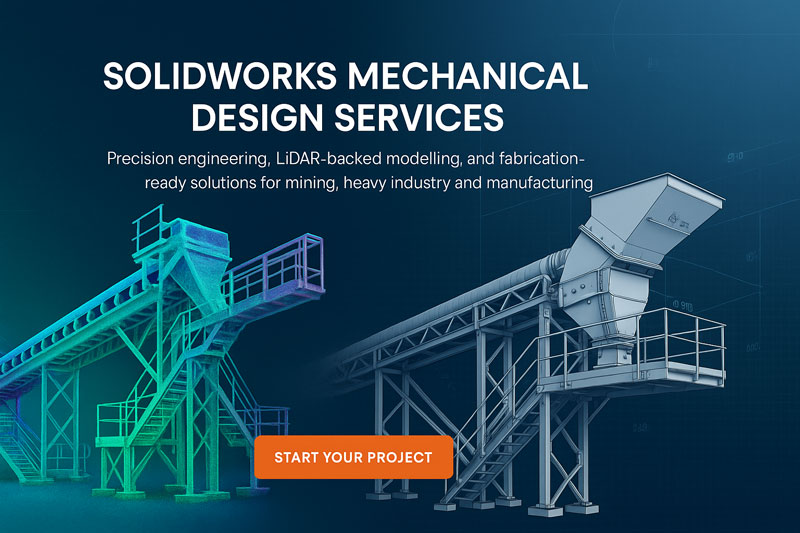
Hero image showing a LiDAR-coloured point-cloud model of an industrial conveyor system on the left transitioning into a detailed SolidWorks 3D CAD model on the right, with the heading โ€˜SolidWorks Mechanical Design Servicesโ€™ and a call-to-action button that reads โ€˜Start Your Projectโ€™

SolidWorks Design Services

The Many Faces of Mechanical Design: How SolidWorks Powers Modern Engineering Across Australia

At Hamilton By Design, we see the same pattern every day across mining, heavy industry, manufacturing, and complex brownfield environments: the quality of engineering outcomes depends directly on the quality of the models driving them. And when it comes to mechanical design, SolidWorks remains one of the most capable and versatile platforms on the planet.

From dragline components to sheet metal enclosures, from pressure vessel upgrades to bespoke robotics, SolidWorks enables engineers to turn ideas into precise, fabrication-ready models that reduce rework, eliminate uncertainty, and accelerate project delivery.

Below, we explore the full spectrum of mechanical design disciplines where SolidWorks excels โ€” and how Hamilton By Design uses this capability to deliver accurate, reliable, engineering-grade outcomes across Australia.


Why SolidWorks Remains the Backbone of Mechanical Design

SolidWorks brings together parametric modelling, simulation, large assembly performance, surfacing, sheet metal tools, weldments, routing and visualisation under a single environment. The result is powerful:

โœ” Engineering that is data-driven
โœ” Models that are precise and fabrication-ready
โœ” Assemblies that reflect true site conditions
โœ” Designs that respond intelligently to changes
โœ” Drawings that follow Australian Standards
โœ” Seamless integration with LiDAR-based as-builts

When paired with Hamilton By Designโ€™s LiDAR scanning workflows, SolidWorks becomes an engine for delivering zero-guesswork mechanical design.


Mechanical Design Disciplines Perfectly Suited to SolidWorks Modelling

SolidWorks supports a huge range of engineering tasks. Below is a deep dive into the disciplines where Hamilton By Design deploys it every day.


1. Machine Design: Precision for Moving Systems

SolidWorks is a natural fit for mechanical equipment upgrades and R&D design work, including:

  • Gearboxes, shafts, keys, couplings
  • Linear motion systems and actuators
  • Mechanical linkages, cams and levers
  • Robotic mechanisms
  • Safety guards, enclosures and subframes
  • Automation concept development

Whether weโ€™re modelling a drive assembly for a conveyor or designing a new piece of automated equipment, SolidWorks gives us full control over the mechanics, kinematics, clearances and manufacturability.


2. Structural Mechanical Design: Frames, Platforms & Fabrication

Mining and industrial plants rely heavily on welded structures and access systems. SolidWorks weldments excel at:

  • Platforms, walkways and stair systems
  • Equipment bases, skids and structural frames
  • Gantries, monorails and supports
  • Pipe supports and brackets
  • Structural reinforcements and upgrade scopes

Built-in cut lists, profile libraries and FEA ensure every frame is practical, safe and fabrication-ready.


3. Pressure Vessels, Tanks & Piping Systems

SolidWorks is an ideal tool for pressure-bound components and interconnected plant systems:

  • Tanks, vessels, bins and hoppers
  • Nozzles, flanges, stiffeners and ladders
  • Pipe routing and spooled sections
  • Chute systems, transitions and flow paths
  • Wear liners and maintenance-friendly redesigns

With stress linearisation, buckling analysis and accurate geometry import from LiDAR scans, we ensure designs meet engineering intent and fit up perfectly on site.


4. Sheet Metal: From Light Fabrication to Industrial Ducting

SolidWorks is the industry standard for sheet metal components:

  • Ducting and HVAC transitions
  • Guards, housings and folded enclosures
  • Electrical cabinets
  • Chute panels
  • Laser-cut and folded brackets

Automatic flat patterns and K-factor control mean fewer mistakes at the plasma/laser cutters and more predictable outcomes for fabricators.


5. Heavy Industry & Mining Equipment Modelling

Hamilton By Designโ€™s roots in mining and heavy industry make SolidWorks invaluable for:

  • Conveyor components and guarding
  • Diverter chutes, hoppers and flow-optimised transitions
  • Bucket-wheel reclaimer parts
  • Crusher and screen upgrades
  • Dragline component modelling
  • Structural deformation/realignment scopes

Combined with LiDAR scanning, SolidWorks becomes the tool that eliminates shutdown fit-up problems.


6. Product Design & Industrial Design

SolidWorksโ€™ surfacing and parametric tools are ideal for:

  • Consumer products
  • Power tools and ergonomic items
  • Injection-moulded components
  • Kitchen or appliance prototypes
  • Concept development for early-stage R&D

It supports rapid iterations, rendering, and export for 3D printing.


7. Robotics & Automation Systems

With the rise of automated processing and Industry 4.0, SolidWorks continues to shine in:

  • End effectors
  • Robotic arms and actuators
  • Kinematic studies
  • Sensor housings
  • Concept layouts for automated cells

We frequently pair this with our LiDAR models of existing plants to create automation solutions that genuinely fit the space.


8. Tooling, Jigs & Fixtures

Fabrication and machining rely on accurate tooling, and SolidWorks helps us design:

  • Welding jigs
  • Machining fixtures
  • Assembly tooling
  • Positioning and inspection gauges
  • Drill guides and alignment tooling

Parametric updates make future modifications simple and consistent.


9. Material Handling Systems

Across mining, ports, agriculture and waste facilities, SolidWorks supports:

  • Conveyor layouts
  • Screw and chain conveyors
  • Transfer chute redesigns
  • Feeders, bins and flow systems
  • Skids and support structures

We routinely pair mechanical redesign with simulation, checking wear patterns, stresses and clearances.


10. Reverse Engineering & As-Built Modelling from LiDAR

This is where Hamilton By Design leads the industry.

We scan sites with millimetre-level LiDAR, then rebuild clean parametric models in SolidWorks for:

  • Brownfield upgrades
  • Fit-up verification
  • Clash detection
  • Replacements and like-for-like manufacturing
  • Structural deformation assessments
  • Shutdown planning

It is the combination of LiDAR + engineering + SolidWorks that gives clients complete confidence in their next project.


How Clients Benefit from SolidWorks-Driven Mechanical Design
โœ” Reduced rework

โœ” Faster shutdown upgrades

โœ” Accurate manufacturing drawings

โœ” Better communication between engineers, fabricators and site teams

โœ” Safer and more predictable installations

โœ” Clear, simulation-backed decision-making

From CHPPs to ports, from power stations to manufacturing plants, SolidWorks modelling allows Hamilton By Design to deliver engineering outcomes you can trust.


Hamilton By Design logo displayed on a blue tilted rectangle with a grey gradient background
3D LiDAR scanning and 3D modelling service button โ€” laser scanner capturing a point cloud for engineering and CAD modelling
Mechanical engineering services

Partner With Hamilton By Design for SolidWorks Mechanical Design

We support clients across:

  • NSW (Sydney, Newcastle, Central Coast, Hunter Valley)
  • QLD (Bowen Basin, Surat Basin, Mount Isa)
  • WA (Perth, Pilbara)
  • SA, VIC and regional Australia

If your next project needs mechanical accuracy, design certainty or LiDAR-integrated engineering, our team is ready to support you.

Name
Address
You would like to:

Our clients

SolidWorks

Finite Element Analysis (FEA) engineering simulation button
Mechanical engineering services

3D Laser Scanning

Engineering Projects

Engineering Services

3D Laser Scanning for Engineering

3-D Lidar Scanning Hunter Valley: Transforming Industrial Projects with Accuracy, Safety and Engineering Confidence

The Hunter Valley is one of Australiaโ€™s most strategically important industrial regions. It supports large mining operations, CHPP facilities, fabrication workshops, energy infrastructure, civil projects and heavy manufacturing. These industries depend on precision, safety and efficient project delivery โ€” yet most operate in aging brownfield environments where original drawings are outdated, equipment has shifted over time, and modifications have occurred for decades without accurate documentation.

In environments like these, traditional measuring methods often fail to provide the precision required for confident engineering and fabrication. This is why 3-D Lidar scanning in the Hunter Valley has become a critical tool for engineers, supervisors, fabricators and project managers. It captures the real-world site conditions with millimetre accuracy, creating a digital foundation for smarter, safer and more efficient project execution.

This article explores the benefits, pros and cons of 3-D Lidar scanning, and explains why the Hunter Valley is uniquely positioned to gain massive value from this technology.


Understanding 3-D Lidar Scanning

3-D Lidar (Light Detection and Ranging) scanning is a non-contact measurement technology that uses lasers to capture millions of points in seconds. The scanner emits laser pulses and measures the return time to determine distances, building a dense โ€œpoint cloudโ€ of the environment.

This point cloud is a precise 3-D representation of:

  • Structural steel
  • Conveyors and transfer towers
  • Chutes, bins and hoppers
  • Tanks, pipework and mechanical equipment
  • Platforms, walkways and buildings
  • Industrial plant rooms and process areas

Once captured, this digital data becomes the foundation for engineering models, fabrication drawings, digital fit checks and project planning.


Why 3-D Lidar Scanning Matters in the Hunter Valley

The Hunter Valley contains some of the most complex and heavily used industrial assets in Australia. Many facilities have been in operation for decades, and almost all have undergone modifications, expansions and repairs. Over time, the real-world geometry diverges significantly from the old drawings stored on paper or outdated CAD files.

This creates major challenges:

  • Measurements taken by hand are inaccurate or unsafe
  • Shutdown windows are extremely tight
  • Fabricators rely on precise data to avoid costly rework
  • Engineers require true geometry for load calculations and interface design
  • Supervisors need reliable information to scope replacement work

3-D Lidar scanning provides a millimetre-accurate representation of what exists onsite, removing guesswork and supporting engineering best practice.


The Benefits of 3-D Lidar Scanning in the Hunter Valley

1. Millimetre Accuracy Improves Engineering Outcomes

In heavy industrial environments, small measurement errors can create large, expensive problems. Structural misalignment, worn steel, bent frames, sagging conveyors and distorted chutes are all common in brownfield plants.

3-D Lidar scanning captures:

  • True dimensions
  • Variations from design
  • Deformation and misalignment
  • Complex curved surfaces
  • Differences caused by wear and tear

Engineers design with confidence because the digital model reflects actual site conditions โ€” not assumptions.


2. Huge Reduction in Rework and Fabrication Errors

Fabricators in Singleton, Muswellbrook, Rutherford, Tomago and throughout the Hunter region rely on accurate measurements to ensure steel and mechanical components fit the first time.

Without accurate data, common fabrication issues include:

  • Bolt holes misaligned
  • Steel members too short or too long
  • Chutes or hoppers not matching openings
  • Pipe spools missing clearances
  • Platforms not sitting square

These problems lead to:

  • Onsite cutting and welding
  • Delayed installations
  • Extended shutdown time
  • Additional crane costs
  • Extra labour expenses

3-D Lidar scanning eliminates these risks, ensuring every component is manufactured to match the as-built site geometry.


3. Improved Shutdown Planning and Faster Execution

Mining and CHPP shutdowns in the Hunter Valley operate under strict time constraints. Any unexpected measurement issue can cause delays affecting production and safety.

With 3-D Lidar scanning:

  • Scope is defined accurately before shutdown
  • Fabrication is completed correctly the first time
  • Digital fit checks identify problems early
  • Installation is faster and safer

Shutdowns become more predictable and efficient.


4. Massive Safety Improvements

Manual measurement often requires workers to:

  • Enter confined spaces
  • Access heights
  • Work around operating equipment
  • Lean over conveyors
  • Navigate dirty, uneven or hazardous areas

3-D Lidar scanning minimises physical access requirements. Technicians can scan large areas from safe positions, reducing:

  • Fall risks
  • Pinch-point exposure
  • Hot-work hazards
  • Time on elevated structures

This is a major benefit for HSE and maintenance teams across the Hunter Valley.


5. Better Communication, Collaboration and Visualisation

Point clouds and 3-D models make it easier for teams to understand the project environment, especially when stakeholders are spread across:

  • Mine sites
  • Fabrication workshops
  • Design offices
  • Engineering consultancies
  • Projects teams and OEM vendors

Digital data allows remote review, reducing the need for repeated site visits and improving decision-making.


6. Ideal for Brownfield Upgrades and Congested Areas

Many Hunter Valley facilities are decades old, with layers of modifications. Clearances are tight, geometry is irregular, and equipment alignment has changed over the years.

3-D Lidar scanning is perfect for:

  • Transfer towers with layered steel
  • Congested plant rooms
  • Pipe networks
  • Stockpile conveyors
  • Old building footprints
  • Complex structural junctions

The scanner captures the complexity instantly and precisely.

Hamilton By Design logo displayed on a blue tilted rectangle with a grey gradient background

Pros and Cons of 3-D Lidar Scanning

While 3-D Lidar scanning is a game-changing tool, it is important to understand both the advantages and limitations.

3D Scanning in The Hunter Valley

3D Laser Scanning

Hunter Valley Laser Scanning: Transforming Engineering Accuracy Across Mining, Manufacturing and Infrastructure

3D Laser Scanning in Singleton and the Hunter: Delivering Accuracy for Mining, Manufacturing and Industrial Projects

Laser Scanning Hunter Valley: Delivering Engineering-Grade Accuracy for Mining, Manufacturing and Industrial Projects

Name
Address
You would like to:
Mechanical engineering services
Australian Drafting logo featuring bold white text reading "Australian Drafting" centred on a blue rounded rectangle background.
Finite Element Analysis (FEA) engineering simulation button
Mechanical engineering services

Hunter Valley Laser Scanning: Transforming Engineering Accuracy Across Mining, Manufacturing and Infrastructure

The Hunter Valley stands as one of Australiaโ€™s most important industrial regions, supporting mining, energy, heavy fabrication, processing, manufacturing and major commercial development. Across this diverse landscape, one challenge consistently affects project performance: the need for accurate, reliable and up-to-date site information.

For engineers, maintenance planners, fabricators and construction managers, relying on outdated drawings or manual tape measurements introduces unnecessary risk. Plants evolve over decades. Structures deform. Equipment shifts alignment. Site conditions rarely match legacy documentation.

This is why Hunter Valley laser scanning has become essential. The ability to capture millimetre-accurate as-built data is transforming how projects are planned, designed and executedโ€”reducing cost, increasing safety and ensuring that every component fits the first time.

Hamilton By Design is proud to support the region with advanced, engineering-grade laser scanning services designed specifically for heavy industry and complex brownfield environments. This article explores how laser scanning works, why the Hunter Valley relies on it, and how it strengthens everything from shutdown planning to fabrication accuracy.


Why the Hunter Valley Depends on Laser Scanning

The Hunterโ€™s operating assets are large, complex and often decades old. Across mines, processing facilities, power stations, port handling infrastructure and manufacturing plants, very few sites match their original drawings.

Typical challenges include:

  • Numerous undocumented modifications
  • Wear, deformation and structural movement
  • Limited or unreliable legacy drawings
  • Tight shutdown windows
  • Hazardous access for manual measuring
  • Brownfield constraints that complicate upgrades

These conditions make traditional measurement methods slow, risky and error-prone. A wrong measurement in a transfer tower, a misaligned conveyor frame, or an incorrect chute dimension can create thousands of dollars in rework and delay.

Hunter Valley laser scanning eliminates these risks completely by capturing the site exactly as it exists todayโ€”not as it was decades ago.


How Hunter Valley Laser Scanning Works

Laser scanning uses high-precision LiDAR technology to record millions of data points across structures, equipment and plant areas. These points combine to create a three-dimensional โ€œpoint cloudโ€โ€”a highly accurate digital representation of real-world conditions.

The Hamilton By Design workflow typically includes:

1. On-Site Reality Capture

Our laser scanner is deployed across key vantage points to capture the full environment, including:

  • Structural steel
  • Conveyors and walkways
  • Chutes, bins, hoppers and material-handling equipment
  • Pipework networks
  • Equipment footprints
  • Building geometry
  • Confined or elevated spaces

The capture process is fast, safe and non-intrusiveโ€”ideal for operational sites.

2. Registration & Point Cloud Processing

Data from each scan position is aligned into a complete, unified point cloud representing the entire area with millimetre accuracy.

3. Modelling & Analysis

From the point cloud we can create:

  • True as-built CAD models
  • Structural layouts
  • Mechanical assemblies
  • Pipework geometry
  • Digital templates for fabrication
  • Probe measurements for checking clearances and alignment

4. Engineering & Fabrication Support

Once converted into a usable engineering environment, the data supports:

  • Shutdown planning
  • Structural redesign
  • Chute and conveyor optimisation
  • Digital fit checks
  • Fabrication drawings
  • Reverse engineering of worn components

The result is a reliable, verified understanding of your siteโ€”available digitally to your entire project team.


Where Hunter Valley Laser Scanning Delivers the Most Value

The unique industrial profile of the Hunter Valley means laser scanning is useful across a broad range of applications. Here are the areas where it delivers the highest impact.


Mining & CHPP Operations

Mining infrastructure in the region is constantly under pressure to operate safely and efficiently. For CHPP upgrades, conveyor realignments, chute replacements and structural modifications, laser scanning provides:

  • True as-built dimensions
  • Clearances and offset measurements
  • Verified alignment data
  • Digital templates for safe, accurate fabrication
  • Reduced shutdown duration
  • Fewer fitment issues onsite

Upgrades become predictable instead of stressful, and fabricators can manufacture with confidence.


Processing Plants & Material-Handling Systems

Transfer towers, bin replacements, screening arrangements and crusher areas often contain congested layouts with poor access. Manual measurement is difficult and unsafe.

Laser scanning solves this by allowing the entire environment to be measured remotely. This supports:

  • Clash prevention
  • Redesign of worn systems
  • Smoother installation
  • Accurate interface points
  • Digital verification before fabrication

Heavy Fabrication & Workshop Integration

Fabricators across the Hunter Valley consistently face the same problem: components not fitting onsite due to bad measurements.

Hunter Valley laser scanning ensures:

  • Perfectly matched bolt hole patterns
  • Correct flange alignment
  • True geometry of mating parts
  • Accurate templates for bending, rolling and welding
  • Reduced rework and scrap

It is a direct cost saver for both workshops and clients.


Energy, Power Stations & Utilities

Power stations and energy sites require sophisticated maintenance planning. Laser scanning helps engineers:

  • Document aging structures
  • Compare deformation over time
  • Plan retrofits and upgrades
  • Replace platforms, pipework and supports with confidence
  • Identify clashes before installation

This improves compliance and reduces risk.


Commercial, Industrial and Infrastructure Projects

Beyond heavy industry, the Hunter region features growing precincts of commercial and industrial developments. Laser scanning supports:

  • Renovations and extensions
  • As-built documentation
  • BIM workflows
  • Accurate drafting and facility mapping

It ensures architects, builders and property owners are working with verified building conditions instead of assumptions.


Why Choose Hamilton By Design for Hunter Valley Laser Scanning?

Hamilton By Design is not simply a scanning serviceโ€”we are engineers first. This is what sets our work apart.

Our Engineering Mindset

We understand plant design, structural requirements, chute behaviour, mechanical layouts and fabrication constraints. This allows us to interpret the point cloud with engineering intent, not just technical detail.

Millimetre Accuracy

Our laser scanning systems deliver the precision required for heavy industry, ensuring designs and fabrication match the real-world geometry exactly.

Complete Digital Workflow

We provide:

  • Point clouds
  • 3D models
  • General arrangement drawings
  • Fabrication drawings
  • DXFs and model exports

Our deliverables integrate seamlessly with fabrication shops and engineering teams across the Hunter.

Local Expertise

We understand the regionโ€™s industries, shutdown pressures, safety expectations and operational challenges.

Confidence Before Steel Is Cut

Every design can be checked digitally for clash, alignment and fitmentโ€”reducing uncertainty and rework.


The Future of Engineering in the Hunter Valley

As sites age and operational demands increase, precise as-built information is becoming essential. Hunter Valley laser scanning is now the standard for safe, efficient and accurate engineering work across the region.

Whether you are replacing structural steel, redesigning a chute, installing new conveyors, upgrading a plant room or fabricating new components, laser scanning gives your project the foundation it needs for success.


Work With Hamilton By Design

Hamilton By Design is ready to support your next project with high-accuracy Hunter Valley laser scanning, modelling and drafting services.

Contact our team to discuss:

  • Your scanning requirements
  • Project constraints
  • Fabrication goals
  • Engineering support needs

We will help you build a digital foundation that improves safety, reduces downtime and ensures every component fits the first time.

Hamilton By Design logo displayed on a blue tilted rectangle with a grey gradient background
3D LiDAR scanning and 3D modelling service button โ€” laser scanner capturing a point cloud for engineering and CAD modelling
Mechanical engineering services

3D Scanning in The Hunter Valley

Enhancing Plant Efficiency with Best Maintenance Practices

3D Point Clouds Are a Game-Changer for Your Projects

Lessons from a Landmark Case

Name
Would you like us to arrange a phone consultation for you?
Address
Finite Element Analysis (FEA) engineering simulation button
Mechanical engineering services

SolidWorks 3D Modelling, Engineering & Design Services

High-accuracy engineering design for mining, fabrication, and industrial projects across Australia

At Hamilton By Design, SolidWorks is at the core of everything we do. From detailed 3D modelling and mechanical design to FEA verification and fabrication-ready deliverables, our SolidWorks workflows support safe, efficient, and accurate engineering outcomes for complex brownfield and greenfield projects.

Whether we are laser-scanning a CHPP plant room, reverse-engineering a structural component, developing new mechanical assemblies, or verifying fit-ups using clash detection, SolidWorks allows us to transform real-world conditions into engineered, dependable solutions.

3D LiDAR scanning and 3D modelling service button โ€” laser scanner capturing a point cloud for engineering and CAD modelling
Mechanical engineering services

Why SolidWorks Matters for Your Project

SolidWorks enables us to deliver higher accuracy, faster turnaround times, and better quality engineering documentation. When combined with our 3D LiDAR scanning and digital engineering workflows, SolidWorks becomes a powerful tool for:

  • Retrofitting and upgrade projects
  • Brownfield plant modifications
  • Structural and mechanical design
  • Reverse engineering of existing components
  • Fabrication drawing creation
  • Pipe routing and equipment layout
  • General arrangement (GA) development
  • Clash detection and interference checks

The result: fewer site surprises, reduced fabrication rework, and more predictable installation outcomes.


Our SolidWorks Capabilities

1. Advanced 3D Modelling

We build accurate, parametric 3D models for mechanical, structural, piping, and equipment systems. Models can be created from:

  • 3D LiDAR point clouds
  • Existing drawings
  • Physical measurements
  • Legacy data or supplier information

These models form the foundation for engineering design, fabrication deliverables, and digital twin development.


2. Engineering Design & Mechanical Development

Hamilton By Design provides full mechanical design support using SolidWorks, including:

  • Concept development
  • Detailed part and assembly design
  • Mechanism and motion analysis
  • Equipment layout planning
  • Design-for-manufacture (DFM) optimisation

We design with fabrication, installation, and long-term maintenance in mind.


3. Structural Modelling & Verification

Using SolidWorks and SolidWorks Simulation, we support structural engineering tasks such as:

  • Steelwork design
  • Platform and walkway modelling
  • Equipment support frames
  • Brackets, mounts, and tie-ins
  • Baseplates and skid packages

Models are used to check clashes, verify site conditions, and support safe installation planning.


4. FEA & Engineering Verification

SolidWorks Simulation allows us to perform engineering checks on components and structures, including:

  • Stress analysis (von Mises, principal stress)
  • Deflection modelling
  • Connection and bolt verification
  • Fatigue checks
  • Material comparison
  • Load path assessments

These studies ensure designs meet engineering standards and withstand real-world operating conditions.


5. Fabrication Drawings & Deliverables

We produce clear, accurate drawings for fabrication, workshop use, and installation teams:

  • Part drawings
  • Assembly drawings
  • DXF files for profiling
  • Welded assemblies
  • Cutting lists and BOMs
  • Marking plans
  • Site installation drawings

All drawings are generated directly from the master SolidWorks model to ensure consistency and reduce rework.


6. Scan-to-SolidWorks: Turning Point Clouds into Engineering Models

Our digital engineering workflow combines:

LiDAR Scan โ†’ Point Cloud โ†’ SolidWorks Model โ†’ Drawings & FEA

This allows us to:

  • Validate brownfield conditions
  • Reduce tape-measure errors
  • Check fit-up accuracy before fabrication
  • Avoid clashes during installation
  • Provide true โ€œas-builtโ€ engineering context

This is one of Hamilton By Designโ€™s strongest capabilities โ€” and a major value driver for complex industrial environments.


SOLIDWORKS Professional Design certification badge by Dassault Systรจmes
SOLIDWORKS Professional Drawing Tools certification badge by Dassault Systรจmes

Our clients:

Industries We Support

SolidWorks is used across every sector Hamilton By Design services, including:

  • Mining & mineral processing
  • CHPP wash plants
  • Heavy industrial facilities
  • Fabrication workshops
  • Government infrastructure
  • Construction & modular buildings
  • Water and utility sectors

From bucket-wheel reclaimers to pump skids, conveyors, tanks, chutes, walkways, platforms, and complete plant rooms โ€” SolidWorks allows us to deliver accurate, validated engineering models for real-world conditions.


Hamilton By Design logo displayed on a blue tilted rectangle with a grey gradient background
3D LiDAR scanning and 3D modelling service button โ€” laser scanner capturing a point cloud for engineering and CAD modelling
Mechanical engineering services

Name
Would you like us to arrange a phone consultation for you?
Address

Newcastle & The Hunter Valley

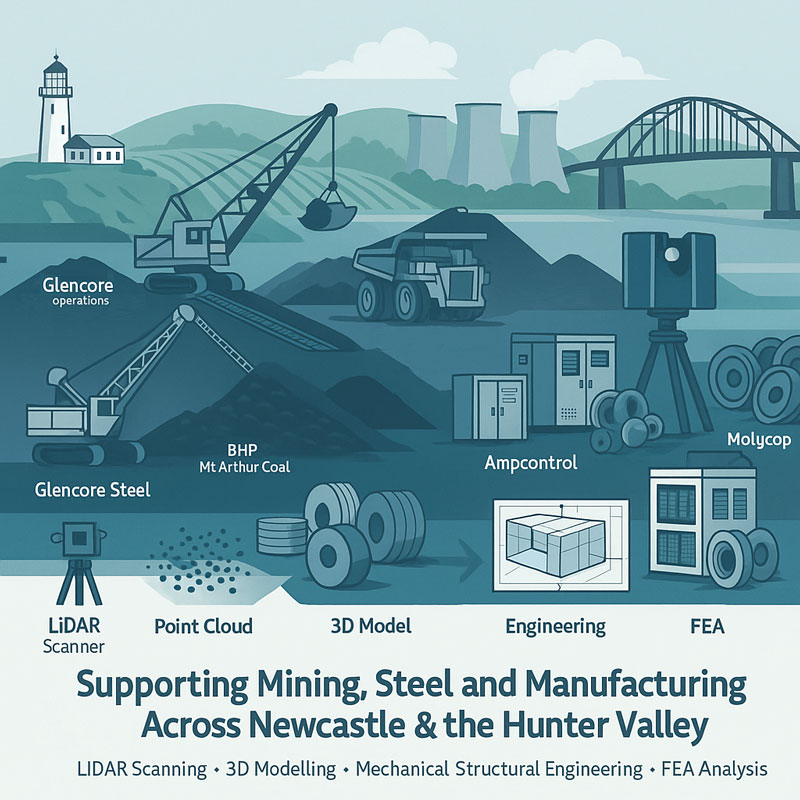
Illustrated scene showing major industrial landmarks across Newcastle and the Hunter Valley, including coal mining equipment, dump trucks, conveyors, steel coils, a LiDAR scanner, point-cloud and 3D model graphics, and labels for Glencore operations, BHP Mt Arthur Coal, Glencore Steel, Ampcontrol and Molycop. The banner text reads โ€˜Supporting Mining, Steel and Manufacturing Across Newcastle & the Hunter Valley โ€“ LIDAR Scanning, 3D Modelling, Mechanical Structural Engineering, FEA Analysis www.hamiltonbydesign.com.au

Precision Engineering for Mining, Steel, Manufacturing & Infrastructure

Blue Gear and Spanner icon

Hamilton By Design supports industry across Newcastle and the Hunter Valley with high-accuracy 3D laser scanning, mechanical and structural engineering, SolidWorks modelling, and fabrication-ready deliverables.
From CHPP plants to heavy manufacturing, we help your team deliver projects that fit first time, every time.

Whether you operate a coal handling facility, a steel mill, a power station, a manufacturing line, or a fabrication workshop, our digital workflows remove rework, reduce shutdown risk, and keep projects moving.


Why the Region Relies on Hamilton By Design

The Newcastleโ€“Hunter corridor is one of Australiaโ€™s most engineering-intensive regions, home to:

  • Glencore coal operations
  • BHP Mt Arthur Coal
  • BlueScope Steel
  • Ampcontrol Tomago
  • Molycop Waratah
  • PWCS Kooragang & Carrington
  • Bayswater & Liddell Power Stations
  • A large network of fabrication and machining workshops

These assets require measurement certainty, digital QA, and accurate engineering models to execute upgrades, fabricate replacements, or plan shutdowns.
Thatโ€™s where Hamilton By Design delivers value.


Our Core Services

โœ” 3D LiDAR Laser Scanning

High-accuracy FARO scanning for:

  • CHPP modules, conveyors, chutes, structural frames
  • Reclaimers, crushers, ROM bins, stockpile conveyors
  • Manufacturing plants and production lines
  • Steel structures and walkways
  • Pipe spools and pump skids
  • Power station equipment, ducting, and access systems

We capture the built environment with sub-millimetre precision.


โœ” Point Cloud Processing & Digital Twins

Your scanned environment is processed into clean, accessible formats for decisions and design:

  • Colourised point clouds
  • Autodesk, Navisworks, & SolidWorks compatible
  • De-cluttering, segmentation, and alignment
  • As-built digital twins

This forms the foundation of our engineering accuracy.


โœ” SolidWorks 3D Modelling & Detail Drafting

We transform your scan data into:

  • Fabrication-ready 3D models
  • Sheet metal components
  • Structural frames
  • Pipe spools
  • Chute geometry
  • Reverse-engineered machinery

All models are delivered with clear origin, mass properties, and assembly logic built in.


โœ” Mechanical & Structural Engineering

Our engineering capability supports:

  • Conveyor upgrades
  • Diverter chutes
  • Structural strengthening
  • Access systems
  • Vibrating equipment assessments
  • Pumping and fluid transfer systems
  • Walkways, stairs, platforms

We design with purpose and detailโ€”fit-for-service and fabrication-ready.


โœ” FEA, Simulation & Digital QA

We validate the performance of your designs:

  • Static stress analysis
  • Weld assessments
  • Fatigue checks
  • Lifting and handling design
  • Load cases for mining applications

Every analysis is supported by documented reports.


3D LiDAR Scanning Hunter & Newcastle banner with white text on a blue background promoting engineering-grade laser scanning services for industrial, mining and infrastructure projects across the Hunter Valley and Newcastle region.
Mechanical Engineering Hunter & Newcastle banner promoting mechanical engineering services for mining, industrial plants, power generation, manufacturing and heavy industry throughout the Hunter Valley and Newcastle region.
Structural Drafting Hunter & Newcastle banner promoting structural drafting services for mining, industrial plants, power generation, manufacturing and infrastructure projects across the Hunter Valley and Newcastle region.

Industries We Service

Mining & CHPP

Glencore โ€ข BHP โ€ข Yancoal โ€ข Bengalla
Conveyors, chutes, spools, access, structural remediation.

Steel & Manufacturing

BlueScope โ€ข Molycop โ€ข Bradken โ€ข Civmec
Heavy fabrication, machinery, production line bottleneck removal.

Power & Energy

AGL Bayswater โ€ข Liddell
Ducting, steelworks, access upgrades, maintenance planning.

Infrastructure & Port Operations

PWCS โ€ข Kooragang Island โ€ข Carrington
Shiploaders, reclaimers, transfer towers, berthing structures.


Why Clients Choose Hamilton By Design
Accuracy

We eliminate guesswork with precise field measurements.

Reduced Shutdown Risk

Projects assemble as intended, reducing time onsite.

Fabrication Certainty

Your workshop receives models and drawings that simply work.

Responsibility & Reliability

We take responsibility for measurement, engineering, and QA along the entire workflow.


Local Knowledge, Regional Capability

We understand the operational requirements of heavy industry in Newcastle & the Hunter Valley:
  • The constraints of CHPP shutdowns
  • The complexity of steel manufacturing
  • The workflow of fabrication shops
  • The need for accurate, fast engineering responses
  • The importance of minimal downtime

Weโ€™ve delivered successful projects across the entire region, from the coast through to Muswellbrook, Singleton, and the Upper Hunter.

Hamilton By Design logo displayed on a blue tilted rectangle with a grey gradient background
3D LiDAR scanning and 3D modelling service button โ€” laser scanner capturing a point cloud for engineering and CAD modelling
Mechanical engineering services

Ready to Improve Your Next Project?

Contact Hamilton By Design

LiDAR Scanning โ€ข 3D Modelling โ€ข Engineering โ€ข FEA โ€ข Digital QA
Supporting Newcastle & the Hunter Valley with precision and reliability.

Email โ€“ info@hamiltonbydesign.com.au

Phone – 0477002249

Name
Address
You would like to:

3D Laser Scanning

Mechanical engineering services
Australian Drafting logo featuring bold white text reading "Australian Drafting" centred on a blue rounded rectangle background.

3D LiDAR Scanning โ€“ Digital Quality Assurance