Industrial Machine Guarding Certification (Fixed Plant) – Engineering Verification & Guard Design

Industrial fixed plant machine guard with interlocked yellow mesh enclosure and engineering verification checklist.

In industrial and mining environments, machine guarding is not a “nice to have” — it’s a critical engineering control that protects people, prevents downtime, and demonstrates compliance with Australian WHS expectations.

Hamilton By Design Co. provides engineering-led design consulting and certification-style verification for fixed plant machine guarding, including new guarding systems, upgrades, and retrofit solutions for existing equipment.

Our focus is simple: protect workers, support safe production, and provide clear, defensible engineering documentation.
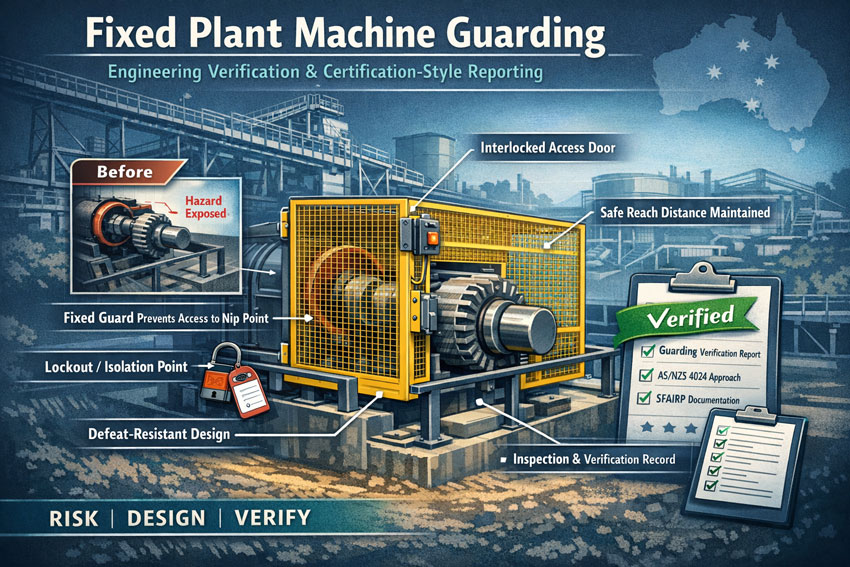

Engineering verification of fixed plant guarding with interlocked guard and inspection report.

What We Mean by “Guarding Certification”

In Australia, machine guarding is not typically certified under a single universal “product stamp.” Instead, machine guarding is assessed and verified through:

  • engineering design and risk-based safeguarding
  • alignment to recognised standards and good practice
  • site verification, inspection, and documentation that supports WHS duties

When we certify a guarding design, we provide an engineering verification that the guarding system has been assessed against Australian safety expectations and provides risk reduction so far as reasonably practicable (SFAIRP) for the intended use.


Fixed Plant Machine Guarding Services

We support fixed plant guarding across mining, processing, manufacturing, infrastructure and heavy industry, including:

Guarding Design & Retrofit Engineering

  • Fixed guards, mesh guards and perimeter guarding
  • Access prevention and safe maintenance access planning
  • Retrofit guarding upgrades for brownfields equipment
  • Guard structural design (frames, supports, fixings, corrosion allowance)

Guarding Verification & Certification Reports

  • Guard inspections (site verification and measurements)
  • Guarding compliance review and gap assessments
  • Design verification and risk reduction justification
  • Practical recommendations that balance safety and maintainability

Interlocks & Guarding Systems (Design Support)

  • Guard-associated interlocking concepts
  • Lock-out and isolation integration
  • Practical “defeat-resistant” guard design principles

(Where functional safety calculations or specialist electrical control validation is required, we can work alongside your controls team or specialist partners.)


What We Deliver

Each project is documented for clarity and defensibility. Typical deliverables include:

  • Guarding risk review (hazards, access points, foreseeable misuse)
  • Design drawings / sketches and installation guidance
  • Verification checklist (inspection points and acceptance criteria)
  • Engineering Verification Report (often used as “certification” evidence)
  • Photo record and “as-installed” notes (where applicable)
  • Limitations, assumptions, and maintenance requirements

Standards & Compliance Approach

Our methodology is aligned with widely accepted Australian safeguarding practice, including:

  • AS/NZS 4024 (Safety of Machinery series)
  • Risk-based safeguarding methodology consistent with ISO 12100 principles
  • WHS duty expectations for plant and machinery risk control

We don’t just reference standards — we apply them to real conditions on your site: access, maintenance needs, exposure time, and realistic human behaviour around machines.


Who We Work With

We support:

  • mine sites and processing plants
  • maintenance departments
  • project teams (brownfields upgrades and shutdown work)
  • workshop supervisors and fabrication teams
  • OEMs and equipment suppliers needing Australian verification support

Whether your plant is locally built or imported, the end goal is the same: a safe guarding system that holds up under WHS scrutiny.


Why Hamilton By Design

Hamilton By Design is an engineer-led team that understands operational realities. We design guarding that:

  • protects people without creating unsafe workarounds
  • supports maintainability and inspection access
  • is practical to fabricate and install
  • is backed by professional engineering documentation

If you need a guarding solution that is fit-for-purpose and properly verified, we can support your team from assessment to final sign-off.


Typical Use Cases

  • Imported machinery requiring Australian guarding verification
  • Pre-commissioning guard reviews before handover
  • Incident-driven guarding upgrades
  • Shutdown retrofit packages and fabrication-ready guard designs
  • Periodic plant guarding audits and gap registers

Hamilton By Design logo displayed on a blue tilted rectangle with a grey gradient background

Call to Action

If you need a machine guarding certification-style verification or a complete fixed plant guarding design package, contact the Hamilton By Design team.

Let’s reduce risk, protect your people, and keep your plant operating safely.
Name
Would you like us to arrange a phone consultation for you?
Address

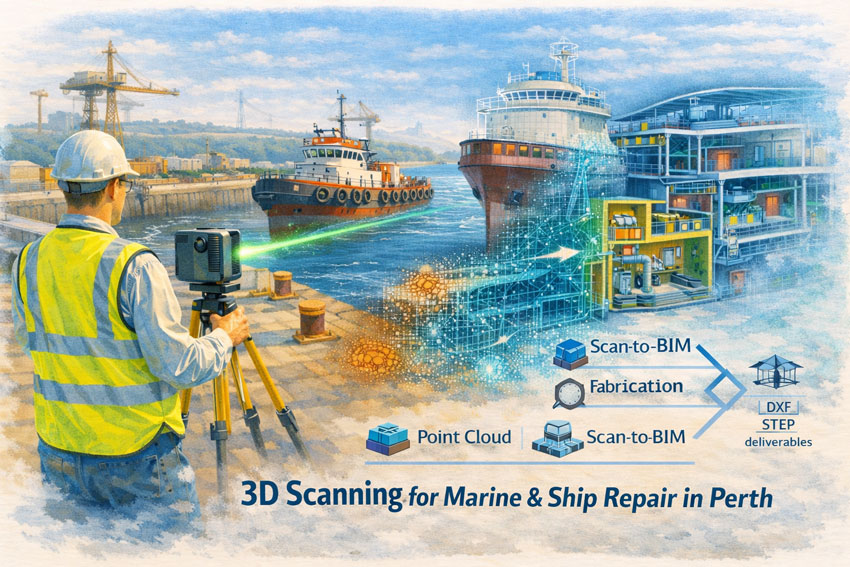
3D Scanning for Marine & Ship Repair in Perth

3D scanning for marine and ship repair in Perth showing laser capture of a vessel transitioning into a point cloud and BIM model.

3D Scanning for Marine & Ship Repair in Perth | Scan-to-BIM

Engineering Certainty for Vessels, Structures and Waterfront Assets

Perth is home to one of Australia’s most active marine maintenance corridors. From commercial vessels and defence platforms to offshore support craft and port infrastructure, every repair decision must be based on accurate geometry rather than assumptions. 3D Scanning for Marine & Ship Repair in Perth provides that certainty—delivering millimetre-accurate digital records of hulls, decks, pipe systems and mechanical spaces before fabrication begins.


Laser scanning of a Perth vessel for Scan-to-BIM marine refit and ship repair engineering.

The Digital Backbone of Marine Repairs

A marine laser scan is more than a survey; it is the backbone of the repair process. The quality of the initial capture determines how smoothly every downstream task will run—steel replacement, pipe spool fabrication, equipment retrofits and alignment works. If the backbone is broken, even simple jobs become complex. Poor measurement leads to rework on the wharf, schedule blowouts and costly vessel downtime.

Terrestrial and handheld scanners capture millions of measured points across:

  • Hull plating and frames
  • Engine rooms and machinery spaces
  • Pipework and HVAC systems
  • Deck structures and cranes
  • Jetty and berth interfaces

This data forms a single source of truth for naval architects, engineers and fabricators working across Fremantle, Henderson and the wider Perth maritime precinct.

From Point Cloud to Fabrication

The real value of 3D Scanning for Marine & Ship Repair in Perth lies in the engineering deliverables created after capture:

  • Point clouds for AutoCAD, Rhino and ShipConstructor
  • Scan-to-BIM or Scan-to-CAD models of hull and structure
  • Fabrication-ready DXF, STEP and Parasolid files
  • Navisworks meshes for clash detection
  • As-built verification for class and regulatory submissions

These outputs allow workshops to prefabricate with confidence while the vessel remains in service, reducing time alongside and improving safety.

Protecting the Project Team

Marine refits involve tight schedules, confined spaces and multiple contractors. High-quality scanning protects project managers, engineers, designers and fabricators by removing interpretation from the process. Decisions are based on measured reality, not tape measures in awkward bilges.

For older vessels with decades of undocumented modifications, scanning becomes the neutral reference that aligns owners, class surveyors and repair yards around the same dataset.

Applications Across Perth’s Marine Sector

3D Scanning for Marine & Ship Repair in Perth supports:

  • Steel renewal and insert design
  • Pipe spool prefabrication
  • Propulsion and shaft alignment checks
  • Engine change-outs and foundation design
  • Ballast and fuel system upgrades
  • Accommodation refits
  • Jetty and berth interface surveys
  • Class compliance documentation

Whether the project is a tug in Fremantle, an offshore support vessel in Henderson, or port infrastructure along the Swan River, accurate capture reduces risk.

Working Around Operational Constraints

Marine assets rarely stop for long. Scanning can be completed during short alongside windows, at night shifts, or between tide movements. A single visit can capture enough information for months of design work without repeated access to restricted areas.

Engineer-Led Capture

Effective marine scanning must be driven by engineering outcomes. Accuracy tolerances, control networks and target placement are defined around the repair deliverables, not the scanner. This ensures the final models support fabrication, alignment and class approval.


Hamilton By Design logo displayed on a blue tilted rectangle with a grey gradient background

Start With a Measured Foundation

3D Scanning for Marine & Ship Repair in Perth enables safer, faster and more predictable refits. When the digital backbone is strong, fabrication fits first time and vessels return to service sooner.

If your vessel or waterfront asset requires accurate as-built data, our team can attend site, capture the geometry and deliver engineering-ready models tailored to your workflow.

Talk to Hamilton By Design about:

  • Marine Scan-to-BIM
  • Hull and pipework digitisation
  • Fabrication models
  • Class documentation support
  • Jetty and berth scanning
Name
Would you like us to arrange a phone consultation for you?
Address

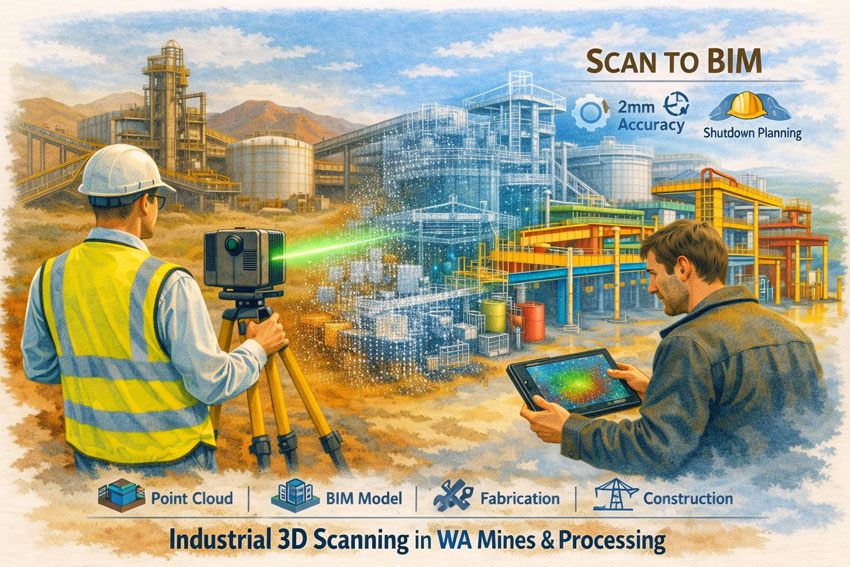
Industrial 3D Scanning in WA Mines & Processing

Laser scanning of WA mining infrastructure with Scan-to-BIM visualisation for industrial processing engineering.

Industrial 3D Scanning in WA Mines & Processing | Scan-to-BIM

Building Engineering Certainty in Brownfield Environments

Western Australia’s mining and mineral processing sector operates some of the most complex industrial assets in the world. Aging infrastructure, continuous production demands, and aggressive expansion schedules mean that every engineering decision must be based on accurate, reliable information. Industrial 3D Scanning in WA Mines & Processing has become the foundation for achieving this certainty—providing precise digital representations of plants, structures, and equipment before a single drawing is issued.


Industrial 3D scanning in WA mines showing laser capture of a processing plant with point cloud transforming into a BIM model.

The Backbone of Modern Mine Engineering

A laser scan is not simply a survey tool; it is the backbone of the entire project lifecycle. The quality of the initial scan determines the ease and accuracy of every task that follows—layout design, clash detection, fabrication, and construction. If the backbone is broken, even simple tasks become difficult. Poor capture leads to rework, fabrication errors, and costly shutdown delays.

Industrial 3D scanning captures millions of measured points across conveyors, tanks, structural steel, pipe racks, and mechanical equipment with millimetre accuracy. For WA mine sites where access is restricted and downtime is expensive, this technology removes guesswork and replaces assumptions with verified data.

From Point Cloud to BIM Deliverables

The true value of scanning lies in what is delivered after capture. For mines and processing facilities, typical outputs include:

  • Engineering-grade point clouds for AutoCAD, Revit, and plant design platforms
  • Scan-to-BIM models of structures, pipework, and mechanical systems
  • Fabrication-ready DXF, STEP, or Parasolid files
  • Navisworks meshes for stakeholder review and constructability planning
  • As-built verification for shutdown and tie-in works

These deliverables allow engineering teams to design remotely, plan upgrades with confidence, and eliminate the need for repeated site visits across the vast distances of Western Australia.

Protecting the Project Team

Industrial projects are often pressured by schedules and budgets. High-quality 3D scanning protects the entire delivery team—project managers, engineers, designers, and fabricators—by providing an objective source of truth. When design decisions are based on measured reality rather than tape measures and sketches, disputes reduce and collaboration improves.

For brownfield WA sites with decades of undocumented modifications, scanning becomes the neutral reference that aligns contractors, owners, and operators around the same dataset.

Applications Across WA Mines & Processing

Industrial 3D Scanning in WA Mines & Processing supports a wide range of activities:

  • Shutdown planning and tie-in verification
  • Conveyor and chute upgrades
  • Tank and structural remediation
  • Pipe spool prefabrication
  • Access platform and maintenance improvements
  • Expansion of crushing and screening circuits
  • Safety and egress compliance reviews

Whether in the Pilbara iron ore operations, Goldfields processing plants, or nickel and lithium facilities, scanning reduces risk in some of Australia’s harshest and most remote environments.

Remote Doesn’t Mean Isolated

Western Australian mine sites can feel isolated, yet digital capture connects them directly to engineering teams anywhere in Australia. A single field visit can provide enough data for months of detailed design work. Teams can “walk the plant” virtually, measure clearances, and develop solutions without repeated flights or shutdown interruptions.

An Engineer-Led Approach

Effective scan programs must be led by engineers who understand how the data will be used. Capture strategies, target placement, and accuracy tolerances are defined around the BIM deliverables, not around the scanner. This ensures that the final models support fabrication, not just visualisation.


Hamilton By Design logo displayed on a blue tilted rectangle with a grey gradient background

Industrial 3D Scanning in WA Mines & Processing is no longer optional—it is the starting point for safe, efficient, and predictable project delivery. When the backbone is strong, every downstream task becomes easier.

If your operation is planning upgrades, shutdowns, or expansions, begin with a measured digital foundation and let the data drive the outcome.

Name
Would you like us to arrange a phone consultation for you?
Address

Advancing Digital Engineering through 3D Scanning Perth – Scan-to-BIM Services

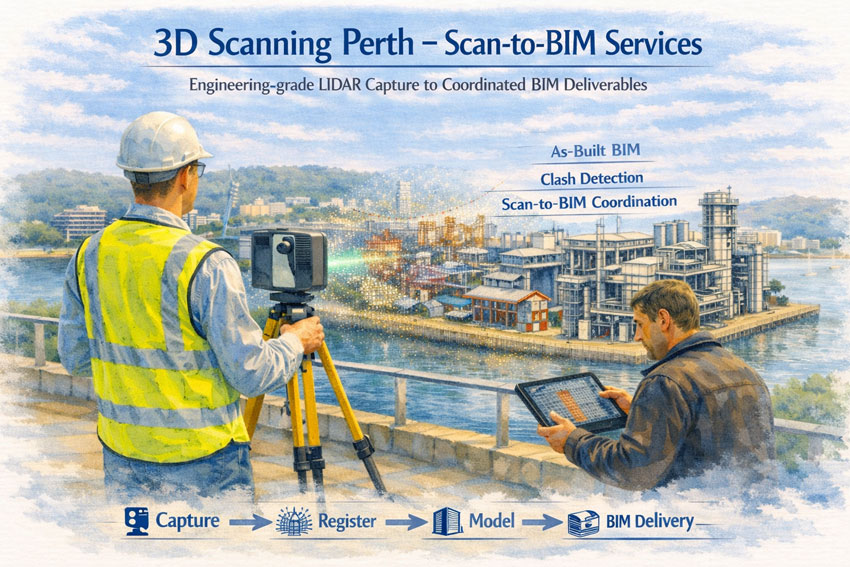
Perth Scan-to-BIM workflow with LiDAR capture converting site conditions into coordinated BIM model for construction and asset management.

3D Scanning Perth – Scan-to-BIM Services | Hamilton By Design

In an era where digital precision underpins engineering success, the integration of 3D Scanning Perth – Scan-to-BIM Services has emerged as a vital component of contemporary project delivery. The services offered by Hamilton By Design – 3D Scanning Services Perth exemplify this integration, aligning advanced engineering-grade LiDAR capture with structured digital modelling workflows that directly support Building Information Modelling (BIM) deliverables.

3D laser scanner operating in Perth with point cloud transitioning into a BIM model illustrating Scan-to-BIM workflow and engineering deliverables.

At its core, 3D scanning in Perth is positioned not merely as a mechanism for acquiring visual datasets, but as a fundamental measurement process that transitions physical reality into validated digital representations. Engineering-grade terrestrial laser scanning produces high-resolution point clouds with measurable geometry—data that BIM platforms rely on for spatial coordination, clash detection, and as-built accuracy in complex environments such as industrial plants, construction sites, and marine facilities.

A key advantage of this engineered data capture is its capacity to feed directly into Scan-to-BIM workflows. From the registered point clouds, detailed 3D models can be developed that adhere to the precision expectations of BIM deliverables—supporting design verification, stakeholder coordination, and multidisciplinary integration. These deliverables typically include:

  • Registered high-accuracy point cloud datasets suitable for BIM import
  • Scan-derived 3D CAD models aligned with BIM spatial and tolerance requirements
  • As-built BIM models that reflect true-to-site geometry for retrofit and renovation projects
  • Documentation packages that underpin regulatory compliance and construction sequencing

Such deliverables ensure that project stakeholders work from a common, reliable digital baseline, effectively bridging the gap between field conditions and model-based project execution. This alignment enhances predictability in engineering coordination and reduces rework associated with discrepancies between assumed conditions and actual site geometry—a fundamental premise of BIM methodology.

Furthermore, when 3D scanning is integrated with BIM workflows in Perth, it supports advanced uses such as clash analysis, spatial coordination, and virtual construction planning. These processes provide multidisciplinary teams with confidence that modelled elements reflect real constraints and interfaces before fabrication and on-site assembly.

Hamilton By Design logo displayed on a blue tilted rectangle with a grey gradient background

In summary, the 3D Scanning Perth – Scan-to-BIM Services articulated by Hamilton By Design demonstrates how high-accuracy spatial capture, when embedded within an engineering-centric workflow, can produce BIM deliverables that elevate project outcomes. By anchoring digital models to measured realities and structuring data for downstream use, clients are equipped with robust, actionable information that enhances design quality, coordination, and constructability across complex ventures.

Name
Would you like us to arrange a phone consultation for you?
Address

3D LiDAR Laser Scanning Services in Bahrain

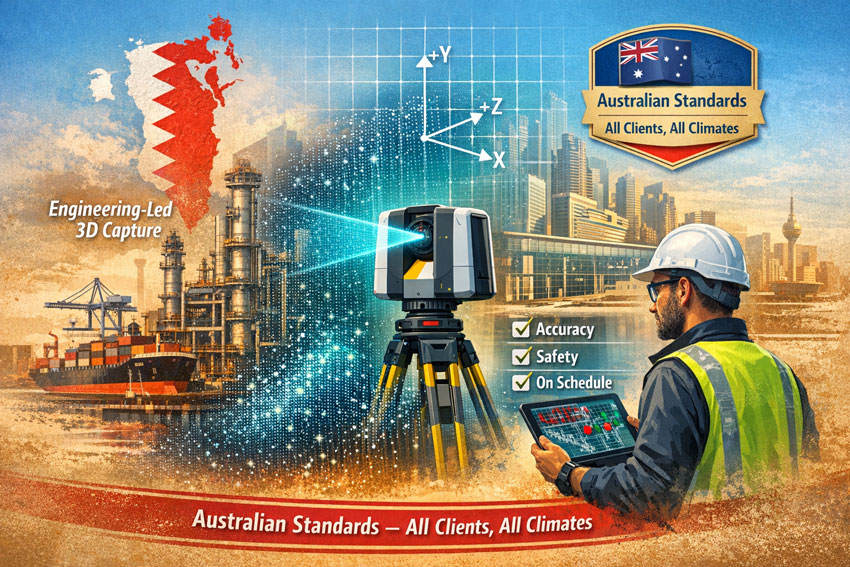
Watercolour illustration of 3D LiDAR laser scanning in Bahrain showing engineers capturing an industrial site with a scanner and tablet, styled in Bahrain flag colours with Australian quality standards message.

3D LiDAR Laser Scanning Services in Bahrain | Australian Standards

Engineering Certainty Through Measured Reality

Bahrain’s construction, industrial and infrastructure sectors are evolving rapidly. Successful projects depend on accurate knowledge of existing conditions rather than historical drawings or assumptions. 3D LiDAR laser scanning services in Bahrain provide that verified foundation.

Hamilton By Design delivers engineering-led 3D LiDAR scanning services in Bahrain, capturing complex facilities and structures with millimetre precision so that design, analysis and construction can proceed from fact.


Verification Before Calculation

Many Bahrain projects involve brownfield environments where documentation no longer reflects reality. Modifications, corrosion, settlement and incremental upgrades create risk for designers and contractors.

Terrestrial LiDAR scanning enables:

  • Objective measurement of existing assets
  • Accurate tie-ins for new works
  • Reduction of site variations
  • Shorter shutdown durations
  • Remote engineering collaboration
  • Reliable prefabrication

The scan is the backbone of the project.
The quality of the initial capture determines the ease of every task that follows. If the backbone is compromised, even simple engineering becomes difficult.


3D laser scanning services Bahrain visual showing LiDAR capture, point cloud workflow and Australian Standards compliance in watercolour engineering style.

Engineering-Led 3D LiDAR Scanning in Bahrain

Our services are not limited to data collection. We approach every Bahrain project as engineers first, ensuring the capture supports:

  • Structural and mechanical verification
  • Constructability and access reviews
  • Interface definition for fabrication
  • Maintenance and shutdown planning
  • Risk reduction for project teams

This perspective protects project managers, engineers, designers and fabricators from decisions based on assumption.


Tailored to Your Systems

Hamilton By Design delivers vendor-neutral outputs that integrate with your existing workflows.

We tailor Bahrain LiDAR deliverables to suit your:

  • CAD platforms
  • BIM environments
  • FEA and analysis tools
  • Engineering and asset systems

Our role is to provide accurate engineering information — your team chooses the software.


Australian Quality – Across All Clients and All Climates

All 3D LiDAR laser scanning services in Bahrain are delivered in accordance with:

  • Australian quality expectations
  • Australian build standards
  • Proven engineering procedures
  • Consistent methodology across all climates

Our workflows are designed for heat, humidity, coastal exposure and heavy industrial environments common to Bahrain, providing defensible and traceable data for every client.


Sectors Supported in Bahrain

  • Oil & gas and process facilities
  • Ports and marine structures
  • Commercial and mixed-use buildings
  • Transport and utilities
  • Manufacturing and logistics
  • Heritage and architectural assets

Whether the requirement is a single tie-in or a full facility digital record, the principle remains the same — measure first, then engineer.


Hamilton By Design logo displayed on a blue tilted rectangle with a grey gradient background

The Hamilton By Design Process

  1. Investigate – High-accuracy LiDAR capture on site in Bahrain
  2. Verify – Registration and quality assurance
  3. Design – Data prepared for your engineering workflow

This structured approach ensures Bahrain projects commence with measured reality rather than interpretation.


Engage 3D LiDAR Laser Scanning Services in Bahrain

If your Bahrain project requires reliable as-built information, Hamilton By Design can mobilise to capture, process and deliver engineering-ready data aligned with Australian standards.

Start your project with certainty, not assumption.

Contact Hamilton By Design to discuss 3D LiDAR laser scanning services in Bahrain.

Name
Would you like us to arrange a phone consultation for you?
Address

SMP Projects: Enabling Project Success Through a Scan → Design → Scan Workflow

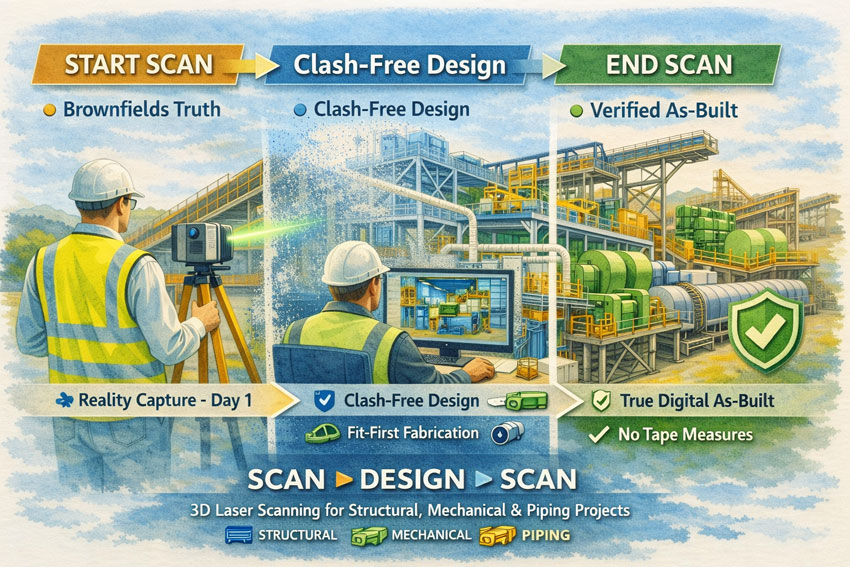
Watercolour-style illustration showing SMP 3D laser scanning workflow from start capture to clash-free design and final digital as-built.

Successful Structural, Mechanical and Piping (SMP) projects are built on one fundamental principle: decisions must be based on accurate knowledge of existing conditions. In brownfields industrial environments, legacy drawings and manual measurements rarely reflect the current state of an asset. Over years of operation, piping is rerouted, structures are strengthened, and equipment is modified to meet changing production demands.

Commencing design on the basis of incomplete or inaccurate information introduces uncertainty that can affect safety, cost, schedule, and quality. Modern 3D laser scanning provides a disciplined method to remove this uncertainty and establish a reliable foundation for project delivery.


Establishing a Reliable Baseline

An initial 3D laser scan captures a high-resolution digital representation of the facility, recording structural elements, mechanical equipment, and piping systems exactly as they exist. This dataset becomes the authoritative reference for all subsequent engineering activities.

By beginning with a comprehensive reality capture, project teams can:

  • Define accurate tie-in locations for new works
  • Understand spatial constraints and access requirements
  • Identify potential clashes before detailed design
  • Reduce reliance on manual surveys and assumptions
  • Provide designers with objective, measurable data

This approach aligns engineering decisions with actual site conditions, supporting informed planning and reducing the likelihood of downstream rework.


SMP scan–design–scan process illustrated with laser scanner, point cloud model and finished industrial plant.

Designing From Truth Rather Than Assumption

When the design phase is grounded in verified scan data, coordination across structural, mechanical, and piping disciplines becomes more effective. Engineers are able to develop models that reflect the real environment rather than an idealised interpretation of it.

The benefits to project success include:

  • Improved accuracy of fabrication documentation
  • Reduced design revisions and RFIs
  • Greater confidence in constructability
  • More reliable cost and schedule forecasting
  • Enhanced collaboration between designers, fabricators, and site teams

A scan-based workflow supports the objective of “fit-first” construction, where components are manufactured with confidence that they will integrate with existing assets.


Verifying Outcomes With a Final Scan

Project success is not only measured by installation, but by the quality of information handed to the asset owner. A second 3D scan at project completion provides a verified digital as-built of all SMP works.

This final dataset delivers:

  • An accurate record of installed structural, mechanical, and piping systems
  • Validation that construction matches design intent
  • A foundation for maintenance and asset management
  • Reliable data for future modifications or expansions
  • Elimination of manual tape-based as-built surveys

The organisation is left with a living digital asset rather than static drawings that quickly lose relevance.


Supporting Measurable Project Outcomes

Adopting a Scan → Design → Scan methodology directly contributes to recognised measures of project success:

  • Safety: Reduced site rework and unplanned interventions
  • Cost Control: Fewer field modifications and claims
  • Schedule Reliability: Shorter shutdowns and predictable installation
  • Quality: Higher confidence in alignment and tolerances
  • Knowledge Retention: Creation of enduring digital records

These outcomes are particularly critical in SMP environments where interfaces between steel, equipment, and piping are complex and tolerances are unforgiving.


Applications Across Industrial Sectors

This workflow is suited to a wide range of SMP activities, including:

  • Conveyor and materials handling upgrades
  • Plant expansions and debottlenecking
  • Tank, hopper and bin modifications
  • Piping reroutes and tie-ins
  • Shutdown and turnaround works
  • Brownfields engineering studies

In each case, accurate spatial data enables better engineering judgement and more predictable project delivery.


Hamilton By Design logo displayed on a blue tilted rectangle with a grey gradient background

A Framework for Sustainable Project Success

For organisations seeking consistent performance from SMP projects, the integration of 3D laser scanning is not a survey exercise—it is a strategic project control measure. By capturing reality at project commencement and verifying it at completion, stakeholders gain confidence that engineering decisions, construction outcomes, and asset records are aligned.

Start with verified data.
Design with confidence.
Finish with a true digital as-built.

Hamilton By Design Co. partners with project teams to implement this approach, supporting safer, more reliable, and more successful SMP outcomes.

Name
Would you like us to arrange a phone consultation for you?
Address