Bolts, Grades, Materials and Standards

A Practical Engineering Guide to Correct Fastener Selection in Australia

Bolts are one of the most common engineered components on any project — and also one of the most misunderstood.

In drawings they appear as a simple note:
M16 – 8.8 – GALV

Yet behind that small call-out sits structural capacity, fatigue life, corrosion resistance, inspection compliance, and legal responsibility.

Many engineering failures do not occur because a beam was undersized or a calculation was incorrect.
They occur because the wrong fastener type was selected for the application.

This article explains:

  • Bolt and nut property classes
  • Where each class should be used
  • Carbon steel vs stainless steel
  • Coatings and environment suitability
  • Structural vs mechanical bolting
  • Australian Standards governing fasteners
  • How to review and challenge incorrect selections — especially when mentoring graduate engineers

1. The Three Different Worlds of Bolting

Most confusion exists because people think a bolt is simply a stronger or weaker version of the same item.

In reality, bolts exist in three different engineering systems:

SystemPurposeGoverning Standards
General Mechanical FasteningHolding components togetherISO / AS 1110 / AS 4291
Structural BoltingLoad transfer between steel membersAS/NZS 1252 / AS 4100
Corrosion Resistant FasteningSurvive environmentStainless / coatings standards

Using a bolt from the wrong system often creates hidden failures.


2. Bolt Property Classes (Metric)

Metric bolts are marked with numbers such as 4.6, 8.8, 10.9, 12.9

These numbers define material strength.

What the Numbers Mean

First number → Ultimate tensile strength (×100 MPa)
Second number → Yield ratio

Example:

8.8 bolt
800 MPa tensile strength
Yields at 80% = 640 MPa


Typical Bolt Classes and Their Uses

ClassStrength LevelTypical Applications
4.6LowLight brackets, sheet metal
4.8Low–mediumGeneral hardware
5.8MediumAutomotive covers
6.8MediumMachinery guards
8.8High tensileGeneral engineering & structural connections
9.8Higher tensileAutomotive mechanical
10.9Very high tensileMining equipment, heavy plant
12.9Ultra high tensileTooling, precision machinery

Important Engineering Concept

A stronger bolt is not always better.

Higher strength bolts:

  • are less ductile
  • tolerate less misalignment
  • fatigue faster in bending

Many failures occur when 12.9 bolts are used where 8.8 bolts were intended.


3. Nut Property Classes

Nuts are graded differently.
They must match the bolt strength.

Nut ClassSuitable Bolt
44.6
55.8
66.8
88.8
99.8
1010.9
1212.9

Critical Rule

Nut class must be equal or higher than bolt class first number

If not, the joint will strip before correct preload is reached.


4. Carbon Steel vs Stainless Steel

Many installations choose stainless assuming it is “better”.

It is not stronger — it is more corrosion resistant.


Mechanical Comparison

PropertyHigh Tensile Carbon SteelStainless Steel
StrengthHighMedium
Fatigue resistanceGoodLower
Vibration resistanceGoodPoorer
Corrosion resistanceDepends on coatingExcellent
Galling riskVery lowHigh
Torque capacityHighLimited

Stainless Grades

GradeEquivalent StrengthTypical Use
A2-50~5.8General hardware
A2-70~7.0Outdoor equipment
A4-80~8.8 tensileMarine / chemical

Important

Stainless steel often fails in structural joints due to:

  • lower yield strength
  • thread galling
  • relaxation under load

5. Coatings and Environment Suitability

Carbon steel requires corrosion protection.

CoatingEnvironment
Black oxideIndoor machinery
Zinc platedIndoor dry
Zinc passivateWorkshop conditions
Hot dip galvanisedOutdoor structural
Mechanical galvanisedStructural bolting
Dacromet / GeometMining & heavy corrosion

Engineering Impact of Coatings

Coatings change friction.

Friction changes preload.

Therefore torque charts must match coating type.

Incorrect torque values are one of the most common installation errors.


6. Structural Bolting vs Mechanical Bolting

These must never be confused.

Mechanical Bolting

Purpose: hold parts together

Failure mode: loosening

Structural Bolting

Purpose: transfer load through friction or bearing

Failure mode: structural collapse

Structural bolts require:

  • certified assemblies
  • controlled tightening method
  • inspection records

General hardware bolts must never be substituted.


7. Storage and Handling Requirements

Fasteners can degrade before use.

Problems Caused by Poor Storage

  • Coating breakdown
  • Hydrogen embrittlement risk
  • Rust under galvanising
  • Lost certification traceability
  • Incorrect torque performance

Recommended Storage Practices

Environment

Dry
Covered
Off concrete
Stable temperature

Handling

Keep manufacturer packaging
Do not mix batches
Record heat numbers

Stainless Steel

Must be isolated from carbon steel contamination.

Carbon particles embed → rust later appears


8. Australian Standards for Fasteners

Below is a consolidated list relevant to Australian engineering practice.


Mechanical Properties

AS/NZS 4291.1 — Mechanical properties of bolts, screws and studs
AS/NZS 4291.2 — Mechanical properties of nuts
ISO 898-1 / ISO 898-2 — Referenced strength properties
ISO 3506 — Stainless steel fasteners


Dimensions & Threads

AS 1110 — Metric hex bolts & screws
AS 1111 — Metric fasteners
AS 1112 — Hexagon nuts
AS 1275 — Metric screw threads
AS 1721 — General purpose metric threads


Structural Bolting

AS/NZS 1252 — High strength structural bolting assemblies
AS 4100 — Steel structures design
AS/NZS 5131 — Structural steel fabrication & erection


Corrosion Protection

AS/NZS 1214 — Galvanised coatings on threaded fasteners
AS/NZS 4680 — Hot dip galvanising
AS 2312.2 — Corrosion protection guide
AS 1897 — Electroplated coatings


Locking and Reliability

AS 4145.2 — Locking devices for fasteners


9. Mentoring the Graduate Engineer

What To Do When the Selection Is Wrong

One of the responsibilities of senior engineers is not just checking work — but teaching judgement.

A graduate will often select bolts by:

  • copying an old drawing
  • choosing stainless for safety
  • choosing highest strength available
  • assuming galvanised means structural

Rather than correcting immediately, guide the reasoning.


Questions That Help Them Learn

Instead of saying “that is wrong”, ask:

What load path is the bolt carrying?
Is it clamping, locating, or supporting?

What failure mode are we preventing?
Slip, fatigue, shear, corrosion, loosening?

Is the environment or the force governing selection?

Does the standard require a certified assembly?

What inspection method applies?


The Goal

Teach that engineering is not selecting a stronger component —
it is selecting the correct component for the failure mode.


Hamilton By Design logo displayed on a blue tilted rectangle with a grey gradient background

Conclusion

Fasteners are engineered components.

Correct selection depends on understanding:

  • strength class
  • application type
  • environment
  • installation method
  • applicable standards

Most bolted joint failures occur not from calculation error, but from incorrect assumptions about what the bolt is meant to do.

Engineering quality is achieved when design intent matches real behaviour.
Name
Would you like us to arrange a phone consultation for you?
Address

Managing “Loader Knee” While Operating a Chainsaw Safely

Managing Loader Knee & Chainsaw Use – Work Safely in Australia

Years spent climbing in and out of loaders, dozers, and haul trucks can leave many operators with what is commonly called “loader knee.” It isn’t a single diagnosis — rather a collection of knee problems caused by repetitive climbing, whole-body vibration, and long hours in fixed seated positions.

For people who also need to use a chainsaw — on a mine site, rural property, or maintenance role — loader knee can become a serious safety risk. Chainsaw work demands balance, stable footing, and quick reactions. The good news is that with the right approach, many people can continue to work safely.

Why Loader Knee and Chainsaws Don’t Mix Easily

Chainsaw operation places unique demands on the lower body:

  • Knees remain slightly bent for long periods
  • Weight shifts constantly between legs
  • The operator must react instantly to kickback or timber movement
  • Work often occurs on uneven ground with vibration through the arms and body

If loader knee has caused instability, pain, or reduced strength, these demands can increase the likelihood of a slip, loss of control, or secondary injury.


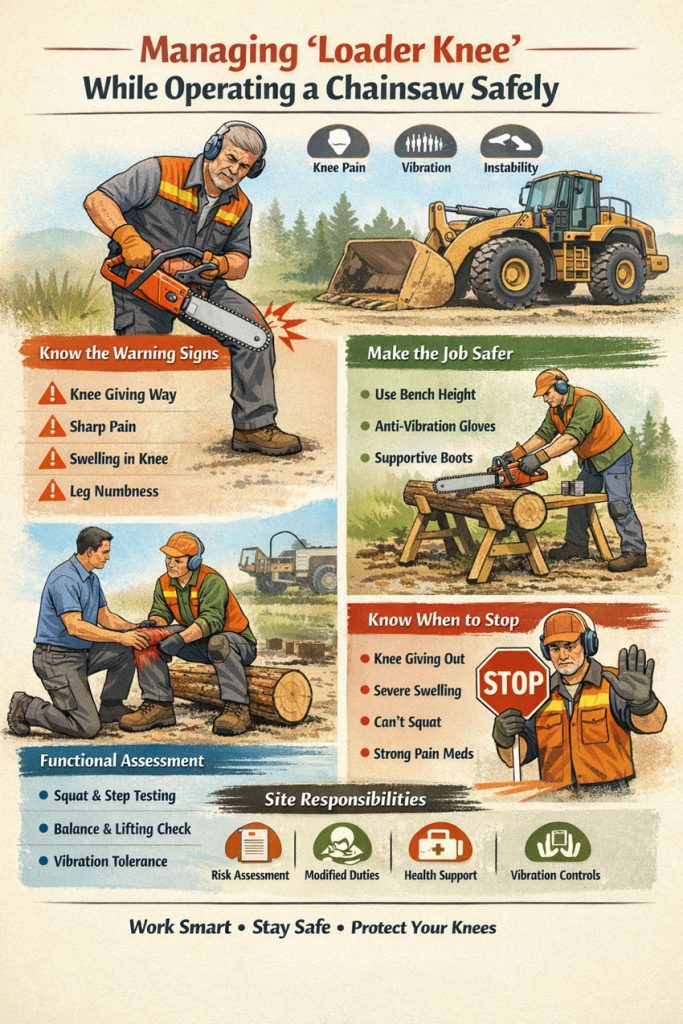
Infographic showing how to manage loader knee while operating a chainsaw safely with warnings, safe work methods and functional assessment steps.

Step 1 – Recognise the Early Warning Signs

Do not push through symptoms when a running saw is in your hands. Stop immediately if you experience:

  • Knee giving way or locking
  • Sharp pain when weight bearing
  • Swelling during the task
  • Reduced ability to squat or step sideways
  • Numbness or altered sensation down the leg

Finishing “one last cut” is how many incidents occur.


Step 2 – Make the Task Safer Before You Start

Engineering and Equipment Controls

  • Work at bench height using saw horses or log stands rather than ground felling
  • Choose a low-vibration chainsaw with a well-maintained sharp chain
  • Use anti-vibration gloves and supportive footwear
  • Avoid slopes, loose ground, and awkward reaches
  • Keep cutting zones close to waist height where possible

Administrative Controls

  • Limit cutting to 15–20 minute blocks with rest breaks
  • Rotate to non-chainsaw duties
  • Use a second person for large or unstable timber
  • Complete a short warm-up before starting

Personal Supports

  • Knee brace with lateral support if recommended by a clinician
  • Strength program targeting quads, hamstrings, and glutes
  • Maintain healthy body weight to reduce joint load

Step 3 – Get the Right Type of Assessment

A general medical certificate often isn’t enough. A functional capacity assessment should test the movements actually required for chainsaw work:

  • Holding a half-squat stance
  • Stepping sideways with a 5–7 kg load
  • Recovering from a stumble
  • Tolerance to vibration
  • Repeated kneel-to-stand movements

This provides a realistic picture of whether the task is safe or needs modification.


Step 4 – Know When to Stop

Chainsaw use should cease — temporarily or permanently — if any of the following are present:

  • Recurrent knee collapse or instability
  • Inability to squat to approximately 70 degrees
  • Increasing swelling during work
  • Use of strong pain medication
  • Recent injections or acute injury

No production target is worth a life-changing accident.


Step 5 – Employer and Site Responsibilities

Under Australian WHS duties, a PCBU must ensure:

  • Task-specific risk assessments
  • Suitable duties or modified work
  • Review of vibration exposure
  • Access to occupational health support
  • Consideration of alternative methods such as pole saws or mechanical cutters

Managing loader knee is not just a personal issue — it is a workplace safety obligation.


Hamilton By Design logo displayed on a blue tilted rectangle with a grey gradient background

A Practical Path Forward

Many experienced operators successfully continue chainsaw work by changing the way the task is done rather than ignoring the condition. The combination of smart engineering controls, realistic medical assessment, and sensible work planning keeps people productive and safe.

If you or your team need help developing:

  • Chainsaw SWMS and task risk assessments
  • Fitness-for-task guidance
  • Access and ergonomic improvements
  • Vibration exposure reviews

Hamilton By Design can assist with practical, site-focused solutions that protect both people and productivity.


Stay safe. Work smart. Look after your knees — they still have plenty of shifts left in them.

Name
Would you like us to arrange a phone consultation for you?
Address

Mechanical Engineering Support for Manufacturing in Benalla

Mechanical Engineering Support Benalla | Manufacturing & Industrial

Practical engineering for real factories, real equipment, real deadlines

Benalla and the North East Victorian region are built on strong manufacturing—electrical equipment, heavy industry, fabrication, food processing, and specialist production. Mechanical engineers working in these environments need support that understands uptime, safety, compliance, and getting equipment back into service quickly.

Hamilton By Design provides hands-on mechanical engineering services that help manufacturers move from site reality to engineering-ready solutions—without disrupting production.


Who we work with

We support mechanical engineers, maintenance teams, project managers, and workshop leaders across:

  • Electrical and industrial equipment manufacturing
  • Process and production facilities
  • Fabrication workshops and OEM suppliers
  • Maintenance and reliability teams
  • Capital upgrade and shutdown projects

Our role is to strengthen your in-house capability with accurate site information, practical design support, and clear engineering deliverables.


Our services

Site verification & as-built capture

Decisions are only as good as the information behind them. We help confirm existing conditions before designs are locked in.

  • Existing plant and equipment verification
  • Field measurement and dimensional checks
  • Brownfield interface confirmation
  • Layout validation before fabrication

3D laser scanning for manufacturing sites

Modern manufacturing upgrades demand accurate spatial data. We capture and deliver point clouds tailored for engineering workflows.

  • Rapid on-site data capture
  • Registered point cloud deliverables
  • Support for upgrades, relocations, and new equipment installs
  • Clash identification before shutdowns

Mechanical layout & modification support

Practical engineering to make changes fit the real world.

  • Equipment arrangement and access reviews
  • Interface coordination with structures and services
  • Design checks against site constraints
  • Fabrication and installation support

Reliability & maintenance engineering

Helping teams reduce downtime and improve maintainability.

  • Maintenance access optimisation
  • Equipment changeover planning
  • Practical improvement recommendations
  • Support for maintenance documentation

Manufacturing documentation

Clear, structured information that workshop and site teams can actually use.

  • Engineering-ready drawing packages
  • Asset and modification records
  • Handover documentation
  • Fabrication support information

Why manufacturing teams choose us

  • Engineer-led, site-first approach – we design around how your plant really operates
  • Production-aware – focused on minimal disruption and practical outcomes
  • Cross-discipline thinking – mechanical, structural and fabrication interfaces
  • Deliverables that work on the workshop floor – not just in the office

Typical projects in Benalla

  • Equipment upgrades and replacements
  • New machine installations into existing lines
  • Factory relocations and layout changes
  • Shutdown measurement and documentation
  • Access and maintainability improvements
  • Reverse engineering of legacy equipment

How we engage

  1. Initial discussion – understand your equipment, constraints, and timeline
  2. Plan the site approach – access, safety, and production considerations
  3. On-site capture & verification
  4. Delivery of practical engineering outputs ready for your workflow

Hamilton By Design logo displayed on a blue tilted rectangle with a grey gradient background

Contact

If you’re a mechanical engineer or manufacturer in Benalla needing practical engineering support, we can help bridge the gap between site and design.

Hamilton By Design Co.
Servicing Benalla & Northeast Victoria


Name
Would you like us to arrange a phone consultation for you?
Address

3D Scanning North Sydney – Structural Steel Detailing on the NSW Central Coast

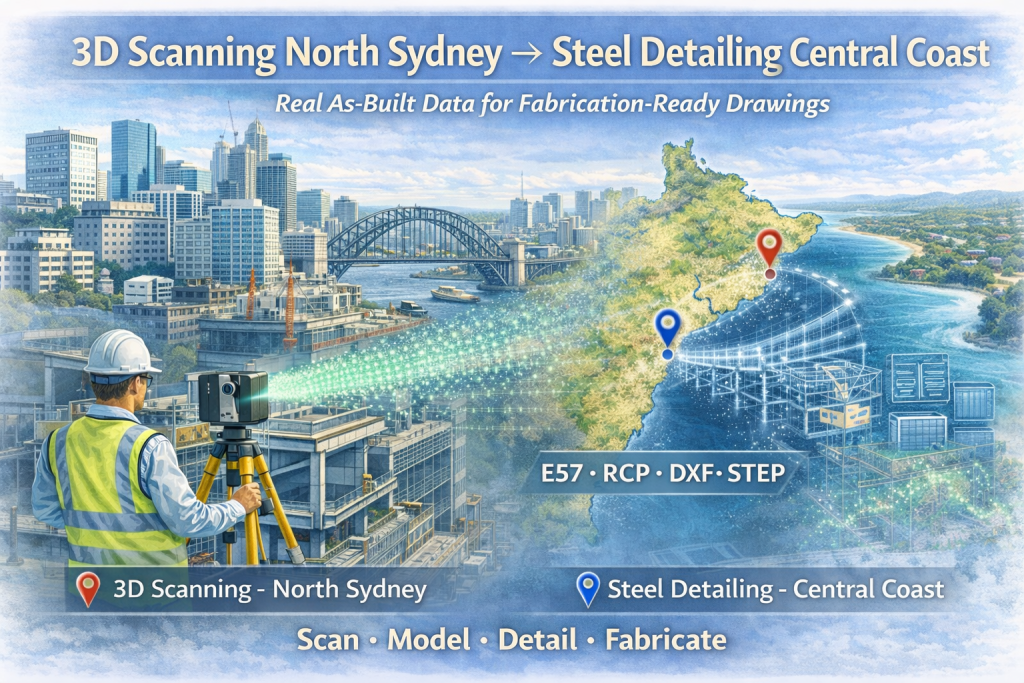
3D scanning in North Sydney transforming as-built data into Central Coast steel detailing and CAD models.

3D Scanning North Sydney – Structural Steel Detailing Central Coast

North Sydney is one of the busiest construction regions in Australia. Tower upgrades, façade replacements, new mezzanines and plant installations are constantly being delivered into existing, complex structures where original drawings are incomplete or inaccurate.

Engineer using lidar scanner in North Sydney with point cloud linking to structural steel detailing on the NSW Central Coast.

Hamilton By Design bridges that gap by combining:

  • 3D laser scanning in North Sydney to capture the real as-built condition, and
  • structural steel detailing on the Central Coast to produce fabrication-ready drawings.

Capture in North Sydney – Detailing on the Central Coast

Our approach removes the uncertainty that traditionally surrounds brownfields work.

  1. On-site 3D scan in North Sydney – buildings, steel frames, plant and services
  2. Convert to an accurate engineering point cloud
  3. Structural steel detailing completed on the Central Coast
  4. Issue shop drawings and models for fabrication

The scan becomes the single source of truth, allowing our Central Coast detailers to work with confidence without repeated site visits.


Why 3D Scanning Matters for Structural Steel

North Sydney projects often involve:

  • strengthening of existing buildings
  • new rooftop plant platforms
  • façade and awning replacements
  • retrofitting mezzanines
  • tie-ins to ageing steelwork

Manual measurement struggles with these conditions. A point cloud captures:

  • true beam sizes and locations
  • floor levels and deflections
  • bolt patterns and connections
  • clashes with services

From this, our team produces accurate steel models and drawings ready for fabrication.


Deliverables From One Scan

  • Structural steel GA drawings
  • Connection details and shop drawings
  • Tekla / Revit models
  • DXF, STEP and Parasolid files
  • Clash reviews against services
  • Fabrication quantities

Engineers design with real geometry; fabricators build without surprises.


Central Coast Drafting Advantage

Completing the detailing on the NSW Central Coast provides:

  • experienced steel detailers
  • fast turnaround without Sydney overheads
  • direct collaboration with your engineer
  • practical fabrication knowledge

We capture in North Sydney, but the modelling, thinking and detailing happens locally on the Coast.


Ideal North Sydney Projects

  • Commercial tower upgrades
  • Heritage building alterations
  • Plant change-outs
  • Rooftop structures
  • Warehouse and mezzanine works
  • Remediation and insurance projects

Hamilton By Design logo displayed on a blue tilted rectangle with a grey gradient background

Start With Accurate Data

If you have a North Sydney project that needs reliable as-built information and professional structural steel detailing, we can take you from scan to finished drawings.

Hamilton By Design – Structural Drafting Central Coast

Name
Would you like us to arrange a phone consultation for you?
Address

3D Engineering Scanning – Solomon Islands

Engineer performing 3D laser scanning in the Solomon Islands with point cloud transitioning to BIM model and FEA analysis.

3D Engineering Scanning Solomon Islands – Point Clouds for BIM & FEA

Reliable Point Clouds for BIM, CAD & FEA Anywhere in the World

Hamilton By Design provides engineering-grade 3D laser scanning services across the Solomon Islands, delivering accurate point clouds that allow designers, engineers, and asset owners to work from real measured data—without the need to be on site.

From Honiara ports to remote island infrastructure, our scans create the digital backbone for modelling, analysis, and fabrication.


Engineering Data You Can Trust

Many assets in the Solomon Islands have:

  • limited or missing drawings
  • decades of informal modifications
  • corrosion from marine environments
  • cyclone and seismic exposure
  • mixed construction standards

Traditional measurement methods struggle in these conditions. Our 3D scanning service captures the true as-built condition so your team can:

  • create BIM and CAD models
  • perform structural and mechanical FEA
  • plan brownfields tie-ins
  • fabricate off-site with confidence
  • complete clash detection before shutdowns

We deliver open, neutral formats so engineers anywhere in Australia, New Zealand, Asia or Europe can immediately begin work.


3D engineering scanning in the Solomon Islands depicting site capture, point cloud creation and remote BIM and FEA design.

What We Deliver

Core Outputs

  • Registered point clouds – E57 / RCP / LAS
  • Colourised engineering datasets
  • Site grid or project datum
  • Mesh models for Navisworks
  • 2D plans, elevations and sections

Optional Engineering Deliverables

  • Scan-to-BIM models (LOD 200–350)
  • Steel and pipe geometry extraction
  • Tie-in coordinates for upgrades
  • Deformation and roundness reports
  • Clash and constructability reviews

All data is processed in Australia under formal QA so it can be relied upon for design approvals and FEA studies.


Designed for Solomon Islands Conditions

Scanning in the Solomons requires Pacific experience:

  • high heat and humidity
  • sudden tropical rain
  • reflective stainless and bright sunlight
  • inter-island logistics
  • remote power availability
  • cyclone season planning

Our workflows are built for efficient field capture with processing completed by our Australian engineering team.


Industries We Support

  • Honiara ports and marine infrastructure
  • Power generation and substations
  • Water and wastewater assets
  • Timber and processing facilities
  • Government and commercial buildings
  • Bridges and civil structures
  • Post-cyclone condition surveys

A Digital Backbone for Global Teams

A quality scan is the backbone of every downstream task.
If the backbone is wrong, every model and FEA result is compromised.

Our service provides a foundation that:

  • removes re-measure risk
  • supports remote engineering
  • shortens shutdowns
  • improves safety and constructability

Designers anywhere in the world can open our data and begin work immediately.


Talk to Us About Your Solomon Islands Project

Whether you need a single building, a wharf, or a full plant captured, we can mobilise quickly and deliver data your team can trust.

Hamilton By Design
Engineering certainty through 3D scanning.

Name
Would you like us to arrange a phone consultation for you?
Address

3D Engineering Scanning in Fiji – Reliable Point Clouds for Global Engineering

Engineer performing 3D laser scanning in Fiji with point cloud transforming into BIM model and FEA analysis beside a tropical port.

3D Engineering Scanning Fiji – Point Clouds for Design & FEA | Hamilton By Design

Hamilton By Design provides professional 3D laser scanning services across Fiji, delivering high-accuracy point clouds that allow designers, engineers, and asset owners anywhere in the world to work with real, measured data—without stepping foot on site.

Our focus is simple:
capture the truth of your asset once, and let every engineering discipline design from the same digital backbone.


Engineering-Grade Data You Can Design From

In Fiji, many industrial, marine, and commercial assets have:

  • incomplete or outdated drawings
  • decades of informal modifications
  • mixed construction standards
  • corrosion and cyclone damage history

Traditional measurement methods struggle in this environment. Our 3D scanning service produces a survey-accurate digital replica that can be used for:

  • 3D modelling in Revit, Plant3D, Tekla, SolidWorks
  • structural analysis and FEA studies
  • clash detection for new equipment
  • fabrication of steel and pipework
  • condition assessments and deformation checks

We deliver neutral, open formats so your team—anywhere in Australia, New Zealand, Fiji, or globally—can immediately begin engineering work.


What We Deliver

Core Outputs

  • Registered point clouds (E57 / RCP / LAS)
  • Colourised, engineering-accurate datasets
  • Site coordinate systems or project datum
  • Mesh models for Navisworks / visualisation
  • 2D plans, elevations, and sections

Optional Engineering Deliverables

  • Scan-to-BIM models (LOD 200–350)
  • Steel and pipe geometry extraction
  • Tie-in coordinates for brownfields projects
  • Deformation and roundness reports
  • Clash and constructability reviews

Every dataset is processed in Australia under formal QA procedures so it can be relied upon for detailed design, certification, and FEA modelling.


Designed for Fiji Conditions

Scanning in Fiji requires more than equipment—it requires experience in Pacific environments.

We plan projects around:

  • tropical heat and humidity
  • sudden rain events
  • reflective stainless and bright sunlight
  • inter-island logistics
  • remote power and access constraints
  • cyclone season scheduling

Our workflows are built so field capture is efficient and robust, while processing and modelling are completed by our Australian engineering team.


Industries We Support in Fiji

  • Ports and wharves – Suva, Lautoka, Levuka
  • Power generation and utilities
  • Sugar and food processing plants
  • Water and wastewater infrastructure
  • Resorts and commercial buildings
  • Bridges and civil structures
  • Post-cyclone assessments
  • Mining and materials handling

A Digital Backbone for Global Teams

A quality scan is the backbone of every downstream task.
If the backbone is wrong, every model, drawing, and FEA result is compromised.

Our aim is to give your project a foundation that:

  • removes re-measure risk
  • allows off-site fabrication
  • supports remote engineering teams
  • shortens shutdowns
  • improves safety and constructability

Designers and engineers in any location can open our data and begin work immediately—confident it represents the real world.


Hamilton By Design logo displayed on a blue tilted rectangle with a grey gradient background

Why Choose Hamilton By Design

  • Engineer-led scanning team
  • Australian processing and QA
  • experience in PNG and Pacific brownfields
  • deliverables tailored to your software
  • practical understanding of fabrication and FEA requirements

We don’t just capture points—we deliver usable engineering information.


Talk to Us About Your Fiji Project

Whether you need a single building, a wharf, or a full processing plant captured, we can mobilise quickly and provide data your global team can trust.

Hamilton By Design
Engineering certainty through 3D scanning.

Name
Would you like us to arrange a phone consultation for you?
Address