Experiencing vibration at your home from nearby construction?

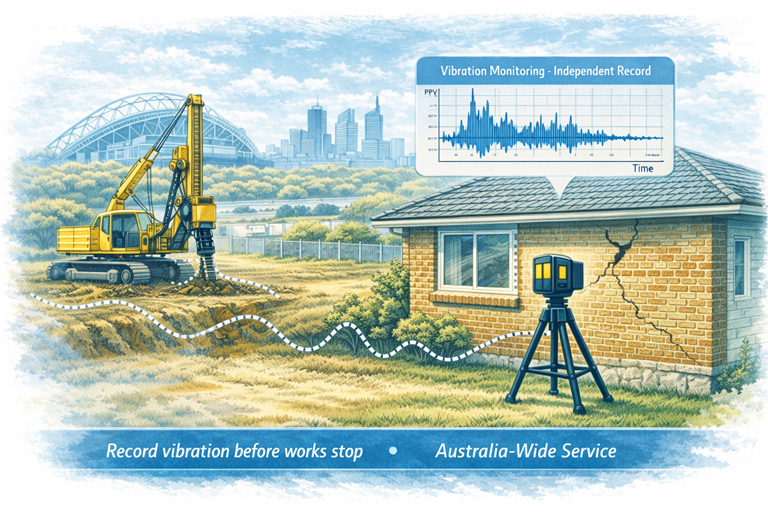
Residential home beside construction works with vibration monitor and recorded vibration graph

Construction activities such as piling, compaction, rock breaking, excavation and heavy vehicle movements can transmit ground vibration well beyond the worksite boundary.
Occupants commonly report rattling windows, shaking floors, or movement felt through walls and ceilings.

This understandably raises a serious concern:

Will this cause damage to my property — and if it does, how will it be proven?

In practice, many property damage disputes are not determined by what occupants experienced, but by what can be objectively demonstrated.
Without measurements taken during the works, it becomes extremely difficult to establish causation later.

Once the construction activity ceases, the opportunity to capture evidence is often permanently lost.
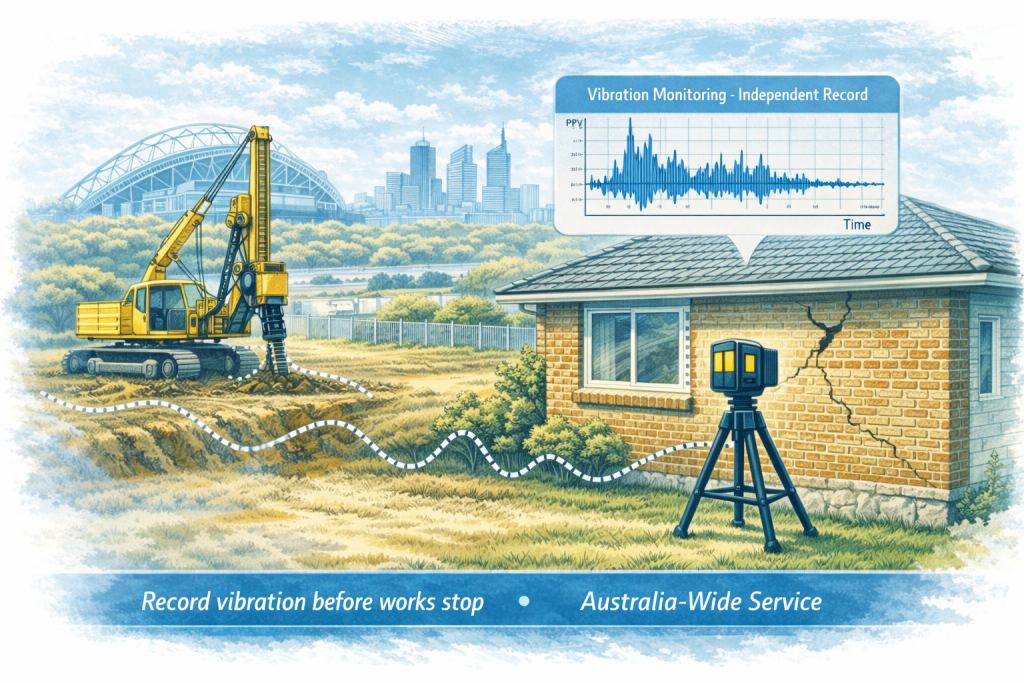

Construction piling rig near a house with cracks and a vibration monitoring device recording ground movement

Why early measurement matters

Vibration is temporary. Structural cracking is permanent.

If vibration is not recorded while it is occurring, later assessments rely heavily on assumption rather than data. In the absence of measured information, the following questions become difficult to answer:

  • Was vibration present at the property?
  • How intense was it?
  • How frequently did it occur?
  • Was it within accepted engineering criteria?
  • Could it reasonably have contributed to observed damage?

By contrast, monitoring performed during the works provides an independent record of actual site conditions at the time events occurred.


Perception vs structural risk

Human perception of vibration does not necessarily correlate with structural damage.

People can feel vibration levels well below those typically associated with building harm.
However, structural response depends on multiple variables:

  • soil type and ground transmission characteristics
  • distance to the works
  • construction methodology and equipment energy
  • building age and condition
  • prior movement or existing cracking
  • structural configuration and materials

Because of these factors, determining risk cannot be based on sensation alone.
It requires measurement and engineering interpretation.


Protecting your position

In many cases, concerns are only raised after visible cracking appears or after works have finished. At that stage, establishing responsibility becomes significantly more complex.

The practical question becomes:

If you do not document the conditions affecting your property while they are occurring — who will?

Contractors monitor works to manage their risk.
Property owners must also protect theirs.

Independent documentation obtained during construction provides a factual reference point for:

  • communication with neighbours or builders
  • engineering review
  • insurance discussion
  • legal or expert assessment if required

Hamilton By Design – independent vibration monitoring

Hamilton By Design provides independent vibration measurement and documentation for residential and commercial properties affected by nearby construction.

We travel across Australia to install monitoring equipment and record site conditions while works are underway.

Services may include:

  • installation of calibrated vibration monitoring equipment
  • event logging and trend review
  • engineering-grade documentation
  • guidance on next steps based on measured data
  • optional crack mapping or 3D capture where appropriate

Act while the works are active

The reliability of any later assessment depends on evidence captured during the period of activity.

Monitoring after the machinery leaves site cannot reconstruct past conditions — it can only speculate about them.

If construction is occurring near your property and you are concerned about potential damage, early documentation is the most effective way to protect your position.


Contact Hamilton By Design

If your home is experiencing vibration from nearby building activity, contact Hamilton By Design to record site conditions before the construction stops.

Hamilton By Design Co.
Engineering • Measurement • Documentation
Australia-wide service

Name
Would you like us to arrange a phone consultation for you?
Address

3D Laser Scanning Brisbane – From Site Capture to Engineering Outcomes

Engineering-grade laser scanning of Australian industrial and mining assets

3D Laser Scanning Brisbane | Site Capture to Engineering Outcomes

A Connected Workflow for Reliable Project Delivery

Most projects in Brisbane do not begin with empty space.
They begin with existing buildings, infrastructure and operating facilities.

Over time, equipment is replaced, services are rerouted and structures are modified. Drawings rarely keep pace with reality. When upgrades are designed from outdated information, installation conflicts and construction delays follow.

3D laser scanning allows project teams to start with measured conditions rather than assumptions.

Hamilton By Design provides a connected workflow — from site capture through to engineering modelling — supporting accurate design and predictable installation.


3D LiDAR scanning services across Australia for mining and industrial facilities

Step 1 — Capture the Real Conditions

Start with measured reality

The first step is collecting reliable site data using high-accuracy LiDAR scanning. This creates a spatial record of structures, services and equipment exactly as they exist.

3D Scanning Brisbane
https://www.hamiltonbydesign.com.au/laser-scanning-engineering-brisbane-cbd/3d-scanning-brisbane/

This process replaces manual measurement and reduces uncertainty before design begins.


Step 2 — Apply Engineering Understanding

Turn measurements into decisions

Scan data alone does not solve problems — interpretation does.
Engineering review ensures the captured data supports real project outcomes such as upgrades, replacements and modifications.

3D Scanning Engineering Brisbane
https://www.hamiltonbydesign.com.au/home/engineering-services/3d-laser-scanning/3d-scanning-engineering-brisbane/

This stage identifies constraints, access limitations and constructability issues before fabrication.


Step 3 — Develop Buildable Models

Create fabrication-ready information

Once verified, the measured conditions are converted into coordinated models used by designers, fabricators and contractors.

Scan to CAD Brisbane
https://www.hamiltonbydesign.com.au/scan-to-cad-brisbane/

Accurate models allow components to be designed to fit existing conditions rather than adjusted in the field.


Step 4 — Apply to Real Projects

Support upgrades and modifications

Reliable as-built information improves planning and installation across many sectors:

3D Scanning Services in Brisbane
https://www.hamiltonbydesign.com.au/laser-scanning-engineering-brisbane-cbd/3d-scanning-brisbane/3d-scanning-services-in-brisbane/

Typical applications include industrial upgrades, infrastructure changes and facility modifications.


Why a Connected Workflow Matters

Many project delays occur because measurement, modelling and engineering are treated as separate tasks. When they are integrated, problems are identified earlier and resolved more efficiently.

This approach helps:

  • reduce rework
  • shorten shutdown durations
  • improve installation certainty
  • support accurate fabrication

Instead of reacting to site conditions, projects are planned around them.


Hamilton By Design logo displayed on a blue tilted rectangle with a grey gradient background

Engineering Starts With Reliable Information

The quality of the final outcome depends on the quality of the starting data.
When existing conditions are known, design becomes predictable.

By linking site capture, modelling and engineering decisions, projects can move forward with confidence.

If your project depends on existing assets, accurate measurement is the first step toward reliable delivery.

Name
Would you like us to arrange a phone consultation for you?
Address

Onsite Scanning Australia Wide

3D laser scanning services in Australia for mining and infrastructure modelling

Engineering-grade 3D laser scanning, LiDAR and digital capture—delivered to site, anywhere in Australia.

When you’re working in a live facility, a remote site, or an aging asset that’s been modified a hundred times, the biggest risk is uncertainty. Missing dimensions. Out-of-date drawings. Unknown interferences. A “close enough” site measure that turns into rework, delays, and variations.

Hamilton By Design provides onsite scanning Australia wide to capture accurate, verifiable site conditions—so your engineers, designers, fabricators, and project managers can make confident decisions from day one.


LiDAR scanning survey across Australia with engineer capturing industrial site data

Why onsite scanning matters

Onsite scanning is the fastest way to convert real-world assets into reliable digital information—especially in brownfield and retrofit environments where original documentation is incomplete or incorrect.

Our field capture provides a precise baseline for:

  • As-built verification before upgrades, tie-ins, and shutdown works
  • Retrofit engineering for legacy plants and facilities
  • Clash detection and constructability checks before fabrication or installation
  • Digital engineering workflows (scan-to-model / scan-to-drawings)
  • Condition documentation for risk reduction, scope definition and handover records

In plain terms: the scan becomes the backbone of your project. If that backbone is broken (poor capture, gaps, or low confidence), everything downstream becomes harder—engineering, drafting, fabrication and installation.


Australia-wide coverage, site-ready delivery

We mobilise to projects across Australia—metro, regional and remote—bringing the scanning equipment, field workflow and practical site experience needed to operate safely and efficiently.

Typical deployment environments include:

  • Mining & resources (processing plants, conveyors, workshops, pump stations)
  • Industrial manufacturing (steel, smelting, production lines, utilities)
  • Infrastructure and utilities (water, wastewater, power, transport assets)
  • Commercial and government assets (plantrooms, services corridors, legacy buildings)
  • Marine and ship repair (fit-up checks, reverse engineering, space claims)

If your site is difficult to access, operational, or time-restricted (e.g., night works), we can plan around your constraints.


What we scan onsite

We support a wide range of scanning objectives, including:

As-built capture for engineering and design

Capture existing steelwork, pipework, structures, platforms, equipment skids, services, and building geometry—so design is based on reality, not assumptions.

Retrofit and brownfield modification support

Ideal for upgrades where the facility has changed over time and legacy drawings don’t match current conditions.

Fabrication and installation verification

Use scans to confirm fitment, alignment, clearances, and integration points before committing to fabrication or mobilisation.

Reverse engineering and metrology-style capture

Where components are undocumented, worn, or custom—scanning provides a measurement foundation for remanufacture or replacement design.


Deliverables that suit real projects

Every project is different, so we align deliverables to what your team actually needs.

Common outputs include:

  • Registered point clouds (for design coordination and record)
  • 2D CAD outputs (elevations, sections, plans where required)
  • 3D model-ready datasets to support engineering and drafting
  • Digital verification notes to support design sign-off and QA

If you’re not sure what deliverable is best, we’ll recommend a practical option based on your scope, schedule, and how the data will be used downstream.


How our onsite scanning service works

  1. Scope & goals – what needs to be captured, why, and what level of detail is required
  2. Site requirements – access windows, inductions, permits, traffic management, WAH/EWP needs
  3. Onsite scanning mobilisation – safe, efficient field capture with a plan to minimise disruption
  4. Processing & registration – structured datasets prepared for engineering use
  5. Delivery & support – files issued with clear naming, coordination notes, and handover guidance

Safety and site integration

We operate with a strong focus on safe field work, practical site coordination, and minimal disruption to operations. Where required, we can work alongside site teams to manage access, exclusion zones, and staged capture.


Why Hamilton By Design

We’re an engineering-led team. That matters—because onsite scanning isn’t just “collecting data.” It’s collecting the right data, at the right density, in the right areas, with a clear understanding of how the information will be used for design, verification, and construction.

If you need confidence in your existing conditions—we can help.


Hamilton By Design logo displayed on a blue tilted rectangle with a grey gradient background

Request onsite scanning Australia wide

If you have an upcoming retrofit, upgrade, verification, or design project and you need accurate site capture, get in touch.

Contact Hamilton By Design to discuss your site, your schedule, and the deliverables you need—anywhere in Australia.


Send us your site location, a brief scope, and any drawings/photos available, and we’ll advise the best scanning approach.

Name
Would you like us to arrange a phone consultation for you?
Address

Industrial LiDAR Scanning & Retrofit Engineering – Pittsburgh, Pennsylvania

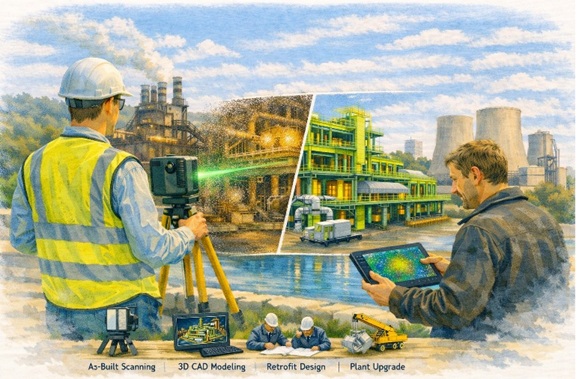
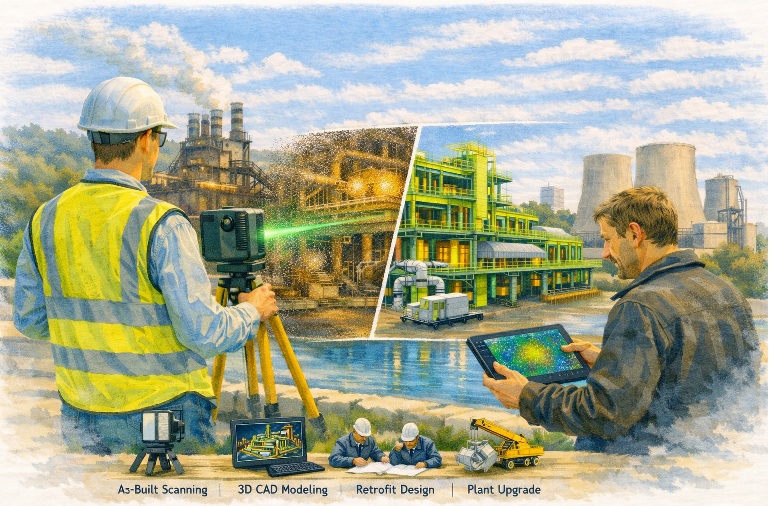
Industrial facility captured using 3D laser scanning for brownfield plant upgrade

Engineering Certainty in Legacy Industrial Facilities

Pittsburgh is not a new-build engineering market.

It is a modification market.

Steel mills, manufacturing plants, utilities and infrastructure in the Pittsburgh region have evolved over decades — often across multiple owners, upgrades and undocumented changes. As a result, existing drawings rarely represent real conditions.

Hamilton By Design supports engineering and project teams by capturing accurate as-built data before modification work begins.

Rather than designing around assumptions, projects are developed from measured reality.


Engineer performing industrial LiDAR scan of a processing plant for retrofit design

Why Retrofit Projects in Pittsburgh Require LiDAR Scanning

Legacy facilities typically contain:

  • undocumented plant changes
  • relocated equipment
  • structural distortion over time
  • incomplete or missing drawings
  • congested services and pipework

When upgrades are designed from outdated information, installation conflicts occur and shutdown durations increase.

High-accuracy LiDAR scanning captures millions of measurement points and creates a true digital representation of the operating facility, reducing rework and unexpected site conflicts.


Typical Pittsburgh Projects We Support

Steel & Heavy Manufacturing

  • equipment replacement
  • access platforms and walkways
  • structural refurbishment
  • plant safety upgrades

Utilities & Processing Facilities

  • pipe routing modifications
  • pump and tank replacement
  • tie-in engineering
  • maintenance shutdown planning

Industrial Infrastructure & Brownfield Sites

  • facility upgrades
  • expansion works
  • mechanical retrofits
  • reverse engineering of existing equipment

Hamilton By Design combines engineering knowledge with reality capture to reduce fabrication and installation risk on operating assets.


Our Engineering-Led Workflow

(See full process: Industrial Retrofit LiDAR Scanning)

1 — Site Capture

We collect high-density scan data without interrupting operations.

2 — Digital As-Built Model

Point clouds are converted into coordinated engineering models.

3 — Retrofit Design

Designs are developed directly from actual geometry.

4 — Fabrication & Installation Confidence

Projects install correctly the first time, reducing shutdown risk.

Engineering-grade scanning enables clash detection, brownfield integration and efficient shutdown planning.


What Problems This Solves

For retrofit projects the largest risk is dimensional uncertainty.

Our workflow removes:

  • field modification work
  • fabrication rework
  • installation clashes
  • extended shutdown durations

Hamilton By Design focuses on reducing engineering and fabrication risk on existing industrial assets using accurate scan data and mechanical design integration.


Engineering-Led, Not Survey-Led

Many providers deliver point clouds.

We deliver engineering decisions.

One team is responsible from measurement through to design support — ensuring the data collected is practical and usable for real construction outcomes.


Supporting Pittsburgh’s Ongoing Industrial Evolution

Regions like Pittsburgh continue to modernise existing infrastructure rather than replace it. Successful upgrades depend on understanding what is already built.

LiDAR scanning provides the digital foundation for safe modification, accurate fabrication and predictable installation.


Hamilton By Design logo displayed on a blue tilted rectangle with a grey gradient background

Talk to Hamilton By Design

If your project involves modifying an existing facility, engage scanning before design begins.

Design from reality — not assumption.


Name
Would you like us to arrange a phone consultation for you?
Address

LiDAR Scanning for Industrial Retrofit Engineering

Industrial facility captured using 3D laser scanning for brownfield plant upgrade

LiDAR Scanning for Industrial Retrofit Engineering | Brownfield Plant As-Built Capture

Steel Mills, Manufacturing Plants & Legacy Facility Upgrades

Across industrial regions such as Pittsburgh, Carnegie and Norristown, engineering teams are not scanning sites for mapping — they are scanning them because they are about to change something critical.

Brownfield facilities rarely match drawings.
Plant modifications fail when decisions are made from assumptions rather than measurements.

Hamilton By Design provides engineering-grade LiDAR scanning and modelling specifically for retrofit engineering — capturing existing assets so upgrades install correctly the first time.


Engineer performing industrial LiDAR scan of a processing plant for retrofit design

Why Industrial Facilities Require Scanning Before Design

In heavy industry the problem is rarely design capability — it is uncertainty of the existing plant.

Old facilities typically contain:

  • undocumented structural alterations
  • relocated services and pipework
  • equipment installed over decades
  • distorted steelwork
  • unavailable or unreliable drawings

When upgrades are designed from historical drawings, fabrication errors and shutdown overruns occur.

Our process replaces assumption with measured reality.

We capture what actually exists — then design from truth.

Hamilton By Design combines mechanical engineering with LiDAR capture to reduce fabrication and installation risk on operating assets.


Typical Projects Supported

Brownfield Industrial Plants

  • plant expansions
  • conveyor modifications
  • structural replacement
  • maintenance shutdown preparation

Steel Mills & Heavy Manufacturing

  • equipment replacement
  • platform and access upgrades
  • retrofit guarding & compliance
  • mechanical component redesign

Utilities & Processing Facilities

  • pipe routing development
  • pump and tank replacement
  • asset life-extension upgrades
  • tie-in engineering

These projects require accurate as-built conditions before design — not survey grade positioning, but engineering-grade dimensional certainty.


Our Retrofit Engineering Workflow

1. Field Capture — Engineering LiDAR Scanning

We capture operating facilities without interrupting production and obtain full spatial reality of structures, equipment and services.

2. Digital As-Built Model

Point cloud data is converted into coordinated 3D engineering models for decision-making and clash prevention.

3. Mechanical & Structural Design

Designs are developed directly from measured geometry rather than historic drawings.

4. Fabrication-Ready Deliverables

We provide models and drawings suitable for fabrication and installation.

This approach allows components to fit existing plant conditions on installation rather than being adjusted in the field.


What This Solves

Industrial retrofit projects fail due to dimensional unknowns — not poor engineering.

LiDAR-driven design removes:

  • shutdown delays
  • rework fabrication
  • on-site modifications
  • installation conflicts
  • access clashes

Hamilton By Design supports manufacturing, processing and heavy industry with accurate as-built data and coordinated models for upgrades, maintenance and asset life-extension projects.


Engineering-Led Scanning — Not Just Surveying

Many scanning providers supply point clouds.

We provide engineering decisions.

The difference is accountability — one team responsible from measurement to design.

One team accountable from scan to fabrication.


When to Engage Us

Engage scanning early when a project involves:

  • replacing equipment
  • modifying structure
  • adding services
  • shutdown installation
  • upgrading legacy facilities

If fabrication depends on existing conditions, scanning should precede design — not follow it.


Hamilton By Design logo displayed on a blue tilted rectangle with a grey gradient background

Talk to Hamilton By Design

Hamilton By Design delivers engineering-grade LiDAR scanning and retrofit design support for operating industrial assets worldwide.

Reduce installation risk.
Design from measured reality.

Name
Would you like us to arrange a phone consultation for you?
Address
Name
Would you like us to arrange a phone consultation for you?
Address

Identifying Fastener Threads in the Field

Metric vs American vs British Threads — and the Australian Standards That Govern Them

In maintenance workshops and brownfield sites, one of the most common hidden problems is not bolt strength — it is thread identification.

Equipment imported from the USA, Europe and the UK often ends up assembled together on Australian sites.
The bolts may look identical.
They may even screw together.

But they are not interchangeable.

Incorrect thread matching damages load capacity, prevents correct preload, and leads to loosening, fatigue cracking and eventual failure.

This guide explains the major fastening thread systems encountered in Australia (excluding pipe threads), how to recognise them, and the Australian Standards that apply.


1. The Three Fastener Thread Systems

There are three main fastening thread families encountered in mechanical and structural equipment:

SystemOriginThread AngleTypical Location
Metric ISOAustralia / Europe / modern equipment60°Most modern machinery
Unified (UNC/UNF)USA60°Mining & imported plant
Whitworth (BSW/BSF/BA)UK / older Commonwealth55°Older equipment & legacy machinery

Even though UNC and Metric share a 60° angle, the pitch is different — therefore they are not compatible.

Whitworth threads are particularly problematic because they will partially screw into metric or UNC holes before binding.


2. Metric Threads (ISO Metric — Australian Standard Fasteners)

These are the primary fastening threads used in Australia.

(Coarse pitch series)

SizeMajor DiameterPitchMinor Diameter (approx)
M66.0 mm1.04.8 mm
M88.0 mm1.256.5 mm
M1010.0 mm1.58.2 mm
M1212.0 mm1.759.9 mm
M1616.0 mm2.013.8 mm
M2020.0 mm2.517.3 mm
M2424.0 mm3.020.8 mm

Fine pitch versions also exist for vibration and adjustment applications.

Typical Uses

  • Structural steel connections
  • Machinery assembly
  • Guards and access platforms
  • General engineering

3. Unified American Threads (UNC / UNF)

Common on imported mining and mobile equipment.

UNC – Coarse

SizeMajor DiameterPitch
1/4-206.35 mm1.27 mm
3/8-169.53 mm1.59 mm
1/2-1312.70 mm1.95 mm
3/4-1019.05 mm2.54 mm
1-825.40 mm3.18 mm

UNF – Fine

Used where vibration resistance is required.

Key Characteristic
UNC bolts will often start threading into metric holes but will not achieve correct preload.


4. British Threads (Whitworth Form)

Recognised by their 55° thread angle.

BSW – Coarse

SizeMajor DiameterPitch
1/4 BSW6.35 mm1.34 mm
3/8 BSW9.53 mm1.59 mm
1/2 BSW12.70 mm2.12 mm
3/4 BSW19.05 mm2.54 mm

BSF – Fine

Used historically in machinery.

BA Threads

Small instrumentation and electrical fasteners.

Typical Location

  • Pre-1980 plant
  • UK imported machinery
  • Electrical equipment

Why Incorrect Thread Matching Causes Failures

Threads do not primarily carry shear load — they generate preload.

If pitch or angle differs:

  • preload is reduced
  • flank contact is uneven
  • joint loosens under vibration
  • fatigue cracking begins

Many failures blamed on vibration are actually incorrect thread engagement.


Field Identification Tips

ObservationLikely Thread
Marked M12Metric
Fraction size (1/2, 3/4)UNC/UNF or Whitworth
Smooth but tight engagementWrong pitch
Binds after 2 turnsWhitworth vs Metric

Thread gauge confirmation is always recommended.


Australian Standards Relating to Fastener Threads

Metric Thread Geometry

AS 1721 — General purpose metric screw threads
AS 1275 — Metric screw threads for fasteners

Fastener Product Standards

AS 1110 — Metric hex bolts and screws
AS 1111 — Commercial hex bolts and screws
AS 1112 — Hexagon nuts
AS 1420 — Socket head cap screws

Mechanical Properties

AS/NZS 4291.1 — Mechanical properties of bolts, screws and studs
AS/NZS 4291.2 — Mechanical properties of nuts
ISO 898-1 / ISO 898-2 — Adopted strength properties
ISO 3506 — Stainless steel fasteners

Structural Bolting

AS/NZS 1252 — High strength structural bolting assemblies
AS 4100 — Steel structures design
AS/NZS 5131 — Fabrication and erection of structural steel

Coatings and Fit Allowances

AS/NZS 1214 — Galvanised coatings on threaded fasteners
AS/NZS 4680 — Hot dip galvanising
AS 2312.2 — Corrosion protection guide
AS 1897 — Electroplated coatings

Name
Would you like us to arrange a phone consultation for you?
Address