


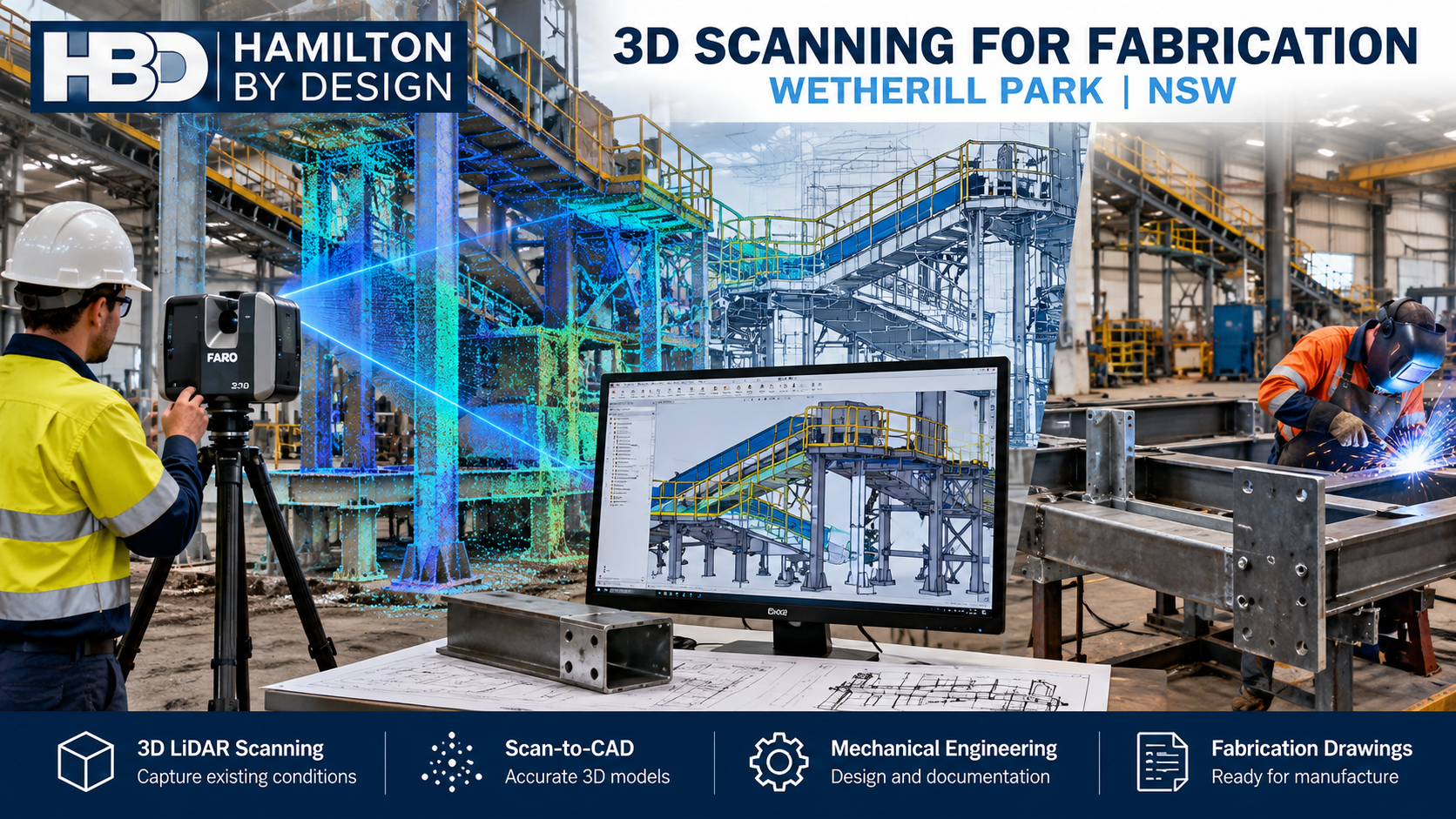
Precision 3D LiDAR Scanning, Scan-to-CAD and Mechanical Engineering for Industrial Fabrication
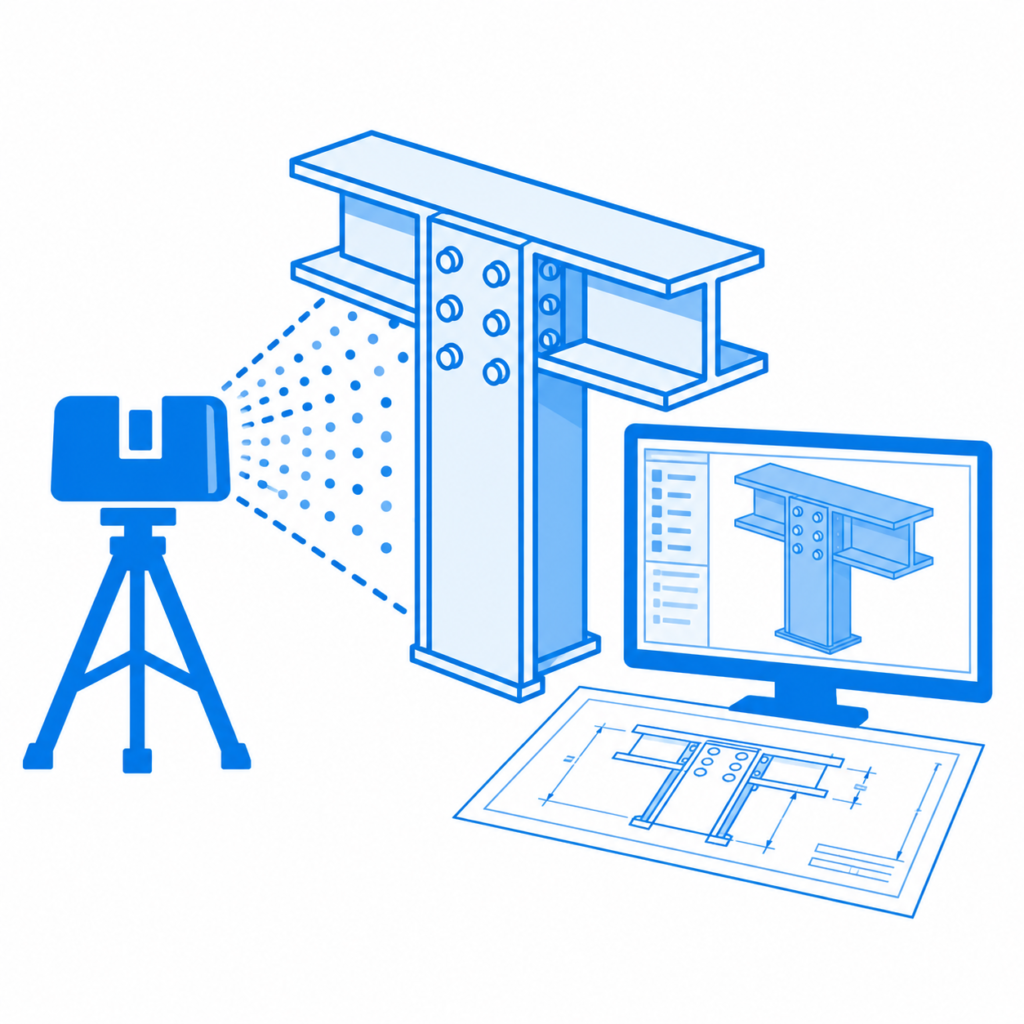
Hamilton By Design provides professional 3D scanning for fabrication in Wetherill Park, NSW, supporting mechanical engineering contractors, steel fabricators, manufacturers and industrial maintenance teams with accurate digital measurements of existing machinery, structures and industrial facilities.
Our engineering-led approach combines 3D LiDAR scanning, point cloud processing, 3D CAD modelling and fabrication drawings to support the manufacture and installation of new equipment, replacement components and structural modifications.
For fabrication projects involving existing equipment or structures, accurate site measurements are essential. Traditional tape measurements and manual surveys can be time-consuming, particularly where complex geometry, restricted access or multiple connection points are involved.
Using advanced 3D scanning technology, Hamilton By Design captures existing site geometry and converts it into engineering information that can be used for design, fabrication and installation planning.
Why Use 3D Scanning for Fabrication?
Fabrication projects frequently require new components to fit accurately within existing industrial environments.
This can involve connecting new steelwork to existing structures, modifying conveyor systems, replacing worn equipment or installing pipework around operational machinery.
Without reliable measurements, fabrication contractors risk manufacturing components that require modification during installation.
3D scanning for fabrication helps reduce these risks by capturing the existing geometry before manufacturing begins.
Our services support:
- Structural steel fabrication and modifications
- Conveyor systems, transfer chutes and hoppers
- Industrial pipework and mechanical services
- Machinery modifications and equipment replacement
- Access platforms, stairs and maintenance structures
- Industrial plant upgrades and equipment relocation
- Fabrication fit-up and installation verification
- Reverse engineering of existing mechanical components
The resulting point cloud provides a detailed spatial reference for engineering design and fabrication planning.
3D LiDAR Scanning for Structural Steel Fabrication
Industrial facilities throughout Wetherill Park contain structural steel frameworks supporting manufacturing equipment, conveyor systems, pipework and access structures.
When new steelwork must connect to existing infrastructure, accurate measurement of connection points and surrounding obstructions is critical.
Hamilton By Design uses terrestrial 3D LiDAR scanning to capture existing structural arrangements, including:
- Steel columns, beams and cross members
- Bracing and structural support arrangements
- Base plates and accessible connection locations
- Existing platforms and access structures
- Equipment clearances and surrounding obstructions
- Relevant floor levels and structural reference points
The registered point cloud can then be used to develop 3D CAD models and engineering drawings for proposed modifications.
This approach is particularly valuable when designing fabricated assemblies that must fit into existing industrial facilities with limited opportunities for modification during installation.
Scan-to-CAD for Fabrication and Manufacturing
Capturing a point cloud is only the first stage of an engineering-led scanning project.
Hamilton By Design provides scan-to-CAD modelling services, converting captured geometry into usable engineering models for design development.
Depending on project requirements, we can develop simplified or detailed models of existing structures, machinery and mechanical equipment.
Our CAD services include:
- SolidWorks 3D mechanical modelling
- Autodesk Inventor modelling
- AutoCAD 2D engineering drawings
- STEP and Parasolid model exports
- General arrangement drawings
- Fabrication and assembly drawings
- Reverse-engineered component models
- Engineering design modifications
Rather than relying solely on raw point cloud information, fabrication contractors can work with CAD models that identify critical dimensions, interfaces and installation constraints.
The level of modelling detail is established according to the intended fabrication application.
3D Scanning for Conveyor and Chute Fabrication
Conveyor systems, transfer chutes and material handling equipment frequently require modifications as production requirements change.
Existing equipment may have undergone numerous alterations over its operational life, meaning original engineering drawings no longer accurately represent the installed arrangement.
Hamilton By Design provides 3D scanning services for conveyor and chute fabrication projects, capturing existing geometry to support engineering modifications.
Typical applications include:
- Conveyor transfer chute replacement
- Hopper and bin modifications
- Conveyor support structure alterations
- Replacement wear liners and fabricated components
- Conveyor transition arrangements
- Mechanical equipment installation
- Material handling plant upgrades
The point cloud can be used to establish the spatial relationship between existing equipment and proposed fabricated assemblies.
This helps designers identify potential clashes and develop installation arrangements before components are manufactured.
Industrial Pipework Scanning and Fabrication
Industrial pipework modifications often involve connecting new fabricated pipe spools to existing systems.
In operational manufacturing facilities, existing pipe routes may pass through congested areas containing structural steel, machinery, cable trays and other services.
Our 3D LiDAR scanning services capture the surrounding environment to assist with pipework routing and fabrication planning.
Applications include:
- Existing pipework route measurement
- Pipe support and bracket design
- Flange and connection location assessment
- Replacement pipe spool planning
- Pump and equipment connection modifications
- Clash detection for proposed pipework
- Development of pipework general arrangement drawings
Where greater dimensional precision is required for individual connections, supplementary close-range measurements or metrology scanning may be undertaken.
This combined approach supports the development of practical fabrication information based on existing site conditions.
Reverse Engineering for Fabrication
Not all fabrication projects begin with existing engineering drawings.
In many manufacturing facilities, equipment has been operating for decades, and original design information may be unavailable or incomplete.
Hamilton By Design provides reverse engineering services to recreate mechanical components and fabricated assemblies from existing physical equipment.
Using terrestrial LiDAR scanning and close-range 3D scanning equipment, we can capture geometry and develop new CAD models for engineering assessment and manufacturing.
Reverse engineering applications include:
- Replacement fabricated assemblies
- Machinery guards and enclosures
- Mechanical support brackets
- Equipment frames and mounting arrangements
- Industrial covers and fabricated housings
- Legacy machinery modifications
- Components requiring design improvements
Our mechanical engineering background allows us to consider not only the measured geometry but also the intended function, assembly arrangement and manufacturing requirements.
From 3D Scanning to Fabrication Drawings
Hamilton By Design can support the complete engineering documentation process, from initial site scanning through to fabrication-ready drawings.
Stage 1 – Site Inspection and 3D Data Capture
We assess the required geometry, existing equipment, access conditions and proposed fabrication interfaces.
Using suitable 3D scanning equipment, we capture the relevant site conditions.
Stage 2 – Point Cloud Registration and Processing
Individual scans are registered into a coordinated point cloud representing the captured industrial environment.
The data is reviewed for alignment, coverage and suitability for the intended engineering application.
Stage 3 – 3D CAD Modelling
The point cloud is used to develop 3D CAD geometry representing existing equipment, structures and critical interfaces.
Stage 4 – Mechanical Engineering and Fabrication Design
Where required, we develop proposed modifications, new assemblies or replacement components using engineering design software.
Stage 5 – Fabrication Drawings and Deliverables
Final deliverables may include:
- PDF general arrangement drawings
- Detailed fabrication drawings
- SolidWorks and Inventor models
- STEP and Parasolid files
- Registered E57 point clouds
- Autodesk ReCap-compatible point cloud files
- Assembly and installation drawings
Deliverables are agreed upon according to the project scope and the fabrication contractor’s requirements.
Reducing Fabrication Rework Through Accurate Site Data
One of the main benefits of 3D scanning for fabrication is the opportunity to identify dimensional and spatial issues before fabrication begins.
Traditional site measurement methods may not capture every obstruction, structural offset or equipment alignment issue.
A registered point cloud provides a detailed visual and measurable reference of the existing environment.
This can help project teams:
- Reduce repeat site visits
- Identify installation obstructions
- Improve coordination between designers and fabricators
- Check proposed equipment clearances
- Reduce avoidable workshop modifications
- Plan fabrication and installation sequences
- Improve communication between engineering and construction teams
However, the accuracy required for fabrication depends on the specific component and its connection details.
Critical bolt patterns, machined interfaces and tight-tolerance components may require supplementary measurements or higher-precision scanning.
Supporting Wetherill Park and Western Sydney Industry
Wetherill Park is an established industrial and manufacturing precinct in Western Sydney, with businesses involved in metal fabrication, mechanical engineering, warehousing, equipment maintenance and industrial production.
Hamilton By Design provides engineering-led 3D scanning services for businesses operating throughout Wetherill Park and surrounding industrial areas, including:
- Smithfield
- Yennora
- Fairfield
- Prospect
- Eastern Creek
- Erskine Park
- St Marys
- Seven Hills
- Blacktown
- Ingleburn
Our services are suited to fabrication contractors, industrial maintenance providers, machinery manufacturers and engineering project teams requiring reliable dimensional information.
We can provide either the registered point cloud for use by your existing engineering team or undertake the additional CAD modelling, mechanical design and fabrication drawing development.
Why Choose Hamilton By Design?
Hamilton By Design combines practical mechanical engineering experience with professional 3D scanning technology.
Our capabilities include:
Engineering-led scanning: 3D data capture undertaken with an understanding of mechanical design, fabrication and installation requirements.
Industrial experience: Experience across manufacturing, mining, material handling, structural steel, machinery and mechanical equipment.
Integrated CAD capability: Point cloud processing, SolidWorks modelling, reverse engineering and fabrication drawing development.
Flexible deliverables: Registered point clouds, CAD models and engineering drawings suitable for integration into existing project workflows.
Practical fabrication focus: Attention to connection details, installation clearances, equipment interfaces and manufacturing requirements.
Our objective is to provide engineering information that assists fabrication contractors in manufacturing components that can be installed efficiently within existing facilities.
Frequently Asked Questions
Can 3D scanning be used to create fabrication drawings?
Yes. Registered point cloud data can be used to develop 3D CAD models and fabrication drawings. The scanning and modelling scope must capture the critical dimensions and interfaces required for manufacturing.
How accurate is 3D LiDAR scanning for fabrication?
Accuracy depends on the scanner, measurement distance, scanning conditions and registration process. Our FARO Focus S70 provides millimetre-level measurement capability under suitable conditions. Where fabrication requires tighter tolerances, supplementary metrology scanning or direct measurement may be necessary.
Can you scan existing machinery without dismantling it?
In many cases, yes. External machinery geometry can be captured without dismantling the equipment, provided the required surfaces are visible and accessible. Hidden components and obstructed areas may require additional access or measurement methods.
Can you provide SolidWorks models from 3D scans?
Yes. We can develop SolidWorks CAD models from registered point clouds and other measured geometry. The required modelling detail depends on whether the models are intended for layout planning, reverse engineering, mechanical design or fabrication.
Can 3D scanning help with structural steel modifications?
Yes. 3D scanning can capture existing structural steel arrangements and support the design of new connections, brackets, beams and supporting structures. Critical fabrication interfaces may require additional dimensional verification.
Do you provide point cloud files without CAD modelling?
Yes. We can provide registered point clouds in formats such as E57 and Autodesk ReCap-compatible files for use by your own engineering or fabrication team.
Can you design the components as well as scan the site?
Yes. Hamilton By Design provides mechanical engineering design, 3D CAD modelling and engineering drawing services, allowing us to support projects from initial scanning through to fabrication documentation.
What information do you need to quote a fabrication scanning project?
A brief description of the proposed modification, site photographs, approximate equipment dimensions and the required final deliverables are generally sufficient to begin assessing the project. We may recommend a site inspection where access, geometry or fabrication requirements are uncertain.
3D Scanning for Fabrication in Wetherill Park – Contact Hamilton By Design
If your business is planning a structural steel modification, machinery upgrade, conveyor alteration or industrial fabrication project in Wetherill Park, Hamilton By Design can assist with accurate 3D measurement and engineering documentation.
We provide 3D LiDAR scanning, scan-to-CAD modelling, mechanical engineering design and fabrication drawings to help your team plan and manufacture components based on reliable site information.
Whether you require a registered point cloud or complete engineering design and fabrication documentation, contact Hamilton By Design to discuss your project requirements.

Contact Us – Talk To Us
Our clients:

























Hamilton By Design – 3D Scanning and Mechanical Engineering