


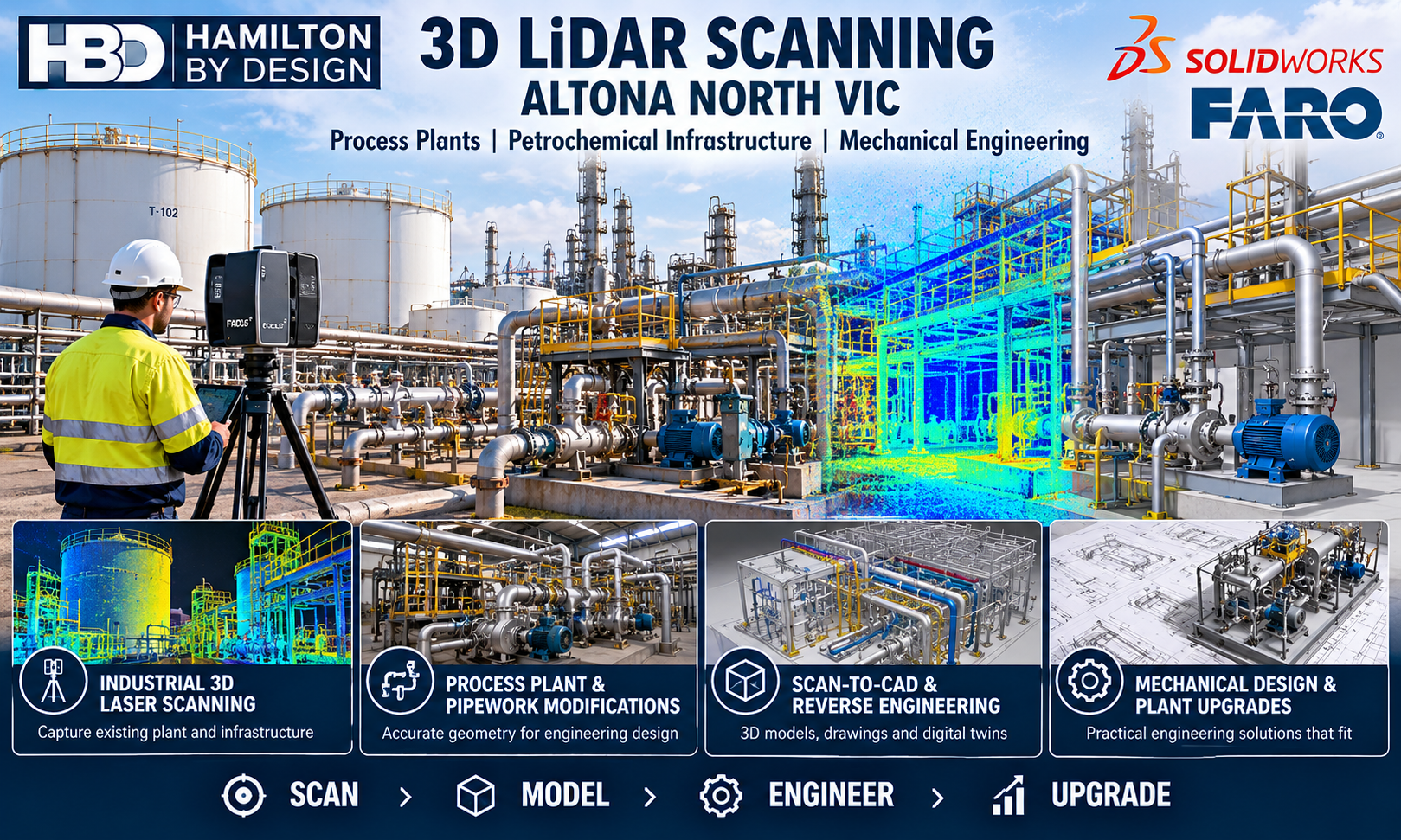
Industrial 3D Laser Scanning | Process Plant Upgrades | Scan-to-CAD | Mechanical Design | As-Built Documentation
3D LiDAR Scanning and Mechanical Engineering in Altona North, Melbourne

Hamilton By Design provides professional 3D LiDAR scanning, reverse engineering, 3D CAD modelling and mechanical engineering services for industrial facilities in Altona North, Victoria.
Altona North and the surrounding western Melbourne industrial corridor have a long history of petrochemical processing, fuel storage, manufacturing, engineering and port-related industrial operations.
These facilities often contain complex arrangements of pipework, pumps, storage tanks, structural steelwork, mechanical equipment and industrial services that have undergone numerous modifications throughout their operating lives.
Accurate documentation of existing conditions is essential when planning plant upgrades, equipment replacement, maintenance projects and industrial redevelopment.
Hamilton By Design combines 3D laser scanning with practical mechanical engineering to help industrial operators understand their existing facilities and develop solutions that fit.
Supporting Altona North’s Changing Industrial Landscape
Altona North is undergoing significant industrial transformation.
The former Mobil Altona refinery has transitioned from fuel refining to fuel import, storage and distribution operations. This transformation includes the reuse of existing infrastructure, equipment upgrades and the decommissioning of redundant process facilities.
Across the broader Altona industrial precinct, established manufacturing and petrochemical operations coexist with logistics facilities, industrial redevelopment and new infrastructure investment.
These activities create potential applications for 3D LiDAR scanning, including:
- Existing plant and equipment surveys
- Fuel storage and transfer infrastructure documentation
- Pump and pipework replacement projects
- Industrial plant decommissioning and redevelopment
- Mechanical equipment installation and relocation
- Process plant modifications and shutdown planning
- Structural steelwork and access platform upgrades
- Conveyor and material handling system modifications
By capturing existing conditions before engineering work begins, project teams can reduce uncertainty and identify potential installation conflicts before fabrication.
3D LiDAR Scanning for Process Plants and Petrochemical Infrastructure
Industrial process facilities contain interconnected equipment and services that can be difficult to measure using conventional methods.
Hamilton By Design uses terrestrial 3D LiDAR scanning to capture the geometry of existing facilities and develop registered point cloud datasets suitable for engineering and design applications.
Typical scanning applications include:
Pipework and Pumping Systems
Capture existing pipe routes, flange positions, pump arrangements, valve locations and equipment clearances to support pipework modifications and replacement projects.
Storage Tanks and Associated Infrastructure
Document accessible tank exteriors, surrounding pipework, supports, platforms and mechanical equipment to assist with planning and engineering.
Process Equipment and Machinery
Capture the physical arrangement of vessels, pumps, compressors, mechanical drives and production equipment for modification or replacement.
Industrial Structures and Access Systems
Develop as-built geometry of structural steelwork, platforms, walkways, ladders and equipment supports to assist with mechanical upgrades and access improvements.
Brownfield Plant Modifications
Combine existing plant geometry with proposed 3D CAD models to evaluate installation clearances, maintenance access and potential clashes.
Plant Upgrades – Making New Equipment Fit Existing Facilities
One of the most valuable applications of 3D LiDAR scanning is ensuring new equipment fits within an existing industrial plant.
Equipment manufacturers may provide accurate 3D models of new machinery, but the surrounding plant may have limited or outdated drawings.
Hamilton By Design can capture the existing installation area and incorporate proposed equipment models into the point cloud environment.
This allows project teams to review:
- Machinery footprints and installation clearances
- Pipework and ductwork interfaces
- Conveyor entry and discharge arrangements
- Maintenance and operational access
- Existing support structures
- Potential interference with surrounding equipment
- Fabrication and installation requirements
The objective is straightforward: new machines that fit, new pipework that fits and plant upgrades that can be installed with fewer unexpected modifications.
Scan-to-CAD and Reverse Engineering
Hamilton By Design converts captured point cloud information into engineering models and drawings using established CAD platforms.
Depending on the project, deliverables may include:
- Registered 3D point cloud datasets
- Autodesk ReCap-compatible point clouds
- SolidWorks 3D mechanical models
- Existing-condition plant layouts
- General arrangement drawings
- Mechanical fabrication drawings
- Equipment installation layouts
- STEP, DXF and other agreed CAD exchange formats
- Navisworks-compatible coordination models
These deliverables can support engineering design, fabrication, contractor coordination and future asset modifications.
Industrial Shutdowns, Maintenance and Brownfield Projects
Shutdown periods often provide limited opportunities to access operational equipment and collect dimensional information.
3D LiDAR scanning can capture large quantities of spatial information during a planned site visit, allowing subsequent modelling and design work to be undertaken away from the operating plant.
Applications include pump replacements, pipework rerouting, equipment support modifications, access improvements and preparation of fabrication drawings.
Where permitted by site conditions and access requirements, scanning can also support future engineering work by retaining a digital record of existing plant geometry.
For fuel terminals, petrochemical installations and other hazardous facilities, scanning activities must be planned around site-specific access restrictions, hazardous-area requirements and operational controls.
Mechanical Engineering and Fabrication Support
Hamilton By Design provides more than point cloud capture.
As a mechanical engineering business, we can use the captured geometry to develop practical design solutions for existing industrial facilities.
Our services include:
- Mechanical equipment design and modifications
- Pump skids and equipment support arrangements
- Conveyor and chute modifications
- Pipework layouts and mechanical interfaces
- Machinery guarding
- Access and maintenance improvements
- Reverse engineering of existing components
- 3D modelling and fabrication documentation
- Engineering support for installation planning
Our approach connects the physical plant with the engineering design process.
Scan → Model → Engineer → Upgrade
Servicing Altona North and Melbourne’s Western Industrial Corridor
Hamilton By Design provides project-based industrial 3D scanning and mechanical engineering services for Altona North and surrounding industrial areas, including:
Altona, Laverton North, Brooklyn, Sunshine West, Tottenham, Derrimut, Truganina, Williamstown North, West Footscray and Port Melbourne.
We support industrial operators, engineering contractors, maintenance teams, fabrication businesses and equipment manufacturers requiring reliable existing-condition information for mechanical engineering projects.
Why Choose Hamilton By Design?
Hamilton By Design combines hands-on industrial experience with 3D LiDAR scanning and mechanical engineering capabilities.
Our services are particularly suited to existing industrial facilities where equipment layouts are complex, access is restricted and accurate dimensional information is needed before modifications can be designed.
We understand the importance of developing practical engineering solutions that consider installation, fabrication, maintenance access and existing plant constraints.
Rather than providing scanning data alone, we can assist clients through the broader process of converting site measurements into useful engineering deliverables.
Frequently Asked Questions
Can 3D LiDAR scanning be used for existing petrochemical facilities?
Yes. Subject to site safety and equipment suitability requirements, 3D LiDAR scanning can document accessible plant geometry, including pipework, equipment, structures and storage infrastructure.
Can you develop SolidWorks models from a point cloud?
Yes. Hamilton By Design can use point cloud information to develop SolidWorks models of existing mechanical equipment, plant layouts and supporting structures.
Can 3D scanning help with new equipment installation?
Yes. Existing plant geometry can be combined with proposed equipment models to assess available space, installation clearances and potential clashes before fabrication or installation.
Can you scan an operating industrial facility?
Scanning may be undertaken in operating facilities where site access, operational conditions and safety requirements permit. Hazardous areas require specific assessment before equipment is introduced.
Do you provide fabrication drawings?
Yes. Hamilton By Design can develop mechanical general arrangement and fabrication drawings from surveyed conditions and approved engineering designs.
Do you service Altona North from interstate?
Yes. Hamilton By Design undertakes project-based scanning and mechanical engineering assignments across Australia, including Victoria.
Discuss Your Altona North 3D LiDAR Scanning Project
Planning a process plant modification, pipework upgrade, equipment replacement or industrial redevelopment project in Altona North?
Hamilton By Design can assist with 3D LiDAR scanning, existing-condition modelling, mechanical engineering and fabrication documentation.

Contact Us – Talk To Us
Our clients:

























Hamilton By Design – 3D LiDAR Scanning & Mechanical Engineering
Accurate existing-condition information for practical industrial engineering solutions.