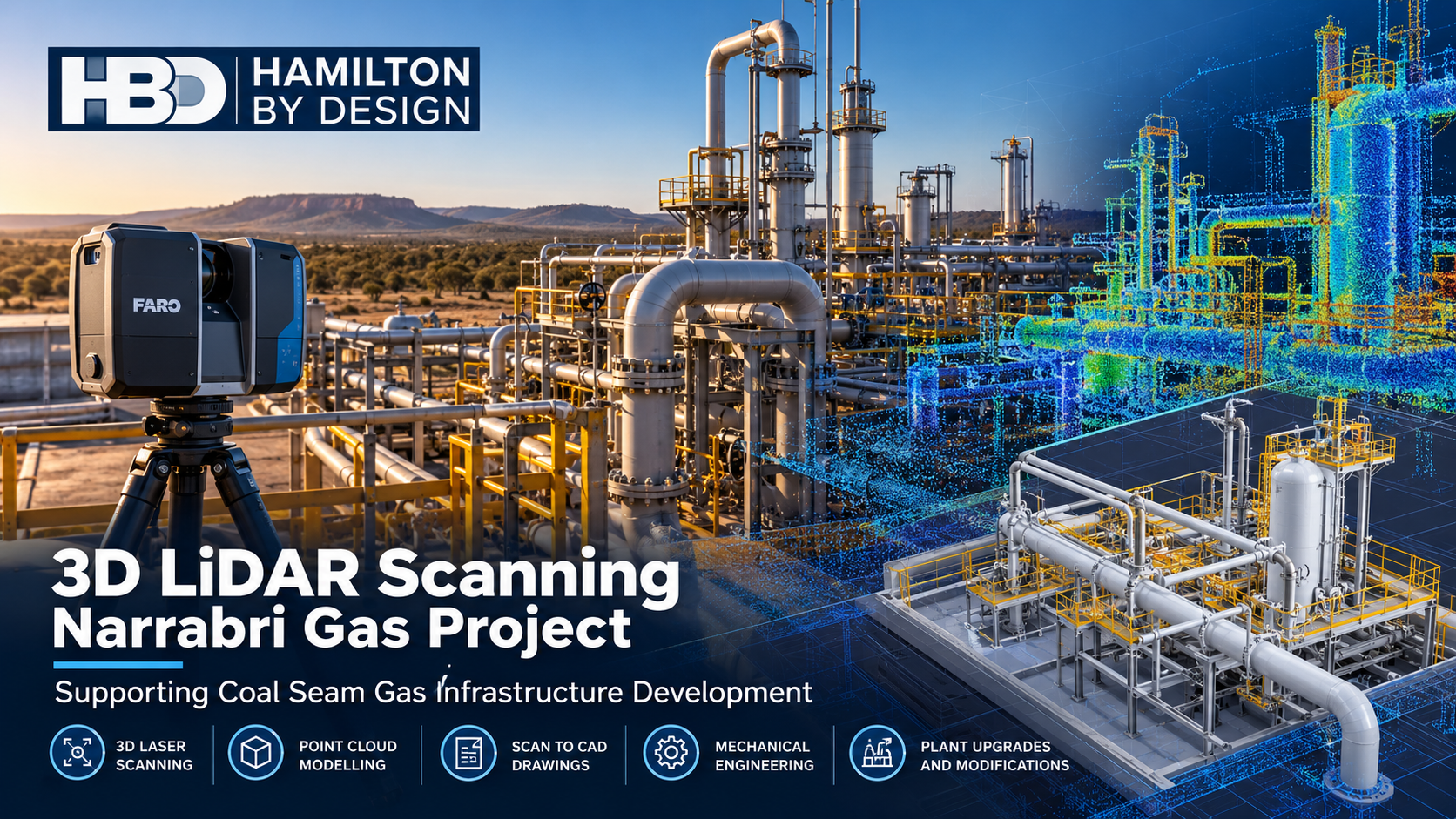
3D Laser Scanning | Mechanical Engineering | Gas Infrastructure | Scan-to-CAD | Narrabri NSW
Supporting Coal Seam Gas Infrastructure Development in Narrabri, NSW
The Narrabri Gas Project, located in the Pilliga region of north-western New South Wales, represents a significant proposed development within Australia’s onshore natural gas industry.
Operated by Santos, the project involves the development of coal seam gas resources and associated infrastructure to support natural gas supply.
The planning, construction, operation and maintenance of gas infrastructure require accurate spatial information, coordinated engineering design and reliable equipment interfaces.

Hamilton By Design provides 3D LiDAR scanning, mechanical engineering, 3D modelling and scan-to-CAD services to support industrial infrastructure projects across regional New South Wales and Australia.
Our services can assist engineering contractors, equipment suppliers and infrastructure developers working on projects such as the Narrabri Gas Project.
By capturing existing site conditions and converting point cloud information into practical engineering models, we help reduce dimensional uncertainty, improve design coordination and minimise the risk of costly fabrication and installation errors.
Why 3D LiDAR Scanning Matters for Coal Seam Gas Infrastructure
Coal seam gas developments can involve geographically distributed infrastructure, including gas gathering networks, processing facilities, compression equipment, pipework, pumps, access platforms and associated mechanical systems.
As infrastructure develops, accurate information about equipment locations, pipework connections and available space becomes increasingly important.
Traditional site measurements may not capture the full complexity of an industrial installation, particularly where multiple contractors are responsible for different engineering packages.
3D LiDAR scanning provides a detailed digital representation of accessible infrastructure and surrounding conditions.
This information can be used to support:
- Existing-condition surveys before engineering design
- Pipework routing and mechanical equipment installation
- Compressor and pump skid modifications
- Structural and mechanical interface coordination
- Equipment replacement and upgrade planning
- Fabrication drawing development
- Maintenance access and equipment clearance assessments
- Construction planning and installation verification
For the Narrabri region, these capabilities can assist both new infrastructure development and future operational modifications.
1. 3D LiDAR Scanning for Gas Processing Facilities
Gas processing and treatment facilities can contain closely spaced equipment, pipework, valves, support structures and maintenance access areas.
Accurate measurement of these installations is essential when designing new equipment or modifying existing systems.
Hamilton By Design uses terrestrial 3D laser scanning to capture accessible industrial environments and produce registered point cloud datasets.
These datasets can provide engineers and contractors with a digital reference for equipment positions, elevations, clearances and surrounding infrastructure.
Potential applications include:
- Gas treatment equipment layouts
- Pipework and valve station surveys
- Compressor station equipment arrangements
- Mechanical equipment foundations and interfaces
- Access platforms and maintenance walkways
- Existing equipment replacement
- Brownfield plant modification planning
Using point cloud information during design can help identify spatial conflicts before equipment reaches the construction site.
2. Scan-to-CAD for Gas Infrastructure Engineering
Collecting point cloud data is only the first stage of an effective engineering workflow.
The information must be converted into usable engineering geometry to support design decisions, fabrication and construction.
Hamilton By Design provides scan-to-CAD services using software including SolidWorks, AutoCAD, Autodesk ReCap and Navisworks.
Depending on project requirements, deliverables can include:
- Registered 3D point clouds
- 3D mechanical equipment models
- Pipework routing models
- General arrangement drawings
- Equipment interface drawings
- Fabrication and installation drawings
- STEP and Parasolid files
- Navisworks-compatible coordination models
This approach allows engineers to develop modifications around actual site geometry rather than relying entirely on historical drawings.
For coal seam gas infrastructure, scan-to-CAD can be particularly valuable when connecting new mechanical systems to existing equipment.
3. Pipework Routing and Mechanical Interface Verification
Pipework installation can present significant challenges when connection points, equipment positions and available clearances are not accurately established.
Small dimensional discrepancies can create substantial installation problems, particularly where prefabricated pipe spools must connect to fixed equipment.
Hamilton By Design can assist with 3D modelling and mechanical design to assess proposed pipework routes against captured site conditions.
Applications may include:
- Gas gathering and process pipework interfaces
- Compressor suction and discharge pipework
- Pump and utility pipework
- Pipe support arrangements
- Valve access and maintenance clearances
- Pipe spool interface verification
- Mechanical equipment connection points
A coordinated 3D model can help establish whether proposed pipework fits within the available space before fabrication begins.
Where required, additional engineering analysis can be undertaken to assess mechanical loads, supports and equipment interfaces.
Pressure containment design, hazardous-area requirements and statutory approvals must be addressed by appropriately qualified specialists.
4. Mechanical Engineering for Compressor and Pump Installations
Coal seam gas infrastructure may require mechanical equipment such as compressors, pumps, filtration systems and associated support arrangements.
Installing or modifying these systems requires careful consideration of equipment geometry, maintenance access and mechanical interfaces.
Hamilton By Design provides mechanical design and drafting services for industrial equipment installations.
Potential services include:
- Compressor and pump skid layouts
- Equipment support frames
- Baseplate and mounting arrangements
- Mechanical equipment guarding
- Maintenance access provisions
- Equipment replacement studies
- Mechanical component reverse engineering
- General arrangement and fabrication drawings
Our mechanical engineering approach combines site measurement, 3D modelling and practical fabrication considerations.
The objective is to develop solutions that can be manufactured, transported, installed and maintained with reduced uncertainty.
5. Reducing Construction and Installation Risk
One of the greatest challenges in industrial construction is discovering dimensional conflicts after equipment has already been fabricated.
Incorrect assumptions about existing infrastructure can lead to:
- Pipe spools requiring modification
- Equipment mounting holes failing to align
- Insufficient maintenance access
- Interference between new and existing services
- Additional site welding or fabrication
- Construction delays and rework
- Increased project costs
3D LiDAR scanning can reduce these risks by providing a more complete record of accessible existing conditions.
For infrastructure developments around Narrabri, early scanning and model coordination can assist engineering teams in identifying potential conflicts before fabrication or installation.
The objective is straightforward: measure the existing conditions, model the proposed installation and verify the fit before construction.
6. Digital Engineering and Point Cloud Coordination
Large infrastructure developments often involve several engineering disciplines and contractors working from different design information.
Maintaining consistency between these information sources is important for effective project delivery.
Hamilton By Design can support digital engineering workflows through registered point clouds, 3D mechanical models and coordinated drawing packages.
These datasets can be incorporated into broader engineering and construction models to assist with:
- Multidisciplinary design reviews
- Mechanical equipment coordination
- Construction sequencing
- Spatial clash identification
- Maintenance planning
- Asset modification studies
- Digital asset documentation
Point cloud information also provides a valuable baseline for future engineering work.
As infrastructure changes, updated surveys can be compared with previous datasets to support ongoing asset management.
7. Supporting Brownfield Modifications and Future Maintenance
Although new infrastructure development receives significant attention, long-term asset performance also depends on maintenance, equipment replacement and plant upgrades.
Industrial facilities commonly undergo modifications throughout their operating lives.
Equipment may be replaced, pipework altered, access platforms modified or new mechanical systems introduced.
These activities benefit from accurate records of existing conditions.
Hamilton By Design can assist maintenance and engineering teams by capturing accessible equipment geometry and developing models for proposed modifications.
This is particularly useful when historical drawings are incomplete, outdated or inconsistent with the installed equipment.
By combining 3D scanning with mechanical engineering, we help bridge the gap between site conditions and practical design deliverables.
8. Supporting Engineering Contractors Across the Narrabri Region
Hamilton By Design provides project-based engineering and 3D scanning services across New South Wales, including regional and remote industrial locations.
For the Narrabri Gas Project and surrounding infrastructure developments, our services may be relevant to:
- Engineering, procurement and construction contractors
- Mechanical installation contractors
- Gas infrastructure developers
- Pipework fabrication companies
- Compressor and pump equipment suppliers
- Industrial maintenance providers
- Mechanical engineering consultancies
- Asset owners and operators
Our involvement can range from a targeted site scanning assignment to a complete scan-to-CAD and mechanical design package.
We can also work alongside existing engineering teams to provide supplementary modelling, drafting and dimensional verification support.
9. Our 3D Scanning and Engineering Workflow
Hamilton By Design follows a practical workflow that connects site measurement with engineering deliverables.
Stage 1 – Define the Scope
Establish the equipment, structures or infrastructure requiring measurement, including the intended engineering use of the data.
Stage 2 – Capture Existing Conditions
Undertake 3D LiDAR scanning of accessible infrastructure using suitable survey positions and site controls.
Stage 3 – Register and Process the Point Cloud
Combine scan positions into a coordinated dataset and review coverage, registration quality and relevant dimensional limitations.
Stage 4 – Develop the 3D Engineering Model
Convert relevant point cloud information into mechanical equipment models, pipework geometry or general arrangement models.
Stage 5 – Review Proposed Modifications
Assess equipment positions, connection interfaces, access clearances and potential spatial conflicts.
Stage 6 – Prepare Engineering Deliverables
Produce agreed 3D models, drawings and coordination files for design review, fabrication planning or construction.
This integrated approach supports more informed engineering decisions and reduces dependence on assumptions about existing infrastructure.
10. Why Choose Hamilton By Design?
Hamilton By Design combines practical mechanical engineering experience with 3D laser scanning and digital modelling capabilities.
Our services are particularly suited to industrial environments where accurate dimensional information is essential for equipment modification and installation.
Our capabilities include:
- FARO terrestrial 3D laser scanning
- Point cloud registration and processing
- SolidWorks mechanical modelling
- AutoCAD engineering drafting
- Scan-to-CAD and reverse engineering
- Mechanical equipment and skid design
- Pipework routing and interface modelling
- Fabrication and general arrangement drawings
- Navisworks model coordination
- Mechanical engineering support for industrial upgrades
By integrating scanning and mechanical design, we provide a practical connection between physical infrastructure and engineering documentation.
Frequently Asked Questions
Can 3D LiDAR scanning support coal seam gas infrastructure development?
Yes. 3D LiDAR scanning can capture existing equipment, structures and accessible pipework to support engineering design, installation planning and dimensional verification. It is particularly useful where new equipment must connect to existing infrastructure.
Can Hamilton By Design scan compressor stations and gas processing facilities?
Hamilton By Design can undertake 3D scanning of suitable industrial infrastructure, subject to site access, safety requirements and equipment suitability. Hazardous-area classification and operating conditions must be assessed before scanning.
Can point clouds be converted into SolidWorks models?
Yes. Hamilton By Design can use registered point cloud information to develop SolidWorks models of mechanical equipment, supports, pipework and other relevant infrastructure.
Can 3D scanning help reduce pipework installation problems?
Yes. Accurate scanning can help establish connection positions, available clearances and equipment interfaces before pipe spools are fabricated. This can reduce dimensional uncertainty and the risk of installation rework.
Does Hamilton By Design provide mechanical engineering services as well as scanning?
Yes. Services include mechanical equipment design, 3D modelling, reverse engineering, general arrangement drawings and fabrication documentation.
Can Hamilton By Design work with engineering contractors in Narrabri?
Yes. Hamilton By Design provides project-based engineering and scanning services throughout regional New South Wales, subject to scope, scheduling and site requirements.
What files can be supplied following a 3D scanning project?
Depending on project requirements, deliverables may include E57, RCP and LAS point cloud files, SolidWorks models, STEP files, Parasolid files, DXF drawings and PDF engineering documentation.
Is Hamilton By Design involved directly in the Narrabri Gas Project?
This page describes services potentially relevant to the Narrabri Gas Project and similar gas infrastructure developments. It does not represent a claim of an existing contract or project appointment with Santos.
3D LiDAR Scanning and Mechanical Engineering – Narrabri NSW
Accurate existing-condition information can make a significant difference to the successful delivery of mechanical equipment installations and infrastructure modifications.
For engineering contractors and infrastructure developers involved in coal seam gas facilities around Narrabri, Hamilton By Design offers a combination of 3D LiDAR scanning, scan-to-CAD and mechanical engineering services.
Whether the requirement involves a compressor skid, pipework interface, equipment replacement or a wider plant survey, our approach focuses on providing reliable geometry and practical engineering deliverables.
Reduce installation uncertainty. Improve engineering coordination. Verify equipment fit before fabrication.
Contact Hamilton By Design
Discuss your 3D scanning, mechanical engineering or infrastructure modelling requirements.
Website: https://www.hamiltonbydesign.com.au/
Service area: Narrabri, Pilliga, north-western NSW and regional Australia.
Hamilton By Design is an independent engineering services provider. References to the Narrabri Gas Project and Santos are for industry and location context only and do not imply an existing commercial relationship, endorsement or project appointment.
Contact Us – Talk To Us
Our clients: