


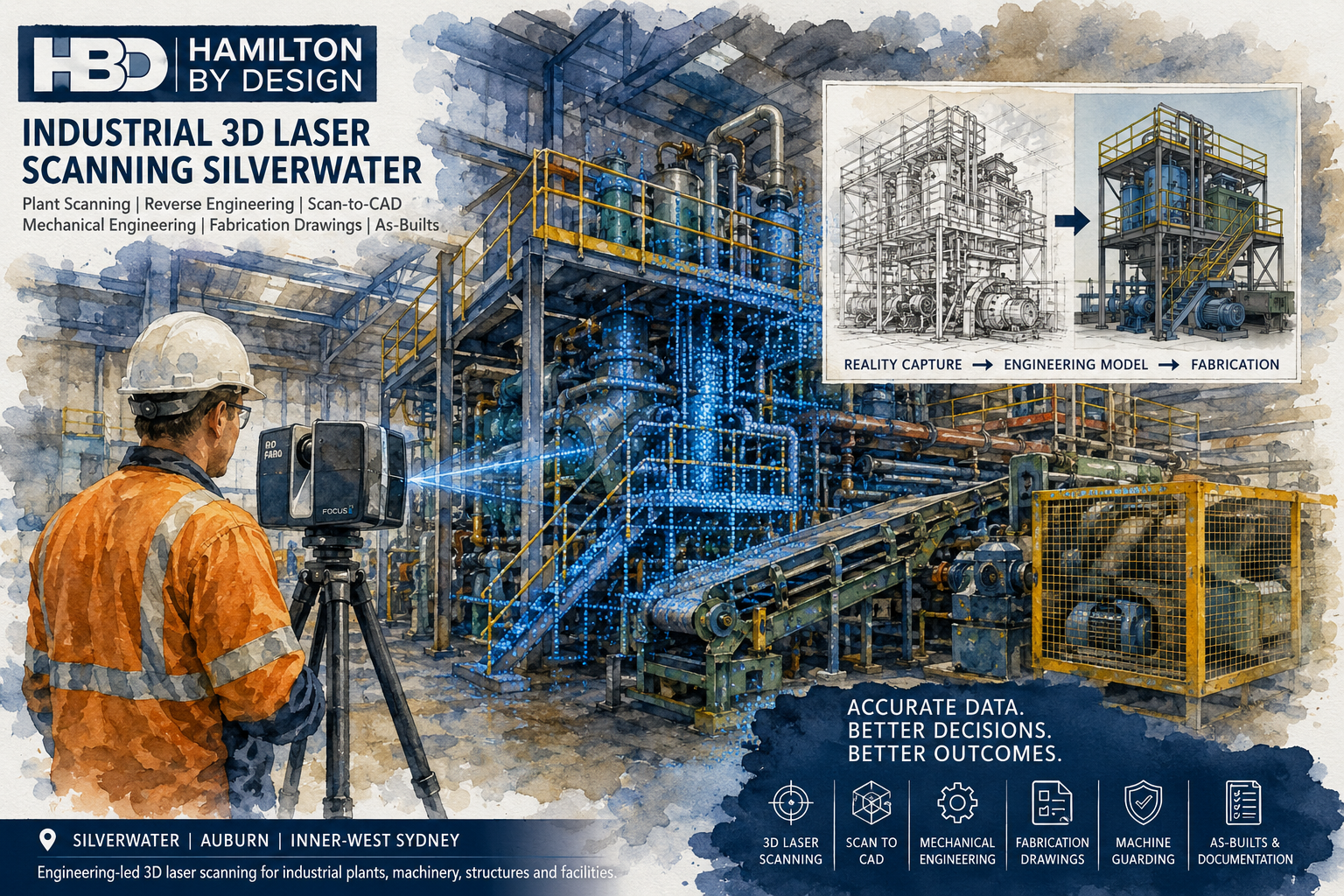

Silverwater and Auburn form one of Sydney’s established industrial corridors, supporting manufacturing, food and process operations, machinery, fabrication, warehousing, logistics and distribution facilities. Many of these sites have evolved progressively over years or decades, with machinery replaced, production lines altered, pipework rerouted, platforms added and buildings adapted to suit changing operational requirements.
For engineers and maintenance teams, this creates a common problem: the drawings available for an industrial facility may no longer accurately represent what exists on site.
Hamilton By Design provides industrial 3D laser scanning in Silverwater and Auburn to capture existing plant conditions and convert that information into practical engineering data. Through 3D laser scanning for industrial plants, point-cloud processing, mechanical engineering, Scan-to-CAD modelling and fabrication documentation, we can help businesses reduce uncertainty before modifying existing equipment or installing new plant.
The objective is not simply to create a point cloud. It is to capture the existing plant accurately enough to support better engineering decisions.
The Biggest Problem: Existing Drawings Do Not Always Match Existing Plant
One of the greatest challenges in a mature industrial facility is determining exactly what has been built.
A factory may have original construction drawings and equipment drawings, but years of maintenance and production changes can mean those documents no longer represent the current arrangement.
Changes might include:
- machinery relocated from its original position;
- new conveyors or processing equipment installed;
- additional structural steel or platforms;
- pipework and ducting rerouted around new equipment;
- guarding modified during maintenance;
- services added without corresponding drawing revisions; or
- obsolete equipment replaced with machinery of different dimensions.
When a new project begins, engineers may therefore be designing against information that is incomplete or incorrect.
For brownfield work, Hamilton By Design can use engineering-grade 3D laser scanning to establish the actual geometry of the plant before detailed engineering begins.
This can substantially reduce the risk of discovering dimensional problems only after fabrication or during installation.
What Is Industrial 3D Laser Scanning?
3D laser scanning uses LiDAR technology to capture millions of spatial measurements from the surrounding environment. These measurements form a three-dimensional point cloud representing the visible geometry of the facility.
Within an industrial plant, this can include:
- machinery;
- conveyors;
- structural steel;
- columns and beams;
- access platforms;
- stairs and handrails;
- tanks and vessels;
- pipework;
- ducting;
- floor levels;
- walls and roof structures;
- electrical and mechanical services; and
- surrounding equipment that may affect a proposed installation.
Unlike taking individual tape or laser measurements, a terrestrial scan captures the relationship between many different objects at the same time.
This becomes particularly useful when working inside congested manufacturing facilities where a proposed machine, conveyor or fabricated assembly must pass through several existing interfaces.
Hamilton By Design provides 3D laser scanning for engineering projects where the scan data is collected with the intended engineering outcome in mind.
Plant Modifications in Silverwater and Auburn
Plant modifications are one of the strongest applications for industrial scanning.
Consider a manufacturer preparing to install a replacement production machine.
The machine itself may have accurate manufacturer drawings. However, the surrounding factory could contain columns, cable trays, pipework, existing machinery, guarding, walkways and building structures that are not accurately documented.
The critical question becomes:
Will the new equipment actually fit?
A 3D scan can establish the existing environment before the new installation is finalised. Proposed equipment can then be incorporated into a 3D engineering model to assess position, access and interfaces.
Hamilton By Design can support this process through mechanical engineering services, combining existing-condition capture with practical mechanical design.
This approach can be applied to:
- machinery replacements;
- production-line modifications;
- conveyor extensions;
- equipment relocations;
- process plant upgrades;
- access modifications;
- platforms and support steel;
- pipework changes; and
- shutdown projects.
Reverse Engineering Auburn Industrial Equipment
Industrial businesses also regularly operate machinery for which usable CAD models or manufacturing drawings are no longer available.
The original equipment manufacturer may no longer exist, replacement parts may have long lead times, or the machine may have been modified significantly during its service life.
In these situations, Hamilton By Design can provide reverse engineering using 3D scanning.
Reverse engineering is more than copying geometry.
The process may involve capturing an existing component or assembly, establishing its important dimensions and interfaces, interpreting how the component functions and developing engineering CAD suitable for its intended purpose.
Applications can include:
- obsolete machinery;
- replacement components;
- fabricated assemblies;
- guards and covers;
- chutes and hoppers;
- structural frames;
- machine bases;
- equipment interfaces; and
- existing plant where original drawings are unavailable.
For Auburn and Silverwater manufacturers, this provides a practical pathway between an existing physical asset and a new engineering model.
Scan-to-CAD Silverwater
A point cloud is an extremely useful record, but many engineering and fabrication projects ultimately require CAD.
Hamilton By Design can convert selected scan information into usable engineering geometry through its 3D CAD modelling and mechanical drafting services.
The amount of modelling required depends on the project.
It is not always necessary to model an entire factory.
For example, if a new machine is being installed, the relevant CAD model might only require:
- floor and foundation geometry;
- nearby columns;
- existing machinery;
- overhead obstructions;
- pipework affecting the installation;
- maintenance access;
- surrounding structural steel; and
- critical connection points.
This targeted Scan-to-CAD approach can provide the engineering team with the information required without unnecessarily modelling unrelated areas of the facility.
Potential deliverables can include:
- SolidWorks models;
- STEP or SAT models;
- AutoCAD DWG files;
- DXF profiles;
- general arrangement drawings;
- equipment layouts;
- fabrication drawings;
- as-built drawings; and
- point-cloud datasets such as E57, RCP or RCS.
Mechanical Drafting and Fabrication Drawings
The real value of industrial scanning often becomes apparent when captured site data is carried through into fabrication.
Once the existing plant geometry is understood, Hamilton By Design can develop the proposed modification using mechanical drafting and 3D CAD.
Depending on the scope, documentation may include:
- general arrangement drawings;
- assembly drawings;
- individual part drawings;
- fabrication details;
- bills of materials;
- cutting lists;
- DXF plate profiles;
- installation information; and
- CAD exchange files for fabrication.
This creates a relatively direct engineering workflow:
Existing plant → 3D scan → point cloud → engineering model → fabrication drawings → manufacture → installation
The benefit is that the fabricated equipment can be designed around measured site conditions rather than assumptions derived from outdated information.
Machine Guarding and Existing Machinery
Silverwater and Auburn contain numerous operating manufacturing and processing facilities where older machinery may also require modifications to guarding, access or maintenance arrangements.
Guarding design can be difficult where machinery has irregular geometry or where available space is constrained by surrounding equipment.
3D scanning can capture the machinery and its immediate environment, giving engineers a reliable geometric reference before developing new guarding.
Hamilton By Design provides machine guarding engineering and verification that can complement the scanning and mechanical-design workflow.
Scanning may assist with establishing:
- machine geometry;
- existing guarding arrangements;
- surrounding access constraints;
- conveyor interfaces;
- structural attachment locations; and
- space available for new guarding.
The resulting information can then support development of practical guarding arrangements that consider fabrication, installation, operation and maintenance.
As-Built Documentation for Mature Industrial Facilities
Not every scanning project relates to a new machine.
Some businesses simply need to establish what they currently own.
Where a plant has undergone numerous undocumented modifications, 3D scanning can provide a detailed existing-condition dataset from which updated as-built information can be generated.
This may be valuable for:
- future capital projects;
- maintenance planning;
- shutdown preparation;
- asset management;
- equipment relocation;
- engineering studies;
- facility layouts; and
- tender documentation.
An accurate point cloud can also allow engineers to return to the captured environment digitally to obtain additional measurements without automatically requiring another site visit.
Reducing Shutdown and Installation Risk
Industrial shutdowns can involve significant production pressures.
A dimensional problem discovered during installation may result in fabricated components being modified on site, additional welding or cutting, delayed crane operations or interference with other shutdown activities.
3D scanning cannot eliminate every project risk, but it can reduce one important source of uncertainty: the geometry of the existing plant.
Hamilton By Design’s approach to engineering-led industrial 3D laser scanning connects reality capture with the engineering work that follows.
Instead of treating scanning as an isolated survey, the scan can become the geometric foundation for design, drafting, fabrication and installation planning.
Why Use an Engineering-Led Scanning Service?
The question when planning a scan should not only be:
“What can we scan?”
A more useful question is:
“What engineering decision will this scan help us make?”
If the final requirement is a replacement component, fabrication assembly, plant layout or equipment modification, understanding that outcome before scanning can influence what should be captured and at what level of detail.
Hamilton By Design combines industrial scanning with mechanical engineering, reverse engineering and CAD documentation so that reality capture forms part of a wider project workflow.
For businesses in Silverwater and Auburn, that can mean one engineering pathway from the existing plant through to fabrication-ready documentation.
Industrial 3D Laser Scanning Silverwater and Auburn
Whether the requirement is to install new machinery, reverse engineer existing equipment, document an industrial facility or produce fabrication drawings for a brownfield modification, accurate existing-condition information provides a stronger starting point.
Hamilton By Design can assist with:
- 3D laser scanning Silverwater
- industrial plant scanning Auburn
- reverse engineering Auburn
- mechanical engineering Silverwater
- Scan-to-CAD Silverwater
- plant modifications;
- equipment layouts;
- machine guarding;
- mechanical drafting;
- fabrication drawings; and
- industrial as-built documentation.
For projects where the existing drawings cannot be trusted, engineering-grade 3D scanning provides a practical way to replace assumptions with measured information.
Frequently Asked Questions
What is industrial 3D laser scanning?
Industrial 3D laser scanning uses LiDAR equipment to capture millions of measurements from machinery, buildings, structures and surrounding plant. These measurements create a three-dimensional point cloud that can be used for measurement, engineering design, Scan-to-CAD and as-built documentation.
Can Hamilton By Design scan an operating factory in Silverwater?
Yes. Industrial scanning can often be undertaken within operating manufacturing and processing environments, subject to site access, safety requirements and the specific project scope. The scanning strategy can be developed around the equipment and areas relevant to the engineering project.
Can 3D scanning help when our existing drawings are inaccurate?
Yes. This is one of the principal applications of industrial scanning. The point cloud records the visible existing condition of the plant, allowing engineering work to be based on measured geometry rather than relying exclusively on historical drawings.
Can you reverse engineer machinery in Auburn from a 3D scan?
Yes, depending on the equipment, component size and required accuracy. Hamilton By Design can combine 3D scanning with reverse engineering and CAD modelling to develop usable engineering information for obsolete machinery, replacement components and modified equipment.
What is Scan-to-CAD?
Scan-to-CAD is the process of using point-cloud data as the geometric basis for creating CAD models or drawings. Depending on the project, this could include SolidWorks models, equipment layouts, AutoCAD drawings, fabrication drawings or as-built documentation.
Do you need to model the entire factory?
No. The required level of modelling should suit the engineering problem. For many plant modifications, only the machinery, structures and interfaces surrounding the proposed work need to be converted into CAD.
Can scanning be used before installing new machinery?
Yes. Existing machinery, columns, structures, services and access constraints can be captured and compared with the proposed equipment layout. This can help identify potential spatial conflicts before equipment arrives on site.
Can Hamilton By Design produce fabrication drawings after scanning?
Yes. Where included in the engineering scope, scan information can be developed into mechanical CAD models, general arrangements, assemblies, detail drawings, BOMs and DXF profiles suitable for fabrication.
Can 3D scanning assist with machine guarding?
Yes. Scanning can establish the geometry of existing machinery and the surrounding environment before new guarding is designed. This is particularly useful where existing machinery has complex geometry or limited available space.
What files can be supplied following industrial scanning?
Depending on project requirements, deliverables can include point-cloud formats such as E57, RCP or RCS together with CAD outputs including DWG, DXF, STEP, SAT, Parasolid, SolidWorks models and PDF engineering drawings.
Who uses industrial 3D laser scanning in Silverwater and Auburn?
Typical users include manufacturers, food and process facilities, machinery builders, engineering contractors, maintenance teams, fabricators, project engineers, facility managers and businesses undertaking brownfield plant modifications.
How do I discuss a Silverwater or Auburn scanning project?
The best starting point is to provide Hamilton By Design with a brief description of the equipment or facility, the problem being solved, photographs where available and an indication of the required engineering deliverable. From there, the scanning and engineering scope can be developed around the project outcome.

Contact Us – Talk To Us
Our clients:











Mechanical Engineering Services
Plant upgrades, machinery modifications, equipment integration and practical mechanical engineering support.
View Service →3D Laser Scanning & Reality Capture
Accurate existing-condition data where drawings are missing, outdated or unreliable.
View Service →Reverse Engineering
Obsolete or undocumented equipment can be reconstructed, modified or reproduced.
View Service →Scan-to-CAD / Point Cloud to CAD
Point-cloud information can be converted into usable CAD models and engineering drawings.
View Service →CAD Design & 3D Modelling
Concepts, sketches or scan data can be developed into detailed manufacturable 3D models.
View Service →Finite Element Analysis – FEA
Stress, deflection, fatigue, buckling, vibration and structural performance can be assessed.
View Service →Machine Guarding Design & Verification
Machinery and conveyor guarding can be designed, modified or engineering-reviewed.
View Service →Manufacturing & Production Engineering
Production lines and machinery can be integrated, modified or upgraded with minimal disruption.
View Service →Secondment Engineering Services
Additional engineering capacity for shutdowns, projects, site work or temporary vacancies.
View Service →Mechanical Drafting
Workshop-ready drawings for manufacturing, installation or plant modification.
View Service →Australian Design Drafting Services
Mechanical, structural and industrial drafting support for engineering and fabrication projects.
View Service →Construction Vibration Monitoring
Independent vibration measurement and documentation near buildings and infrastructure.
View Service →