

Why 3D Modelling Must Be Governed
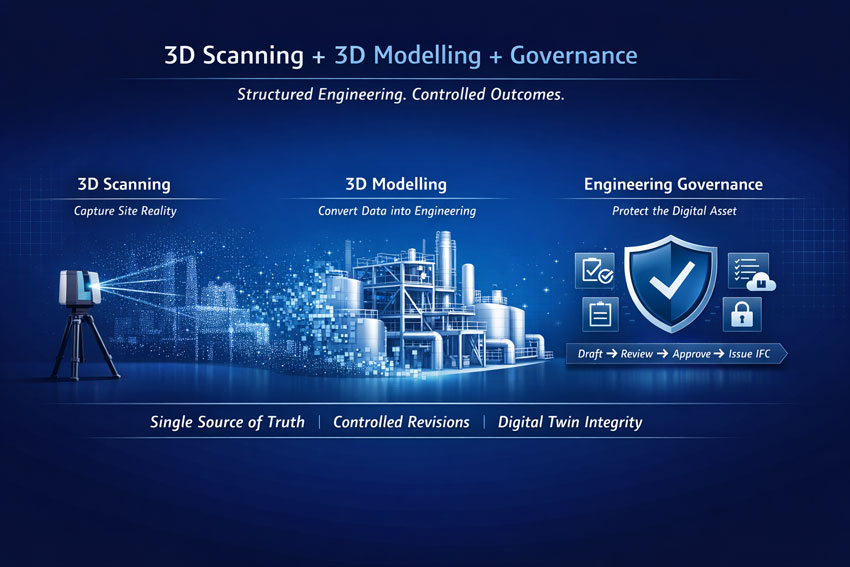
3D scanning captures reality.
3D modelling interprets reality.
Engineering governance protects reality.
In industrial environments, capturing a site with LiDAR is only the beginning. The real value is unlocked when scan data is structured, validated, controlled and maintained within a governed engineering framework.
At Hamilton By Design, we integrate 3D scanning, 3D modelling and engineering governance into a single structured workflow — ensuring your digital environment becomes a reliable operational asset.
3D Scanning: Capturing the Truth
3D laser scanning creates an accurate representation of existing conditions. In brownfield facilities, this is critical.
It allows organisations to:
- Understand spatial constraints
- Identify clashes before construction
- Reduce rework
- Improve shutdown planning
- Establish a baseline for upgrades
However, raw scan data alone does not provide governance.
It provides information — not control.
3D Modelling: Turning Data into Usable Engineering
Once scanning is complete, modelling converts point clouds into structured engineering models.
This includes:
- Parametric plant models
- Equipment layouts
- Structural frameworks
- Pipe and services modelling
- As-built verification
But modelling without revision discipline can quickly become fragmented.
If models are updated without control, version tracking is lost. If contractors modify geometry without approval workflows, digital twins become unreliable.
This is where governance becomes essential.
Engineering Governance: Protecting the Digital Asset
Engineering governance ensures that:
- Scan-derived models follow structured revision control
- Contractors work within defined digital environments
- Updates are traceable and auditable
- Digital twins reflect site-approved configurations
- Brownfield upgrades do not corrupt master models
Without governance, a digital twin becomes a static snapshot.
With governance, it becomes operational infrastructure.
Why Governance Matters in Brownfield Environments
Live industrial facilities are complex and constantly evolving.
Multiple contractors.
Compressed shutdown windows.
Legacy drawings.
Unrecorded historical modifications.
In these environments, uncontrolled digital updates introduce risk.
Governance provides:
- Role-based access control
- Structured approval workflows
- Defined issue status (IFR / IFA / IFC)
- Change logs and audit trails
- Platform-based collaboration
It prevents the common scenario where fabricated equipment arrives on site — only to discover it was built to an outdated model or incorrect drawing revision.
Integrated with the 3DEXPERIENCE Platform
To ensure structured digital continuity, Hamilton By Design aligns scanning and modelling workflows within governed digital environments such as the 3DEXPERIENCE Platform:
https://www.3ds.com/3dexperience/
When properly configured, the platform supports:
- Controlled document lifecycles
- Revision management
- Collaborative review environments
- Secure cloud access
- Single source of truth governance
The technology is powerful.
The governance framework ensures it delivers.
The Structured Workflow
Hamilton By Design delivers a disciplined process:
- 3D Scan — Capture accurate site conditions
- Model Development — Convert data into structured engineering models
- Governance Framework — Apply revision control and document lifecycle management
- Platform Integration — Align within controlled digital environments
- Ongoing Control — Maintain digital twin integrity during upgrades
This transforms 3D data into a governed engineering asset.
More Than Scanning. Structured Engineering Control.
Many providers can scan.
Many can model.
Few provide structured engineering governance across the full lifecycle.
Hamilton By Design delivers the integration of all three — ensuring digital engineering environments remain accurate, controlled and commercially protected.
If your organisation is investing in digital capture, ensure it is supported by governance.
Because a scan without structure is just data.
Governed data becomes infrastructure.