

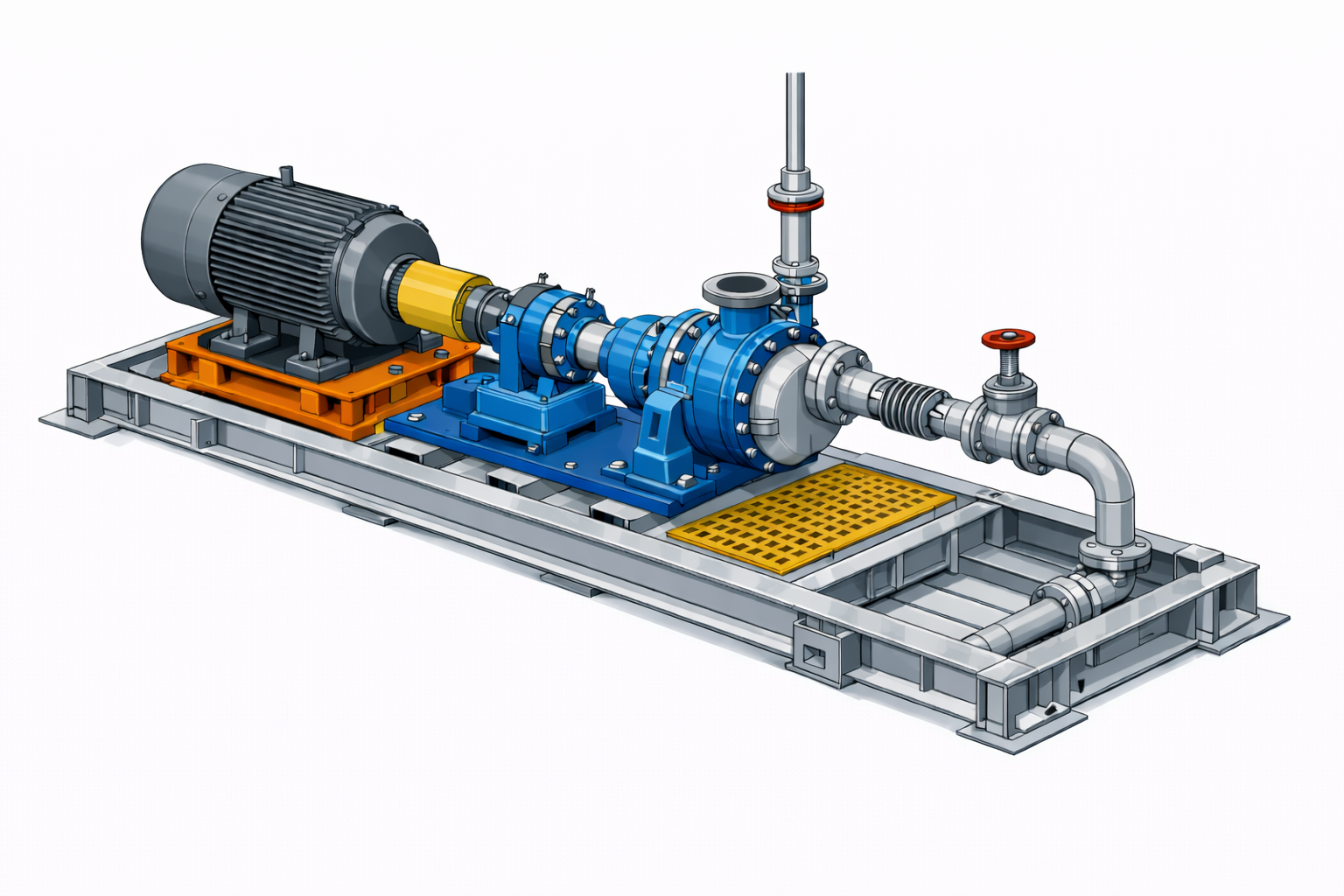
Pump systems are critical components in many mining operations. They are used to move slurry, process water, tailings, and chemicals throughout the plant.
To simplify installation and maintenance, engineers often package pumps and associated equipment into pump skids. A pump skid is a modular assembly that integrates the pump, motor, pipework, valves, instrumentation, and structural base into a single engineered unit.
Effective pump skid design in mining helps operations achieve:
- faster installation
- improved equipment reliability
- easier maintenance access
- reduced shutdown time
Because mining plants operate continuously, properly engineered pump skids are essential for maintaining plant reliability and operational efficiency.
What Is a Pump Skid?
A pump skid is a pre-engineered mechanical system mounted on a structural steel frame.
Typical components of a mining pump skid include:
- centrifugal or slurry pump
- electric motor or drive system
- suction and discharge pipework
- isolation and control valves
- instrumentation and pressure gauges
- base frame or skid structure
The entire assembly can be transported and installed as a single module, reducing site installation work.
Key Engineering Considerations in Pump Skid Design
Designing pump skids for mining environments requires careful attention to mechanical engineering principles, maintenance access, and operating conditions.
1. Structural Base Frame Design
The base frame must support the pump, motor, and piping loads while maintaining alignment.
Engineers design the skid structure to:
- support dynamic loads from rotating equipment
- minimise vibration
- provide lifting points for transport and installation
- ensure structural stability during operation
Structural stiffness is particularly important to maintain pump and motor alignment, which directly affects equipment life.
2. Pump and Motor Alignment
Misalignment between the pump and motor can cause:
- excessive bearing wear
- vibration issues
- premature mechanical seal failure
During pump skid design, engineers consider:
- mounting plate stiffness
- adjustable motor bases
- alignment tolerances
- coupling selection
Accurate alignment is essential for ensuring long-term reliability of rotating equipment.
3. Pipework and Hydraulic Design
The suction and discharge pipework must be carefully designed to avoid performance issues.
Poor pipework design can lead to:
- cavitation
- pressure losses
- vibration
- premature pump wear
Engineering considerations include:
- correct pipe sizing
- smooth flow transitions
- proper valve selection
- adequate support for pipework loads
In slurry applications, pipe materials must also be selected to handle abrasive materials common in mining operations.
4. Maintenance Accessibility
Mining maintenance teams must be able to service pumps quickly, particularly during plant shutdowns.
Pump skid layouts should allow:
- easy removal of pump components
- access to motors and couplings
- safe valve operation
- space for lifting equipment
Maintenance accessibility is a major factor in reducing downtime during shutdown maintenance.
5. Integration With Existing Plant Infrastructure
In many mining facilities, new pump skids must be installed within existing processing plants.
Engineers often use 3D laser scanning and digital plant models to capture the existing environment and ensure the skid fits correctly within available space.
This digital approach helps engineers:
- identify structural clashes
- confirm installation clearances
- verify pipe routing
- reduce installation risk
More information about mining mechanical engineering design services can be found here:
Designing Pump Skids for Shutdown Installations
Many pump replacements or upgrades occur during planned shutdowns where installation time is limited.
Proper engineering preparation allows pump skid systems to be:
- fabricated off-site
- delivered as complete assemblies
- installed quickly during shutdown windows
This approach significantly reduces the risk of delays during plant maintenance activities.
Learn more about engineering preparation for mining shutdowns here:
Using Digital Engineering to Reduce Installation Risk
Modern mining engineering increasingly relies on digital engineering models.
Using digital plant models allows engineers to:
- position pump skids accurately within existing infrastructure
- plan lifting and installation activities
- verify piping connections before fabrication
- minimise site modifications
This reduces uncertainty and ensures that equipment fits correctly during installation.
You can read more about this approach here:
Improving Reliability Through Good Equipment Design
Well-designed pump skids improve both equipment performance and plant maintainability.
By integrating mechanical, structural, and piping design into a single engineered assembly, mining operations benefit from:
- faster equipment installation
- simplified maintenance procedures
- improved operational reliability
For mining operations seeking to upgrade plant equipment or install new pumping systems, engineered pump skid design provides a practical and reliable solution for modern processing plants.