Scan to CAD Services for Sydney Ports

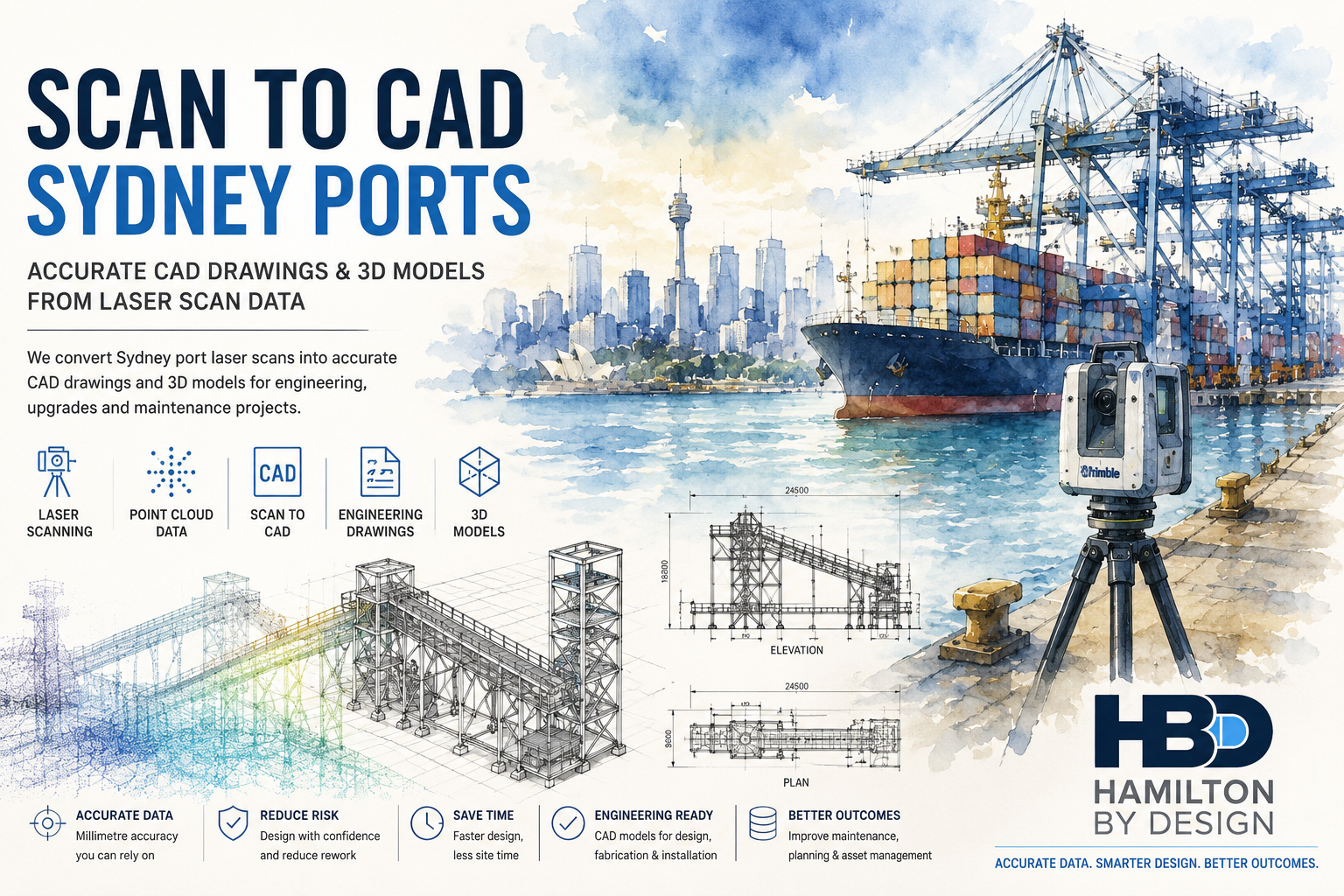
Scan to CAD Sydney Ports hero image showing Sydney Harbour port infrastructure, container terminal operations, LiDAR scanning equipment, point cloud data and engineering CAD models used for mechanical engineering, drafting and asset management projects.

Sydney’s ports and marine infrastructure are constantly evolving through maintenance programs, equipment upgrades, expansion projects and operational improvements. Accurate information about existing assets is essential for successful engineering design, fabrication and construction.

Hamilton By Design provides professional Scan to CAD services for Sydney ports, transforming laser scan and LiDAR point cloud data into accurate CAD drawings, 3D models and engineering documentation.

Our engineering-led approach ensures point cloud data is converted into practical deliverables that support mechanical engineering, drafting, fabrication, asset management and infrastructure upgrades.

Whether you require a simple as-built drawing or a complete 3D plant model, our Scan to CAD services provide accurate digital information that helps reduce project risk and improve engineering outcomes.


What is Scan to CAD?

Scan to CAD is the process of converting laser scan data into usable engineering drawings and 3D models.

Using point cloud data captured through terrestrial LiDAR scanning, engineers and drafters can create:

  • AutoCAD Drawings
  • General Arrangement Drawings
  • Plant Layouts
  • Structural Models
  • Mechanical Equipment Models
  • Pipework Models
  • As-Built Documentation
  • BIM Models
  • Digital Twin Assets

This process allows existing facilities to be accurately documented without relying on outdated or incomplete drawings.


Why Sydney Ports Require Scan to CAD Services

Many port facilities have been modified numerous times throughout their operational life.

Common challenges include:

  • Missing documentation
  • Outdated drawings
  • Unknown modifications
  • Congested infrastructure
  • Limited access areas
  • Restricted shutdown windows
  • Complex equipment layouts

By converting reality capture data into engineering-ready CAD models, project teams can work from accurate information that reflects actual site conditions.


Typical Sydney Port Infrastructure We Model

Container Terminals

We create CAD models and drawings for:

  • Container handling equipment
  • Crane support structures
  • Storage facilities
  • Maintenance workshops
  • Access infrastructure

Bulk Materials Handling Facilities

Our Scan to CAD services support:

  • Conveyors
  • Transfer stations
  • Chutes
  • Hoppers
  • Ship loaders
  • Stackers
  • Reclaimers

Marine Infrastructure

We can model:

  • Wharves
  • Jetties
  • Berths
  • Marine loading facilities
  • Access walkways
  • Structural steelwork

Industrial Plant Infrastructure

Including:

  • Pipework systems
  • Pump stations
  • Mechanical equipment
  • Structural steel
  • Maintenance platforms
  • Process infrastructure

Engineering Applications of Scan to CAD

Mechanical Engineering

Accurate CAD models provide the foundation for:

  • Equipment replacement projects
  • Plant upgrades
  • Retrofit design
  • Conveyor modifications
  • Maintenance planning
  • Shutdown engineering

Engineers can design around actual site conditions, reducing installation risks and minimising costly modifications.


Engineering Drafting

Point cloud data can be converted into:

  • Fabrication Drawings
  • General Arrangement Drawings
  • Layout Drawings
  • Equipment Drawings
  • Structural Steel Drawings
  • Installation Documentation

This allows engineering teams to produce reliable documentation from accurate site information.


Brownfield Engineering Projects

Scan to CAD is particularly valuable for brownfield projects where original drawings may no longer reflect existing conditions.

Benefits include:

  • Reduced site visits
  • Improved design accuracy
  • Clash detection
  • Better installation planning
  • Reduced construction risk

Shutdown Planning

Port shutdowns involve significant planning and coordination.

Accurate CAD models allow project teams to:

  • Verify clearances
  • Plan installations
  • Assess access requirements
  • Identify clashes
  • Improve shutdown efficiency

CAD Deliverables Available

Hamilton By Design can provide a range of engineering deliverables depending on project requirements.

2D Deliverables

  • AutoCAD Drawings
  • Floor Plans
  • Elevations
  • Sections
  • Layout Drawings
  • General Arrangement Drawings
  • As-Built Documentation

3D Deliverables

  • SolidWorks Models
  • Inventor Models
  • STEP Files
  • SAT Files
  • Parasolid Files
  • Plant Models

BIM Deliverables

  • Revit Models
  • IFC Models
  • Asset Information Models
  • Scan to BIM Models

Benefits of Scan to CAD for Sydney Port Projects

Accurate Engineering Information

CAD models are created directly from point cloud data, providing confidence that designs are based on actual site conditions.


Reduced Design Risk

Accurate models help identify clashes and installation issues before fabrication begins.


Faster Project Delivery

Engineering teams can begin work immediately without waiting for extensive site measurements.


Improved Asset Management

Accurate CAD documentation supports maintenance planning, inspections and future upgrades.


Better Project Outcomes

Reliable information results in improved decision making throughout the project lifecycle.


Why Choose Hamilton By Design?

Hamilton By Design combines:

  • Scan to CAD Services
  • 3D LiDAR Scanning
  • Mechanical Engineering
  • Engineering Drafting
  • Reverse Engineering
  • Scan to BIM
  • Asset Management Support

Unlike traditional drafting providers, we understand how engineering models are used throughout design, fabrication, installation and maintenance activities.

Our engineering-first approach ensures practical outcomes that support the long-term management and improvement of port infrastructure assets.


Sydney Port Facilities We Support

We provide Scan to CAD services throughout:

  • Port Botany
  • White Bay
  • Glebe Island
  • Sydney Harbour Industrial Facilities
  • Container Terminals
  • Bulk Handling Facilities
  • Marine Infrastructure Assets
  • Intermodal Freight Terminals

We also support projects throughout:

  • Sydney
  • Newcastle
  • Central Coast
  • Wollongong
  • Regional NSW
  • Australia-wide

Hamilton By Design logo displayed on a blue tilted rectangle with a grey gradient background

Need Scan to CAD Services for a Sydney Port Project?

Whether you require accurate as-built drawings, 3D plant models, mechanical engineering support or asset documentation, Hamilton By Design can convert your laser scan data into engineering-ready CAD deliverables.

Our Services Include:

โœ” Scan to CAD
โœ” 3D LiDAR Scanning
โœ” Mechanical Engineering
โœ” Engineering Drafting
โœ” Reverse Engineering
โœ” Scan to BIM
โœ” Digital Twin Development
โœ” Asset Documentation

Contact Hamilton By Design today to discuss your Sydney port infrastructure project and obtain a tailored proposal.

Talk to Us – Contact Us

Name
Would you like us to arrange a phone consultation for you?
Address

Our clients:


Frequently Asked Questions โ€“ Scan to CAD Sydney Ports

1. What is Scan to CAD and how is it used in Sydney ports?

Scan to CAD is the process of converting laser scan or LiDAR point cloud data into accurate 2D drawings and 3D CAD models. Sydney port operators use Scan to CAD for engineering design, maintenance planning, equipment upgrades and asset management projects.


2. What types of port infrastructure can be converted into CAD models?

Hamilton By Design can create CAD models of:

  • Container terminals
  • Wharves and jetties
  • Ship loaders
  • Conveyors
  • Chutes and hoppers
  • Pipework systems
  • Structural steelwork
  • Pump stations
  • Marine loading facilities
  • Industrial plant equipment

3. Why use Scan to CAD instead of traditional site measurements?

Scan to CAD uses millions of measured data points captured by LiDAR scanners, creating a far more detailed and accurate representation of existing conditions than traditional manual measurements.


4. What CAD deliverables can be produced from point cloud data?

Common deliverables include:

  • AutoCAD drawings
  • General arrangement drawings
  • Layout drawings
  • Structural steel models
  • Mechanical equipment models
  • Pipework models
  • Fabrication drawings
  • As-built documentation

5. Can Scan to CAD support brownfield port upgrades?

Yes. Scan to CAD is particularly valuable for brownfield projects where original drawings may be outdated, missing or no longer reflect actual site conditions. Accurate models help reduce design risks and improve project outcomes.


6. What file formats can Hamilton By Design provide?

We can provide deliverables in formats including:

  • DWG
  • DXF
  • STEP
  • SAT
  • Parasolid
  • SolidWorks
  • Inventor
  • IFC
  • Revit

Depending on project requirements.


7. How does Scan to CAD reduce engineering project risk?

Accurate CAD models allow engineers to verify dimensions, identify clashes, check clearances and develop designs based on actual site conditions. This reduces rework, installation issues and costly construction delays.


8. Can point cloud data be used for mechanical engineering projects?

Absolutely. Point cloud data provides the foundation for equipment upgrades, conveyor modifications, plant expansions, structural changes and reverse engineering projects commonly undertaken within Sydney ports.


9. Can Scan to CAD data be used for BIM and digital twin projects?

Yes. CAD models generated from laser scan data can be incorporated into BIM workflows, digital twin platforms, asset management systems and future infrastructure planning projects.


10. Why choose Hamilton By Design for Scan to CAD services in Sydney ports?

Hamilton By Design combines:

  • 3D LiDAR Scanning
  • Scan to CAD
  • Mechanical Engineering
  • Engineering Drafting
  • Reverse Engineering
  • Scan to BIM
  • Digital Twin Development

Unlike drafting-only providers, we understand how engineering models are used throughout design, fabrication, construction and maintenance, ensuring practical outcomes for port infrastructure projects.

3D LiDAR Scanning Services for Sydney Ports

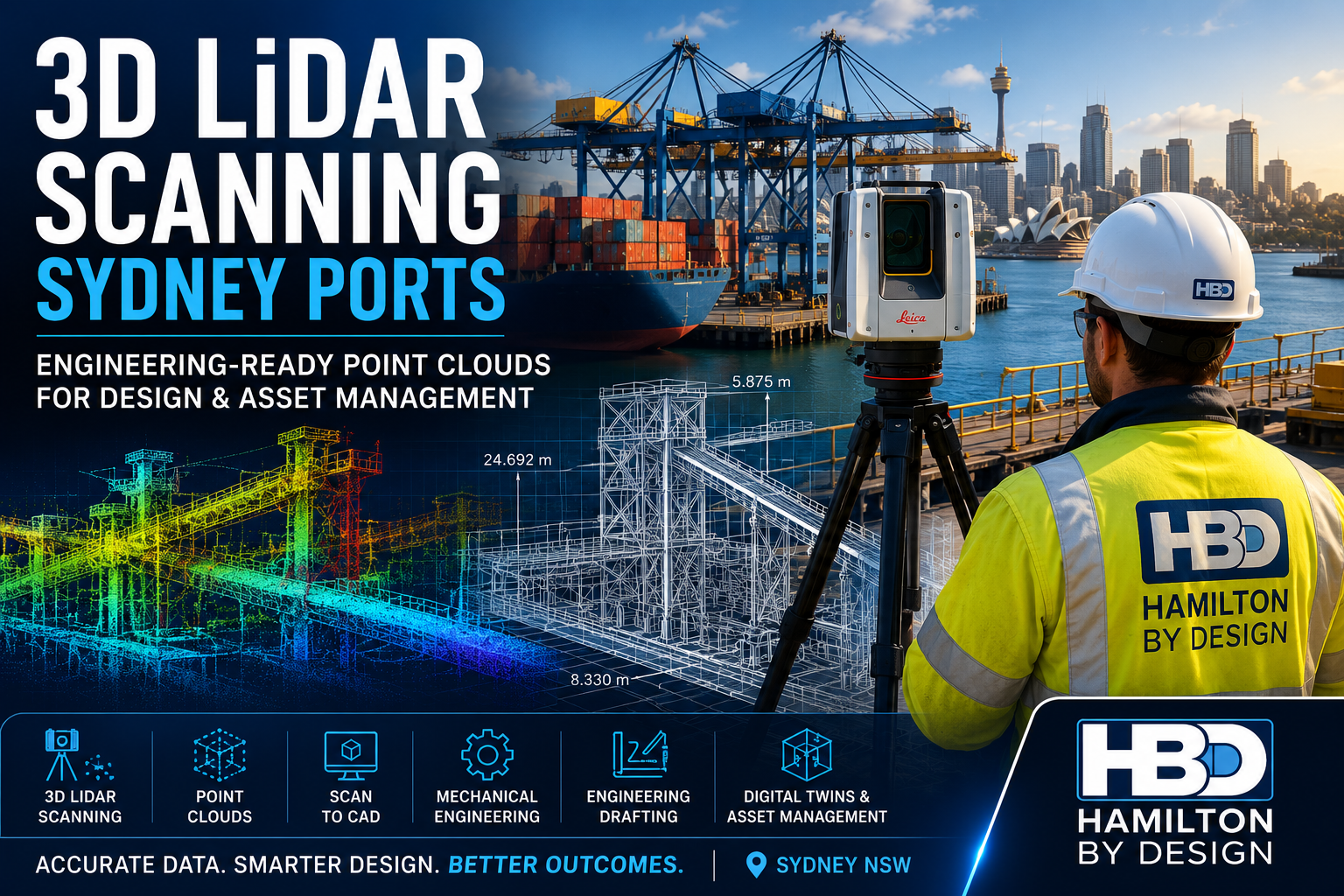
Engineer using 3D LiDAR scanner at Sydney port with container cranes, marine infrastructure and point cloud overlay for engineering design.

Sydney’s ports are critical gateways for Australia’s import, export and logistics industries. Facilities such as container terminals, bulk materials handling operations, fuel terminals, marine loading facilities and supporting infrastructure require accurate engineering information to support maintenance, upgrades and future expansion.

Hamilton By Design provides engineering-grade 3D LiDAR scanning services for Sydney ports, delivering highly accurate point cloud data for engineering design, drafting, asset management, digital twins and brownfield infrastructure projects.

Using advanced terrestrial LiDAR technology, we capture millions of measurement points across complex operating environments, creating detailed digital records that allow engineers, asset owners and project teams to make informed decisions with confidence.


What is 3D LiDAR Scanning?

LiDAR (Light Detection and Ranging) uses laser technology to accurately measure and record physical assets.

The result is a highly detailed point cloud, representing existing infrastructure in three dimensions. This digital dataset can be used for:

  • Mechanical engineering
  • Structural engineering
  • Engineering drafting
  • Scan to CAD workflows
  • Asset management
  • Digital twin development
  • BIM modelling
  • Shutdown planning
  • As-built verification

For ports and marine facilities, LiDAR scanning provides an efficient method of capturing accurate site information while reducing the need for repeat site visits.


Why Sydney Ports Use LiDAR Scanning

Many port facilities have evolved over decades through multiple upgrade projects, equipment replacements and operational modifications.

As a result, common challenges include:

  • Missing drawings
  • Outdated documentation
  • Inaccessible areas
  • Congested infrastructure
  • Unknown clearances
  • Limited shutdown windows
  • Safety restrictions

LiDAR scanning creates a complete digital record of the facility, allowing project teams to design around actual site conditions rather than assumptions.


Typical Sydney Port Assets We Scan

Container Terminals

We capture:

  • Container crane structures
  • Storage yards
  • Maintenance workshops
  • Container handling equipment
  • Access roads and infrastructure

Bulk Materials Handling Facilities

Our scanning services support:

  • Conveyors
  • Transfer stations
  • Ship loaders
  • Stackers
  • Reclaimers
  • Chutes and hoppers
  • Stockpile systems

Marine Infrastructure

LiDAR scanning is ideal for:

  • Wharves
  • Jetties
  • Berths
  • Loading facilities
  • Access walkways
  • Marine structures

Industrial Plant Assets

We regularly scan:

  • Pipework systems
  • Pump stations
  • Mechanical equipment
  • Structural steelwork
  • Maintenance platforms
  • Process infrastructure

Benefits of LiDAR Scanning for Port Engineering Projects

Accurate Site Capture

LiDAR scanning captures millions of survey-grade measurements to create a highly accurate representation of existing conditions.


Engineering-Ready Point Clouds

Data is delivered in formats suitable for engineering workflows including:

  • E57
  • RCP
  • RCS
  • LAS
  • LGS

Reduced Project Risk

Accurate site information reduces:

  • Design clashes
  • Installation issues
  • Site rework
  • Construction delays

Faster Engineering Design

Engineering teams can begin modelling and drafting immediately using accurate site information.


Improved Shutdown Planning

Detailed reality capture allows project teams to:

  • Plan work before mobilisation
  • Reduce site measurements
  • Minimise downtime
  • Improve installation efficiency

Engineering Applications

Mechanical Engineering

LiDAR scanning supports:

  • Equipment upgrades
  • Conveyor modifications
  • Plant expansions
  • Equipment replacement projects
  • Retrofit engineering

By designing around actual site conditions, engineers can reduce uncertainty and improve installation outcomes.


Engineering Drafting

Point cloud data can be converted into:

  • General arrangement drawings
  • Plant layouts
  • Fabrication drawings
  • Structural steel models
  • Equipment drawings
  • Installation documentation

Scan to CAD

Hamilton By Design can convert point cloud data into:

  • AutoCAD models
  • SolidWorks models
  • Inventor models
  • STEP files
  • As-built CAD documentation

This is particularly valuable when original drawings are unavailable or no longer accurate.


Asset Management & Digital Twins

Many port operators are implementing digital asset management systems.

LiDAR scanning provides the foundation for:

  • Digital twins
  • Asset registers
  • BIM models
  • Maintenance planning
  • Future upgrade projects

Engineering Deliverables

Depending on project requirements, Hamilton By Design can provide:

Point Cloud Deliverables

  • E57
  • RCP
  • RCS
  • LAS
  • LGS

CAD Deliverables

  • DWG
  • DXF
  • AutoCAD Models
  • Engineering Layouts

3D Models

  • SolidWorks
  • Inventor
  • STEP
  • Parasolid
  • SAT

BIM Deliverables

  • Revit Models
  • IFC Models
  • Scan to BIM Models
  • Asset Information Models

Why Choose Hamilton By Design?

Unlike many reality capture providers, Hamilton By Design combines:

  • 3D LiDAR Scanning
  • Mechanical Engineering
  • Engineering Drafting
  • Scan to CAD
  • Reverse Engineering
  • Structural Design Support
  • Digital Engineering Workflows

This engineering-first approach ensures that the information captured on site directly supports practical project outcomes.

Our team understands how point cloud data is used during engineering, design, fabrication and construction, enabling us to deliver solutions that reduce risk and improve project efficiency.


Sydney Port Locations We Support

We provide services throughout:

  • Port Botany
  • White Bay
  • Glebe Island
  • Sydney Harbour Industrial Facilities
  • Container Terminals
  • Bulk Handling Facilities
  • Intermodal Freight Terminals
  • Marine Infrastructure Assets

We also support projects throughout:

  • Sydney
  • Newcastle
  • Central Coast
  • Wollongong
  • Regional NSW
  • Australia-wide
Hamilton By Design logo displayed on a blue tilted rectangle with a grey gradient background

Need a 3D LiDAR Scanning Quote for a Sydney Port Project?

Whether you’re planning a brownfield upgrade, shutdown project, asset management program or engineering design activity, Hamilton By Design can provide accurate, engineering-grade reality capture services tailored to your project requirements.

Our Sydney Port Services Include:

โœ” 3D LiDAR Scanning
โœ” Terrestrial Laser Scanning
โœ” Scan to CAD
โœ” Mechanical Engineering
โœ” Engineering Drafting
โœ” Reverse Engineering
โœ” Scan to BIM
โœ” Digital Twin Development

Contact Hamilton By Design to discuss your Sydney port infrastructure project and obtain a tailored proposal.

Talk to Us – Contact Us

Name
Would you like us to arrange a phone consultation for you?
Address

Our clients:


Frequently Asked Questions โ€“ 3D LiDAR Scanning Sydney Ports

1. What is 3D LiDAR scanning and how is it used in Sydney ports?

3D LiDAR scanning uses laser technology to capture millions of accurate measurements of existing infrastructure. In Sydney ports, it is used to document container terminals, wharves, conveyors, ship loaders, pipework and marine facilities for engineering, maintenance and upgrade projects.


2. What are the benefits of LiDAR scanning for port infrastructure projects?

LiDAR scanning provides accurate as-built information, reduces site visits, improves engineering design accuracy, minimises project risk and helps prevent costly rework during construction and shutdown activities.


3. What types of Sydney port assets can be scanned?

Hamilton By Design can scan a wide range of infrastructure including:

  • Container terminals
  • Wharves and jetties
  • Ship loaders
  • Conveyors
  • Chutes and hoppers
  • Pipework systems
  • Structural steelwork
  • Pump stations
  • Marine loading facilities
  • Maintenance platforms

4. How accurate is 3D LiDAR scanning?

Engineering-grade LiDAR scanning can achieve millimetre-level accuracy. Typical registered point cloud datasets for industrial facilities are suitable for mechanical engineering, drafting, Scan to CAD and BIM workflows.


5. Can LiDAR scanning be performed while a port remains operational?

Yes. Many scanning projects are completed during normal operations, maintenance periods or scheduled shutdowns. The scanning process is non-contact and can often be completed with minimal disruption to operations.


6. What deliverables can be produced from a LiDAR scanning project?

Deliverables may include:

  • E57 Point Clouds
  • RCP and RCS Files
  • AutoCAD Drawings
  • SolidWorks Models
  • STEP Files
  • General Arrangement Drawings
  • Scan to BIM Models
  • Asset Information Models

7. How does LiDAR scanning support mechanical engineering projects?

LiDAR scanning provides accurate dimensional data that engineers can use to design replacement equipment, upgrade conveyors, modify structures, assess clearances and plan brownfield engineering projects with confidence.


8. Can point cloud data be converted into CAD models?

Yes. Hamilton By Design provides Scan to CAD services, converting point cloud data into accurate 2D drawings and 3D models suitable for engineering design, drafting, fabrication and asset management.


9. Is LiDAR scanning suitable for digital twin and asset management projects?

Absolutely. LiDAR scanning forms the foundation of many digital twin initiatives by creating accurate digital representations of physical assets that can be used for maintenance planning, inspections, upgrades and future development projects.


10. Why choose Hamilton By Design for Sydney port LiDAR scanning?

Hamilton By Design combines:

  • 3D LiDAR Scanning
  • Mechanical Engineering
  • Engineering Drafting
  • Scan to CAD
  • Reverse Engineering
  • Digital Twin Development

Unlike survey-only providers, we understand how scan data is used throughout the engineering lifecycle, delivering practical outcomes for Sydney port operators, engineering consultants and infrastructure asset owners.