Chute Blockages and Build-Up in Mining Plants | Hamilton By Design Co.
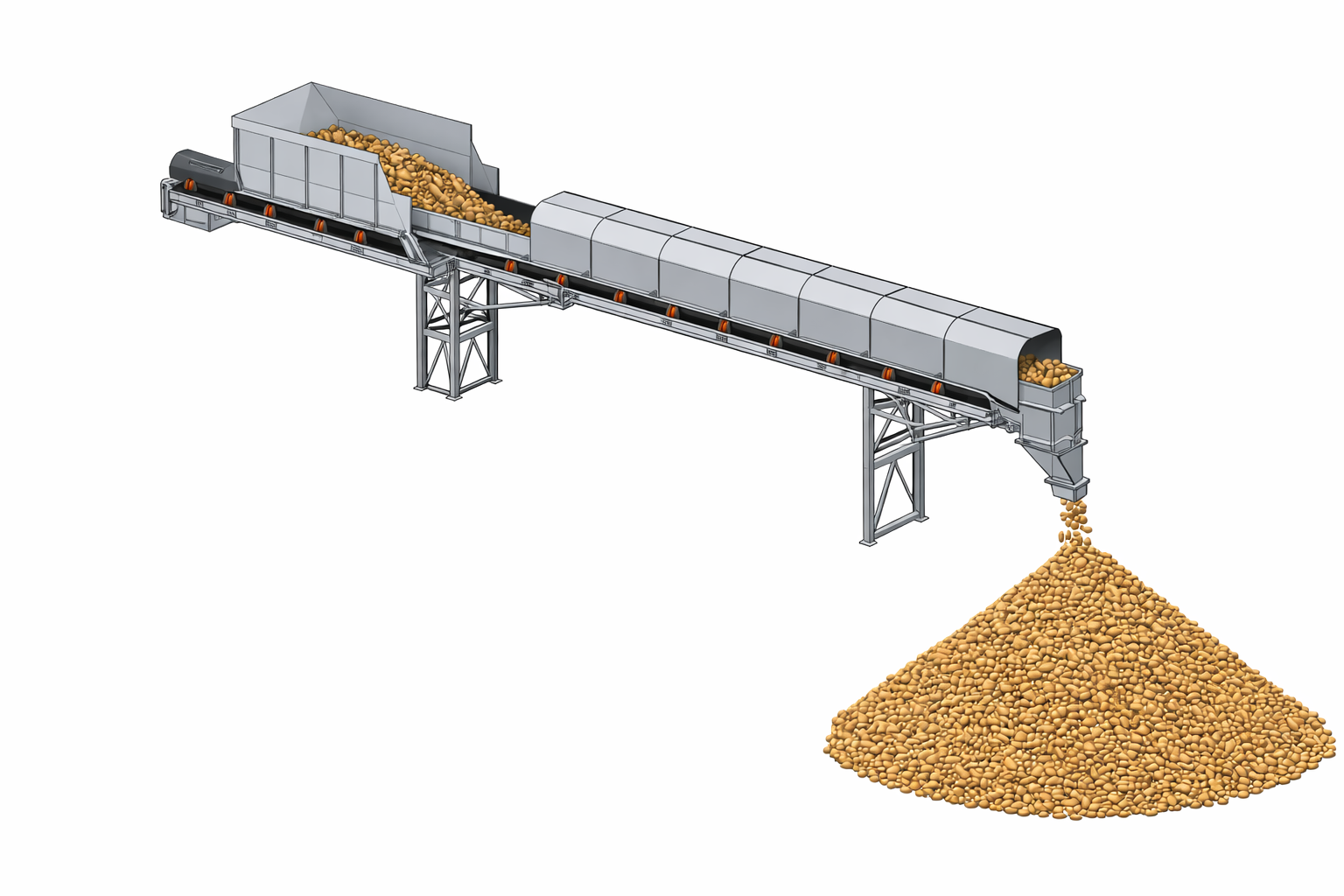
Transfer chute blockages and material build-up are some of the most common and costly problems in mining and bulk materials handling plants. A chute may look simple on paper, but in real operations it must control the flow of difficult materials under changing conditions, often within tight brownfield constraints.
When a chute begins to block, pack up, or accumulate build-up, the result is rarely limited to one small maintenance issue. Restricted flow can lead to reduced plant throughput, unplanned stoppages, excessive wear, spillage, dust, manual clean-outs, and increased shutdown risk.
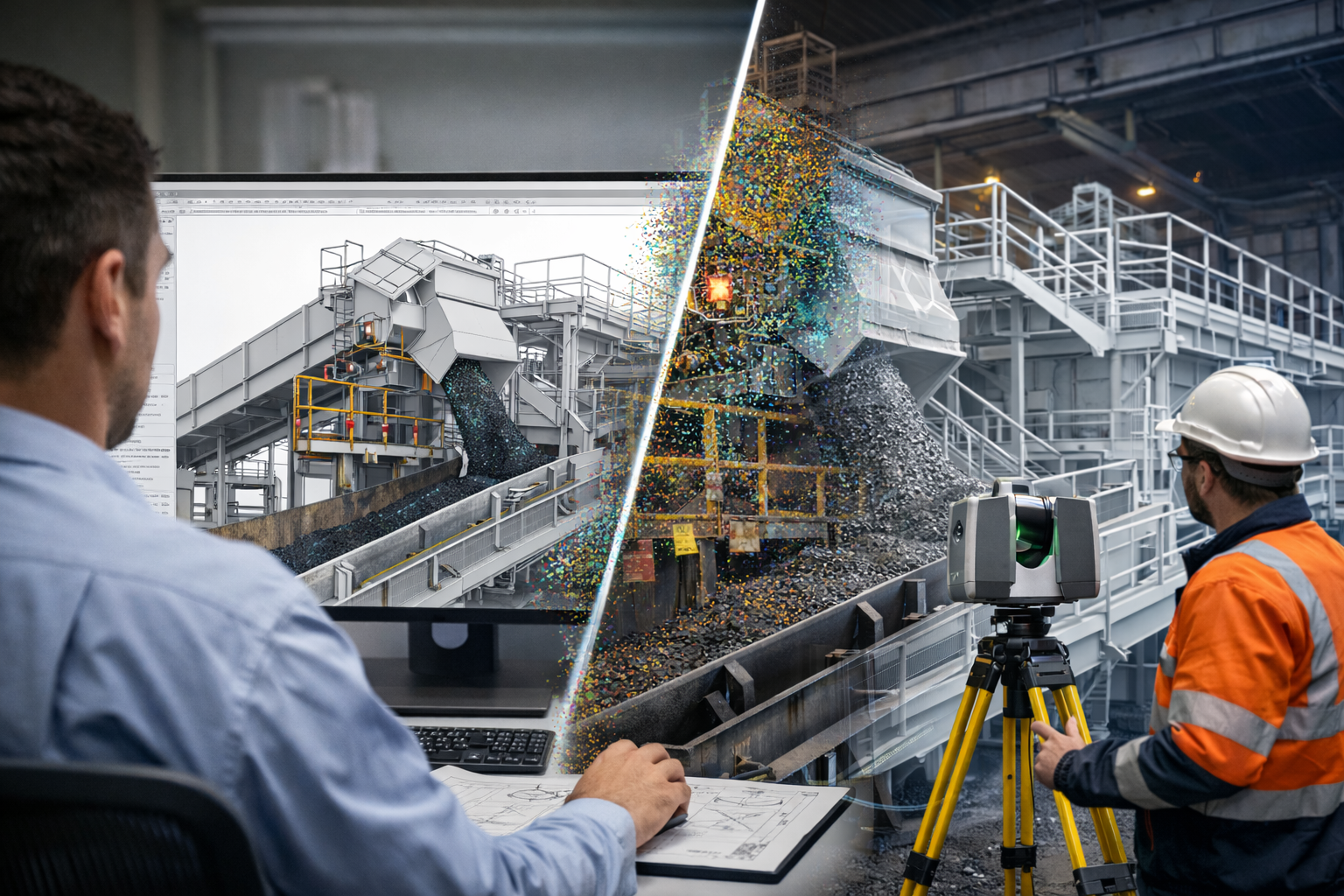
At Hamilton By Design Co., we use engineering-grade 3D laser scanning, point cloud to CAD modelling, and practical mechanical design workflows to help clients understand why existing transfer chutes are failing and how those problems can be addressed with real-world upgrade solutions.
Why Transfer Chutes Block in Real Plants
A transfer chute does more than direct material from one conveyor to another. It must manage the velocity, direction, confinement, and discharge of a bulk solid that may behave very differently from day to day.
In theory, material should flow cleanly through the chute and load the receiving belt in a controlled manner. In practice, that often does not happen.
Blockages and build-up usually develop because of one or more of the following conditions:
- Sticky or wet material
- High fines content
- Poor internal chute geometry
- Dead zones or low-velocity regions
- Sudden changes in direction
- Inadequate clearances
- Existing plant modifications not shown on old drawings
- Wear plates or liners altering the internal flow path over time
This is one of the key lessons from bulk solids handling literature and modern transfer chute simulation work: a chute should be treated as a flow system, not just fabricated steelwork. If the bulk material is not guided correctly, the chute can quickly become the source of recurring reliability issues.
Common Signs of Chute Blockages and Build-Up
Many transfer chutes continue operating badly for months or years before a proper redesign is considered. The warning signs are often already there:
Frequent clean-outs
Operators or maintenance crews may need to manually remove compacted or hung-up material from inside the chute or around discharge points.
Reduced throughput
Partial restriction can reduce the chute’s effective flow area, limiting plant performance without always producing a full blockage.
Spillage and dust
As the internal flow path changes, material may discharge poorly, generating side loading, skirt leaks, and fugitive dust.
Uneven wear
Material build-up often redirects flow, concentrating abrasion and impact into localised wear zones.
Belt loading problems
A blocked or partially restricted chute can cause off-centre loading, surging, or unstable discharge onto the receiving conveyor.
Shutdown surprises
A chute that “kind of works” during operation may become a major problem during shutdown replacement or upgrade works when its actual geometry and surrounding interfaces are finally exposed.

Why Old Drawings Often Do Not Tell the Full Story
One of the most common issues in brownfield mining plants is that the existing chute does not match the drawings.
Over time, sites are modified. Liners are changed. Plates are added. Wear zones are patched. Access platforms are altered. Guards move. Structural members are added or cut back. Conveyor details are updated but not always captured in the plant model.
As a result, a design team can be asked to solve a blockage problem using information that is incomplete, outdated, or simply wrong.
This is where 3D laser scanning of the existing chute and surrounding plant becomes highly valuable. Instead of relying on assumptions, the project can begin with measured site reality.
How 3D Laser Scanning Helps Diagnose Chute Problems
3D laser scanning allows existing transfer stations, chute structures, conveyors, supports, platforms, and surrounding equipment to be captured accurately as an as-built point cloud.
This gives engineers and plant teams a much better starting point for understanding blockage and build-up issues.
With a high-quality site capture, it becomes easier to:
- Verify the true chute geometry
- Check whether the internal chute path matches legacy drawings
- Measure clearances around the chute and conveyors
- Identify brownfield constraints that will affect upgrades
- Capture surrounding steelwork, guards, supports, access ways, and services
- Build a reliable CAD base for redesign or shutdown planning
- Reduce fit-up risk before fabrication
For blocked or restricted transfer points, this matters because the problem is rarely isolated to one plate or one wear liner. The full transfer arrangement often needs to be understood in context.
Point Cloud to CAD for Chute Upgrade Projects
Once the existing chute and surrounding transfer area have been scanned, the point cloud can be converted into useful engineering models and drawing outputs.
Depending on project requirements, this may include:
- Existing arrangement models
- AutoCAD model space layouts
- General arrangement drawings
- Section views through critical transfer zones
- Conveyor interface checks
- Structural and access reference models
- Base geometry for redesign concepts
This step is important because scanning alone does not solve the problem. The value comes from turning measured site conditions into a workable engineering model that supports analysis, redesign, communication, and project delivery.
Typical Causes of Chute Build-Up
No two plants are identical, but the same broad patterns appear again and again in mining and bulk materials handling systems.
Poor chute geometry
Flat ledges, abrupt transitions, internal obstructions, and shallow flow surfaces can create low-energy zones where material begins to hang up.
Material variability
A chute may perform reasonably with dry product but fail badly when moisture, fines content, or feed consistency changes.
Wear changing the flow path
As liners wear, the material trajectory and internal contact pattern can change. In some cases, past repairs can unintentionally make the problem worse.
Inadequate discharge control
If the material is not being guided cleanly through the chute, unstable flow can create recirculation, impact concentration, and inconsistent discharge onto the receiving belt.
Brownfield constraints
Legacy chute geometry is often shaped by what could fit at the time, not by what offered the best flow. This is especially true where upgrades have been added over many years.
A Practical Engineering Approach
At Hamilton By Design Co., we see chute blockage problems as both a materials handling issue and a brownfield engineering issue.
That means the practical workflow is often:
1. Capture the existing transfer area
We scan the chute, conveyors, structure, and surrounding plant to create an accurate as-built record.
2. Build the engineering base model
We convert the point cloud into usable CAD references for design, review, and planning.
3. Understand the real constraint
We assess what the current chute is doing, what clearances exist, and where the upgrade risks are likely to sit.
4. Support redesign and upgrade works
The as-built data can then be used to support mechanical design, chute modification concepts, shutdown planning, and fabrication fit-up.
This practical approach is especially useful where the site is already experiencing recurring clean-outs, ongoing maintenance cost, or uncertainty around existing geometry.
Where This Applies
This type of work is relevant across a wide range of bulk materials handling environments, including:
- Coal handling plants
- Hard rock mining operations
- Quarry transfer systems
- Materials handling conveyors
- Process plant transfer stations
- Brownfield chute replacement projects
Why This Matters
Transfer chutes are often underestimated. A poorly performing chute can quietly create lost production, repeated maintenance, high cleanup cost, and shutdown complications for years.
The real lesson from bulk solids handling practice is that a chute should not be designed or upgraded as just a fabricated box. It must be understood as part of a controlled material flow system, operating within the real physical constraints of the plant.
When those constraints are not fully understood, blockage and build-up problems tend to repeat.
That is why 3D laser scanning, point cloud to CAD modelling, and measured as-built engineering data are such valuable first steps in solving restricted or unreliable transfer points.



Need Support with an Existing Chute Problem?
If your site is dealing with chute blockages, material build-up, inaccurate plant drawings, or shutdown upgrade risk, Hamilton By Design Co. can help capture the existing conditions and provide an engineering-ready base for the next stage of the project.

We support mining and industrial clients with:
- 3D laser scanning of existing plant
- Point cloud to CAD conversion
- Existing condition modelling
- Brownfield upgrade support
- Chute and transfer station design workflows
Contact Hamilton By Design Co. to discuss your existing chute, transfer point, or scanning requirement.
Our clients