SolidWorks Mechanical Design Services

Hero image showing a LiDAR-coloured point-cloud model of an industrial conveyor system on the left transitioning into a detailed SolidWorks 3D CAD model on the right, with the heading ‘SolidWorks Mechanical Design Services’ and a call-to-action button that reads ‘Start Your Project’

SolidWorks Design Services

The Many Faces of Mechanical Design: How SolidWorks Powers Modern Engineering Across Australia

At Hamilton By Design, we see the same pattern every day across mining, heavy industry, manufacturing, and complex brownfield environments: the quality of engineering outcomes depends directly on the quality of the models driving them. And when it comes to mechanical design, SolidWorks remains one of the most capable and versatile platforms on the planet.

From dragline components to sheet metal enclosures, from pressure vessel upgrades to bespoke robotics, SolidWorks enables engineers to turn ideas into precise, fabrication-ready models that reduce rework, eliminate uncertainty, and accelerate project delivery.

Below, we explore the full spectrum of mechanical design disciplines where SolidWorks excels — and how Hamilton By Design uses this capability to deliver accurate, reliable, engineering-grade outcomes across Australia.


Why SolidWorks Remains the Backbone of Mechanical Design

SolidWorks brings together parametric modelling, simulation, large assembly performance, surfacing, sheet metal tools, weldments, routing and visualisation under a single environment. The result is powerful:

✔ Engineering that is data-driven
✔ Models that are precise and fabrication-ready
✔ Assemblies that reflect true site conditions
✔ Designs that respond intelligently to changes
✔ Drawings that follow Australian Standards
✔ Seamless integration with LiDAR-based as-builts

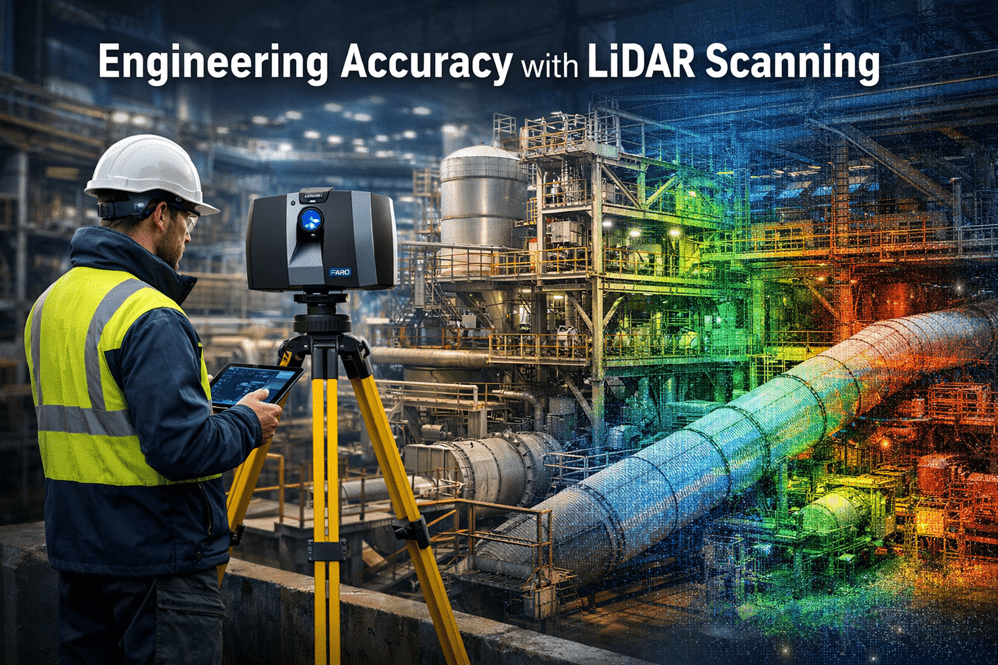
When paired with Hamilton By Design’s LiDAR scanning workflows, SolidWorks becomes an engine for delivering zero-guesswork mechanical design.


Mechanical Design Disciplines Perfectly Suited to SolidWorks Modelling

SolidWorks supports a huge range of engineering tasks. Below is a deep dive into the disciplines where Hamilton By Design deploys it every day.


1. Machine Design: Precision for Moving Systems

SolidWorks is a natural fit for mechanical equipment upgrades and R&D design work, including:

  • Gearboxes, shafts, keys, couplings
  • Linear motion systems and actuators
  • Mechanical linkages, cams and levers
  • Robotic mechanisms
  • Safety guards, enclosures and subframes
  • Automation concept development

Whether we’re modelling a drive assembly for a conveyor or designing a new piece of automated equipment, SolidWorks gives us full control over the mechanics, kinematics, clearances and manufacturability.


2. Structural Mechanical Design: Frames, Platforms & Fabrication

Mining and industrial plants rely heavily on welded structures and access systems. SolidWorks weldments excel at:

  • Platforms, walkways and stair systems
  • Equipment bases, skids and structural frames
  • Gantries, monorails and supports
  • Pipe supports and brackets
  • Structural reinforcements and upgrade scopes

Built-in cut lists, profile libraries and FEA ensure every frame is practical, safe and fabrication-ready.


3. Pressure Vessels, Tanks & Piping Systems

SolidWorks is an ideal tool for pressure-bound components and interconnected plant systems:

  • Tanks, vessels, bins and hoppers
  • Nozzles, flanges, stiffeners and ladders
  • Pipe routing and spooled sections
  • Chute systems, transitions and flow paths
  • Wear liners and maintenance-friendly redesigns

With stress linearisation, buckling analysis and accurate geometry import from LiDAR scans, we ensure designs meet engineering intent and fit up perfectly on site.


4. Sheet Metal: From Light Fabrication to Industrial Ducting

SolidWorks is the industry standard for sheet metal components:

  • Ducting and HVAC transitions
  • Guards, housings and folded enclosures
  • Electrical cabinets
  • Chute panels
  • Laser-cut and folded brackets

Automatic flat patterns and K-factor control mean fewer mistakes at the plasma/laser cutters and more predictable outcomes for fabricators.


5. Heavy Industry & Mining Equipment Modelling

Hamilton By Design’s roots in mining and heavy industry make SolidWorks invaluable for:

  • Conveyor components and guarding
  • Diverter chutes, hoppers and flow-optimised transitions
  • Bucket-wheel reclaimer parts
  • Crusher and screen upgrades
  • Dragline component modelling
  • Structural deformation/realignment scopes

Combined with LiDAR scanning, SolidWorks becomes the tool that eliminates shutdown fit-up problems.


6. Product Design & Industrial Design

SolidWorks’ surfacing and parametric tools are ideal for:

  • Consumer products
  • Power tools and ergonomic items
  • Injection-moulded components
  • Kitchen or appliance prototypes
  • Concept development for early-stage R&D

It supports rapid iterations, rendering, and export for 3D printing.


7. Robotics & Automation Systems

With the rise of automated processing and Industry 4.0, SolidWorks continues to shine in:

  • End effectors
  • Robotic arms and actuators
  • Kinematic studies
  • Sensor housings
  • Concept layouts for automated cells

We frequently pair this with our LiDAR models of existing plants to create automation solutions that genuinely fit the space.


8. Tooling, Jigs & Fixtures

Fabrication and machining rely on accurate tooling, and SolidWorks helps us design:

  • Welding jigs
  • Machining fixtures
  • Assembly tooling
  • Positioning and inspection gauges
  • Drill guides and alignment tooling

Parametric updates make future modifications simple and consistent.


9. Material Handling Systems

Across mining, ports, agriculture and waste facilities, SolidWorks supports:

  • Conveyor layouts
  • Screw and chain conveyors
  • Transfer chute redesigns
  • Feeders, bins and flow systems
  • Skids and support structures

We routinely pair mechanical redesign with simulation, checking wear patterns, stresses and clearances.


10. Reverse Engineering & As-Built Modelling from LiDAR

This is where Hamilton By Design leads the industry.

We scan sites with millimetre-level LiDAR, then rebuild clean parametric models in SolidWorks for:

  • Brownfield upgrades
  • Fit-up verification
  • Clash detection
  • Replacements and like-for-like manufacturing
  • Structural deformation assessments
  • Shutdown planning

It is the combination of LiDAR + engineering + SolidWorks that gives clients complete confidence in their next project.


How Clients Benefit from SolidWorks-Driven Mechanical Design

✔ Reduced rework

✔ Faster shutdown upgrades

✔ Accurate manufacturing drawings

✔ Better communication between engineers, fabricators and site teams

✔ Safer and more predictable installations

✔ Clear, simulation-backed decision-making

From CHPPs to ports, from power stations to manufacturing plants, SolidWorks modelling allows Hamilton By Design to deliver engineering outcomes you can trust.


Hamilton By Design logo displayed on a blue tilted rectangle with a grey gradient background

Partner With Hamilton By Design for SolidWorks Mechanical Design

We support clients across:

  • NSW (Sydney, Newcastle, Central Coast, Hunter Valley)
  • QLD (Bowen Basin, Surat Basin, Mount Isa)
  • WA (Perth, Pilbara)
  • SA, VIC and regional Australia

If your next project needs mechanical accuracy, design certainty or LiDAR-integrated engineering, our team is ready to support you.

Name
You would like to:

Our clients

SolidWorks

3D Laser Scanning

Engineering Projects

Engineering Services

3D Laser Scanning for Engineering

The Real-World Accuracy of 3D LiDAR Scanning With FARO S150 & S350 Scanners

When people first explore 3D LiDAR scanning, one of the most eye-catching numbers in any product brochure is the advertised accuracy. FARO’s Focus S150 and S350 scanners are often promoted as delivering “±1 mm accuracy,” which sounds definitive and easy to rely on for engineering, mining and fabrication work. But anyone who has spent time working with 3D LiDAR scanning in real industrial environments understands that accuracy isn’t a single number — it is a system of interrelated factors.

This article explains what the ±1 mm specification from FARO really means, how accuracy shifts with distance, and what engineers, project managers and clients need to do to achieve dependable results when applying 3D LiDAR scanning on live sites.


Infographic explaining 3D LiDAR scanning accuracy, showing a scanner capturing a building and highlighting factors that affect accuracy such as temperature, atmospheric noise, surface reflectivity and tripod stability. Includes diagrams comparing realistic versus unrealistic ±1 mm accuracy, the impact of distance, environment and registration quality, and notes that large open sites typically achieve ±3–6 mm global accuracy.

1. What FARO’s “±1 mm Accuracy” Really Means in 3D LiDAR Scanning

The ±1 mm number applies only to the internal distance measurement unit inside the scanner. It reflects how accurately the laser measures a single distance in controlled conditions.

It does not guarantee:

  • ±1 mm for every point in a full plant model
  • ±1 mm for every dimension extracted for engineering
  • ±1 mm global accuracy across large multi-scan datasets

In 3D LiDAR scanning, ranging accuracy is just one ingredient. Real-world accuracy is shaped by distance, reflectivity, scan geometry and how multiple scans are registered together.


2. How Accuracy Changes With Distance in Real Projects

Even though the S150 and S350 list the same ranging accuracy, their 3D LiDAR scanning performance changes as distance increases. This is due to beam divergence, angular error, environment and surface reflectivity.

Typical real-world behaviour:

  • 0–10 m: extremely precise, often sub-millimetre
  • 10–25 m: excellent for engineering work, only slight noise increase
  • 25–50 m: more noticeable noise and increasing angular error
  • 50–100 m: atmospheric distortion and reduced overlap become evident
  • Near maximum range: still useful for mapping conveyors, yards and structures, but not suitable for tight fabrication tolerances

This distance-based behaviour is one of the most important truths to understand about 3D LiDAR scanning in field conditions.


3. Ranging Accuracy vs Positional Accuracy vs Global Accuracy

Anyone planning a project involving 3D LiDAR scanning must distinguish between:

Ranging Accuracy

The ±1 mm value — only the distance measurement.

3D Positional Accuracy

The true X/Y/Z location of a point relative to the scanner.

Global Point Cloud Accuracy

How accurate the entire dataset is after registration.

Global accuracy is the number engineers depend on, and it is normally around ±3–6 mm for large industrial sites — completely normal for terrestrial 3D LiDAR scanning.


4. What Real Field Testing Reveals About FARO S-Series Accuracy

Independent practitioners across mining, infrastructure, CHPPs, plants and structural environments report similar results when validating 3D LiDAR scanning against survey control:

  • ±2–3 mm accuracy in compact plant rooms
  • ±5–10 mm across large facilities
  • Greater drift across long, open, feature-poor areas

These outcomes are not equipment faults — they are the natural result of how 3D LiDAR scanning behaves in open, uncontrolled outdoor environments.


5. Why Registration Matters More Than the Scanner Model

Most real-world error in 3D LiDAR scanning comes from registration, not the laser itself.

Cloud-to-Cloud Registration

Good for dense areas, less reliable for long straight conveyors, open yards or tanks.

Target-Based Registration

Essential for high-precision engineering work.
Allows tie-in to survey control and dramatically improves global accuracy.

If your project needs ±2–3 mm globally, target control is mandatory in all 3D LiDAR scanning workflows.


6. Surface Reflectivity and Environmental Effects

Reflectivity dramatically affects measurement quality during 3D LiDAR scanning:

  • Matte steel and concrete return excellent data
  • Rusted surfaces return good data
  • Dark rubber, black plastics and wet surfaces reduce accuracy
  • Stainless steel and glass behave unpredictably

Environmental factors — wind, heat shimmer, dust, rain — also reduce accuracy. Early morning or late afternoon typically produce better 3D LiDAR scanning results on mining and industrial sites.


7. When ±1 mm Is Actually Achievable

True ±1 mm accuracy in 3D LiDAR scanning is realistic when:

  • Working within 10–15 m
  • Surfaces are matte and reflective
  • Registration uses targets
  • Tripod stability is high
  • Conditions are controlled

This makes it suitable for:

  • Pump rooms
  • Valve skids
  • Structural baseplates
  • Reverse engineering
  • Small mechanical upgrades

But achieving ±1 mm across a full plant, CHPP, or yard is outside the capability of any terrestrial 3D LiDAR scanning workflow.


8. S150 vs S350: Which One for Your Accuracy Needs?

S150 – Engineering-Focused Precision

Ideal for industrial rooms, skids, structural steel and retrofit design work where short-to-mid-range accuracy is essential.

S350 – Large-Area Coverage

Perfect for conveyors, rail lines, yards, and outdoor infrastructure.
Global accuracy must be survey-controlled for tight tolerances.

Both scanners deliver excellent 3D LiDAR scanning performance, but the S150 is the engineering favourite while the S350 is the large-site specialist.


9. What to Specify in Contracts to Avoid Misunderstandings

Instead of stating:

“Scanner accuracy ±1 mm.”

Specify:

  • Local accuracy requirement (e.g., ±2 mm at 15 m)
  • Global accuracy requirement (e.g., ±5 mm total dataset)
  • Registration method (mandatory target control)
  • Environmental constraints
  • Verification method (e.g., independent survey checks)

This ensures everyone understands what 3D LiDAR scanning will realistically deliver.


10. When a Terrestrial Scanner Is Not Enough

Do not rely solely on 3D LiDAR scanning for:

  • Machine alignment <1 mm
  • Bearing or gearbox placement
  • Certified dimensional inspection
  • Metrology-level tolerances

In these cases, supplement scanning with:

  • Laser trackers
  • Total stations
  • Metrology arms
  • Hybrid workflows

Conclusion: The Real Truth About 3D LiDAR Scanning Accuracy

FARO’s S150 and S350 are outstanding tools for industrial 3D LiDAR scanning, but the ±1 mm spec does not tell the full story. Real-world accuracy is a combination of:

  • Distance
  • Registration method
  • Surface reflectivity
  • Site conditions
  • Workflow discipline

When used correctly, these scanners consistently deliver high-quality, engineering-grade point clouds suitable for clash detection, retrofit design, fabrication planning and as-built documentation.

3D LiDAR scanning is not just a laser — it is an entire measurement system.
And when the system is applied with care, it produces reliable, repeatable data that reduces rework, improves safety, and strengthens decision-making across mining, construction, fabrication and industrial operations.

Where Is your project

3D Scanning Sydney CBD3D Scanning Brisbane CBD
3D Scanning across Melbourne3D Scanning across Perth
3D Scanning across Adelaide3D Scanning in The Hunter Valley
3D Scanning Mount Isa3D Scanning Emerald
3D Laser Scanning Central Coast3D Scanning in The Pilbara
3d Scanning other Areas of Australia3D Scanning Outside Australia
Hamilton By Design logo displayed on a blue tilted rectangle with a grey gradient background
Name
You would like to:

3D CAD Modelling | 3D Scanning

3D Experience Platform Login

3D Scanning for Construction

Transforming Projects with 3D Scanning

3D LiDAR Scanning – Digital Quality Assurance