Machine Guarding for Ship Loaders, Stackers & Reclaimers in Bulk Materials Handling

Machine Guarding for Ship Loaders, Stackers & Reclaimers | Bulk Materials Safety

Why guarding matters on large bulk material machines

Ship loaders, stackers and reclaimers combine elements of mobile plant, fixed plant and continuous conveying systems. Their scale, movement and operating envelopes introduce hazards that cannot be managed with ad-hoc or legacy guarding.

Most guarding failures are not caused by a single missing guard, but by brownfield modifications, undocumented changes, and loss of original design intent. This makes engineering-led guarding essential for safety, compliance and uptime.


Australian Standards framework for guarding

AS 4024 โ€“ Safety of Machinery

The AS 4024 series provides the primary principles for machine guarding, including hazard identification, risk assessment, guarding selection, and safe distances. For bulk materials handling equipment, it must be applied in context rather than as a checklist.

AS 1755 โ€“ Conveyors: Safety requirements

AS 1755 governs conveyor-specific hazards common to ship loaders, stackers and reclaimers, including:

  • Nip points and pulleys
  • Transfer and chute interfaces
  • Emergency stop systems
  • Access for inspection and maintenance

Most real-world non-conformances occur at head/tail pulleys, transitions, take-ups and return belts beneath walkways.

AS 1657 โ€“ Fixed access systems

Guarding must coexist with compliant access. AS 1657 covers walkways, stairs, ladders, handrails and edge protection. Poor integration often leads to guards being removed to regain access โ€” undermining safety intent.

AS 4324.1 โ€“ Mobile bulk materials handling equipment

AS 4324.1 recognises ship loaders, stackers and reclaimers as integrated machines, where guarding, access, structure and maintainability must be considered together.


Guarding challenges unique to ship loaders & reclaimers

Scale and movement
These machines include slew, luff and travel motions, requiring guarding to remain effective across all operating positions.

Brownfield evolution
Temporary or reactive guarding solutions often become permanent without verification against standards.

Shutdown constraints
Guarding changes made under shutdown pressure frequently prioritise constructability over defensible engineering.


Engineering-led guarding approach

Effective guarding is based on:

  • Engineering-grade spatial understanding of reach, envelopes and access paths
  • Risk-based selection of fixed, interlocked or removable guarding in line with AS 4024
  • Integration with maintenance and operations, avoiding unsafe workarounds

On large machines, guarding that cannot be safely removed, reinstated or inspected will not survive long-term operation.


Common high-risk interfaces

Guarding assessment typically focuses on:

  • Conveyor head, tail and bend pulleys
  • Transfer points and chutes
  • Slew, luff and drive mechanisms
  • Gearboxes, brakes and take-ups
  • Return belt zones beneath accessways

Each interface must be checked against AS 4024, AS 1755, AS 1657 and AS 4324.1 as a combined framework.


Our clients:


Building toward a bulk materials handling safety framework

This post forms part of a broader technical narrative around safe, maintainable bulk materials handling systems.
Future companion topics may include:

  • Conveyor transfer point guarding
  • Brownfield guarding upgrades during life-extension works
  • Balancing guarding and access on reclaimers
  • Using validated 3D data to de-risk shutdown modifications

Together, these posts naturally support a future Bulk Materials Handling / Stacker & Reclaimer Engineering landing page without forcing a sales message.


Hamilton By Design logo displayed on a blue tilted rectangle with a grey gradient background

Key takeaway

On ship loaders, stackers and reclaimers, guarding must be engineered, spatially validated and operationally practical. When aligned with Australian Standards, guarding becomes an enabler of safe production โ€” not a liability.

Discuss machine safety and guarding for bulk materials handling equipment

If you are reviewing or upgrading ship loaders, stackers, reclaimers or conveyor systems, early engineering input can reduce safety risk, rework and shutdown pressure.

For discussions relating to:

  • Machine guarding and conveyor safety
  • Brownfield compliance with Australian Standards
  • Engineering-led reviews for bulk materials handling equipment

Please connect with us by filling out the form below.
Name
Would you like us to arrange a phone consultation for you?
Address

Drafting Capacity for Todayโ€™s Projects: An Integrated Scan โ†’ Model โ†’ Detail โ†’ Check Workflow

Drafting Capacity for Todayโ€™s Projects | Engineering-Led Documentation

Engineering and construction projects are increasingly delivered under compressed timeframes, constrained resources, and heightened compliance expectations. In this environment, access to reliable drafting capacityโ€”supported by robust processesโ€”is critical to maintaining quality and reducing project risk.

Hamilton By Design provides experienced drafting capacity, available for short-term support or longer-term secondment, delivered within a structured scan โ†’ model โ†’ detail โ†’ check workflow that aligns documentation with real-world conditions and engineering intent.


Drafting capacity aligned with contemporary project demands

Modern projects often require drafting support that can scale quickly to address:

  • Peak workloads during design development or shutdown preparation
  • Short-term resourcing gaps within engineering teams
  • Documentation demands driven by upgrades, modifications, or compliance works
  • Brownfield environments where existing information is incomplete or unreliable

In these situations, drafting capacity must be more than transactional. It must integrate with engineering workflows and reflect current site conditions.


Scan: establishing an accurate technical baseline

Where existing drawings cannot be relied upon, accurate documentation begins with engineering-grade reality capture.

Our team utilises 3D laser scanning to establish a defensible geometric baseline of existing assets. This approach supports drafting activities by ensuring that models and drawings are developed from verified site data, rather than assumptions or legacy documentation.


Model: structured CAD developed for engineering use

Scan data is translated into purpose-built CAD models, developed to suit the intended engineering and documentation outcomes. Models are structured with appropriate datums, tolerances, and levels of detail to support:

  • Engineering assessment and design coordination
  • Structural and mechanical detailing
  • As-built documentation and future modification

This modelling stage ensures drafting activities are grounded in usable, engineering-aligned data.


Detail: producing clear, buildable documentation

Drafting output remains one of the most critical interfaces between design and construction.

From verified models, our draftspersons produce clear, fabrication-ready drawings that communicate engineering intent accurately and unambiguously. Documentation is prepared with consideration for:

  • Constructability and sequencing
  • Fabrication practicality
  • Coordination between disciplines
  • Alignment with relevant Australian Standards

The emphasis is on documentation that can be confidently issued to site.


Check: verification as a formal step, not an afterthought

Before issue, drawings and models are subject to structured review to confirm:

  • Consistency with scan data and models
  • Coordination across views and drawing sets
  • Technical clarity and buildability

This checking step reduces the likelihood of downstream rework and supports defensible documentation outcomes.


Why integrated drafting capacity matters

When drafting is separated from scanning, modelling, or checking, risk is introduced at each handover.

An integrated scan โ†’ model โ†’ detail โ†’ check workflow:

  • Improves documentation reliability
  • Reduces errors caused by assumptions
  • Supports compliance and verification
  • Enhances confidence during fabrication and construction

This approach is particularly effective for existing assets, industrial facilities, and brownfield upgrades.


Flexible drafting support and secondment

Hamilton By Designโ€™s drafting capacity can be provided as:

  • Short-term drafting support
  • Longer-term secondment within client teams
  • Targeted assistance during high-demand project phases

Drafting support is delivered within an engineering-led environment, ensuring alignment between documentation and technical intent.

To learn more about flexible resourcing options, visit our Secondment Services page:
๐Ÿ‘‰ https://www.hamiltonbydesign.com.au/home/secondment-services/


Hamilton By Design logo displayed on a blue tilted rectangle with a grey gradient background

Conclusion

As project complexity and delivery pressures continue to increase, drafting capacity must be current, integrated, and accountable.

By providing experienced draftspersons supported by a structured scan โ†’ model โ†’ detail โ†’ check workflow, Hamilton By Design enables project teams to scale documentation capability without compromising accuracy, buildability, or engineering quality.

Name
Would you like us to arrange a phone consultation for you?
Address

Australian Standards That Shape Engineering, Scanning & Documentation Projects

Australian Standards play a critical role in how engineering, design, and construction work is delivered โ€” particularly on industrial, mining, power, and brownfield projects where safety, reliability, and compliance matter.

At Hamilton By Design, engineering services, 3D scanning, CAD modelling, and as-built documentation are delivered with a clear understanding of how Australian Standards inform real-world engineering decisions. Rather than treating standards as a checklist, they are applied as part of a practical, engineering-led workflow.


Why Australian Standards matter in real projects

Australian Standards exist to ensure that structures, equipment, and systems are:

  • Safe to build, operate, and maintain
  • Fit for their intended purpose
  • Designed and documented consistently
  • Defensible if designs are reviewed or audited

On existing sites, outdated drawings and undocumented modifications make standards-based assessment even more important. Accurate data, clear documentation, and sound engineering judgement are essential to applying standards correctly.


Key Australian Standards referenced across our work

The following Australian Standards are commonly referenced across Hamilton By Design projects and content, particularly where engineering, scanning, drafting, and compliance intersect.


AS 1657 โ€“ Fixed platforms, walkways, stairways and ladders

This standard governs access systems used for operation and maintenance.

It is frequently applied when:

  • Assessing existing platforms and walkways
  • Designing upgrades or retrofits
  • Verifying clearances, handrails, and access geometry

Engineering-grade as-built information is often required to accurately assess compliance on existing sites.


AS 3990 โ€“ Mechanical equipment steelwork

AS 3990 applies to steelwork that supports mechanical equipment.

It is commonly referenced for:

  • Equipment support frames
  • Plant steelwork and interfaces
  • Integration of access systems with equipment

Accurate geometry and documentation are essential when modifying or extending existing steelwork.


AS 4100 โ€“ Steel structures

AS 4100 forms the basis for the design and assessment of steel structures.

This standard is applied to:

  • Structural steel framing
  • Platforms, walkways, and support structures
  • Structural upgrades and strengthening works

Structural engineering decisions rely on accurate understanding of existing member sizes, connections, and load paths.


AS 4991 โ€“ Lifting devices

AS 4991 covers the design and use of lifting devices.

It is relevant when:

  • Designing or modifying lifting points
  • Documenting lifting arrangements
  • Assessing existing lifting equipment

Clear engineering documentation supports safe lifting operations and ongoing compliance.


AS 4024 โ€“ Safety of machinery

AS 4024 relates to machinery safety and risk control.

It is typically referenced where:

  • Machinery interfaces with structures or access systems
  • Guarding or safety systems are affected by modifications
  • Engineering changes may impact operator safety

AS 1100 โ€“ Technical drawing (implied through documentation workflows)

AS 1100 governs technical drawing conventions.

While not always referenced explicitly, it underpins:

  • Engineering drawings
  • Structural and mechanical drafting
  • As-built documentation

Clear, standardised drawings are essential for construction, fabrication, and future asset modifications.


National Construction Code (NCC)

The NCC provides a regulatory framework for building compliance.

Engineering and documentation workflows often support:

  • Existing building upgrades
  • Compliance verification
  • Safety-in-design obligations

Accurate as-built documentation helps ensure engineering decisions align with NCC requirements.


The role of 3D scanning and as-built data in standards-based engineering

Australian Standards often require engineers to understand what actually exists on site, not just what is shown on legacy drawings.

Engineering-grade 3D laser scanning and LiDAR are used to:

  • Capture accurate geometry of existing assets
  • Identify undocumented modifications
  • Support standards-based assessment and design
  • Produce reliable as-built documentation

This is particularly important on brownfield and live sites where assumptions introduce risk.


Applying standards with engineering judgement

Australian Standards do not replace engineering judgement โ€” they rely on it.

Effective application of standards requires:

  • Accurate site information
  • Understanding of real operating conditions
  • Clear documentation of assumptions and limitations
  • Coordination between engineering, drafting, and construction

This is why standards, scanning, drafting, and engineering must work together as part of a single workflow.


Our clients:


Final thoughts

Australian Standards provide the framework for safe and compliant engineering, but outcomes depend on how they are applied.

By combining engineering expertise with accurate data capture and clear documentation, standards can be applied confidently โ€” reducing risk, improving safety, and delivering better long-term asset performance.


Hamilton By Design logo displayed on a blue tilted rectangle with a grey gradient background

Need standards-aware engineering support?

If your project involves upgrades, existing assets, or compliance-driven design, engineering-led scanning, drafting, and documentation can make all the difference.

Hamilton By Design supports projects where Australian Standards, engineering judgement, and real-world conditions must align.

Name
Would you like us to arrange a phone consultation for you?
Address

As-Built Documentation

As-Built Documentation | Why Accurate Records Matter in Engineering


When drawings donโ€™t reflect what is actually installed on site, projects are exposed to design errors, safety risks, rework, and compliance issues. In industrial, mining, power, and construction environments, relying on outdated or assumed information can quickly lead to costly mistakes.

At Hamilton By Design, as-built documentation is treated as an engineering deliverable, not an administrative afterthought.


What is as-built documentation?

As-built documentation records the true, physical condition of an asset after construction, modification, or installation.

This can include:

  • As-built drawings (plans, sections, elevations)
  • As-built CAD models
  • Verified dimensions and interfaces
  • Documented deviations from original design
  • Digital records suitable for future upgrades and maintenance

Unlike โ€œdesign intentโ€ drawings, as-built documentation reflects what exists in reality, not what was originally planned.


Why poor as-built documentation causes problems

Many facilities operate with drawings that are:

  • Outdated
  • Incomplete
  • Never updated after modifications
  • Based on assumptions or manual measurements

This creates risk when:

  • Designing upgrades or tie-ins
  • Replacing equipment
  • Assessing compliance with Australian Standards
  • Planning shutdowns or maintenance works

Common outcomes include:

  • Components that donโ€™t fit
  • Unexpected clashes during installation
  • Delays during shutdown windows
  • Increased safety risk during construction and maintenance

How 3D laser scanning improves as-built accuracy

Modern as-built documentation increasingly relies on engineering-grade 3D laser scanning and LiDAR, rather than tape measures or legacy drawings.

3D scanning allows engineers to:

  • Capture accurate geometry of existing assets
  • Verify interfaces, clearances, and alignments
  • Identify undocumented changes and deviations
  • Produce reliable CAD models and drawings

When combined with engineering judgement, scanning provides defensible, fit-for-purpose as-built data suitable for design, fabrication, and compliance.


As-built documentation and Australian Standards

As-built documentation plays a critical role in supporting compliance with:

  • Australian Standards (e.g. access systems, steelwork, structures)
  • The National Construction Code (NCC)
  • Safety-in-design obligations
  • Asset integrity and maintenance requirements

Accurate as-built records enable engineers to:

  • Verify existing conditions against current standards
  • Design compliant upgrades and modifications
  • Demonstrate due diligence if designs or decisions are reviewed

Without reliable as-built data, compliance assessments are often based on assumptions โ€” increasing risk for owners and contractors alike.


Scan-to-CAD: turning reality into usable engineering information

Capturing a point cloud is only the first step.

True as-built documentation requires scan-to-CAD workflows, where scan data is converted into:

  • Structured 3D CAD models
  • Clear 2D drawings
  • Fabrication-ready geometry
  • Engineering documentation suitable for construction

This process requires:

  • Controlled datums
  • Appropriate tolerances
  • Engineering interpretation of scan data
  • Understanding of how drawings will be used on site

Poorly modelled scan data can be just as problematic as poor drawings.


Where as-built documentation adds the most value

As-built documentation is particularly valuable for:

  • Brownfield and live-site upgrades
  • Mining and industrial facilities
  • Power generation and utilities
  • Manufacturing plants
  • Existing buildings undergoing refurbishment
  • Assets with long operational life and multiple modifications

In these environments, accurate documentation reduces risk, improves safety, and enables better decision-making across the asset lifecycle.


Engineering-led as-built documentation

At Hamilton By Design, as-built documentation is delivered as part of an integrated engineering workflow, combining:

  • Engineering-grade 3D laser scanning
  • CAD modelling and drafting
  • Mechanical and structural engineering expertise
  • Standards-aware documentation

This ensures as-built records are:

  • Accurate
  • Buildable
  • Defensible
  • Suitable for future engineering use

Our clients:


Final thoughts

As-built documentation is not just about record-keeping โ€” it is about engineering confidence.

Accurate as-built information:

  • Reduces project risk
  • Improves safety
  • Supports compliance
  • Saves time and cost on future works

In complex industrial and construction environments, investing in proper as-built documentation pays for itself many times over.


Hamilton By Design logo displayed on a blue tilted rectangle with a grey gradient background

Need accurate as-built documentation?

If youโ€™re planning upgrades, maintenance, or new works and need engineering-grade as-built documentation, Hamilton By Design can help.

Accurate data today enables better decisions tomorrow.

Name
Would you like us to arrange a phone consultation for you?
Address

Structural Drafting Software Is Only as Good as the Engineering Behind It

Engineer operating an engineering-grade LiDAR scanner to capture an industrial steel structure for structural drafting and fabrication documentation

Structural Drafting Software โ€” Why Engineering Leadership Matters

Structural drafting underpins how assets are designed, reviewed, fabricated, and built. While there is no shortage of powerful drafting software on the market, successful project outcomes are not defined by software alone โ€” they are defined by engineering judgement applied through the right tools.

At Hamilton By Design, we operate across multiple structural drafting platforms to suit asset risk, fabrication pathways, and project complexity. Below are the five most widely used structural drafting software platforms in industry today โ€” and how they fit into an engineering-led workflow.


AutoCAD โ€” The Industry Baseline for Structural Drafting

AutoCAD remains the most widely accepted platform for 2D structural drafting across Australia.

It is commonly used for:

  • General arrangement drawings
  • Structural sections and details
  • Retrofit and brownfield documentation
  • As-built drawings

AutoCADโ€™s strength lies in its universality and clarity, particularly for issuing IFC documentation. However, on complex or fabrication-heavy projects, AutoCAD alone relies heavily on the experience and discipline of the engineer and drafter producing the drawings.


Revit โ€” Coordinated Structural Documentation in a BIM Environment

Revit enables a model-driven approach to structural drafting, where plans, sections, elevations, and schedules are generated from a single coordinated model.

It is well suited to:

  • Building structures
  • Multidiscipline coordination
  • Projects requiring digital handover or asset information models

While Revit is a powerful coordination tool, its effectiveness depends on engineering control of modelling assumptions, member sizing, and load paths. Without that oversight, models can appear complete while concealing risk.


Engineering-led LiDAR scanning of an industrial steel platform to produce accurate structural drafting data

Tekla Structures โ€” Fabrication-Level Structural Drafting

Tekla Structures is widely recognised as the benchmark platform for steel and concrete detailing.

It is commonly used where:

  • Fabrication accuracy is critical
  • Connection design must be unambiguous
  • CNC data, BOMs, and shop drawings are required

Tekla excels in mining, heavy industry, and complex steel structures where what is modelled is what gets built. Its strength is not simply its software capability, but its ability to enforce constructability and clarity.


Advance Steel โ€” Steel Detailing Within an AutoCAD Environment

Advance Steel extends traditional AutoCAD workflows into 3D steel detailing.

It is often selected where:

  • Fabricators operate primarily in AutoCAD
  • 3D steel modelling is required without a full BIM transition
  • Fabrication drawings and NC data are needed

Advance Steel provides an efficient pathway from drafting to fabrication when applied within an engineering-controlled workflow.


Our clients:


SolidWorks โ€” Structural Drafting for Industrial and Mechanical Assets

SolidWorks is widely used for industrial structures integrated with mechanical equipment.

It is particularly effective for:

  • Platforms, frames, skids, and support structures
  • Conveyors and transfer stations
  • Structures requiring integration with machinery and FEA

For industrial environments, SolidWorks enables structural drafting to be developed in context, reducing interface risk between mechanical and structural elements.


Software Is a Tool โ€” Engineering Is the Outcome

No single software platform is โ€œbestโ€ in all circumstances. Each has strengths depending on:

  • Asset type
  • Fabrication method
  • Risk profile
  • Compliance requirements

The real differentiator is engineering leadership โ€” selecting the right platform, applying the correct standards, and ensuring drawings are fit-for-purpose and fit-for-fabrication.


Hamilton By Design logo displayed on a blue tilted rectangle with a grey gradient background

Structural Drafting Done Properly

At Hamilton By Design, structural drafting is delivered as part of an engineering-led service, not a drafting-only output. Our work is supported by:

  • Engineering-grade 3D LiDAR scanning
  • Fabrication-ready documentation
  • Australian Standards-aligned detailing
  • Clear accountability from concept through to construction

If your project requires structural drafting that stands up to fabrication, construction, and long-term operation, we can help.


Need Structural Drafting Support?

If youโ€™re planning a new structure, upgrading an existing asset, or preparing fabrication documentation, contact Hamilton By Design to discuss how an engineering-led drafting approach can reduce risk and improve outcomes.

Name
Would you like us to arrange a phone consultation for you?
Address

Reality Capture Sydney for Real Estate & Property Assets

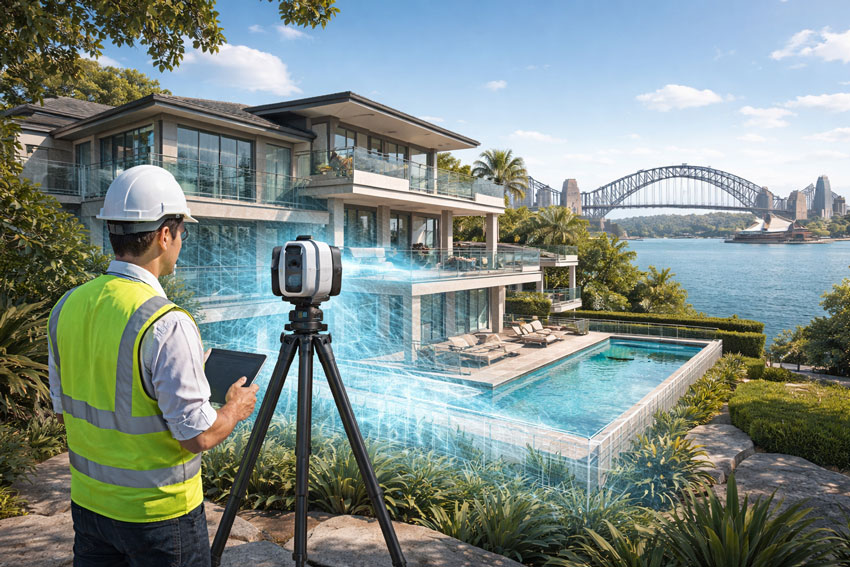
Engineer using a LiDAR scanner to capture a Sydney harbour-front residential property with Sydney Harbour Bridge in the background

Reality Capture Sydney for Real Estate & Property Assets

High-Accuracy Digital Records and Premium Visual Context

Sydneyโ€™s real estate and commercial property market demands accurate information, clear presentation, and confidence in decision-making. Whether supporting leasing, refurbishment, due diligence, or long-term asset management, reality capture in Sydney provides property owners and managers with a reliable digital record of what exists today.

Hamilton By Design delivers professional reality capture services in Sydney, combining high-accuracy spatial data with high-end visual outputs suited to commercial and premium property assets.


Reality capture of a Sydney waterfront residential property using LiDAR scanning with harbour and bridge context

What Is Reality Capture for Real Estate?

In a property context, reality capture is the process of digitally recording buildings and spaces using advanced laser scanning and spatial capture technologies. The result is a dimensionally accurate digital representation of an asset that can be reused across multiple projects without repeated site visits.

Reality capture is commonly used across Sydney for:

  • Accurate existing-condition records
  • Leasing and tenancy planning
  • Commercial fit-outs and refurbishments
  • Asset documentation and compliance support
  • Due diligence during acquisition or divestment

Unlike traditional photography or basic floor plans, reality capture provides measurable, verifiable data that reduces uncertainty and risk.


High-End Capture of Sydneyโ€™s Harbour & Landmark Context

For premium assets, context matters. Hamilton By Design captures high-resolution reality capture imagery that includes Sydneyโ€™s built environment and surrounding landmark context, where appropriate.

This may include:

  • Harbour-front commercial buildings
  • Assets with views or proximity to Sydney Harbour
  • Visual context incorporating the Sydney Harbour Bridge
  • CBD and waterfront developments

These high-end visuals support investor presentations, leasing material, and executive-level decision-making, while remaining grounded in accurate spatial data.


Why Reality Capture Matters in Sydneyโ€™s Property Market

Sydney properties often involve:

  • High asset values
  • Live, occupied buildings
  • Tight refurbishment timeframes
  • Complex services and structural interfaces

Reality capture helps property stakeholders to:

โœ” Verify what exists before committing capital
โœ” Reduce surprises during refurbishments
โœ” Support consultants with reliable base information
โœ” Minimise disruption to tenants
โœ” Maintain a long-term digital record of the asset

For property owners and managers, this translates directly to reduced risk and better outcomes.


Typical Real Estate Applications

As-Built Property Records

Create accurate digital records where original drawings are missing, outdated, or unreliable.

Leasing & Tenancy Planning

Support test fits, space planning, and consultant coordination with trusted spatial data.

Refurbishment & Upgrade Projects

Capture existing conditions prior to works to reduce redesign, delays, and cost overruns.

Due Diligence & Asset Review

Provide clarity and confidence during acquisition, divestment, or asset reviews.


A Professional, Asset-Focused Approach

While many services focus on visual outputs alone, Hamilton By Design approaches reality capture from an asset and decision-support perspective. Our deliverables are:

  • Dimensionally reliable
  • Fit for professional use
  • Suitable for consultants and contractors
  • Appropriate for commercial and executive audiences

This ensures reality capture data can be relied upon when property decisions carry financial and contractual significance.


Deliverables to Suit Property Clients

Depending on your requirements, we can provide:

  • Registered point clouds
  • CAD-ready base files
  • Accurate spatial references
  • Section views and area verification
  • Digital records suitable for future upgrades

All outputs are tailored to the intended property use, not generic scanning deliverables.


Our clients:


Reality Capture Sydney โ€” Confidence for Property Decisions

Reality capture removes uncertainty from property decisions. By accurately capturing what exists today, Sydney property owners and managers can plan, lease, refurbish, and manage assets with confidence.

Hamilton By Design supports Sydney real estate and commercial property clients with professional reality capture services that combine accuracy, clarity, and premium presentation.

Contact Hamilton By Design to discuss your Sydney property or real estate reality capture requirements.

Name
Would you like us to arrange a phone consultation for you?
Address
https://www.hamiltonbydesign.com.au/home/engineering-services/3d-scanning-sydney/3d-engineering-in-sydney