Foundations First: What Recent Media Coverage Reminds Engineers About Process

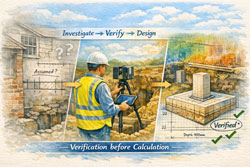
Watercolour-style illustration showing an engineer using a laser scanner to verify existing foundations before design, moving from “assumed” to “verified”.

Engineering Lessons from Recent Media: Foundations & Process First

A recent Tasmanian news story reported on a homeowner receiving a substantial payout after major renovations led to cracking in their house. The coverage in The Mercury described how the problems were linked to inadequate consideration of existing footings and ground conditions during the design of a second-storey extension:

Woodbridge homeowner wins huge payout after home cracked following two-storey extension
https://www.themercury.com.au/truecrimeaustralia/police-courts-tasmania/woodbridge-homeowner-wins-huge-payout-after-home-cracked-following-twostorey-extension

Legal industry commentators also discussed the same matter as a reminder of professional responsibilities when working on existing buildings:

Cracks in the duty: When engineers miss the foundations – Barry Nilsson Lawyers
https://bnlaw.com.au/knowledge-hub/insights/cracks-in-the-duty-when-engineers-miss-the-foundations/

Rather than revisiting who was right or wrong, the reporting offers a constructive opportunity to reflect on how everyday engineering processes can be improved—especially on renovation and brownfield projects where information is incomplete.


1. Investigation Is Part of Design

The media narrative highlights a simple truth:
when we work with existing structures, the ground and foundations are not background details—they are primary design inputs.

Good practice means:

  • Treating site verification as a formal stage of the project
  • Making recommendations for geotechnical or structural checks early
  • Being clear about what is known and what is assumed

A design based only on drawings is never as reliable as one based on verified conditions.


2. Make Assumptions Visible

News coverage often shows that problems grow in the grey space between architect, engineer, and builder.

Helpful habits include:

  • Keeping an assumptions register shared by the whole team
  • Noting on drawings what has been confirmed on site
  • Setting clear triggers for further investigation

When assumptions have owners, risks have boundaries.


3. Communication Is a Structural Element

Many reported disputes stem less from technical ability and more from gaps in communication.

Engineers can lead by:

  • Discussing uncertainties openly at the start
  • Confirming decisions in writing after meetings
  • Encouraging contractors to report unexpected conditions

Good communication is often cheaper than remediation.


4. Scope Changes = Risk Changes

Renovations rarely stay the same as the first sketch.
Media accounts of failures frequently involve projects that grew beyond the original intent.

Better process includes:

  • Re-checking engineering scope whenever the design evolves
  • Linking approvals to stages of investigation
  • Pricing verification as a real deliverable, not an afterthought

Clarity of scope is a form of structural strength.


5. Document the Story of the Project

Journalists and lawyers both rely on records to understand what happened.

For engineers, simple steps make a big difference:

  • Photos tied to inspection notes
  • Short design basis statements
  • Emails confirming client instructions
  • Sketches of as-found conditions

Documentation is not defensive—it is professional memory.


6. Respect the Interface Between Old and New

The media coverage repeatedly points to the moment where new work met an older structure.
That interface is where uncertainty lives.

Practical responses:

  • Specific checks on existing footings before adding load
  • Independent review for heritage or unknown construction
  • Monitoring after completion to confirm behaviour

The junction between old and new deserves the most attention.


7. The Courage to Pause

Perhaps the most human lesson from the reports is that engineers sometimes need to slow a project down.

Saying:

“We need more information before proceeding”

is not obstruction—it is professionalism.

Organisations that support this courage protect clients and engineers alike.


Turning Headlines into Better Practice

The story covered by The Mercury and the subsequent industry commentary do not need to be read as cautionary tales. They can be read as learning opportunities:

  • Investigate before you calculate
  • Make assumptions visible
  • Communicate uncertainty early
  • Document decisions clearly
  • Treat existing conditions with respect

These are the foundations of good engineering, long before concrete is poured.
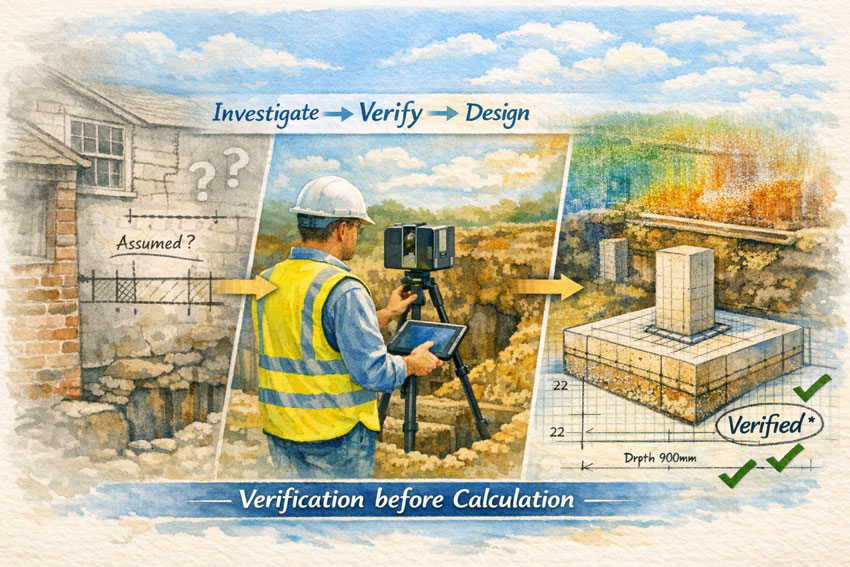

Engineer performing site investigation with 3D scanner, illustrating investigate → verify → design workflow for existing structures.

Final Thought

Risk will always exist in renovation and brownfield work.
What we control is the process we wrap around that risk.

When engineers focus on verification, transparency, and collaboration, projects become safer, clients are better served, and the profession grows stronger.

Good engineering is not only about correct numbers—
it is about asking the right questions at the right time.

References

“Woodbridge homeowner wins huge payout after home cracked following two-storey extension”The Mercury (Tasmania)
🔗 https://www.themercury.com.au/truecrimeaustralia/police-courts-tasmania/woodbridge-homeowner-wins-huge-payout-after-home-cracked-following-twostorey-extension/news-story/32fe411a57c2471be44962cba86100bd


3D CAD Modelling Australia service banner for Hamilton By Design
Finite Element Analysis (FEA) engineering simulation button
Mechanical engineering services

Lessons from a Landmark Case:

The Importance of Robust Structural Design Review

In 2024, SafeWork SA concluded a landmark case involving a spectator-roof collapse during a football club redevelopment project in South Australia. While no life-threatening injuries occurred, the incident highlighted how critical it is for design, review, and certification processes to work together to ensure safety on site.

This was the first successful design-related prosecution under South Australia’s Work Health and Safety Act, sending a clear signal to the engineering and construction sector: design decisions carry legal and safety obligations, not just technical ones.

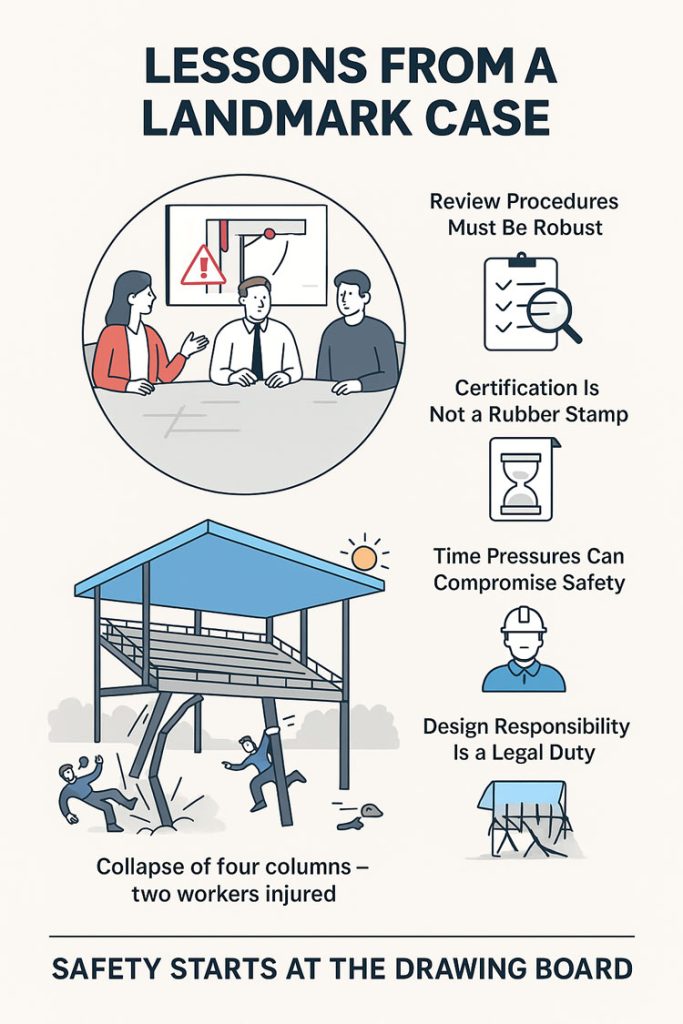
Infographic titled “Lessons from a Landmark Case,” showing engineers reviewing a design, icons highlighting robust review procedures, proper certification, time-pressure risks, and legal design responsibilities. The lower illustration depicts a structure collapsing after four column failures with two workers falling, emphasising the message “Safety starts at the drawing board

What Happened (Briefly)

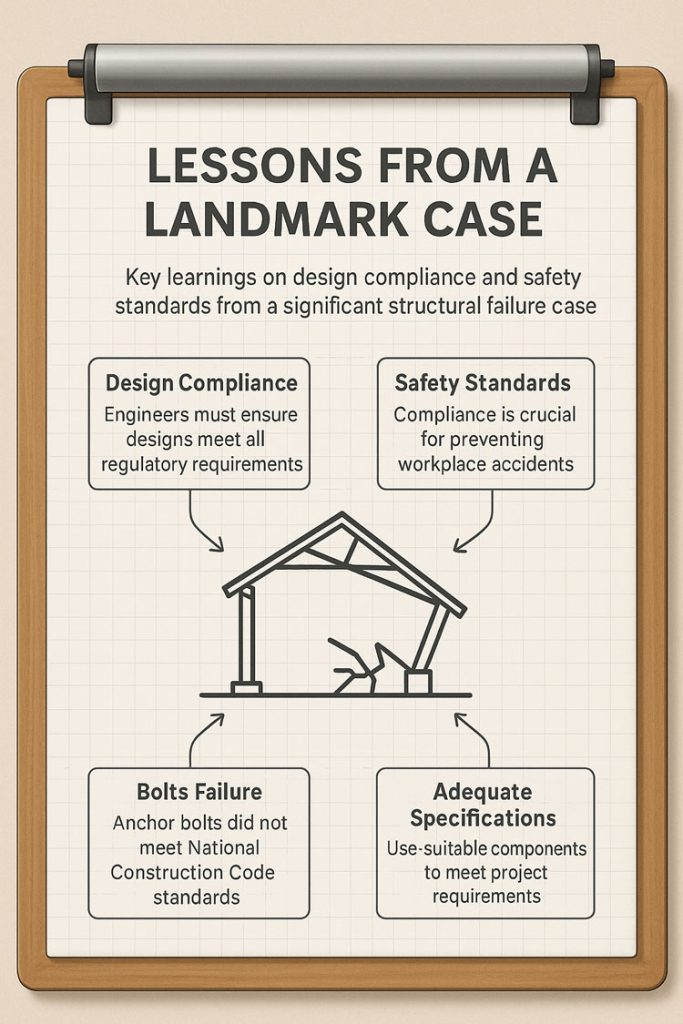
During roof sheeting works in late 2021, four of seven supporting columns of a cantilevered spectator roof failed, causing two apprentices to slide down the roof sheets. SafeWork SA’s investigation found that the anchor bolts specified for the column base plates were inadequate and did not meet the requirements of the National Construction Code (NCC).

An independent compliance review also failed to detect this issue, allowing the error to pass unchecked into construction. The result was a collapse that could have had far more severe consequences had the roof been fully loaded or occupied.

Key Learnings for the Industry

This case underscores several important lessons for engineers, designers, project managers, and certifiers:

1. Design Responsibility Is a WHS Duty

Under the WHS Act, designers have a duty to ensure their work is safe not just in its intended use, but during construction. This means bolts, connections, and base plates must be designed for real-world loads — including wind uplift, combined shear and tension, and concrete breakout limits per NCC and relevant Australian Standards.

2. Review Procedures Must Be Robust — and Followed

Having a documented review procedure is not enough if it isn’t rigorously applied. Independent verification and internal peer review are critical to catching design errors before they reach site.

3. Certification Is Not a Rubber Stamp

Independent certifiers play a key role in safeguarding public safety. They must actively verify that designs meet compliance, rather than simply sign off on documentation.

4. Time Pressures Can Compromise Safety

Compressed project timelines were noted as a factor in missed opportunities to catch the error. Project teams must resist the temptation to shortcut review steps when schedules are tight — safety must remain non-negotiable.

5. Documentation & Traceability Protect Everyone

Maintaining calculation records, checklists, and review signoffs creates a clear audit trail. This helps demonstrate due diligence if something goes wrong.

Infographic titled ‘Lessons From a Landmark Case’ displayed on a clipboard. It highlights key learnings from a structural failure case: design compliance, safety standards, bolts failure, and adequate specifications. At the centre is a simple line drawing of a collapsed structure, with arrows pointing to four labelled boxes describing the importance of regulatory compliance, workplace safety standards, anchor bolt failures, and using suitable components to meet project requirements

Why This Matters

The collapse at Angaston Football Club was a relatively small incident with minor injuries — but it could easily have been catastrophic. By learning from cases like this, the industry can improve its processes and prevent future failures.

As professionals, our role is to design for safety, verify rigorously, and document clearly. Doing so protects workers, end-users, and our own organisations.

Legal & Ethical Considerations

This post is intended as a learning resource, not as an allocation of blame. The case referenced is a matter of public record through SafeWork SA and SAET decisions, and all commentary here focuses on general principles of safe design and compliance.

We recommend that other practitioners review their own QA and certification procedures in light of this case to ensure compliance with the National Construction Code and WHS obligations.

More Information —> The Advertiser / Adelaide Now

Hamilton By Design logo displayed on a blue tilted rectangle with a grey gradient background

Mechanical Engineering | Structural Engineering

Mechanical Drafting | Structural Drafting

3D CAD Modelling | 3D Scanning

Chute Design

SolidWorks Contractors in Australia

Hamilton By Design – Blog

Finite Element Analysis (FEA) engineering simulation button
Mechanical engineering services