Engineering-Grade Port Facility LiDAR Scanning Services in Sydney

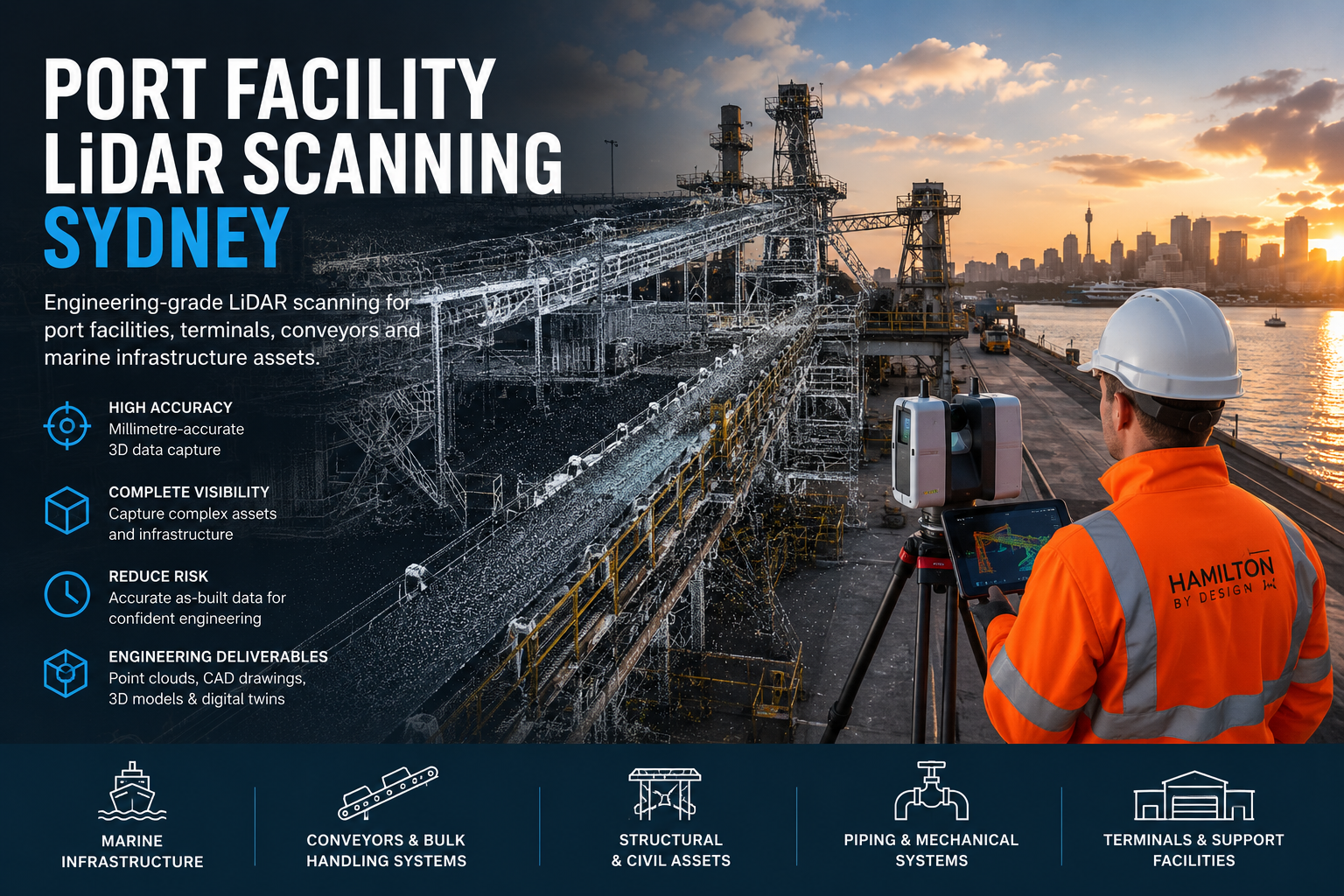
Port Facility LiDAR Scanning Sydney showing a surveyor using a terrestrial laser scanner to capture conveyors, terminal infrastructure and marine assets at a Sydney port facility for engineering design, asset management and Scan-to-CAD projects.
Blue 3D LiDAR scanner icon on a tripod with scanning waves

Hamilton By Design provides engineering-grade LiDAR scanning services for port facilities, container terminals, bulk handling infrastructure, marine assets and industrial facilities throughout Sydney. Our team specialises in capturing highly accurate three-dimensional data of existing infrastructure to support engineering design, asset management, maintenance planning, shutdown projects, brownfield upgrades and digital asset documentation.

Using advanced terrestrial LiDAR scanning technology, we capture millions of measurement points across complex operating environments to create accurate digital representations of port infrastructure. The resulting point clouds can be used for Scan-to-CAD, Scan-to-BIM, reverse engineering, structural analysis, mechanical design and asset verification projects.

Whether you require the scanning of conveyors, ship loaders, wharves, transfer stations, pipework systems, warehouses, structural steelwork or entire port terminals, Hamilton By Design delivers reliable and engineering-ready data suitable for detailed design and project execution.

LiDAR Scanning Services for Sydney Port Infrastructure

Sydney’s ports and marine facilities are critical infrastructure assets that operate continuously and often undergo maintenance, expansion and upgrade projects. Accurate as-built information is essential when designing modifications or integrating new equipment into existing facilities.

Our Port Facility LiDAR Scanning Sydney services support:

  • Container terminals
  • Bulk handling facilities
  • Cargo handling infrastructure
  • Conveyor systems
  • Wharf structures
  • Marine loading facilities
  • Pump stations
  • Transfer towers
  • Ship loading systems
  • Warehouses and storage facilities
  • Structural steel infrastructure
  • Maintenance workshops
  • Utilities and services infrastructure

By creating accurate digital representations of existing assets, project teams can significantly reduce design risks and avoid costly site rework.

Why LiDAR Scanning Is Important for Port Facilities

Many Sydney port facilities have evolved over decades, with infrastructure expanded, modified and upgraded numerous times. Existing drawings are often incomplete, outdated or missing altogether.

Traditional site measurement methods can be time-consuming, disruptive and prone to error. LiDAR scanning provides a safer and more efficient alternative by rapidly capturing millions of accurate measurements across large and complex environments.

Benefits include:

  • Reduced site visits
  • Improved safety outcomes
  • Accurate as-built documentation
  • Faster engineering design
  • Reduced rework during construction
  • Improved project planning
  • Enhanced clash detection
  • Better asset management

The result is a highly detailed digital record that can be referenced throughout the lifecycle of an asset.

Typical Port Assets We Scan

Hamilton By Design regularly scans a wide range of marine, mechanical, structural and civil infrastructure.

Marine Infrastructure

Our scanning services are ideal for:

  • Wharves
  • Berths
  • Jetties
  • Piers
  • Fender systems
  • Mooring structures
  • Marine access platforms
  • Cargo loading facilities

These assets can be accurately captured and modelled to support maintenance and upgrade projects.

Mechanical Infrastructure

Port facilities often contain extensive mechanical systems requiring accurate documentation and modelling.

Common assets include:

  • Conveyors
  • Chutes
  • Hoppers
  • Stackers
  • Reclaimers
  • Crushers
  • Transfer stations
  • Pump systems
  • Pipework networks
  • Valves and fittings

Detailed point clouds enable engineers to develop accurate retrofit and replacement designs with confidence.

Structural Infrastructure

Structural scanning projects commonly include:

  • Structural steelwork
  • Conveyor gantries
  • Access platforms
  • Walkways
  • Handrails
  • Maintenance structures
  • Warehouses
  • Industrial buildings

The captured data can be converted into CAD models and engineering drawings for future projects.

Engineering Applications

LiDAR scanning data provides valuable input for a wide range of engineering activities.

Scan to CAD

Point cloud data can be converted into:

  • 2D CAD drawings
  • General arrangement drawings
  • Sections and elevations
  • Site layouts
  • Equipment layouts

These deliverables provide a reliable foundation for engineering projects.

Reverse Engineering

Where original drawings are unavailable, scanned assets can be reverse engineered to create:

  • 3D CAD models
  • Manufacturing drawings
  • Replacement component designs
  • Equipment upgrades
  • Legacy asset documentation

This approach is particularly valuable for ageing port infrastructure and obsolete equipment.

Brownfield Upgrade Projects

Many port facilities remain operational while upgrade works are undertaken.

LiDAR scanning enables engineers to:

  • Verify available space
  • Identify clashes
  • Validate clearances
  • Design around existing infrastructure
  • Improve constructability

The result is reduced project risk and improved installation outcomes.

Our LiDAR Scanning Process

1. Project Planning

We begin by reviewing project requirements, site access constraints and deliverable expectations.

This stage identifies:

  • Scan coverage requirements
  • Safety considerations
  • Access restrictions
  • Accuracy requirements
  • Final deliverables

2. Site Data Capture

Using professional LiDAR scanning equipment, we capture millions of accurate measurements throughout the facility.

Data collection may include:

  • Terrestrial laser scanning
  • High-density point cloud capture
  • Structural scanning
  • Mechanical equipment scanning
  • Infrastructure scanning

Large facilities can be captured efficiently while minimising disruption to operations.

3. Point Cloud Registration

Following site capture, scans are processed and registered into a unified coordinate system.

This process creates:

  • Registered point clouds
  • Quality assurance reports
  • Survey-aligned datasets
  • Engineering-ready deliverables

4. Modelling and Documentation

The point cloud data can then be converted into engineering deliverables including CAD drawings, BIM models and 3D asset models.

Deliverables

Hamilton By Design can provide a range of deliverables depending on project requirements.

Point Cloud Deliverables

  • E57
  • RCP
  • RCS
  • LAS
  • LGS

CAD Deliverables

  • DWG drawings
  • DXF drawings
  • Site plans
  • General arrangements
  • Sections and elevations

3D Models

  • SolidWorks models
  • STEP files
  • SAT files
  • Navisworks models
  • BIM models

Engineering Deliverables

  • Asset documentation
  • Clash detection reports
  • As-built verification
  • Reverse engineering models
  • Upgrade design support

Industries We Support

Our Port Facility LiDAR Scanning Sydney services support a broad range of industries including:

  • Ports and marine infrastructure
  • Logistics and transport
  • Manufacturing
  • Mining and bulk materials handling
  • Utilities
  • Water infrastructure
  • Industrial facilities
  • Government infrastructure
  • Engineering consultancies
  • Construction contractors

Our engineering background allows us to understand how scanning data will ultimately be used within design, maintenance and asset management workflows.

Why Choose Hamilton By Design

Hamilton By Design combines practical engineering experience with advanced reality capture technology. Unlike survey-only providers, our team understands how point cloud data is used throughout engineering projects, from concept design through to fabrication and installation.

We provide engineering-focused LiDAR scanning services that support real-world project outcomes, helping clients reduce risk, improve accuracy and accelerate project delivery.

Whether you require a conveyor scanned for a shutdown project, a wharf documented for refurbishment works, or an entire port facility captured for future upgrades, Hamilton By Design delivers accurate, reliable and engineering-ready data across Sydney and surrounding regions.

Hamilton By Design logo displayed on a blue tilted rectangle with a grey gradient background

Contact Hamilton By Design

If you require Port Facility LiDAR Scanning in Sydney, contact Hamilton By Design to discuss your project requirements. We provide engineering-grade reality capture, Scan-to-CAD, reverse engineering and infrastructure documentation services for port operators, contractors and engineering consultants throughout Sydney and Australia.

Talk to Us – Contact Us

Name
Would you like us to arrange a phone consultation for you?
Address

Our clients:


Mechanical Engineering in Mining Infrastructure

Mining processing plant infrastructure with conveyors and transfer towers illustrating mechanical engineering design for mining operations.

Mining mechanical engineering covers the design, integration, and optimisation of equipment used in extraction, processing, and materials handling.

Typical systems include:

  • Conveyor systems and transfer stations
  • Crushing and screening equipment
  • Pumping systems and slurry transport
  • Structural mechanical equipment supports
  • Chutes, bins, and materials handling systems
  • Mechanical plant upgrades and retrofits

Each of these systems must be designed to handle high loads, abrasive materials, and continuous operation while integrating into existing plant layouts.

For projects involving plant upgrades or shutdown work, it is critical to capture existing plant conditions accurately before design begins.

Learn more about this process here:


Engineering Design for Existing Mining Plants

Many mining projects involve modifying existing infrastructure rather than building new facilities. This presents several engineering challenges:
  • Limited installation space
  • Legacy equipment and undocumented plant layouts
  • Structural constraints
  • Integration with operating equipment

Hamilton By Design addresses these challenges by using engineering-grade 3D laser scanning to capture precise plant geometry before design work begins.

This approach allows engineers to work with accurate digital models of operating plants, reducing risk during installation and shutdown work.

Learn more about our scanning services:

From Point Cloud to Mechanical Engineering Model

Once a plant has been scanned, the collected data is converted into a point cloud model that represents the existing infrastructure.

From this data we can produce:

  • Mechanical equipment layouts
  • Pipe routing designs
  • Structural steel interfaces
  • Conveyor and chute designs
  • Equipment modification models

The process ensures new engineering designs fit within the true geometry of the plant, avoiding clashes and installation problems.

Read more about the workflow here:


Mechanical Design for Mining Shutdown Projects

Shutdowns are one of the most critical periods in mining operations. Mechanical engineering designs prepared for shutdown installation must be accurate, buildable, and delivered on tight timelines.

Typical shutdown design work includes:

  • Conveyor upgrades and chute modifications
  • Pump station upgrades
  • Structural steel modifications
  • Pipework rerouting
  • Equipment replacement projects

With accurate plant models and detailed mechanical drafting, shutdown installations can proceed with minimal disruption to production.

Learn more about shutdown engineering support:


Materials Handling System Design

A large portion of mining mechanical engineering focuses on bulk materials handling systems.

These systems include:

  • Conveyors and drive systems
  • Transfer chutes and loading points
  • Storage bins and hoppers
  • Feeders and discharge systems

Engineering design must consider:

  • Flow characteristics of the material
  • Wear and abrasion resistance
  • Maintenance access
  • Structural loads and equipment interfaces

When properly designed, materials handling systems improve plant reliability and reduce maintenance costs.


Structural Integration in Mechanical Design

Mechanical equipment rarely operates independently. It must integrate with structural steel, concrete foundations, and existing infrastructure.

This requires coordination between:

  • Mechanical engineers
  • Structural engineers
  • drafting and modelling teams
  • site installation teams

At Hamilton By Design we integrate these disciplines within our modelling workflows to ensure mechanical systems are fully coordinated with plant infrastructure.


Engineering Services for Mining Operations

Hamilton By Design supports mining operations with a range of mechanical engineering services, including:

  • Mechanical equipment design
  • Conveyor and chute design
  • Pump system engineering
  • Structural steel interface design
  • Plant modification modelling
  • Engineering drafting and documentation
  • 3D laser scanning of existing infrastructure

Our engineering services are commonly used during:

  • plant upgrades
  • shutdown preparation
  • brownfield expansions
  • maintenance planning
  • infrastructure upgrades

Why Accurate Engineering Design Matters in Mining

Mining infrastructure operates under demanding conditions. Poor engineering design can lead to:

  • installation delays
  • shutdown overruns
  • equipment failures
  • safety risks

By combining accurate site capture, engineering modelling, and practical design experience, mechanical engineering teams can reduce project risk and deliver reliable infrastructure upgrades.


Mechanical Engineering Support for Mining Projects

Hamilton By Design works with mining companies, engineering contractors, and maintenance teams to deliver practical mechanical engineering solutions for mining infrastructure.

Our services combine:

  • site knowledge
  • engineering modelling
  • practical fabrication awareness
  • plant upgrade experience

To learn more about our mining engineering services visit:


Further reading:

CHPP Engineering title graphic featuring bold white text reading "CHPP Engineering" centred on a blue rounded rectangle background.
Pipework Drafting title graphic featuring bold white text reading "Pipework Drafting" centred on a blue rounded rectangle background.
3D LiDAR Scanning for Engineering Projects title graphic featuring bold white text on a blue rounded rectangle background.
3D LiDAR scanning and 3D modelling service button โ€” laser scanner capturing a point cloud for engineering and CAD modelling
Mechanical engineering services

Name
Would you like us to arrange a phone consultation for you?
Address

Our clients

3D CAD Modelling Australia service banner for Hamilton By Design

3D Laser Scanning in Parramatta: Safer Conveyor Design with Engineering-Grade Accuracy

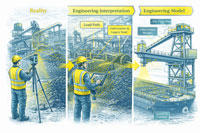
Engineering-grade LiDAR scanning of a brownfield industrial asset, showing the progression from site capture and point cloud interpretation to a fabrication-ready engineering model.

3D Laser Scanning for Conveyor Design & Safe Engineering in Parramatta

Parramatta continues to grow as a major industrial and infrastructure hub for Western Sydney. With ageing plant, frequent upgrades, and tighter safety expectations, many facilities are now turning to engineering-grade 3D laser scanning to improve the way conveyor systems and material handling equipment are designed, modified, and maintained.

At Hamilton By Design, we use high-accuracy LiDAR scanning to capture existing conditions and convert them into precise 3D models that engineers, designers, and maintenance teams can rely on โ€” before anyone picks up a spanner or starts cutting steel.

Why Conveyor Systems Are High-Risk Assets

Conveyors are involved in a significant number of serious workplace incidents across Australia. Common contributors include:

  • Inadequate guarding and access control
  • Poor visibility of nip points and transfer zones
  • Modifications made without updated drawings
  • Space constraints forcing unsafe maintenance practices

In many older facilities around Parramatta, conveyors have been extended, rerouted, or repaired multiple times over decades โ€” often without accurate as-built documentation. This creates real risk when new upgrades or safety improvements are planned.

Without reliable spatial data, design decisions are often made on assumptions, outdated drawings, or rough site measurements.

Engineering-Grade Scanning: Not Just โ€œPretty Picturesโ€

Not all 3D scans are suitable for engineering or safety-critical work.

We use engineering-grade LiDAR scanning capable of delivering dimensional accuracy of approximately ยฑ2 mm over 70 metres, which allows us to:

  • Model conveyor structures, walkways, guards, and transfer stations
  • Detect clashes before fabrication
  • Verify compliance with safe access and guarding requirements
  • Support certified engineering design and sign-off

The resulting point cloud and CAD models become the foundation for proper conveyor design, safety reviews, and fabrication drawings.

This is critical when safe design obligations must be demonstrated under WHS legislation.


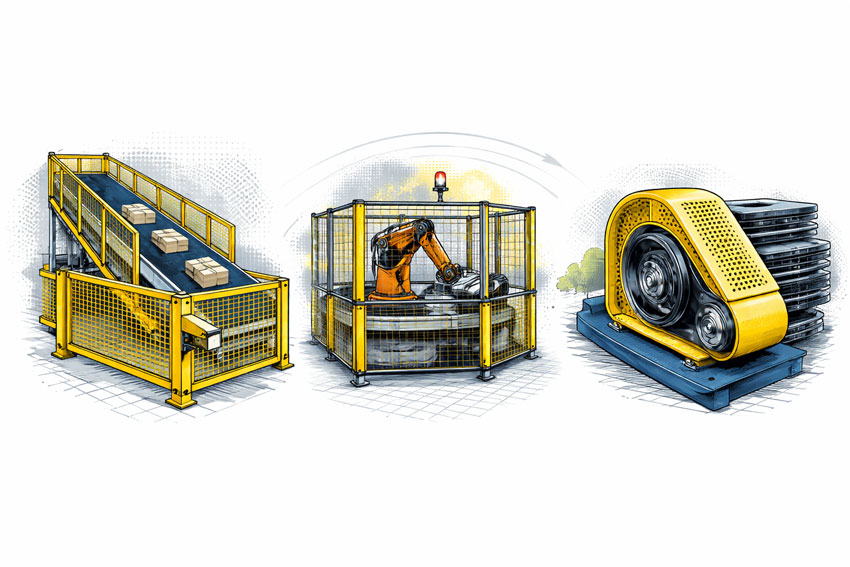
Industrial machine guards including a guarded conveyor, fenced robotic cell, and covered belt drive system

Supporting Safe Design from Concept to Commissioning

Safe Design is not just about guarding at the end of a project โ€” it starts at the design stage.

By scanning your existing plant, we can support:

  • Risk assessments using accurate spatial context
  • Redesign of transfer points and access platforms
  • Guarding upgrades that actually fit the site
  • Maintenance access improvements without production impact

Because models are generated from real geometry, engineers can confidently design modifications knowing they will physically fit when installed.

This reduces shutdown risk, rework, and last-minute site changes โ€” all common contributors to project delays and safety incidents.

Learning from Industry Incidents โ€” and Preventing the Next One

Many conveyor-related incidents share similar root causes:

  • Poor access for cleaning or inspection
  • Unplanned modifications
  • Incomplete hazard identification during design
  • Reliance on legacy drawings that no longer match reality

3D scanning allows hazards to be identified early and reviewed by multiple stakeholders โ€” engineering, safety, operations, and maintenance โ€” using the same accurate model.

It also creates a permanent digital record of the asset at a point in time, which is invaluable for:

  • Incident investigations
  • Compliance documentation
  • Future upgrade planning

In high-risk environments, accurate data is not a luxury โ€” it is a control measure.

Local Scanning and Engineering Support in Parramatta

Hamilton By Design provides on-site 3D scanning and engineering services across Parramatta and Western Sydney, supporting:

  • Conveyor upgrades and replacements
  • Safety improvement projects
  • Plant expansions and brownfield modifications
  • Fabrication and installation planning

Our team is engineering-led, meaning scanning is not treated as a standalone service โ€” it is directly integrated into mechanical design, drafting, and project delivery.

We also provide fabrication-ready drawings and can support workshops with shop details derived directly from scan-based models.


Hamilton By Design logo displayed on a blue tilted rectangle with a grey gradient background

3D LiDAR scanning and 3D modelling service button โ€” laser scanner capturing a point cloud for engineering and CAD modelling
Mechanical engineering services

From Point Cloud to Practical Outcomes

3D scanning is only valuable if it leads to better decisions on the ground.

Our workflow typically includes:

  1. On-site LiDAR scanning with minimal disruption to operations
  2. Registration and cleaning of point cloud data
  3. Conversion into CAD models suitable for engineering design
  4. Design development, safety reviews, and fabrication drawings

This ensures your project is driven by real-world data โ€” not assumptions.

Name
Would you like us to arrange a phone consultation for you?
Address
3D Scanning Sydney banner promoting engineering-grade 3D laser scanning, LiDAR scanning, and reality capture services by Hamilton By Design.
Mechanical Engineering Sydney banner with white text on a blue background representing Hamilton By Design's mechanical engineering services in Sydney.
Mechanical Drafting and 3D Modelling Sydney banner highlighting Hamilton By Design's CAD drafting, 3D modelling, and engineering design services in Sydney.

Hamilton By Design provides engineering-led 3D scanning, LiDAR scanning, mechanical engineering and digital engineering services throughout Sydney and Greater Sydney.

Explore our related Sydney services:


  • 3D Scanning Sydney โ€“ Engineering-grade terrestrial laser scanning, as-built surveys and point cloud capture for industrial, infrastructure and commercial projects.
  • Reality Capture Sydney โ€“ High-accuracy reality capture, digital twins, asset documentation and engineering-grade site verification.
  • Scan to CAD Sydney โ€“ Convert point cloud data into AutoCAD, SolidWorks, Inventor and other engineering-ready CAD deliverables.
  • Point Cloud Modelling Sydney โ€“ Engineering-grade point cloud processing, clash detection, as-built verification and 3D modelling.
  • Mechanical Engineering Sydney โ€“ Mechanical design, plant upgrades, materials handling systems, conveyors, chutes, platforms and engineering support.
  • Structural Drafting Sydney โ€“ Structural steel drafting, fabrication drawings, GA drawings, workshop detailing and as-built documentation.

Hamilton By Design supports projects throughout Sydney CBD, Parramatta, Liverpool, Penrith, Blacktown, Chatswood, Alexandria, Mascot, Newcastle and the Central Coast.


Blue banner graphic displaying the text "Point Cloud to CAD - Australia" in large white lettering, representing point cloud processing, scan-to-CAD conversion and digital engineering services across Australia.
Blue banner graphic displaying the text "Scan to CAD Sydney" in large white lettering, representing engineering-led point cloud to CAD conversion, LiDAR scanning and digital engineering services in Sydney.
Blue banner graphic displaying the text "Reality Capture Sydney - CBD" in large white lettering, representing engineering-led reality capture, LiDAR scanning and digital engineering services within Sydney CBD commercial buildings and infrastructure.

Mechanical Engineering | Structural Engineering


AS 1755 Conveyor Safety

Engineer reviewing a guarded conveyor system with fixed side and nip-point guards designed to prevent access to moving parts.

Designing Conveyor Guarding for Compliance, Safety, and Practical Operation

Conveyors are widely used across processing, manufacturing, and materials-handling environments, but they also present some of the most persistent safety risks in industrial operations. Entrapment, nip points, rotating components, and maintenance access are all recognised hazards that must be managed through proper design and guarding.

In Australia, these risks are addressed through AS 1755 โ€“ Conveyors โ€“ Safety Requirements, which establishes the minimum safety expectations for conveyor systems across their full lifecycle, from design and installation through to operation and maintenance.

This article outlines what AS 1755 requires, why compliant conveyor guarding is critical, and how engineering-led design plays a key role in achieving practical safety outcomes.


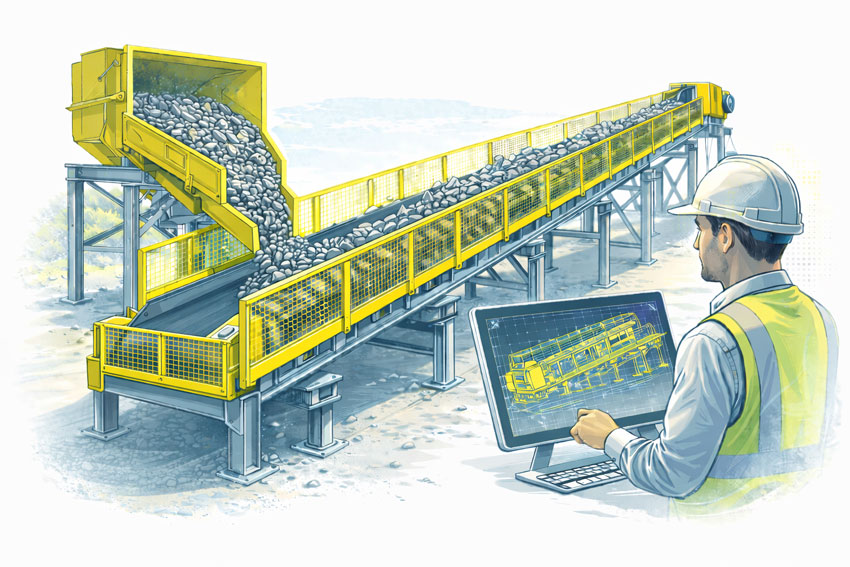
Bulk materials conveyor with compliant safety guarding at the hopper, tail end, and along the conveyor, shown with an engineer reviewing guarding design drawings.
3D LiDAR scanning and 3D modelling service button โ€” laser scanner capturing a point cloud for engineering and CAD modelling
Mechanical engineering services

What Is AS 1755?

AS 1755 is the Australian Standard that defines safety requirements for belt conveyors and other conveyor systems. It addresses both new and existing installations and applies to conveyors used in industrial, commercial, and processing environments.

Rather than focusing on individual guarding components in isolation, AS 1755 considers the conveyor system as a whole, including how people interact with it during normal operation, inspection, cleaning, and maintenance.

The standard is referenced by regulators, safety professionals, and engineers as the primary benchmark for conveyor safety in Australia.


Key Safety Principles in AS 1755

AS 1755 is built around a number of core safety principles that influence how conveyor guarding should be designed.

These include eliminating hazards where possible, controlling remaining risks through engineering solutions, and ensuring that guarding does not introduce new risks by restricting access or encouraging unsafe behaviour.

In practice, this means that compliant guarding must be effective, durable, and suitable for the operating environment, while still allowing conveyors to be inspected, cleaned, and maintained safely.


Conveyor Guarding Requirements

A major focus of AS 1755 is the control of access to hazardous areas. This includes guarding of:

  • Drive pulleys and tail pulleys
  • Return rollers and idlers
  • Nip points and shear points
  • Rotating shafts and couplings
  • Chain drives, belt drives, and gearboxes

Guarding must be designed so that body parts cannot access hazardous zones, taking into account reach distances, openings, and the position of the conveyor relative to walkways or platforms.

Importantly, AS 1755 recognises that guarding must be fit for purpose. Poorly designed guards that are difficult to remove, inspect, or maintain are often bypassed or removed altogether, creating new safety risks.


Fixed Guards vs Interlocked Guards

AS 1755 allows for different types of guarding depending on the application and risk profile.

Fixed guards are commonly used where access is not required during normal operation. These guards must be securely fixed and require tools for removal.

Interlocked guards may be required where regular access is necessary. These systems ensure that the conveyor cannot operate while the guard is open or removed, reducing the risk of exposure to moving parts.

Selecting the appropriate guarding strategy requires an understanding of how the conveyor is used in practice, not just how it appears on drawings.


Existing Conveyors and Retrofit Challenges

Many conveyors currently in service were installed before the latest versions of AS 1755 were adopted. In these cases, compliance is often achieved through retrofit guarding rather than full replacement.

Retrofitting guarding to existing conveyors introduces additional challenges, including:

  • Limited space around existing equipment
  • Incomplete or outdated drawings
  • Structural constraints
  • Ongoing operation during upgrades

Engineering-led assessment and accurate documentation of existing conditions are critical when designing retrofit guarding solutions that comply with AS 1755 without disrupting operations.


The Role of Engineering in Conveyor Guarding Design

AS 1755 does not provide prescriptive โ€œone-size-fits-allโ€ guard designs. Instead, it sets performance requirements that must be interpreted and applied by competent professionals.

Engineering input is essential to ensure that conveyor guarding:

  • Addresses all relevant hazards
  • Integrates with existing mechanical and structural systems
  • Can be fabricated and installed accurately
  • Supports safe maintenance and inspection activities

Poorly engineered guarding may appear compliant on paper but fail in real-world use.


Documentation, Verification, and Ongoing Safety

Compliance with AS 1755 is not a one-time activity. Conveyor systems evolve over time as layouts change, equipment is upgraded, and operating practices shift.

Clear documentation of guarding design, installation, and assumptions provides a baseline for future modifications and safety reviews. This documentation is also critical when demonstrating due diligence to regulators or during incident investigations.


Why AS 1755 Matters

AS 1755 exists to prevent serious injuries and fatalities associated with conveyor systems. When applied correctly, it provides a structured framework for identifying hazards, implementing effective controls, and maintaining safe operation over the life of the equipment.

Achieving compliance requires more than installing mesh around moving parts. It requires understanding how people interact with conveyors and designing guarding that supports safe behaviour rather than working against it.


Hamilton By Design logo displayed on a blue tilted rectangle with a grey gradient background

Conveyor guarding designed in accordance with AS 1755 is a critical component of safe industrial operations. Engineering-led design, accurate documentation, and practical consideration of maintenance and operation are essential to achieving compliance that works in practice.

When conveyor safety is treated as an engineering problem rather than a checkbox exercise, the result is safer equipment, fewer incidents, and more reliable operations.

Manufacturing and production services button

Our clients


Name
Would you like us to arrange a phone consultation for you?
Address

3D CAD Modelling Australia service banner for Hamilton By Design


CHPP Engineering title graphic featuring bold white text reading "CHPP Engineering" centred on a blue rounded rectangle background.
Pipework Drafting title graphic featuring bold white text reading "Pipework Drafting" centred on a blue rounded rectangle background.
3D LiDAR Scanning for Engineering Projects title graphic featuring bold white text on a blue rounded rectangle background.


Finite Element Analysis (FEA) engineering simulation button
Structural drafting services button
Mechanical drafting services button


Australian Drafting logo featuring bold white text reading "Australian Drafting" centred on a blue rounded rectangle background.
Engineering Governance title graphic featuring bold white text reading "Engineering Governance" centred on a blue rounded rectangle background.
Engineering-Grade LiDAR Scanning title graphic featuring bold white text on a blue rounded rectangle background.


Mechanical drafting services button
Structural drafting services button


Fabrication and product design services
3D CAD Modelling Australia service banner for Hamilton By Design
Mechanical, Structural & Pipework Drafting service banner by Hamilton By Design featuring white text on a blue background.


3D LiDAR scanning and 3D modelling service button โ€” laser scanner capturing a point cloud for engineering and CAD modelling
Mechanical engineering services

Mechanical Engineering | Structural Engineering