From Scan to Shutdown

3D laser scanner capturing an industrial structure for engineering-grade digital modelling and verification

Why Hamilton By Design Is the Engineering Partner of Choice in Moranbah and the Bowen Basin – Engineering where it matters most

Moranbah and the surrounding Bowen Basin sit at the centre of Australiaโ€™s coal production engine. This is not a region defined by conceptual studies or theoretical designโ€”it is defined by tonnes per hour, shutdown windows, safety performance, and whether plant modifications fit first time.

For mining companies operating in this regionโ€”including major operators such as BHP Mitsubishi Alliance, Anglo American, Glencore, Whitehaven Coal, QCoal Group, Yancoal Australia, Coronado Global Resources, and Bowen Coking Coalโ€”engineering success is measured by outcomes, not promises.

Hamilton By Design exists specifically for environments like Moranbah: brownfield, high-risk, shutdown-driven, and unforgiving of design errors. This article explains why our engineer-led, scan-to-fabrication workflow aligns so closely with the realities of mechanical engineering in the Bowen Basinโ€”and how it delivers value across CHPPs, materials-handling plants, and mine infrastructure.


Moranbah: a convergence of mining, mechanics, and margin

Mechanical engineering in Moranbah is unique because it operates at the intersection of:

  • Live production assets
  • Harsh environmental conditions
  • Compressed shutdown schedules
  • Zero tolerance for rework

Almost every mine in the region is supported by a CHPP, conveyors, crushers, stackers, reclaimers, and complex transfer stations. These assets are often decades old, modified many times, and poorly documented.

For operators, this creates constant engineering risk:

  • Unknown as-built conditions
  • Dimensional uncertainty
  • Legacy structural fatigue
  • Congested plant layouts
  • Safety constraints during access and installation

Hamilton By Design was formed to remove this uncertainty.


The core problem: brownfield uncertainty

Most engineering failures in the Bowen Basin are not caused by poor calculations. They are caused by poor information.

Traditional workflows often rely on:

  • Outdated drawings
  • Manual tape measurements
  • Partial site access
  • Assumptions made under time pressure

In Moranbah, these assumptions are expensive.

A single clash during a CHPP shutdown can cascade into:

  • Lost production
  • Extended outages
  • Emergency site modifications
  • Safety exposure
  • Cost overruns

Hamilton By Design addresses this problem at its source: accurate, engineer-owned site data.


Engineer-led 3D laser scanning: data you can trust

4

Hamilton By Design delivers engineering-grade 3D LiDAR scanning, not generic survey capture. This distinction matters.

Our scans are:

  • Planned by mechanical engineers
  • Captured with fabrication tolerances in mind
  • Registered and verified for design use
  • Interpreted by the same engineers who model and draft the solution

For Bowen Basin operators, this means:

  • Confidence in clearances
  • Reliable tie-in locations
  • Accurate centre-lines and datum references
  • Reduced site revisits
  • Fewer RFIs during fabrication and installation

This approach underpins everything that follows.


From scan to CAD: turning reality into buildable models

Point clouds are only valuable if they are converted into usable engineering models.

Hamilton By Design specialises in:

  • SolidWorks-based mechanical modelling
  • CHPP equipment modelling
  • Conveyor and chute systems
  • Structural steel and platforms
  • Pipework, transfer chutes, and guards

Unlike generic drafting services, our models are:

  • Built for fabrication
  • Aligned to Australian Standards
  • Structured for downstream FEA where required
  • Designed with maintenance and installation in mind

For Moranbah projects, this means the model becomes a single source of truthโ€”shared between engineering, fabrication, and site teams.


Shutdown-driven design: engineering to the clock

Shutdowns in the Bowen Basin are short, expensive, and unforgiving.

Hamilton By Design engineers design specifically for shutdown execution by:

  • Preferring modular assemblies
  • Designing for pre-fabrication and trial-fit
  • Minimising hot work on site
  • Reducing installation complexity
  • Embedding lift and access considerations early

Our experience working with fabricators and site crews ensures that drawings are not just correctโ€”they are buildable under shutdown conditions.


Fabrication-ready drawings that reduce risk

4

In Moranbah, fabrication errors propagate directly to site risk.

Hamilton By Design produces:

  • Detailed fabrication drawings
  • Clear GA and assembly drawings
  • Accurate BOMs
  • Weld-ready detailing
  • Clear tolerances and notes

Fabricators value our drawings because they:

  • Reduce shop-floor guesswork
  • Minimise RFIs
  • Support first-time assembly
  • Align with real-world workshop practices

For mining companies, this translates to smoother shutdowns and fewer surprises.
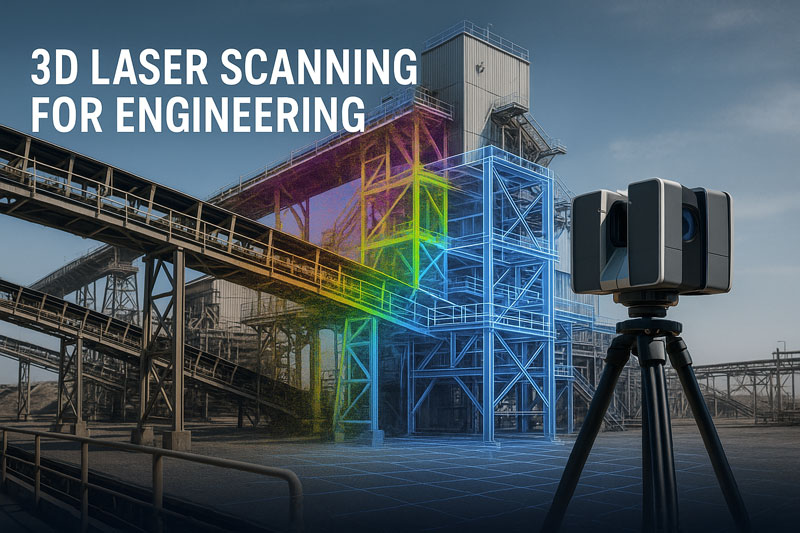

A 3D laser scanner on a tripod capturing an industrial plant structure, with a colourful point cloud and blue CAD wireframe overlay illustrating engineering-grade 3D laser scanning accuracy.

Structural verification and FEA where it counts

Many Bowen Basin assets were not designed for their current duty cycles. Increased throughput, equipment upgrades, and extended asset life introduce structural risk.

Hamilton By Design integrates:

  • Structural checks
  • Load-path verification
  • Fatigue considerations
  • Finite Element Analysis (where appropriate)

FEA is applied pragmaticallyโ€”not as an academic exercise, but as a decision-support tool to:

  • Validate modifications
  • Avoid over-design
  • Reduce unnecessary steel
  • Confirm safety margins

This approach supports compliance while respecting cost and schedule constraints.


Digital QA and as-built confidence

One of the most overlooked advantages of scan-based engineering is digital quality assurance.

Hamilton By Design can:

  • Validate fabricated components against the model
  • Confirm installed geometry post-shutdown
  • Provide updated as-built documentation
  • Support future modifications with confidence

For asset owners, this builds a cumulative digital assetโ€”each project improving the next.


Why this matters to Bowen Basin operators

For companies operating multiple sites across the region, the benefits compound:

  • Consistency across projects and sites
  • Reduced engineering rework
  • Improved shutdown reliability
  • Better collaboration with fabricators
  • Lower total project risk

Hamilton By Designโ€™s workflow aligns with how mining actually operates in Moranbahโ€”not how it is described in textbooks.


A partner, not just a consultant

Hamilton By Design does not operate as a detached design office. We work alongside:

  • Maintenance teams
  • Shutdown planners
  • Fabricators
  • Site supervisors

Our value lies in understanding why a design is needed, how it will be built, and when it must be installed.

This mindset resonates strongly in the Bowen Basin, where credibility is earned through delivery.


Why Moranbah companies choose Hamilton By Design

In summary, Hamilton By Design helps mining companies in Moranbah and the Bowen Basin because we:

  • Specialise in brownfield mining environments
  • Deliver engineer-led 3D scanning
  • Convert data into fabrication-ready models
  • Design for shutdown execution
  • Reduce risk across engineering, fabrication, and installation
  • Speak the language of site, not just design offices

Engineered for Moranbah

Moranbah is not a place for generic solutions. It demands engineering that is accurate, practical, and accountable.

Hamilton By Design was built for regions like thisโ€”where engineering decisions have immediate operational consequences and where doing it right the first time matters.

For mining companies across the Bowen Basin, we provide more than drawings.
We provide clarity, confidence, and constructable engineeringโ€”from scan to shut down.

Hamilton By Design logo displayed on a blue tilted rectangle with a grey gradient background

Our clients:
Name
Would you like us to arrange a phone consultation for you?
Address

3D Laser Scanning in Singleton and the Hunter: Delivering Accuracy for Mining, Manufacturing and Industrial Projects

Singleton sits at the heart of the Hunterโ€™s industrial engine room. Surrounded by major mines, CHPPs, power stations, fabrication workshops and heavy industrial precincts, the region depends on accurate information, efficient planning and safe, predictable project execution. With assets that have operated for decades, countless undocumented modifications and structures that no longer match original drawings, engineering teams face a constant challenge โ€” how to measure, model and design with confidence.

This is exactly where 3D laser scanning in Singleton and Hunter regions is transforming project workflows. Hamilton By Design provides millimetre-accurate digital capture that eliminates guesswork and supports engineering, fabrication, maintenance and shutdown planning across the entire industrial sector.

Whether you’re a CHPP superintendent in Singleton, a fabrication manager in Muswellbrook, a maintenance engineer in the Hunter Valley, or a project manager responsible for upgrades across multiple sites, accurate laser scanning has become essential. This article explores why the demand for 3D scanning has surged, how the technology works, and how Hamilton By Design uses it to support safer, more efficient and more reliable outcomes across the Hunter region.


Why Singleton and the Hunter Need 3D Laser Scanning

The Hunter region is home to some of Australiaโ€™s most active heavy industrial environments. These operations consist of massive structural steel assemblies, conveyors, process equipment, platforms, chutes, bins and pipework โ€” all subject to wear, deformation and ongoing modification. Many facilities were built long before digital documentation became standard. As a result:

  • Original drawings rarely reflect the current condition
  • Measurements taken by hand are slow, risky and often inaccurate
  • Shutdown windows are extremely tight
  • Brownfield constraints make new installations complex
  • Fabricators rely heavily on accurate data to ensure perfect fitment

Incorrect measurements donโ€™t just cause inconvenience โ€” they create costly fabrication errors, installation delays, safety risks and additional shutdown time.

3D laser scanning removes these risks entirely by creating a verified digital record of what is actually on site.


What 3D Laser Scanning Delivers

Hamilton By Design uses engineering-grade LiDAR scanners to capture millions of precise data points across a site. These points form a point cloud, which is a detailed 3D representation of the real environment. This data can then be used to create accurate models, drawings, simulations and digital checks.

With 3D laser scanning in Singleton and Hunter you get:

  • Accurate as-built geometry
  • Digital templates for fabrication
  • Reliable interface points for new steel or equipment
  • Precise alignment and clearance data
  • Clash identification before installation
  • Improved shutdown planning and safety

For engineers, fitters, boilermakers and fabricators, this accuracy becomes the foundation for smarter decision-making and better project outcomes.


Key Industries Using 3D Laser Scanning in Singleton and the Hunter

1. Mining & CHPP Operations

Singleton is surrounded by some of the most productive mines in the country. Mines and CHPP operations rely heavily on scanning for:

  • Chute and hopper replacements
  • Conveyor alignment checks
  • Transfer tower redesigns
  • Structural integrity assessments
  • Bin, screen and crusher upgrades
  • Digital twins for long-term planning

Because these plants operate continuously, shutdown windows are limited. Laser scanning allows accurate pre-planning, reducing time spent onsite during shutdowns and eliminating unexpected clashes.


2. Fabrication & Manufacturing

The Hunter has a strong fabrication industry, supplying steel structures, mechanical components, platforms, tanks and pipework to mining and energy clients. But fabrication quality relies on measurement quality.

3D laser scanning ensures:

  • Components fit the first time
  • Bolt holes align correctly
  • Flanges match perfectly
  • Structural steel connects without modification
  • Expensive rework on site is eliminated

Workshops across Singleton, Muswellbrook, Thornton and Rutherford increasingly depend on digital accuracy to remain competitive.


3. Power Stations & Energy Infrastructure

The Hunter region includes major power generation assets and critical energy infrastructure. Many structures are ageing, and modifications require absolute accuracy.

Laser scanning supports:

  • Platform replacements
  • Pipe rerouting
  • Structural upgrades
  • Boiler house modifications
  • Maintenance planning
  • Deformation analysis

Reliable as-built data ensures compliance and reduces risk during shutdowns.


4. Industrial, Civil and Commercial Upgrades

Singletonโ€™s industrial footprint is expanding, and many facilities require:

  • As-built documentation
  • Renovations and extensions
  • Spatial coordination
  • Facility redevelopment
  • BIM integration

Laser scanning provides the foundation for safe and efficient project planning across commercial and industrial facilities.


The Hamilton By Design Workflow

Hamilton By Design offers a complete digital engineering solution, from scanning to modelling to fabrication-ready drawings. Our workflow includes:

1. On-Site Scanning

We capture every detail โ€” structural steel, mechanical equipment, conveyors, platforms, bins, hoppers, pipework and building geometry.

2. Processing & Registration

Individual scans are stitched together into a single, accurate point cloud representing the full environment.

3. CAD Modelling

We convert point cloud data into:

  • 3D models
  • GA drawings
  • Fabrication details
  • DXF files for laser cutting
  • Assembly and installation references

4. Digital Fit Checks

Before fabrication begins, we overlay new designs to check for:

  • Clashes
  • Misalignments
  • Interference with existing structures
  • Access and maintenance constraints

5. Project Delivery

Clients receive data that supports safe installation and reduces downtime.


Benefits of 3D Laser Scanning in Singleton and the Hunter

Reduced Rework

Accurate digital data means fabricators build with confidence and installers avoid modifications on site.

Safer Data Capture

Laser scanning reduces the need for manual measuring in hazardous areas.

Faster Shutdown Execution

Pre-planning with accurate data speeds up installation and reduces plant downtime.

Improved Engineering and Design

Designers work from verified geometry rather than guessing from old drawings.

Better Communication

Point clouds and 3D models allow all stakeholders to visualise the site clearly.

Cost Savings from Start to Finish

Less rework, fewer delays and more efficient fabrication combine to deliver real financial value.


Why Choose Hamilton By Design?

Hamilton By Design is uniquely positioned to support Singleton and Hunter clients because:

  • We combine laser scanning expertise with real engineering capability
  • We understand mining, CHPP, fabrication and industrial environments
  • We provide end-to-end digital workflows, not just raw data
  • Our models and drawings are created with fabrication and installation in mind
  • We deliver millimetre-accurate results you can trust

Our team works closely with mine sites, fabricators, energy providers and industrial operators across the region, delivering practical solutions built on real data.


Hamilton By Design logo displayed on a blue tilted rectangle with a grey gradient background

Work With Hamilton By Design

If your project requires precise measurement, modelling, redesign or fabrication, 3D laser scanning in Singleton and the Hunter is the most reliable way to ensure accuracy and reduce risk.

Hamilton By Design is ready to support your next upgrade, shutdown, replacement or maintenance campaign with:

  • On-site laser scanning
  • Point cloud processing
  • CAD modelling
  • Fabrication drawings
  • Digital engineering support

Reach out to discuss your upcoming project โ€” and experience the confidence that only accurate, high-quality 3D data can provide.

Name
Would you like us to arrange a phone consultation for you?
Address

3D Scanning in The Hunter Valley

Hunter Valley Laser Scanning: Transforming Engineering Accuracy Across Mining, Manufacturing and Infrastructure

3D Laser Scanning

3D LiDAR Scanning โ€“ Digital Quality Assurance

Hunter Valley Laser Scanning: Transforming Engineering Accuracy Across Mining, Manufacturing and Infrastructure

The Hunter Valley stands as one of Australiaโ€™s most important industrial regions, supporting mining, energy, heavy fabrication, processing, manufacturing and major commercial development. Across this diverse landscape, one challenge consistently affects project performance: the need for accurate, reliable and up-to-date site information.

For engineers, maintenance planners, fabricators and construction managers, relying on outdated drawings or manual tape measurements introduces unnecessary risk. Plants evolve over decades. Structures deform. Equipment shifts alignment. Site conditions rarely match legacy documentation.

This is why Hunter Valley laser scanning has become essential. The ability to capture millimetre-accurate as-built data is transforming how projects are planned, designed and executedโ€”reducing cost, increasing safety and ensuring that every component fits the first time.

Hamilton By Design is proud to support the region with advanced, engineering-grade laser scanning services designed specifically for heavy industry and complex brownfield environments. This article explores how laser scanning works, why the Hunter Valley relies on it, and how it strengthens everything from shutdown planning to fabrication accuracy.


Why the Hunter Valley Depends on Laser Scanning

The Hunterโ€™s operating assets are large, complex and often decades old. Across mines, processing facilities, power stations, port handling infrastructure and manufacturing plants, very few sites match their original drawings.

Typical challenges include:

  • Numerous undocumented modifications
  • Wear, deformation and structural movement
  • Limited or unreliable legacy drawings
  • Tight shutdown windows
  • Hazardous access for manual measuring
  • Brownfield constraints that complicate upgrades

These conditions make traditional measurement methods slow, risky and error-prone. A wrong measurement in a transfer tower, a misaligned conveyor frame, or an incorrect chute dimension can create thousands of dollars in rework and delay.

Hunter Valley laser scanning eliminates these risks completely by capturing the site exactly as it exists todayโ€”not as it was decades ago.


How Hunter Valley Laser Scanning Works

Laser scanning uses high-precision LiDAR technology to record millions of data points across structures, equipment and plant areas. These points combine to create a three-dimensional โ€œpoint cloudโ€โ€”a highly accurate digital representation of real-world conditions.

The Hamilton By Design workflow typically includes:

1. On-Site Reality Capture

Our laser scanner is deployed across key vantage points to capture the full environment, including:

  • Structural steel
  • Conveyors and walkways
  • Chutes, bins, hoppers and material-handling equipment
  • Pipework networks
  • Equipment footprints
  • Building geometry
  • Confined or elevated spaces

The capture process is fast, safe and non-intrusiveโ€”ideal for operational sites.

2. Registration & Point Cloud Processing

Data from each scan position is aligned into a complete, unified point cloud representing the entire area with millimetre accuracy.

3. Modelling & Analysis

From the point cloud we can create:

  • True as-built CAD models
  • Structural layouts
  • Mechanical assemblies
  • Pipework geometry
  • Digital templates for fabrication
  • Probe measurements for checking clearances and alignment

4. Engineering & Fabrication Support

Once converted into a usable engineering environment, the data supports:

  • Shutdown planning
  • Structural redesign
  • Chute and conveyor optimisation
  • Digital fit checks
  • Fabrication drawings
  • Reverse engineering of worn components

The result is a reliable, verified understanding of your siteโ€”available digitally to your entire project team.


Where Hunter Valley Laser Scanning Delivers the Most Value

The unique industrial profile of the Hunter Valley means laser scanning is useful across a broad range of applications. Here are the areas where it delivers the highest impact.


Mining & CHPP Operations

Mining infrastructure in the region is constantly under pressure to operate safely and efficiently. For CHPP upgrades, conveyor realignments, chute replacements and structural modifications, laser scanning provides:

  • True as-built dimensions
  • Clearances and offset measurements
  • Verified alignment data
  • Digital templates for safe, accurate fabrication
  • Reduced shutdown duration
  • Fewer fitment issues onsite

Upgrades become predictable instead of stressful, and fabricators can manufacture with confidence.


Processing Plants & Material-Handling Systems

Transfer towers, bin replacements, screening arrangements and crusher areas often contain congested layouts with poor access. Manual measurement is difficult and unsafe.

Laser scanning solves this by allowing the entire environment to be measured remotely. This supports:

  • Clash prevention
  • Redesign of worn systems
  • Smoother installation
  • Accurate interface points
  • Digital verification before fabrication

Heavy Fabrication & Workshop Integration

Fabricators across the Hunter Valley consistently face the same problem: components not fitting onsite due to bad measurements.

Hunter Valley laser scanning ensures:

  • Perfectly matched bolt hole patterns
  • Correct flange alignment
  • True geometry of mating parts
  • Accurate templates for bending, rolling and welding
  • Reduced rework and scrap

It is a direct cost saver for both workshops and clients.


Energy, Power Stations & Utilities

Power stations and energy sites require sophisticated maintenance planning. Laser scanning helps engineers:

  • Document aging structures
  • Compare deformation over time
  • Plan retrofits and upgrades
  • Replace platforms, pipework and supports with confidence
  • Identify clashes before installation

This improves compliance and reduces risk.


Commercial, Industrial and Infrastructure Projects

Beyond heavy industry, the Hunter region features growing precincts of commercial and industrial developments. Laser scanning supports:

  • Renovations and extensions
  • As-built documentation
  • BIM workflows
  • Accurate drafting and facility mapping

It ensures architects, builders and property owners are working with verified building conditions instead of assumptions.


Why Choose Hamilton By Design for Hunter Valley Laser Scanning?

Hamilton By Design is not simply a scanning serviceโ€”we are engineers first. This is what sets our work apart.

Our Engineering Mindset

We understand plant design, structural requirements, chute behaviour, mechanical layouts and fabrication constraints. This allows us to interpret the point cloud with engineering intent, not just technical detail.

Millimetre Accuracy

Our laser scanning systems deliver the precision required for heavy industry, ensuring designs and fabrication match the real-world geometry exactly.

Complete Digital Workflow

We provide:

  • Point clouds
  • 3D models
  • General arrangement drawings
  • Fabrication drawings
  • DXFs and model exports

Our deliverables integrate seamlessly with fabrication shops and engineering teams across the Hunter.

Local Expertise

We understand the regionโ€™s industries, shutdown pressures, safety expectations and operational challenges.

Confidence Before Steel Is Cut

Every design can be checked digitally for clash, alignment and fitmentโ€”reducing uncertainty and rework.


The Future of Engineering in the Hunter Valley

As sites age and operational demands increase, precise as-built information is becoming essential. Hunter Valley laser scanning is now the standard for safe, efficient and accurate engineering work across the region.

Whether you are replacing structural steel, redesigning a chute, installing new conveyors, upgrading a plant room or fabricating new components, laser scanning gives your project the foundation it needs for success.


Work With Hamilton By Design

Hamilton By Design is ready to support your next project with high-accuracy Hunter Valley laser scanning, modelling and drafting services.

Contact our team to discuss:

  • Your scanning requirements
  • Project constraints
  • Fabrication goals
  • Engineering support needs

We will help you build a digital foundation that improves safety, reduces downtime and ensures every component fits the first time.

Hamilton By Design logo displayed on a blue tilted rectangle with a grey gradient background

3D Scanning in The Hunter Valley

Enhancing Plant Efficiency with Best Maintenance Practices

3D Point Clouds Are a Game-Changer for Your Projects

Lessons from a Landmark Case

Stop Reacting โ€” Start Engineering

Hamilton By Design logo displayed on a blue tilted rectangle with a grey gradient background

How Smart Mechanical Strategies Extend CHPP Life

Every coal wash plant in Australia tells the same story: constant throughput pressure, harsh operating conditions, and the never-ending battle against wear, corrosion, and unplanned downtime. The reality is simple โ€” if you donโ€™t engineer for reliability, youโ€™ll spend your time repairing failure.

At Hamilton By Design, we specialise in mechanical engineering, 3D scanning, and digital modelling for coal handling and preparation plants (CHPPs). Our goal is to help site teams transition from reactive maintenance to a precision, data-driven strategy that keeps production steady and predictable.

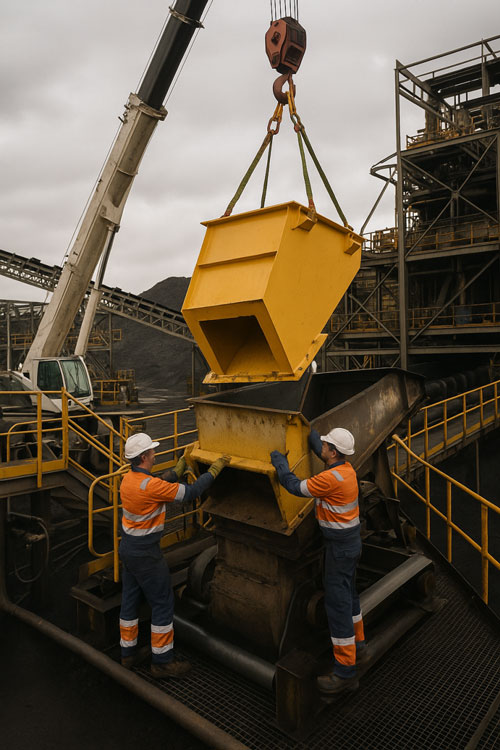
Workers guiding a crane-lifted yellow chute into position at a coal handling and preparation plant, with conveyor infrastructure and safety equipment visible on site

Design for Reliability โ€” Not Reaction

Reliability begins with smart mechanical design. Poor geometry, limited access, and undersized components lead to fatigue and repeated downtime. Instead, modern CHPP maintenance programs start by engineering for fit, lift, and life:

  • Fit: Design components that align with the existing structure โ€” every bolt, flange, and mating face verified digitally before fabrication.
  • Lift: Incorporate certified lifting points that comply with AS 4991 Lifting Devices, and ensure clear access paths for cranes or chain blocks.
  • Life: Select wear materials suited to the physics of the process โ€” quenched and tempered steel for impact, rubber or ceramic for abrasion, and UHMWPE for slurry lines.

Itโ€™s not just about parts; itโ€™s about engineering foresight. A well-designed plant component is safer to install, easier to inspect, and lasts longer between shutdowns.


Scan What You See โ€” Not What You Think You Have

Over time, every wash plant drifts from its original drawings. Field welds, retrofits, and corrosion mean that โ€œas-builtโ€ and โ€œas-existsโ€ are rarely the same thing.

Thatโ€™s where LiDAR scanning transforms maintenance. Using sub-millimetre accuracy, 3D laser scans capture your plant exactly as it stands โ€” every pipe spool, every chute, every bolt hole.

With this data, our engineers can:

  • Overlay new models directly into your point cloud to confirm fit-up before fabrication.
  • Identify alignment errors, corrosion zones, and clearance conflicts before shutdowns.
  • Generate true digital twins that allow for predictive maintenance and simulation.

LiDAR scanning isnโ€™t just a measurement tool; itโ€™s an insurance policy against rework and lost production.

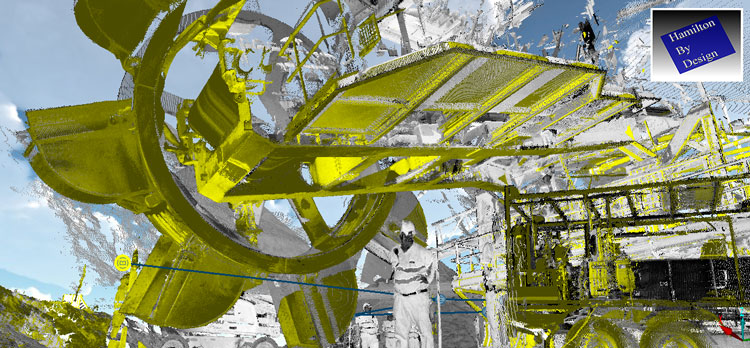
3D LiDAR point cloud of a CHPP plant showing detailed structural geometry, equipment, platforms, and personnel captured during an industrial site scan for engineering and upgrade planning.

Corrosion: The Hidden Killer in Every CHPP

Coal and water donโ€™t just move material โ€” they create acidic environments that eat through untreated or aging steel. In sumps, launders, and under conveyors, corrosion silently compromises strength until a structure is no longer safe to walk on.

Regular inspections are the first line of defence. At Hamilton By Design, we recommend combining:

  • Daily visual checks by operators for surface rust and coating damage.
  • Thickness testing during shutdowns to track wall loss on chutes and pipes.
  • 3D scan comparisons every 6โ€“12 months to quantify deformation and corrosion in critical structures.

With modern tools, you can see corrosion coming long before it becomes a failure.


From Data to Decision: Predictive Maintenance in Action

A coal wash plant produces a river of data โ€” motor loads, vibration levels, pump pressures, liner thickness, and flow rates. The key is turning that data into insight.

By integrating scanning results, maintenance records, and sensor data, plant teams can identify trends that point to future breakdowns. For example:

  • Vibration trending can reveal bearing fatigue weeks before failure.
  • Load monitoring can detect screen blinding or misalignment.
  • Scan data overlays can show sagging supports or displaced chutes.

When you understand what your plant is telling you, you move from reacting to problems to predicting and preventing them.


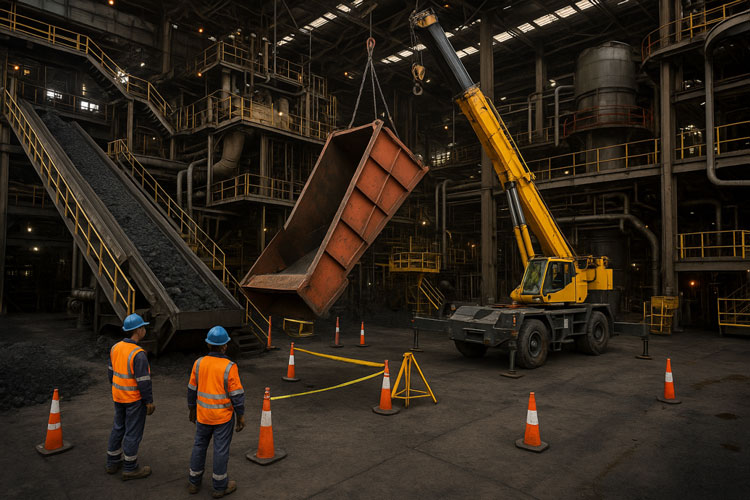
Industrial shutdown scene showing workers monitoring a mobile crane lifting a large steel chute inside a coal processing plant, with safety cones and exclusion zones in place

Shutdowns: Planned, Precise, and Productive

Every shutdown costs money โ€” the real goal is to make every hour count. The best shutdowns start months ahead with validated design data and prefabrication QA.

Before you cut steel or mobilise cranes, every component should be digitally proven to fit. Trial assemblies, lifting studies, and bolt access checks prevent costly surprises once youโ€™re on the clock.

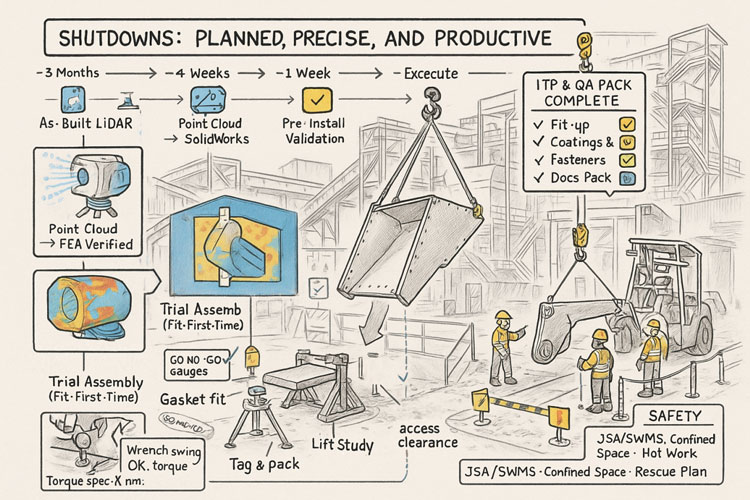
At Hamilton By Design, our process combines:

  • LiDAR scanning to confirm as-built geometry.
  • SolidWorks modelling and FEA for mechanical verification.
  • Pre-installation validation to ensure bolt holes, flanges, and lift paths align on day one.

Thatโ€™s how you replace chutes, spools, and launders in a fraction of the usual time โ€” safely, and with confidence.

Hand-drawn infographic showing the shutdown workflow from LiDAR scanning and FEA verification through SolidWorks modelling, pre-install validation, trial assembly, lift study, and execution, including ITP and QA checks, safety steps, and onsite installation activities

The Payoff: Reliability You Can Measure

The plants that invest in engineering-led maintenance see results that are tangible and repeatable:

Improvement AreaTypical Gain
Reduced unplanned downtime30โ€“40%
Increased liner lifespan25โ€“50%
Shorter shutdown duration10โ€“20%
Fewer fit-up issues and rework60โ€“80%
Improved safety performance20โ€“30%

Reliability isnโ€™t luck โ€” itโ€™s engineered.


Hamilton By Design logo displayed on a blue tilted rectangle with a grey gradient background

Your Next Step: A Confidential Mechanical Assessment

Whether your plant is in the Bowen Basin, Hunter Valley, or Central West NSW, our team can deliver a confidential mechanical and scanning assessment of your wash plant.

Weโ€™ll benchmark your current maintenance strategy, identify high-risk areas, and provide a clear roadmap toward predictive, engineered reliability.

๐Ÿ“ฉ For a confidential assessment of your current wash plant, contact:
info@hamiltonbydesign.com.au

Stop reacting. Start engineering. Build reliability that lasts.

Name
Would you like us to arrange a phone consultation for you?
Address

Our clients:
Mechanical Engineering | Structural Engineering

Mechanical Drafting | Structural Drafting

3D CAD Modelling | 3D Scanning

Chute Design

Coal Chute Design

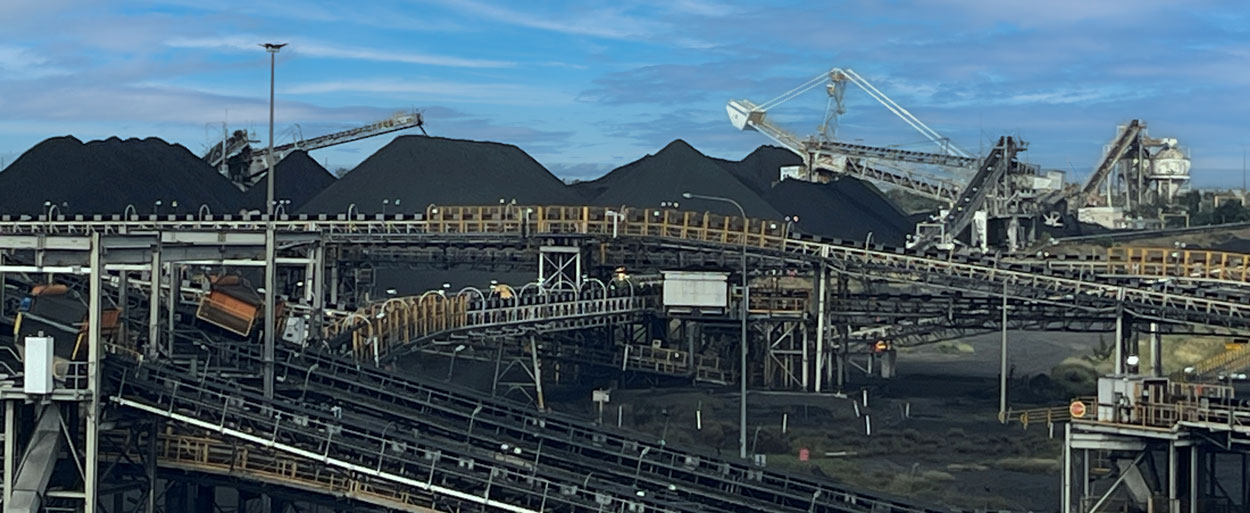
Coal handling and processing facility with multiple conveyors, stockpiles of coal, and stacking-reclaiming machinery operating under a blue sky

A Systems Engineering Approach for Reliable Coal Handling

In coal mining operations, transfer chutes play a deceptively small role with disproportionately large impacts. They sit quietly between conveyors, crushers, and stockpiles, directing tonnes of coal every hour. Yet when a chute is poorly designed or not maintained, the whole coal handling system suffers: blockages stop production, dust creates safety and environmental hazards, and worn liners demand costly maintenance shutdowns.

At Hamilton by Design, we believe coal chute design should be treated not as a piece of steelwork, but as a systems engineering challenge. By applying systems thinking, we connect stakeholder requirements, material behaviour, environmental factors, and lifecycle performance into a holistic design approach that delivers long-term value for mining operations in the Hunter Valley and beyond.


Coal Chutes in the Mining Value Chain

Coal chutes form the links in a chain of bulk material handling equipment:

  • ROM bins and crushers feed coal into the system.
  • Conveyors carry coal across site, often over long distances.
  • Transfer chutes guide coal between conveyors or onto stockpiles.
  • Load-out stations deliver coal to trains or ports for export.

Although they are small compared to conveyors or crushers, coal chutes are often where problems first appear. A well-designed chute keeps coal flowing consistently; a poorly designed one causes buildup, spillage, dust emissions, and accelerated wear. Thatโ€™s why leading operators now see chute design as a critical system integration problem rather than just a fabrication task.

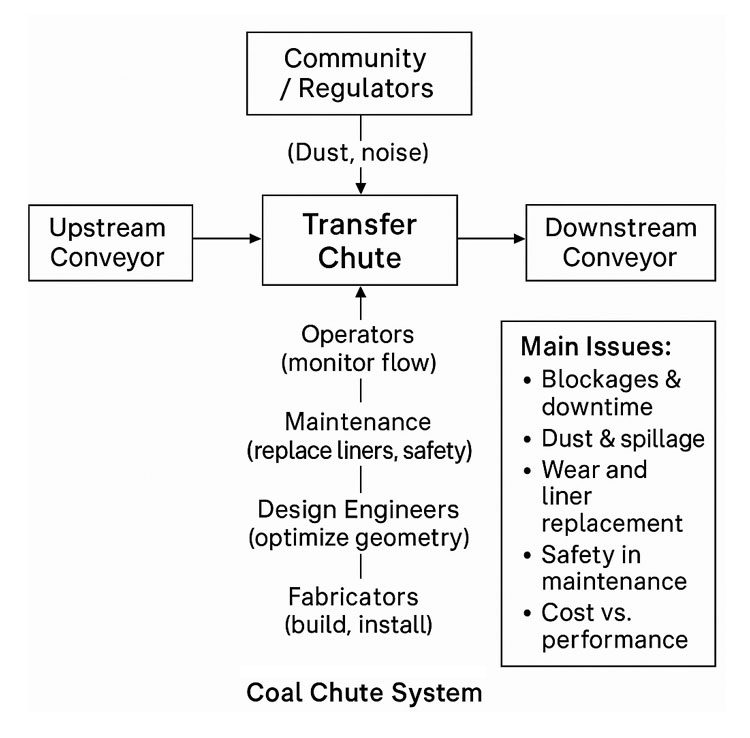
Flow diagram of a coal chute system showing upstream and downstream conveyors, the transfer chute, stakeholder interactions, and main issues such as blockages, dust, wear, maintenance safety, and cost versus performance

Systems Engineering in Coal Chute Design

Systems engineering is the discipline of managing complexity in engineering projects. It recognises that every component is part of a bigger system, with interdependencies and trade-offs. Applying this mindset to coal chute design ensures that each chute is considered not in isolation, but as part of the broader coal handling plant.

1. Requirements Analysis

The first step is gathering and analysing stakeholder and system requirements:

  • Throughput capacity: e.g. handling 4,000 tonnes per hour of coal.
  • Material properties: coal size distribution, moisture content, abrasiveness, stickiness.
  • Safety requirements: compliance with AS/NZS 4024 conveyor safety standards, confined space entry protocols, guarding, and interlocks.
  • Environmental compliance: dust, noise, and spillage limits.
  • Maintenance objectives: target liner life (e.g. 6 months), maximum downtime per liner change (e.g. 30 minutes with two workers).

A structured requirements phase reduces the risk of costly redesign later in the project.


2. System Design and Integration

Once requirements are defined, the design process considers how the chute integrates into the coal handling system:

  • Flow optimisation using DEM: Discrete Element Modelling allows engineers to simulate coal particle behaviour, test different geometries, and reduce blockages before steel is ever cut.
  • Dust control strategies: designing chutes with enclosures, sprays, and extraction ports to minimise airborne dust.
  • Wear management: predicting wear zones, selecting suitable liner materials (ceramic, Bisplate, rubber composites), and ensuring easy access for replacement.
  • Structural and safety design: ensuring the chute can withstand dynamic loads, vibration, and impact, while providing safe access platforms and guarding.
  • Interfaces with conveyors and crushers: alignment, skirt seals, trip circuits, and integration with PLC/SCADA control systems.

By treating the chute as a subsystem with multiple interfaces, designers avoid the โ€œbolt-onโ€ mentality that often leads to operational headaches.


3. Verification and Validation

The systems engineering V-model reminds us that every requirement must be verified and validated:

  • Component verification: weld inspections, liner hardness testing, nozzle spray checks.
  • Subsystem verification: chute section fit-up, guard gap measurements, coating checks.
  • Integration testing: conveyor-chute alignment, PLC spray interlocks, trip circuits.
  • System validation: commissioning with live coal flow, dust monitoring against limits, maintainability time trials for liner change.

By linking requirements directly to tests in a traceability matrix, operators can be confident that the chute is not only built to spec, but proven in operation.


Lifecycle Engineering: Beyond Installation

Good chute design doesnโ€™t stop at commissioning. A lifecycle engineering mindset ensures the chute continues to deliver performance over years of operation.

  • Maintainability: modular liners, captive fasteners, hinged access doors, and clear procedures reduce downtime and improve worker safety.
  • Reliability: DEM-informed designs and wear-resistant materials reduce the frequency of blockages and rebuilds.
  • Sustainability: dust suppression and enclosure strategies reduce environmental impact and support community and regulatory compliance.
  • Continuous improvement: feedback loops from operators and maintenance teams feed into the next design iteration, closing the systems engineering cycle.

A Rich Picture of Coal Chute Complexity

Visualising the coal chute system as a rich picture reveals its complexity:

  • Operators monitoring flow from control rooms.
  • Maintenance crews working in confined spaces, replacing liners.
  • Design engineers using DEM simulations to model coal flow.
  • Fabricators welding heavy plate sections on site.
  • Environmental officers measuring dust levels near transfer points.
  • Regulators and community monitoring compliance.

This web of relationships shows why coal chute design benefits from systems thinking. No single stakeholder sees the whole pictureโ€”but systems engineering does.


Benefits of a Systems Engineering Approach

When coal chute design is guided by systems engineering principles, operators gain:

  • Higher reliability: smoother coal flow with fewer blockages.
  • Lower maintenance costs: liners that last longer and can be swapped quickly.
  • Improved compliance: dust, spillage, and safety issues designed out, not patched later.
  • Lifecycle value: less unplanned downtime and a lower total cost of ownership.

In short, systems engineering transforms coal chutes from weak links into strong connectors in the mining value chain.


Case Study: Hunter Valley Context

In the Hunter Valley, coal mines have long struggled with transfer chute problems. Companies like T.W. Woods, Chute Technology, HIC Services, and TUNRA Bulk Solids have all demonstrated the value of combining local fabrication expertise with advanced design tools. Hamilton by Design builds on this ecosystem by applying structured systems engineering methods, ensuring each chute project balances performance, safety, cost, and sustainability.


Conclusion

Coal chute design might seem like a small detail, but in mining, details matter. When transfer chutes fail, production stops. By applying systems engineering principlesโ€”from requirements analysis and DEM modelling to verification, lifecycle planning, and continuous improvementโ€”we can design coal chutes that are reliable, maintainable, and compliant.

At Hamilton by Design, we believe in tackling these challenges with a systems mindset, delivering solutions that stand up to the realities of coal mining.


Are you struggling with coal chute blockages, dust, or costly downtime in your coal handling system?

Hamilton By Design logo displayed on a blue tilted rectangle with a grey gradient background

Contact Hamilton by Design today and discover how our systems engineering expertise in coal chute design can optimise your mining operations for performance, safety, and sustainability.

Mechanical Engineering | Structural Engineering

Mechanical Drafting | Structural Drafting

3D CAD Modelling | 3D Scanning

Chute Design

SolidWorks Contractors in Australia

Hamilton By Design โ€“ Blog

Our clients:
Name
Would you like us to arrange a phone consultation for you?
Address