3D Laser Scanning in Rockhampton QLD: Engineering-Grade Data for Safer Conveyor Design and Risk Management

Engineering-led SolidWorks drafting in Australia with 25 years of Hamilton By Design experience

3D Laser Scanning in Rockhampton QLD for Safer Conveyor Design & Risk Management

Rockhampton plays a critical role in Central Queenslandโ€™s heavy industry, supporting mining, bulk materials handling, agriculture, and transport infrastructure. Across these sectors, conveyor systems are essential โ€” and they are also one of the highest-risk assets on site.

As facilities age and production demands increase, many operators are upgrading or modifying conveyors within tight shutdown windows. In these environments, engineering-grade 3D laser scanning (LiDAR) is becoming a key tool for reducing design risk, improving safety outcomes, and avoiding costly site rework.

At Hamilton By Design, we use high-accuracy 3D scanning to capture existing plant conditions and convert them into reliable engineering models that support safer conveyor design and more effective risk management.

Conveyor Systems and Industry Incidents: Where Things Go Wrong

Industry incident investigations across Queensland repeatedly identify similar contributing factors in conveyor-related injuries:

  • Inadequate guarding at transfer points and pulleys
  • Restricted access forcing unsafe maintenance practices
  • Plant modifications made without updated drawings
  • Design reviews based on outdated or incomplete site data

In regional facilities around Rockhampton, conveyors are often extended, repaired, and repurposed over many years. What starts as a temporary modification can become permanent, and original drawings no longer reflect reality on the ground.

When new upgrades are designed using assumptions instead of accurate geometry, risk is built into the project from day one.
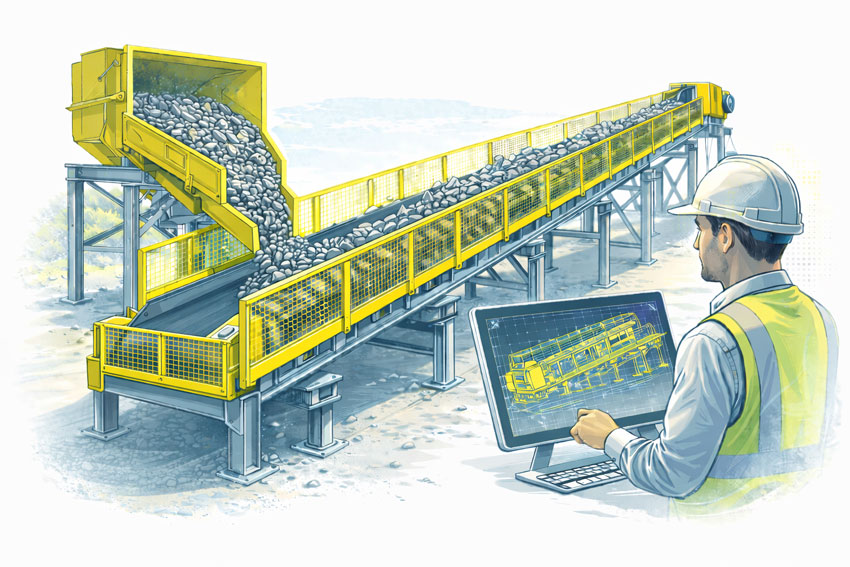

Bulk materials conveyor with compliant safety guarding at the hopper, tail end, and along the conveyor, shown with an engineer reviewing guarding design drawings.

Why Engineering-Grade Scanning Matters for Conveyor Design

Not all 3D scans are suitable for mechanical design or safety-critical decisions.

We use engineering-grade LiDAR scanning capable of delivering accuracy in the order of ยฑ2 mm over 70 metres, allowing engineers to:

  • Model conveyor structures, frames, and supports
  • Accurately locate rollers, drives, guards, and transfer chutes
  • Verify clearances for new equipment and walkways
  • Identify clashes before fabrication and installation

The resulting point clouds and CAD models form a reliable digital baseline that engineers, safety teams, and maintenance planners can all work from.

When plant modifications are driven by accurate data, both design quality and safety outcomes improve.

Safe Design Starts with Knowing What Actually Exists

Safe Design is not something that can be retrofitted easily once steel is fabricated and installed.

Scan-based models allow hazards to be assessed during the design phase, including:

  • Access and egress routes for maintenance
  • Reach distances and pinch point exposure
  • Guarding coverage around rotating equipment
  • Space constraints that may encourage unsafe shortcuts

This is particularly important in conveyor corridors where multiple services, structures, and walkways compete for limited space.

Designing from accurate site geometry allows risks to be eliminated or reduced before they reach the worksite.


Risk Management Through Reality Capture

From a risk management perspective, 3D scanning supports more than just design accuracy. It also improves:

  • Hazard identification and risk assessments
  • Method statements and installation planning
  • Shutdown coordination and contractor interfaces
  • Compliance documentation and audit trails

Point cloud data also provides a permanent record of asset condition at a point in time, which can be invaluable for:

  • Future upgrade planning
  • Incident investigations
  • Asset integrity assessments

In high-risk conveyor environments, reliable data is a control measure in its own right.

Supporting Rockhampton Industry with Integrated Engineering Services

Hamilton By Design provides on-site 3D scanning and mechanical engineering support for projects in Rockhampton and Central Queensland, including:

  • Conveyor upgrades and replacements
  • Transfer point redesigns
  • Guarding and access improvements
  • Brownfield plant modifications
  • Fabrication and installation planning

Because we are an engineering-led team, scanning is directly integrated into mechanical design, drafting, and fabrication support โ€” not treated as a standalone survey service.

This ensures models are built to suit engineering workflows and deliver practical, buildable outcomes.


Hamilton By Design logo displayed on a blue tilted rectangle with a grey gradient background

From Point Cloud to Practical Results

Our typical workflow includes:

  1. On-site LiDAR scanning with minimal operational disruption
  2. Registration and processing of point cloud data
  3. Conversion into CAD models suitable for mechanical design
  4. Design development, safety reviews, and shop drawings

This approach reduces shutdown risk, improves installation accuracy, and helps ensure safety improvements are achieved in practice โ€” not just on paper.

Name
Would you like us to arrange a phone consultation for you?
Address

AS 3774 โ€“ Loads on Bulk Solids Containers: Why It Matters for Safety and Compliance

Engineer using 3D LiDAR scanner to capture silos, hoppers, bins, and bulk solids containers at an industrial processing plant.

AS 3774 โ€“ Loads on Bulk Solids Containers | Safety & Compliance

AS 3774 Loads on Bulk Solids Containers exists for a simple reason:
bulk solids do not behave like fluids, and incorrect load assumptions can create serious structural and safety risks.

For asset owners, engineers, and project teams involved in mining, mineral processing, manufacturing, and bulk materials handling, AS 3774 provides the framework for understanding how loads actually develop in silos, bins, hoppers, chutes, transfer stations, and surge bins.

Yet despite its long-standing availability, many new installations are still being delivered without full consideration of AS 3774 load cases.

The risks created by this gap are often not immediately visible โ€” but they are very real.


Engineer using 3D LiDAR scanner to capture silos, hoppers, bins, and bulk solids containers at an industrial processing plant.

What AS 3774 Is Designed to Address

AS 3774 recognises that bulk solids behave in complex and sometimes counter-intuitive ways. Unlike liquids, bulk materials:

  • Develop non-uniform wall pressures
  • Apply eccentric and asymmetric loads
  • Change load paths depending on flow behaviour
  • Generate dynamic and cyclic forces during filling and discharge

The standard provides guidance for determining realistic design loads based on how material actually flows and interacts with container geometry.

This applies across all bulk solids containers, including:

  • Silos
  • Bins and surge bins
  • Hoppers
  • Chutes and transfer stations
  • Rail and ship loading structures
  • Feeders integrated with bins

Why Safety and Compliance Depend on AS 3774

The purpose of AS 3774 is not academic. It exists to prevent outcomes such as:

  • Progressive wall deformation
  • Fatigue cracking and bolt failure
  • Local buckling or plate tearing
  • Uncontrolled discharge or blockage release
  • Unexpected load transfer into supporting structures

What makes these issues particularly dangerous is that they often develop over time, not at commissioning.

A structure can appear โ€œfineโ€ on day one โ€” while accumulating damage due to:

  • Cyclic loading
  • Eccentric discharge patterns
  • Inaccurate assumptions about material properties
  • Mixed construction materials behaving differently over time

Common Design Assumptions That Create Hidden Risk

In practice, many bulk solids containers are still designed using simplified or incorrect assumptions, including:

1. Treating Bulk Solids Like Fluids

Uniform hydrostatic pressure assumptions do not reflect real wall loading patterns and can significantly under-predict peak stresses.

2. Ignoring Eccentric Discharge

Off-centre outlets, partial blockages, or asymmetric flow paths can introduce large bending and torsional effects that are not obvious from geometry alone.

3. Incorrect or Assumed Material Properties

Bulk density, cohesion, moisture content, and flow behaviour are often assumed rather than verified โ€” yet small changes can have large load implications.

4. Mixed Materials Without Long-Term Consideration

It is not uncommon to see hoppers fabricated from a combination of stainless steel and mild steel, without adequate consideration of:

  • Differential stiffness
  • Fatigue behaviour
  • Corrosion mechanisms
  • Galvanic interaction

These issues may not present as immediate failures, but they can significantly reduce structural life and reliability.


Why the Risk Is Often Not Evident Today

One of the most concerning aspects of non-compliance with AS 3774 is that failure is rarely immediate.

Instead, risk accumulates quietly through:

  • Repeated filling and discharge cycles
  • Minor operational changes
  • Variations in material condition
  • Small geometric imperfections

By the time visible cracking, deformation, or operational issues appear, the structure may already be compromised.


The Role of Modern Engineering Tools (Briefly)

While AS 3774 is fundamentally about load determination, modern engineering tools can support compliance by helping teams:

  • Verify as-built geometry against design assumptions
  • Identify eccentric discharge paths and flow constraints
  • Review interfaces, wall angles, and structural continuity
  • Support independent engineering assessment without extended shutdowns

These tools do not replace the standard โ€” but they can help reveal whether its principles have been properly applied.


What Asset Owners and Project Managers Should Ask For

To demonstrate that AS 3774 has been adequately considered, asset owners and project managers should expect to see clear answers to questions such as:

  • What load cases were considered under AS 3774?
  • How were discharge conditions defined and assessed?
  • What assumptions were made about material properties?
  • How were eccentric and asymmetric loads addressed?
  • Was fatigue or cyclic loading considered?
  • How were mixed materials and interfaces assessed?
  • Has an independent engineering review been undertaken?

If this information cannot be clearly provided, compliance is difficult to demonstrate, regardless of how new the installation is.


Hamilton By Design logo displayed on a blue tilted rectangle with a grey gradient background

Why This Matters for New Installations

AS 3774 compliance is not about legacy assets or historical practices.
It is about ensuring that new installations are fit for purpose, safe, and defensible.

Where bulk solids containers are being delivered today without adequate consideration of realistic load behaviour, the risk is being transferred downstream โ€” to operators, maintainers, and asset owners.


Our clients


A Practical Closing Thought

If you are unsure whether AS 3774 has been properly applied to a bulk solids container, an independent engineering review can provide clarity.

The cost of verifying load assumptions and structural adequacy is typically minor compared to the consequences of discovering load-related issues after commissioning.

Hamilton By Design supports asset owners and project teams with engineering review, verification, and redesign of bulk solids containers, helping ensure that safety and compliance are addressed before problems develop.

Name
Would you like us to arrange a phone consultation for you?
Address

AS 4324.1 Brownfield Bulk Handling Assets: Engineering Mobile Equipment for Todayโ€™s Mine Sites

AS 4324.1 Bulk Handling Equipment | Brownfield Stacker & Reclaimer Engineering

Mobile equipment for the continuous handling of bulk materialsโ€”such as stackers, reclaimers, and ship loadersโ€”forms the backbone of Australiaโ€™s mining and export infrastructure. Many of these assets operate continuously in demanding environments, often well beyond their original design life.

Australian Standard AS 4324.1 provides essential guidance for the design and safe operation of this class of equipment. However, on many Australian mine sites, the practical application of the standard is misunderstood or only partially implemented, particularly when dealing with legacy machines and brownfield upgrades.

For asset owners and engineering managers, the challenge is rarely about greenfield compliance. It is about managing risk, extending asset life, and implementing upgrades without unplanned downtime.


Ship loader and bulk cargo vessel with GPS monitoring units and sensor overlays illustrating controlled loading zones and engineering oversight under AS 4324.1

Understanding AS 4324.1 in a Brownfield Context

AS 4324.1 addresses mobile equipment used for continuous bulk handling, including:

  • Yard stackers and reclaimers
  • Bucket wheel reclaimers
  • Slewing and travelling machines
  • Ship loaders at export terminals

While the standard establishes a strong baseline for design and safety, many operating machines:

  • Pre-date the current revision of the standard
  • Have undergone multiple undocumented modifications
  • Operate under loading conditions that differ from original assumptions

In these situations, engineering judgement is required. Compliance becomes less about box-ticking and more about demonstrating that risks are understood, controlled, and managed over the asset lifecycle.


Common Challenges on Operating Mine Sites

Across coal handling plants, iron ore operations, and port facilities, several recurring issues emerge:

1. Incomplete or Outdated As-Built Information

Accurate geometry, slew limits, clearances, and structural interfaces are often unknown. This creates risk during upgrades and maintenance planning.

2. Fatigue and Structural Degradation

Large mobile machines experience cyclic loading across slewing, luffing, and travel motions. Fatigue cracking and unexpected failures require ongoing monitoring, not one-off assessments.

3. Access, Guarding, and Maintenance Compliance

Requirements evolve over time. Older machines may not meet current expectations for access systems, guarding, or safe maintenance practices.

4. Downtime Sensitivity

Stackers, reclaimers, and ship loaders are often production-critical assets. Upgrade windows are limited, and poor fit-up or rework can have significant commercial consequences.


Technology Supporting Modern Risk Management

While AS 4324.1 remains the foundation, modern technology allows asset owners to manage risk more effectivelyโ€”particularly on brownfield equipment.

GPS Positioning and Controlled Operating Zones

Where GPS positioning is enabled, defined operating zones can be established to:

  • Prevent interaction with stockpiles during rapid translation
  • Automatically reduce slew or travel speed in high-risk zones
  • Limit impact loads on critical components such as slew rings and fluffing gears

These systems are primarily productivity-driven, but they also reduce the likelihood of high-energy impacts that contribute to mechanical damage.


LiDAR Scanning as an Emerging Risk Layer

LiDAR scanning is not a replacement for traditional controls, and it is still evolving in this application. However, it can provide:

  • Accurate spatial awareness of surrounding structures
  • Verification of clearances and exclusion envelopes
  • A secondary risk-management layer supporting operator decision-making

When combined with engineering-led interpretation, LiDAR contributes to a layered risk approach rather than acting as a standalone safety system.


Condition Monitoring and Real Load Understanding

Accelerometers installed across a range of frequencies can deliver valuable insight into:

  • Actual operating loads
  • Dynamic response during slewing, reclaiming, and travel
  • Early indicators of fatigue-related issues

This data supports more informed maintenance decisions and provides evidence of how a machine is truly being usedโ€”often revealing load cases not considered in original designs.


Engineering-Led Compliance and Asset Life Extension

For brownfield assets, compliance with AS 4324.1 is best approached as a continuous engineering process, not a single milestone. This includes:

  • Accurate reality capture and digital models
  • Verification of clearances, interfaces, and structural geometry
  • Informed upgrade design that fits the first time
  • Risk-based decision-making supported by real operating data

This approach helps asset owners extend the life of critical machines while managing risk, performance, and availability.


How Hamilton By Design Supports Bulk Handling Assets

Hamilton By Design works with asset owners and engineering teams to support:

  • Brownfield upgrades of stackers, reclaimers, and ship loaders
  • Engineering-grade LiDAR scanning and as-built documentation
  • Fit-for-purpose mechanical design for modifications and life-extension
  • Independent engineering insight across OEM and site interfaces

Our focus is on engineering clarity, practical risk reduction, and minimising disruption to operations.


Talk to an Engineer About Your Asset

If you are planning a brownfield upgrade, life-extension, or risk review of mobile bulk-handling equipment, talk to an engineer at Hamilton By Design about how accurate data and practical engineering can support your next decision.

Our clients:

Name
Would you like us to arrange a phone consultation for you?
Address

Detailing Transfer Stations in the Age of Digital Engineering

Transfer stations and chutes sit at the intersection of bulk materials handling, structural engineering, and fabrication practicality. While the fundamentals of good detailing have not changed, the way engineers now capture, coordinate, and validate these details has evolved significantly over the past decade.

This article revisits the principles of transfer station detailing and places them in a modern digital-engineering context, where accurate site data, constructability, and lifecycle performance are critical.


Engineering illustration of a transfer chute showing a LiDAR point cloud overlay aligned with the same chute geometry for as-built verification.

Why Transfer Station Detailing Still Matters

Poorly detailed transfer stations remain one of the most common sources of:

  • Material spillage and dust generation
  • Accelerated liner and structure wear
  • Unplanned downtime and maintenance escalation
  • Safety risks to operators and maintainers

In many cases, the root cause is not the concept design, but inadequate detailing and incomplete understanding of site geometry.

Even well-intended designs can fail if:

  • Existing structures are misrepresented
  • Conveyor interfaces are assumed rather than measured
  • Fabrication tolerances are not realistically achievable on site

The Shift from Assumed Geometry to Measured Reality

Historically, detailing relied heavily on:

  • Legacy drawings
  • Manual tape measurements
  • Partial site surveys
  • โ€œBest guessโ€ alignment assumptions

Today, engineering-grade reality capture has fundamentally changed what is possible.

Using 3D laser scanning (LiDAR), engineers can now work from:

  • Millimetre-accurate point clouds
  • Verified conveyor centre lines
  • True chute-to-structure interfaces
  • Real as-installed conditions rather than design intent

This shift dramatically reduces site rework and fabrication clashes.

This approach is central to how Hamilton By Design supports bulk materials handling upgrades across mining, ports, and heavy industry.


Detailing Considerations That Still Get Missed

Even with modern tools, certain detailing fundamentals remain critical.

1. Interface Accuracy

Transfer stations often interface with:

  • Existing conveyors
  • Walkways and access platforms
  • Structural steelwork installed decades earlier

Without accurate as-built data, small errors compound quickly. Laser scanning eliminates this uncertainty.

Related reading:
https://www.hamiltonbydesign.com.au/3d-laser-scanning-engineering/


2. Wear Liner Integration

Good detailing must account for:

  • Liner thickness variation
  • Fixing access and replacement paths
  • Load paths through liners into structure

Digitally modelling liners within the chute geometry allows engineers to validate:

  • Clearances
  • Installation sequence
  • Maintenance access before steel is cut

3. Fabrication Reality

A detail that looks acceptable in 2D can become problematic when fabricated.

Modern workflows now link:

  • 3D scanning
  • Solid modelling
  • Fabrication drawings
  • Digital QA checks

This reduces site modifications and ensures components fit first time.

Example of fabrication-ready workflows:
https://www.hamiltonbydesign.com.au/mechanical-engineering-design-services/


Transfer Stations as Systems, Not Isolated Chutes

A key lesson reinforced over time is that transfer stations must be treated as systems, not standalone components.

Good detailing considers:

  • Upstream and downstream belt tracking
  • Material trajectory consistency
  • Structural vibration and dynamic loading
  • Maintenance access under real operating conditions

Digital engineering allows these interactions to be reviewed early, reducing operational risk.


The Role of Engineering-Led Scanning

Not all scans are equal.

For engineering applications, scanning must be:

  • Performed with known accuracy
  • Registered and verified correctly
  • Interpreted by engineers, not just technicians

This distinction matters when designs are used for fabrication and compliance.

Hamilton By Designโ€™s approach combines engineering-led LiDAR scanning with mechanical design, ensuring the data collected is suitable for real engineering decisions.

Learn more:
https://www.hamiltonbydesign.com.au/engineering-led-3d-lidar-scanning/


Closing Thoughts

While detailing principles for transfer stations have stood the test of time, the tools and expectations have changed.

Modern projects demand:

  • Verified geometry
  • Fabrication-ready models
  • Reduced site risk
  • Higher confidence before steel is ordered

By integrating reality capture, detailed modelling, and constructability thinking, transfer station detailing can move from a risk point to a performance advantage.


Hamilton By Design logo displayed on a blue tilted rectangle with a grey gradient background

Our clients:


Name
Would you like us to arrange a phone consultation for you?
Address

Further Reading

Chute Design at Hamilton By Design

Chute Design at Hamilton By Design

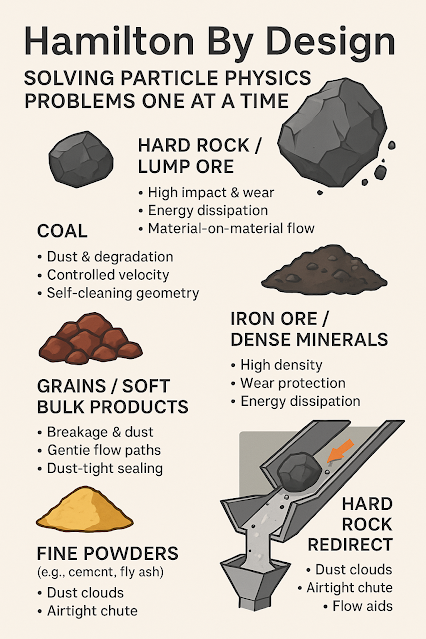
At Hamilton by Design, we see ourselves as more than engineers โ€” we are problem-solvers who bring both science and experience to the table. Every bulk material transfer is unique, and each one carries its own challenges. By combining the principles of particle physics with decades of hands-on site experience, we design chutes and transfer points that perform in the real world, not just on a computer screen.

We are a small, specialised company, not a large corporate machine. That means you deal directly with the people who understand your operation, your materials, and your challenges. We take pride in our ability to stand on-site, watch the flow of material, and recognise behaviours that only years of experience can teach. This gives us the clarity to engineer practical solutions that keep your plant running reliably.

For us, your success is our success. We measure our achievement not by the number of projects we complete, but by the value we add to your operation โ€” less dust, less wear, fewer stoppages, more tonnes moved.

Learn more about our approach and solutions Hamilton By Design – Chute Design


Our clients:

Name
Would you like us to arrange a phone consultation for you?
Address

Mechanical
Engineering
| Structural
Engineering

Mechanical
Drafting
| Structural
Drafting

3D
Laser Scanning
| 3D
CAD Modelling
| 3D
Scanning

SolidWorks
Contractors in Australia

Hamilton By Design โ€“ Blog

Consulting Engineers

About Us โ€“
Hamilton By Design

Bulk Materials Conveyor Transfer

Designing reliable bulk materials conveyor transfer station chutes involves a careful consideration of various principles to ensure efficient material handling, minimize maintenance, and avoid operational issues. Here are the key principles and potential pitfalls to look out for:

Key Principles

Material Flow Dynamics:

    • Controlled Flow: Ensuring that the material flow is controlled and predictable is crucial. This involves designing the chute to guide the material smoothly from one conveyor to the next without creating bottlenecks or excessive turbulence.
    • Optimal Angles: The chute’s angles should be carefully calculated. Angles that are too steep may cause material to accelerate excessively, leading to wear and impact damage, while shallow angles can cause blockages.
    • Trajectory Management: Properly managing the material’s trajectory helps in reducing spillage and wear. The trajectory should be designed to align with the receiving conveyor’s speed and direction.

    Wear Resistance:

      • Material Selection: Using wear-resistant materials for the chute construction can significantly extend its lifespan. Materials like AR (abrasion-resistant) steel or liners made from ceramic or rubber are common choices.
      • Strategic Wear Points: Identifying and reinforcing areas that are prone to high wear, such as impact zones and high-friction areas, can prevent premature failure.

      Dust and Spillage Control:

        • Sealing: Effective sealing around the chute is essential to prevent dust and material spillage, which can lead to environmental issues and loss of product.
        • Dust Suppression: Incorporating dust suppression systems, such as water sprays or dust extraction, can minimize airborne particles, ensuring a safer and cleaner working environment.

        Maintenance and Accessibility:

          • Ease of Access: Designing the chute for easy access allows for routine maintenance and inspection without requiring extensive downtime or complex procedures.
          • Modular Components: Using modular components can simplify the replacement of worn parts, reducing maintenance time and costs.

          Structural Integrity:

            • Robust Design: The chute must be structurally robust to withstand the dynamic loads of the bulk materials. This includes ensuring that the support structure is adequately reinforced.
            • Vibration and Impact Resistance: Designing to mitigate vibration and absorb impacts can reduce structural fatigue and extend the life of the chute.

            Flow Rate Compatibility:

              • Capacity Matching: Ensuring the chute design matches the flow rate of the conveyor system it serves is vital. Overloading can lead to blockages and spillage, while underloading may indicate inefficient use of the system.

              Pitfalls to Avoid

              Incorrect Angle of Inclination:

                • Blockages and Spillage: If the chute angle is too steep or too shallow, it can lead to blockages or spillage. A steep angle might cause uncontrolled flow, while a shallow angle might lead to material build-up.

                Insufficient Wear Protection:

                  • Premature Wear: Failing to use appropriate wear-resistant materials or neglecting high-wear areas can result in frequent maintenance and downtime due to premature wear and tear.

                  Poorly Designed Transitions:

                    • Material Segregation: Abrupt transitions or poorly designed junctions can cause material segregation, uneven flow, and increased wear on the chute and conveyor components.

                    Inadequate Dust Control:

                      • Environmental and Health Issues: Neglecting dust control can lead to significant environmental and health issues, as well as potential regulatory fines and operational inefficiencies.

                      Maintenance Challenges:

                        • Difficult Access: Designing chutes without considering maintenance access can lead to extended downtime and increased labor costs during repairs and inspections.

                        Ignoring Dynamic Loads:

                          • Structural Failures: Not accounting for the dynamic loads and impact forces exerted by the bulk materials can lead to structural failures and hazardous conditions.

                          Poor Integration with Conveyor System:

                            • Operational Inefficiencies: Failing to properly integrate the chute design with the conveyor system can lead to operational inefficiencies, increased wear on conveyor components, and potential system failures.

                            By adhering to these principles and being mindful of the potential pitfalls, the design of bulk materials conveyor transfer station chutes can be optimized for reliability, efficiency, and longevity.

                            For more information on Bulk Materials Conveyor Transfer please feel free to connect

                            Name
                            Would you like us to arrange a phone consultation for you?
                            Address


                            Mechanical Engineering | Structural Engineering

                            Mechanical Drafting | Structural Drafting

                            3D CAD Modelling | 3D Scanning

                            Hamilton By Design