Drafting Capacity for Todayโ€™s Projects: An Integrated Scan โ†’ Model โ†’ Detail โ†’ Check Workflow

Drafting Capacity for Todayโ€™s Projects | Engineering-Led Documentation

Engineering and construction projects are increasingly delivered under compressed timeframes, constrained resources, and heightened compliance expectations. In this environment, access to reliable drafting capacityโ€”supported by robust processesโ€”is critical to maintaining quality and reducing project risk.

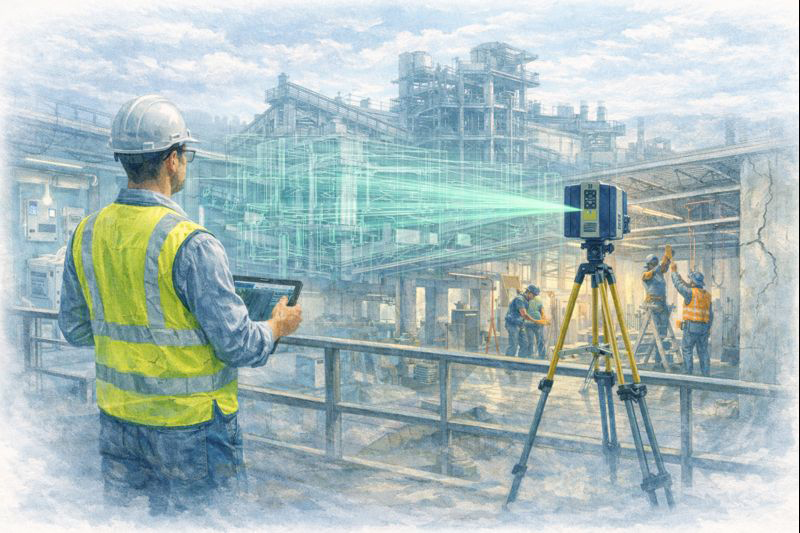
Hamilton By Design provides experienced drafting capacity, available for short-term support or longer-term secondment, delivered within a structured scan โ†’ model โ†’ detail โ†’ check workflow that aligns documentation with real-world conditions and engineering intent.


Drafting capacity aligned with contemporary project demands

Modern projects often require drafting support that can scale quickly to address:

  • Peak workloads during design development or shutdown preparation
  • Short-term resourcing gaps within engineering teams
  • Documentation demands driven by upgrades, modifications, or compliance works
  • Brownfield environments where existing information is incomplete or unreliable

In these situations, drafting capacity must be more than transactional. It must integrate with engineering workflows and reflect current site conditions.


Scan: establishing an accurate technical baseline

Where existing drawings cannot be relied upon, accurate documentation begins with engineering-grade reality capture.

Our team utilises 3D laser scanning to establish a defensible geometric baseline of existing assets. This approach supports drafting activities by ensuring that models and drawings are developed from verified site data, rather than assumptions or legacy documentation.


Model: structured CAD developed for engineering use

Scan data is translated into purpose-built CAD models, developed to suit the intended engineering and documentation outcomes. Models are structured with appropriate datums, tolerances, and levels of detail to support:

  • Engineering assessment and design coordination
  • Structural and mechanical detailing
  • As-built documentation and future modification

This modelling stage ensures drafting activities are grounded in usable, engineering-aligned data.


Detail: producing clear, buildable documentation

Drafting output remains one of the most critical interfaces between design and construction.

From verified models, our draftspersons produce clear, fabrication-ready drawings that communicate engineering intent accurately and unambiguously. Documentation is prepared with consideration for:

  • Constructability and sequencing
  • Fabrication practicality
  • Coordination between disciplines
  • Alignment with relevant Australian Standards

The emphasis is on documentation that can be confidently issued to site.


Check: verification as a formal step, not an afterthought

Before issue, drawings and models are subject to structured review to confirm:

  • Consistency with scan data and models
  • Coordination across views and drawing sets
  • Technical clarity and buildability

This checking step reduces the likelihood of downstream rework and supports defensible documentation outcomes.


Why integrated drafting capacity matters

When drafting is separated from scanning, modelling, or checking, risk is introduced at each handover.

An integrated scan โ†’ model โ†’ detail โ†’ check workflow:

  • Improves documentation reliability
  • Reduces errors caused by assumptions
  • Supports compliance and verification
  • Enhances confidence during fabrication and construction

This approach is particularly effective for existing assets, industrial facilities, and brownfield upgrades.


Flexible drafting support and secondment

Hamilton By Designโ€™s drafting capacity can be provided as:

  • Short-term drafting support
  • Longer-term secondment within client teams
  • Targeted assistance during high-demand project phases

Drafting support is delivered within an engineering-led environment, ensuring alignment between documentation and technical intent.

To learn more about flexible resourcing options, visit our Secondment Services page:
๐Ÿ‘‰ https://www.hamiltonbydesign.com.au/home/secondment-services/


Hamilton By Design logo displayed on a blue tilted rectangle with a grey gradient background

Conclusion

As project complexity and delivery pressures continue to increase, drafting capacity must be current, integrated, and accountable.

By providing experienced draftspersons supported by a structured scan โ†’ model โ†’ detail โ†’ check workflow, Hamilton By Design enables project teams to scale documentation capability without compromising accuracy, buildability, or engineering quality.

Name
Would you like us to arrange a phone consultation for you?
Address

Australian Standards That Shape Engineering, Scanning & Documentation Projects

Australian Standards play a critical role in how engineering, design, and construction work is delivered โ€” particularly on industrial, mining, power, and brownfield projects where safety, reliability, and compliance matter.

At Hamilton By Design, engineering services, 3D scanning, CAD modelling, and as-built documentation are delivered with a clear understanding of how Australian Standards inform real-world engineering decisions. Rather than treating standards as a checklist, they are applied as part of a practical, engineering-led workflow.


Why Australian Standards matter in real projects

Australian Standards exist to ensure that structures, equipment, and systems are:

  • Safe to build, operate, and maintain
  • Fit for their intended purpose
  • Designed and documented consistently
  • Defensible if designs are reviewed or audited

On existing sites, outdated drawings and undocumented modifications make standards-based assessment even more important. Accurate data, clear documentation, and sound engineering judgement are essential to applying standards correctly.


Key Australian Standards referenced across our work

The following Australian Standards are commonly referenced across Hamilton By Design projects and content, particularly where engineering, scanning, drafting, and compliance intersect.


AS 1657 โ€“ Fixed platforms, walkways, stairways and ladders

This standard governs access systems used for operation and maintenance.

It is frequently applied when:

  • Assessing existing platforms and walkways
  • Designing upgrades or retrofits
  • Verifying clearances, handrails, and access geometry

Engineering-grade as-built information is often required to accurately assess compliance on existing sites.


AS 3990 โ€“ Mechanical equipment steelwork

AS 3990 applies to steelwork that supports mechanical equipment.

It is commonly referenced for:

  • Equipment support frames
  • Plant steelwork and interfaces
  • Integration of access systems with equipment

Accurate geometry and documentation are essential when modifying or extending existing steelwork.


AS 4100 โ€“ Steel structures

AS 4100 forms the basis for the design and assessment of steel structures.

This standard is applied to:

  • Structural steel framing
  • Platforms, walkways, and support structures
  • Structural upgrades and strengthening works

Structural engineering decisions rely on accurate understanding of existing member sizes, connections, and load paths.


AS 4991 โ€“ Lifting devices

AS 4991 covers the design and use of lifting devices.

It is relevant when:

  • Designing or modifying lifting points
  • Documenting lifting arrangements
  • Assessing existing lifting equipment

Clear engineering documentation supports safe lifting operations and ongoing compliance.


AS 4024 โ€“ Safety of machinery

AS 4024 relates to machinery safety and risk control.

It is typically referenced where:

  • Machinery interfaces with structures or access systems
  • Guarding or safety systems are affected by modifications
  • Engineering changes may impact operator safety

AS 1100 โ€“ Technical drawing (implied through documentation workflows)

AS 1100 governs technical drawing conventions.

While not always referenced explicitly, it underpins:

  • Engineering drawings
  • Structural and mechanical drafting
  • As-built documentation

Clear, standardised drawings are essential for construction, fabrication, and future asset modifications.


National Construction Code (NCC)

The NCC provides a regulatory framework for building compliance.

Engineering and documentation workflows often support:

  • Existing building upgrades
  • Compliance verification
  • Safety-in-design obligations

Accurate as-built documentation helps ensure engineering decisions align with NCC requirements.


The role of 3D scanning and as-built data in standards-based engineering

Australian Standards often require engineers to understand what actually exists on site, not just what is shown on legacy drawings.

Engineering-grade 3D laser scanning and LiDAR are used to:

  • Capture accurate geometry of existing assets
  • Identify undocumented modifications
  • Support standards-based assessment and design
  • Produce reliable as-built documentation

This is particularly important on brownfield and live sites where assumptions introduce risk.


Applying standards with engineering judgement

Australian Standards do not replace engineering judgement โ€” they rely on it.

Effective application of standards requires:

  • Accurate site information
  • Understanding of real operating conditions
  • Clear documentation of assumptions and limitations
  • Coordination between engineering, drafting, and construction

This is why standards, scanning, drafting, and engineering must work together as part of a single workflow.


Our clients:


Final thoughts

Australian Standards provide the framework for safe and compliant engineering, but outcomes depend on how they are applied.

By combining engineering expertise with accurate data capture and clear documentation, standards can be applied confidently โ€” reducing risk, improving safety, and delivering better long-term asset performance.


Hamilton By Design logo displayed on a blue tilted rectangle with a grey gradient background

Need standards-aware engineering support?

If your project involves upgrades, existing assets, or compliance-driven design, engineering-led scanning, drafting, and documentation can make all the difference.

Hamilton By Design supports projects where Australian Standards, engineering judgement, and real-world conditions must align.

Name
Would you like us to arrange a phone consultation for you?
Address

Reality Capture Sydney for Real Estate & Property Assets

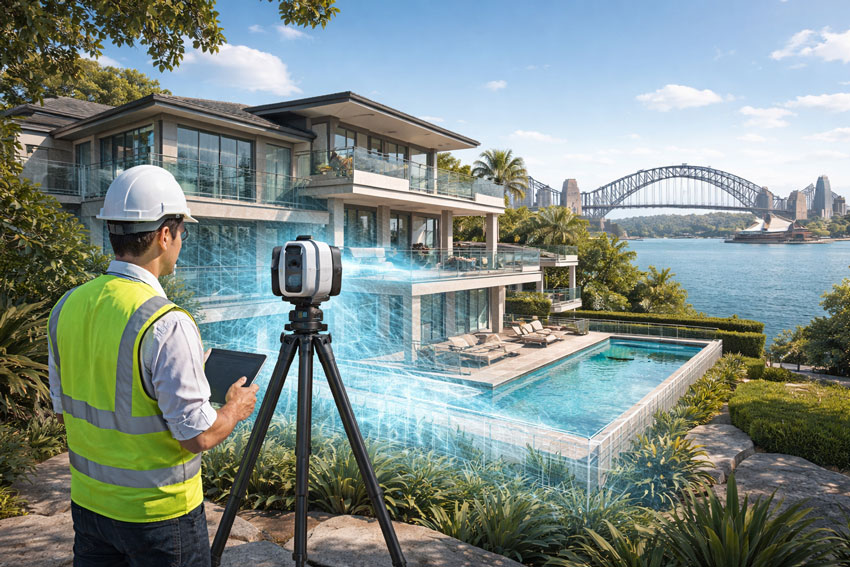
Engineer using a LiDAR scanner to capture a Sydney harbour-front residential property with Sydney Harbour Bridge in the background

Reality Capture Sydney for Real Estate & Property Assets

High-Accuracy Digital Records and Premium Visual Context

Sydneyโ€™s real estate and commercial property market demands accurate information, clear presentation, and confidence in decision-making. Whether supporting leasing, refurbishment, due diligence, or long-term asset management, reality capture in Sydney provides property owners and managers with a reliable digital record of what exists today.

Hamilton By Design delivers professional reality capture services in Sydney, combining high-accuracy spatial data with high-end visual outputs suited to commercial and premium property assets.


Reality capture of a Sydney waterfront residential property using LiDAR scanning with harbour and bridge context

What Is Reality Capture for Real Estate?

In a property context, reality capture is the process of digitally recording buildings and spaces using advanced laser scanning and spatial capture technologies. The result is a dimensionally accurate digital representation of an asset that can be reused across multiple projects without repeated site visits.

Reality capture is commonly used across Sydney for:

  • Accurate existing-condition records
  • Leasing and tenancy planning
  • Commercial fit-outs and refurbishments
  • Asset documentation and compliance support
  • Due diligence during acquisition or divestment

Unlike traditional photography or basic floor plans, reality capture provides measurable, verifiable data that reduces uncertainty and risk.


High-End Capture of Sydneyโ€™s Harbour & Landmark Context

For premium assets, context matters. Hamilton By Design captures high-resolution reality capture imagery that includes Sydneyโ€™s built environment and surrounding landmark context, where appropriate.

This may include:

  • Harbour-front commercial buildings
  • Assets with views or proximity to Sydney Harbour
  • Visual context incorporating the Sydney Harbour Bridge
  • CBD and waterfront developments

These high-end visuals support investor presentations, leasing material, and executive-level decision-making, while remaining grounded in accurate spatial data.


Why Reality Capture Matters in Sydneyโ€™s Property Market

Sydney properties often involve:

  • High asset values
  • Live, occupied buildings
  • Tight refurbishment timeframes
  • Complex services and structural interfaces

Reality capture helps property stakeholders to:

โœ” Verify what exists before committing capital
โœ” Reduce surprises during refurbishments
โœ” Support consultants with reliable base information
โœ” Minimise disruption to tenants
โœ” Maintain a long-term digital record of the asset

For property owners and managers, this translates directly to reduced risk and better outcomes.


Typical Real Estate Applications

As-Built Property Records

Create accurate digital records where original drawings are missing, outdated, or unreliable.

Leasing & Tenancy Planning

Support test fits, space planning, and consultant coordination with trusted spatial data.

Refurbishment & Upgrade Projects

Capture existing conditions prior to works to reduce redesign, delays, and cost overruns.

Due Diligence & Asset Review

Provide clarity and confidence during acquisition, divestment, or asset reviews.


A Professional, Asset-Focused Approach

While many services focus on visual outputs alone, Hamilton By Design approaches reality capture from an asset and decision-support perspective. Our deliverables are:

  • Dimensionally reliable
  • Fit for professional use
  • Suitable for consultants and contractors
  • Appropriate for commercial and executive audiences

This ensures reality capture data can be relied upon when property decisions carry financial and contractual significance.


Deliverables to Suit Property Clients

Depending on your requirements, we can provide:

  • Registered point clouds
  • CAD-ready base files
  • Accurate spatial references
  • Section views and area verification
  • Digital records suitable for future upgrades

All outputs are tailored to the intended property use, not generic scanning deliverables.


Our clients:


Reality Capture Sydney โ€” Confidence for Property Decisions

Reality capture removes uncertainty from property decisions. By accurately capturing what exists today, Sydney property owners and managers can plan, lease, refurbish, and manage assets with confidence.

Hamilton By Design supports Sydney real estate and commercial property clients with professional reality capture services that combine accuracy, clarity, and premium presentation.

Contact Hamilton By Design to discuss your Sydney property or real estate reality capture requirements.

Name
Would you like us to arrange a phone consultation for you?
Address
https://www.hamiltonbydesign.com.au/home/engineering-services/3d-scanning-sydney/3d-engineering-in-sydney

Reality Capture Sydney

Engineer using a LiDAR scanner to capture a Sydney harbour-front residential property with Sydney Harbour Bridge in the background

Reality Capture Sydney | Property & Real Estate Services

Engineering-Grade LiDAR & Digital Reality Capture for the Built Environment

As Sydneyโ€™s construction, infrastructure, and industrial assets become more complex, traditional measurement methods are no longer sufficient. Reality capture has become a critical enabler for accurate planning, risk reduction, and confident project delivery across the built environment in Sydney.

Hamilton By Design provides engineering-grade reality capture services in Sydney, combining high-accuracy LiDAR laser scanning with practical engineering workflows to deliver reliable as-built data, digital twins, and construction-ready models.

Learn more about our Sydney scanning capability:
https://www.hamiltonbydesign.com.au/home/engineering-services/3d-scanning-sydney/3d-scanning-services-in-sydney/


What Is Reality Capture?

Reality capture is the process of digitally recording real-world assets using technologies such as:

  • LiDAR laser scanning
  • High-resolution spatial data capture
  • Registered point clouds
  • 3D models aligned to real geometry

The result is an accurate digital representation of existing conditions โ€” enabling engineers, designers, and constructors to work from a single source of truth rather than assumptions or outdated drawings.


Reality capture of a Sydney waterfront residential property using LiDAR scanning with harbour and bridge context

Why Reality Capture Matters in Sydney

Sydney projects frequently involve:

  • Live operational assets
  • Brownfield construction and upgrades
  • Tight construction tolerances
  • Complex interfaces between structural, mechanical, and architectural systems

Reality capture enables project teams to:

โœ” Verify existing conditions before design
โœ” Reduce rework and construction clashes
โœ” Improve coordination across disciplines
โœ” Accelerate approvals and decision-making
โœ” Improve safety by minimising site re-visits

This is particularly valuable across commercial buildings, transport infrastructure, industrial facilities, utilities, and large refurbishment projects.


Engineering-Led Reality Capture โ€” The Hamilton By Design Difference

At Hamilton By Design, reality capture is not treated as a standalone surveying task. Our services are engineer-led, ensuring the data captured is fit for downstream use in:

  • Mechanical and structural design
  • Construction coordination
  • Retrofit and upgrade works
  • Fabrication and installation planning

Our Sydney reality capture services integrate directly with CAD, BIM, and engineering documentation workflows โ€” ensuring accountability from scan through to design and delivery.


Typical Reality Capture Applications in Sydney

As-Built Documentation

Capture accurate as-built conditions for compliance, certification, handover, or future upgrades.

Construction & Refurbishment Projects

Scan existing buildings and structures prior to modifications, extensions, or adaptive reuse.

Industrial & Infrastructure Assets

Capture complex geometry such as plant rooms, pipework, platforms, and structural steel.

Digital Twins & Asset Records

Create reliable digital records that support ongoing asset management and lifecycle planning.


Deliverables Tailored to Project Needs

Depending on your scope, Hamilton By Design can provide:

  • Registered LiDAR point clouds
  • CAD-ready geometry
  • BIM-compatible models
  • Section views and reference drawings
  • Engineering drawings derived from scan data

All deliverables are issued to suit engineers, builders, asset owners, and project managers working across Sydney.


Hamilton By Design logo displayed on a blue tilted rectangle with a grey gradient background

Reality Capture Sydney โ€” Build with Confidence

Reality capture removes uncertainty from complex projects. By accurately capturing what exists today, project teams can design, coordinate, and construct with confidence tomorrow.

Hamilton By Design supports Sydney-based projects with engineering-grade reality capture, practical deliverables, and a deep understanding of how digital data is used in real construction and industrial environments.

Contact Hamilton By Design to discuss your Sydney reality capture requirements or arrange a site scan.

Name
Would you like us to arrange a phone consultation for you?
Address

3D Construction Scanning Darwin

Engineering-grade 3D laser scanner capturing Darwin port infrastructure, harbour assets, and urban skyline

Engineering-Grade LiDAR for Accurate As-Built & Construction Delivery

Construction projects in Darwin operate in a demanding environment โ€” tropical weather, remote logistics, accelerated schedules, and complex interfaces between structural, mechanical, and architectural elements. 3D construction scanning provides a reliable digital foundation to reduce risk, eliminate rework, and support confident decision-making throughout the project lifecycle.

Hamilton By Design delivers engineering-grade 3D construction scanning in Darwin, supporting contractors, engineers, builders, and asset owners with accurate spatial data, as-built models, and construction-ready documentation.

๐Ÿ‘‰ Learn more about our Darwin scanning capability:
https://www.hamiltonbydesign.com.au/3d-scanning-in-darwin/
https://www.hamiltonbydesign.com.au/home/engineering-services/3d-scanning-darwin/darwin-lidar-laser-scanning-services/


What Is 3D Construction Scanning?

3D construction scanning uses high-accuracy LiDAR laser scanners to capture the real-world geometry of construction sites, partially completed works, and existing assets. The output is a dense, survey-grade point cloud that can be used to create:

  • Accurate as-built drawings
  • BIM and digital twin models
  • Clash detection and coordination models
  • Verification of construction tolerances
  • Retrofit and upgrade designs

Unlike traditional tape or total-station methods, LiDAR captures millions of points per second, ensuring complex geometry is recorded correctly the first time.


Engineering-grade 3D laser scanner capturing Darwin port infrastructure, harbour assets, and urban skyline

Why 3D Construction Scanning Matters in Darwin

Construction in Darwin often involves:

  • Live brownfield sites
  • Remote or logistically constrained projects
  • Tight shutdown or installation windows
  • High consequences of dimensional errors

3D construction scanning enables:

โœ” Reduced rework and RFIs
โœ” Improved trade coordination
โœ” Accurate verification before fabrication
โœ” Faster design and approval cycles
โœ” Safer site data capture with minimal disruption

This is particularly valuable for industrial buildings, ports, power generation facilities, defence infrastructure, and commercial developments across the Northern Territory.


Typical Construction Applications

As-Built Verification

Confirm what has actually been built โ€” not what was assumed โ€” before handover, certification, or the next construction stage.

Construction Progress Capture

Document progress at key milestones to support planning, claims, and coordination.

Retrofit & Upgrade Projects

Capture existing structures accurately before mechanical, electrical, or structural upgrades commence.

Clash Detection & Coordination

Overlay scanned data with design models to identify clashes early and avoid costly site changes.


Hamilton By Design logo displayed on a blue tilted rectangle with a grey gradient background

Engineering-Led Scanning โ€” Not Just Data Capture

At Hamilton By Design, 3D construction scanning is delivered by engineers, not just scanning technicians. This means:

  • Scan strategies aligned to engineering outcomes
  • Data captured at appropriate accuracy for construction tolerances
  • Deliverables tailored for CAD, BIM, and fabrication workflows
  • Clear accountability from scan to design to documentation

Our scanning integrates directly with mechanical design, structural analysis, and construction documentation services โ€” providing a single source of truth for your project.


Deliverables to Suit Construction Teams

Depending on your requirements, we can provide:

  • Registered point clouds
  • CAD-ready models
  • Revit / BIM outputs
  • Section views and construction references
  • Engineering drawings derived from scan data

All deliverables are tailored to suit builders, engineers, subcontractors, and asset owners.


Our clients:


3D Construction Scanning Darwin โ€” Partner with Confidence

Whether you are delivering a new build, managing a complex refurbishment, or upgrading an existing facility, 3D construction scanning in Darwin provides the clarity and accuracy needed to build with confidence.

Hamilton By Design supports construction projects across Darwin and the Northern Territory with engineering-grade LiDAR scanning, practical deliverables, and real-world construction experience.

Let Connect us to discuss your project requirements or arrange a site scan.

Name
Would you like us to arrange a phone consultation for you?
Address

3D Scanning Engineering in Dubbo

3D Scanning Engineering in Dubbo

Dubbo is one of Australiaโ€™s most important inland cities. Often described as the capital of western New South Wales, it supports a vast region spanning agriculture, mining, infrastructure, health, education, and logistics. Unlike towns defined by a single industry, Dubboโ€™s strength lies in its diversity and its role as a regional engineering and services hub.

Engineering projects in and around Dubbo range from industrial facilities and infrastructure upgrades to mining support, utilities, and large-scale agricultural assets. Many of these projects involve brownfield conditions, legacy infrastructure, and tight delivery timelinesโ€”making accurate site data and practical engineering essential.

Hamilton By Design supports Dubbo projects with engineer-led 3D LiDAR laser scanning, mechanical and structural engineering, 3D CAD modelling, FEA, and fabrication-ready drafting. Our workflow is focused on accuracy, constructability, and delivering designs that work first time.

Engineering challenges in a regional hub like Dubbo

As a regional centre, Dubbo supports assets spread across a wide geographic area. Engineering teams often deal with:

  • Existing infrastructure that has been extended or modified over time
  • Limited or outdated drawings
  • Projects that must be delivered efficiently to minimise disruption
  • Assets that serve agriculture, mining, transport, and public infrastructure

In these environments, assumptions create risk. Reliable as-built information is critical before design, fabrication, or construction begins.

3D Laser Scanning for Dubbo projects

Hamilton By Design uses high-accuracy 3D Laser Scanning to capture the true as-built condition of sites in and around Dubbo. Laser scanning records millions of precise measurements, creating a detailed digital record of buildings, plant, structures, and surrounding interfaces.

3D laser scanning is particularly valuable for:

  • Brownfield industrial and infrastructure sites
  • Agricultural and processing facilities
  • Mining and quarry support assets
  • Projects where drawings no longer reflect site reality

Scanning is typically completed during short, controlled site visits, minimising disruption while providing data that can be relied on throughout the project.

From scan data to accurate 3D models

Once scanning is complete, the data is processed and converted into detailed 3D CAD Modelling. These models represent what actually exists on site, rather than what historic documentation suggests.

For Dubbo-based and regional projects, scan-based 3D modelling supports:

  • Mechanical upgrades and equipment replacements
  • Structural additions such as platforms, supports, and access ways
  • Integration of new assets into existing facilities
  • Long-term digital records for future maintenance and expansion

Accurate models reduce uncertainty and help project teams make informed decisions early.

Mechanical and structural engineering built on real conditions

Dubboโ€™s engineering projects often involve coordinating multiple disciplines across constrained or operational sites. Working from scan-derived models allows engineers to:

  • Understand existing load paths and constraints
  • Check clearances and access early in the design
  • Coordinate mechanical and structural elements within one environment

This leads to designs that are practical, buildable, and aligned with how assets are actually used.

FEA to support performance and compliance

Where performance, safety, or compliance is critical, Hamilton By Design applies FEA Capabilities to support engineering decisions.

Finite Element Analysis is commonly used to:

  • Check structural capacity under operational loads
  • Assess modifications to existing steel and concrete
  • Review fatigue, vibration, and deflection
  • Support engineering approval and sign-off

Using FEA on scan-based geometry gives confidence that designs will perform as intended in real operating conditions.

Easy-to-build fabrication drawings with engineering approval

Clear documentation is essential for successful deliveryโ€”particularly in regional locations where rework can be costly. Hamilton By Design produces fabrication-ready Drafting directly from coordinated 3D models.

Typical deliverables include:

  • General arrangement and detail drawings
  • Fabrication and installation drawings
  • Engineering-reviewed and approval-ready documentation

This focus on clarity and constructability helps fabricators and contractors build efficiently and accurately the first time.

Reducing risk through digital engineering

By capturing site conditions once and completing the majority of engineering off site, Dubbo projects benefit from:

  • Reduced site visits and travel costs
  • Improved safety outcomes
  • Better coordination before fabrication
  • Fewer surprises during installation

This approach is well suited to Dubboโ€™s role as a regional hub supporting diverse industries across western NSW.

Supporting Dubbo and regional NSW with practical engineering

Dubboโ€™s strength lies in its ability to support many industries across a wide region. Hamilton By Designโ€™s integrated scanning and engineering workflow aligns with this roleโ€”providing accurate data, sound engineering judgement, and clear documentation to support reliable project delivery.

3D Scanning Engineering in Dubbo is about turning complex, real-world conditions into clear, buildable engineering outcomes that support infrastructure, industry, and growth across western New South Wales.

Our Clients:

Name
Would you like us to arrange a phone consultation for you?
Address

3D CAD Modelling | 3D Scanning