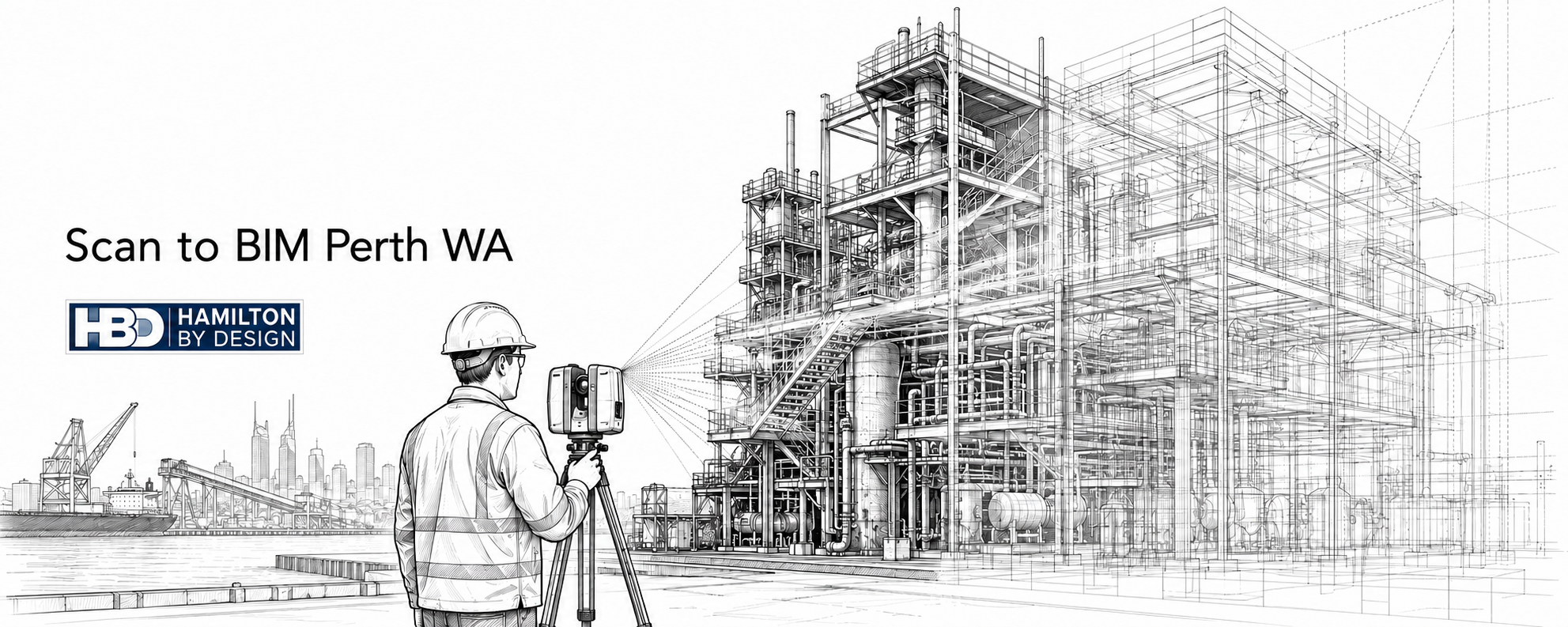
Scan to BIM Perth WA | LiDAR Scanning & BIM Modelling

Embracing the idea of Scan to BIM Perth WA would suggest accurate site information is critical for successful engineering, construction, maintenance and upgrade projects. In Perth and across Western Australia, many mining, industrial, commercial and infrastructure assets have changed over time, but the drawings have not always kept up.
Equipment gets replaced. Pipework is modified. Structural steel is strengthened or repaired. Access platforms are changed. Services are rerouted. Buildings are refurbished. Over time, the original drawings may no longer reflect what is actually installed on site.
This is where Scan to BIM Perth becomes valuable.
Scan to BIM is the process of capturing an existing site using 3D laser scanning or LiDAR technology, then converting that point cloud data into an accurate Building Information Model. The result is a usable digital model that helps engineers, project managers, builders, asset owners and maintenance teams make better decisions based on real site conditions.
Hamilton By Design provides engineering-led Scan to BIM services across Perth and Western Australia, supporting mining, industrial, commercial, infrastructure and brownfield upgrade projects.
For projects that require accurate reality capture before design or fabrication begins, Hamilton By Design also provides 3D laser scanning in Perth to capture reliable point cloud data for downstream BIM, CAD and engineering workflows.
The Biggest Problem: Inaccurate or Missing As-Built Information
The biggest problem Scan to BIM solves is the lack of reliable as-built information.
Many Perth and WA sites rely on old drawings, incomplete records or assumptions made from previous projects. In some cases, drawings may exist but do not include later site modifications. In other cases, asset owners may only have PDFs, hand-marked drawings or partial CAD files.
This creates major project risk.
If engineers are designing from inaccurate information, new equipment may not fit. Steelwork may clash with existing structure. Pipe routes may conflict with services. Fabricated parts may arrive on site and require modification. Shutdown work may take longer than planned because the real site does not match the design assumptions.
These issues can lead to:
- Design clashes
- Fabrication errors
- Installation delays
- Extra site visits
- Shutdown overruns
- Safety risks
- Increased project costs
- Poor coordination between trades
- Rework during construction
- Poor asset records for future maintenance
For brownfield industrial and mining projects, these risks are especially important because work is often carried out around live plant, restricted access zones, shutdown windows and complex existing infrastructure.
Scan to BIM helps reduce this uncertainty by capturing the actual site and turning it into practical digital information.
What Is Scan to BIM?
Scan to BIM combines two key processes: reality capture and Building Information Modelling.
First, the existing site is captured using 3D laser scanning or LiDAR. The scanner records millions of measurement points across the site. These points form a point cloud, which is a highly accurate 3D representation of the existing conditions.
The point cloud can then be used to create a BIM model. Depending on the project, this model may include building elements, structural steel, pipework, mechanical equipment, platforms, conveyors, access systems, services, walls, slabs, columns and other site features.
The final model may be delivered in formats such as Revit, Navisworks, IFC, DWG or other agreed digital formats.
The key value is that the model is based on measured site data, not guesswork.
Who Uses Scan to BIM in Perth?
Scan to BIM is used by a wide range of organisations and project teams across Perth and Western Australia.
Typical users include:
- Mining companies
- Industrial plant owners
- Commercial property owners
- Infrastructure operators
- Engineering consultants
- Mechanical engineers
- Structural engineers
- Architects
- Builders
- Fabricators
- Shutdown planners
- Asset managers
- Maintenance teams
- Project managers
- Facility managers
For asset owners, Scan to BIM provides better records of what is installed.
For engineers, it provides a more reliable base for design.
For builders and fabricators, it helps reduce clashes and installation problems.
For maintenance teams, it supports planning, access review and future asset management.
Where Is Scan to BIM Used in Perth and WA?
Scan to BIM can be used anywhere existing conditions need to be captured accurately.
In Perth, this may include commercial buildings, hospitals, schools, industrial workshops, warehouses, manufacturing sites, processing plants, water infrastructure, ports and transport facilities.
Across Western Australia, Scan to BIM is also valuable for mining and heavy industrial locations, including processing plants, materials handling facilities, port infrastructure, power generation assets, pump stations, treatment plants and regional industrial sites.
Common WA locations and project areas include:
- Perth CBD
- Kwinana
- Henderson
- Welshpool
- Canning Vale
- Fremantle
- Rockingham
- Bunbury
- Geraldton
- Kalgoorlie
- Port Hedland
- Karratha
- Pilbara
- Goldfields
- Regional Western Australia
Hamilton By Design supports broader engineering and scanning work through its Perth WA engineering and 3D scanning services page, which is a useful internal location hub for Perth-based clients.
How the Scan to BIM Process Works
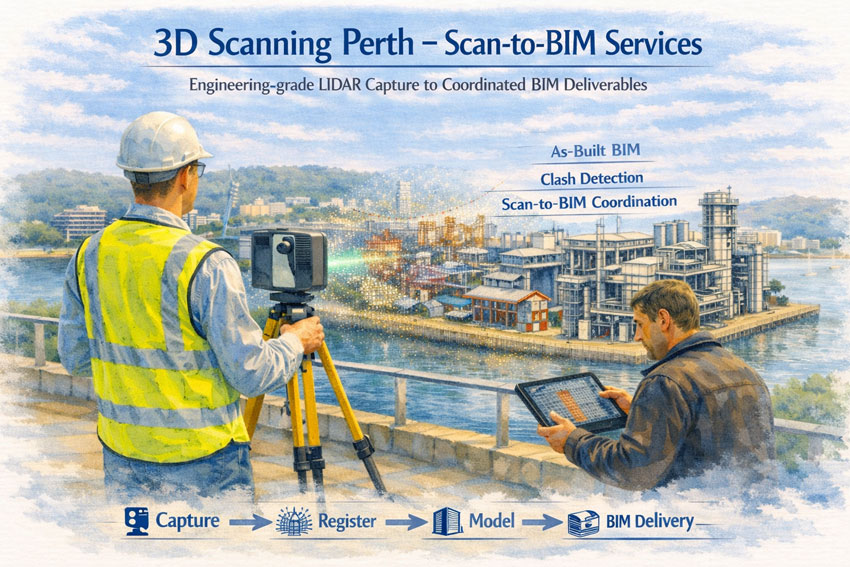
A typical Scan to BIM workflow includes several stages.
1. Project Scope and Capture Planning
Before scanning begins, the project team needs to understand what the model will be used for.
This is important because not every Scan to BIM project needs the same level of detail. A model for architectural refurbishment may require different information compared with a model for conveyor upgrades, pipework modifications, structural access design or plant layout changes.
Key questions include:
- What area needs to be captured?
- What level of detail is required?
- Is the model for design, construction, asset records or maintenance?
- Are mechanical and structural elements required?
- Are services and pipework required?
- What deliverable format is needed?
- Is the work being used for clash detection?
- Is the site live, restricted or difficult to access?
Clear scope at the start helps ensure the final model is useful.
2. 3D Laser Scanning or LiDAR Site Capture
The site is captured using professional 3D scanning equipment. The scanner collects accurate spatial data from multiple positions around the site.
For complex industrial facilities, multiple scan positions may be required to capture equipment, steelwork, pipework, access platforms, conveyors and building elements from different angles.
The result is a point cloud that represents the real site geometry.
3. Point Cloud Registration
After site capture, the individual scans are registered together into a single coordinated point cloud.
This stage aligns the scans so the full site can be reviewed as one digital environment.
Typical point cloud formats may include:
- E57
- RCP
- RCS
- LAS
The registered point cloud becomes the foundation for the BIM model.
4. BIM Model Development
The point cloud is then used to create a BIM model. Depending on the project, this may include modelling architectural, structural, mechanical or services elements.
For industrial and mining projects, modelled items may include:
- Structural steel
- Platforms
- Stairs
- Handrails
- Pipework
- Tanks
- Pumps
- Conveyors
- Chutes
- Hoppers
- Mechanical equipment
- Access areas
- Building structure
- Services corridors
The goal is not just to make the model look good. The goal is to create a model that supports real project decisions.
Where CAD deliverables are required rather than a full BIM workflow, Hamilton By Design can also convert point cloud data into engineering models and drawings through its Scan to CAD Perth service.
5. Quality Review Against the Point Cloud
Once the BIM model is created, it should be checked against the point cloud. This helps confirm that the model reflects the captured site conditions and that the required scope has been covered.
Quality review is important because Scan to BIM is only useful if the model is accurate enough for the intended purpose.
A model used for general planning may not require the same detail as a model used for fabrication coordination, clash detection or construction sequencing. The required accuracy and level of detail should match the project outcome.
6. Delivery of BIM and CAD Outputs
Final deliverables depend on the project requirements.
Common deliverables include:
- Revit model
- Navisworks model
- IFC model
- DWG drawings
- 2D plans
- Sections and elevations
- PDF documentation
- Registered point cloud
- E57 files
- RCP / RCS files
- Clash detection model
- As-built documentation
Tools That Assist With Scan to BIM
Scan to BIM relies on a combination of capture equipment, point cloud software, BIM software and engineering review.
Useful tools include:
| Tool | Purpose |
|---|---|
| 3D laser scanner / LiDAR | Captures accurate site geometry |
| FARO Focus / terrestrial scanner | Engineering-grade site capture |
| FARO SCENE | Point cloud registration and processing |
| Autodesk ReCap | Point cloud preparation for Autodesk workflows |
| Revit | BIM model development |
| Navisworks | Coordination and clash review |
| AutoCAD | 2D drawings and CAD outputs |
| IFC | Model exchange between software platforms |
| E57 / RCP / RCS / LAS | Point cloud delivery formats |
| SolidWorks / Inventor | Mechanical modelling where required |
The right tools depend on the final use of the data. A commercial building project may require a Revit-focused workflow, while an industrial plant upgrade may need a combination of point cloud, CAD, BIM and mechanical modelling outputs.
Why Engineering-Led Scan to BIM Matters
Not all Scan to BIM providers approach the work the same way.
Some providers focus mainly on scanning and visual modelling. That may be enough for some building documentation projects, but industrial and mining sites often need a deeper understanding of how the asset works.
Engineering-led Scan to BIM is different because the model is developed with practical project outcomes in mind.
For example, in a processing plant, the important question may not simply be “what does the site look like?” The real questions may be:
- Will the new equipment fit?
- Can the conveyor be modified safely?
- Is there enough access for installation?
- Will new pipework clash with existing steel?
- Can the platform support maintenance access?
- What needs to be removed before shutdown?
- Can fabrication drawings be developed from the scan data?
- What existing structure must remain untouched?
Hamilton By Design’s Scan to BIM approach is suited to mechanical, structural, mining and industrial environments where the digital model needs to support real engineering decisions.
For clients working nationally, the broader Scan to BIM Mining and Industrial Facilities page provides additional context around mining, processing plant, materials handling and heavy industrial applications.
Benefits of Scan to BIM Perth
Scan to BIM provides several important benefits for Perth and WA projects.
Better Design Accuracy
Design teams can work from real site data instead of old drawings or assumptions. This reduces the risk of designing around information that no longer reflects the site.
Reduced Site Rework
Accurate existing-condition data helps reduce fabrication and installation problems. This is particularly valuable where fabricated components need to fit into existing plant, structure or services.
Improved Clash Detection
Models can be reviewed before construction to identify conflicts between new and existing elements.
This helps project teams detect problems before labour, materials and equipment are committed to site work.
Faster Project Planning
Teams can review the site digitally without always needing to return to site.
This is useful for remote WA projects where travel, access and site inductions can add time and cost.
Improved Shutdown Confidence
For mining and industrial projects, accurate scan data helps plan work before shutdown begins.
Shutdowns are often expensive and time-sensitive. Scan to BIM helps reduce uncertainty before work starts.
Better Asset Records
Owners receive a more reliable digital record of existing assets.
This can support future maintenance, inspections, upgrades and long-term asset management.
Improved Collaboration
BIM models provide a shared reference point for engineers, builders, contractors, fabricators and asset managers.
When everyone is working from the same accurate information, coordination improves.
Scan to BIM for Brownfield Projects
Brownfield projects are one of the strongest use cases for Scan to BIM.
Unlike greenfield projects, brownfield sites already contain existing plant, structure, services, access restrictions and operational constraints. The site may have been modified many times over decades.
This makes accurate information critical.
Scan to BIM helps brownfield projects by capturing the real conditions before design or fabrication begins. This reduces the chance of clashes, improves planning and gives project teams a more reliable foundation for decision-making.
For Perth and WA mining, resources, port and industrial projects, this can be the difference between a smooth installation and a costly shutdown delay.
Recommended Page Details
| SEO Item | Suggested Detail |
|---|---|
| Page Name | Scan to BIM Perth WA |
| URL | /scan-to-bim-perth/ |
| Keyword Focus | Scan to BIM Perth |
| Location | Perth WA |
| Meta Description | Engineering-led Scan to BIM services in Perth WA. Convert 3D laser scan data into accurate BIM models for mining, industrial, commercial, infrastructure and brownfield upgrade projects. |
FAQs
What is Scan to BIM?
Scan to BIM is the process of capturing an existing site using 3D laser scanning or LiDAR, then converting the point cloud data into a Building Information Model. The model can be used for design, construction planning, asset management, clash detection and future maintenance.
Why is Scan to BIM useful for Perth and WA projects?
Scan to BIM is useful because many Perth and WA assets have incomplete or outdated drawings. By capturing the real site conditions, project teams can reduce assumptions, avoid clashes and plan upgrades with greater confidence.
What industries use Scan to BIM in Perth?
Scan to BIM is used across mining, mineral processing, ports, manufacturing, commercial buildings, infrastructure, water treatment, power generation and industrial facilities.
What deliverables can be provided from a Scan to BIM project?
Typical deliverables may include Revit models, Navisworks models, IFC files, DWG drawings, 2D plans, sections, elevations, registered point clouds, E57 files, RCP files, RCS files and PDF documentation.
Is Scan to BIM only for buildings?
No. Scan to BIM can be used for buildings, but it is also valuable for industrial plants, mining infrastructure, processing facilities, pipework, structural steel, conveyors, platforms, equipment and brownfield engineering projects.
Can Scan to BIM help reduce shutdown risk?
Yes. Scan to BIM can help project teams understand existing site conditions before shutdown work begins. This can reduce clashes, improve sequencing and reduce the risk of unexpected site issues during installation.
What is the difference between Scan to BIM and Scan to CAD?
Scan to BIM usually creates an information-rich model, often used in Revit, Navisworks or IFC workflows. Scan to CAD usually focuses on producing CAD models and drawings for engineering, drafting, fabrication or layout work. The right choice depends on the project outcome.
Do I need a full BIM model for every project?
No. Some projects only need a point cloud, 2D drawings or a Scan to CAD model. Other projects need a full BIM model for coordination, asset management or construction planning. The deliverable should match the project need.

Scan to BIM Perth gives project teams a more reliable way to understand existing buildings, plants and infrastructure before design, fabrication or construction begins.
For Perth and Western Australia, where mining, industrial, commercial and infrastructure assets often involve complex existing conditions, accurate digital information can reduce risk, improve coordination and support better long-term asset management.
By combining 3D laser scanning, point cloud processing, BIM modelling and engineering experience, Hamilton By Design helps turn real site conditions into practical digital deliverables that support better project outcomes.
Talk to Us – Contact Us
Our clients: