Mechanical Engineering | 3D Scanning | 3D Modelling
Tag: 3D Lidar Scanning
3D LiDAR scanning covers the capture of high-accuracy spatial data using laser scanning technology to create detailed 3D representations of real-world environments. This tag brings together content showing how LiDAR scanning supports engineering, construction, mining, infrastructure, and asset management through reliable as-built site data.
1. Setting the Scene: The Central Coast & Its Industrial Backbone
Home to nearly 350,000 people across Gosford, Wyong, Terrigal, and beyond, the Central Coast is well-known for its beaches and bushland—yet it also supports a robust industrial and mining‑services sector (Jora, Wikipedia). With growing infrastructure demands and proximity to resource projects like the Wallarah 2 coal proposal near Wyong (Wikipedia), mechanical engineers play a pivotal role behind the scenes.
2. What Do Mechanical Engineers Do in Mining on the Coast?
Mechanical engineers in mining and related heavy industries are responsible for:
Design & Maintenance: Planning, designing, and overseeing maintenance of critical mineral processing plants, machinery, conveyors, trucks and drilling rigs (Jobsora).
Health & Safety Compliance: Ensuring mechanical systems meet stringent safety regulations and operator protection standards (Jora).
Environmental Efficiency: Optimising equipment to reduce energy use, emissions, and noise—all while supporting mine rehabilitation efforts .
3. Job Opportunities in the Region
Recent job listings highlight robust opportunities for mechanical engineers across the Coast:
Mining Mechanical Engineer roles are regularly advertised in Gosford/Lisarow, appearing in SEEK and Jora job postings (SEEK).
Roles span senior design positions to hands‑on maintenance engineering—offering full-time opportunities with firms like Wabtec, Hyundai Rotem, Boral, and Coffey (SEEK).
Entry-level and graduate engineering roles are also available through pathways like Central Coast Council traineeships and TAFE NSW programs (Central Coast Council).
4. Industry Trends and What You’ll Need
As described by Titan Recruitment, the mining sector is embracing several transformative trends (Titan Recruitment):
Automation & Robotics: Engineers are tasked with integrating autonomous machinery and control systems.
Digital & Data Analytics: Skills in condition monitoring, sensors, and predictive analytics are in demand.
Sustainability Focus: There’s emphasis on clean, efficient systems that reduce environmental footprint.
Complex Machine Design: As equipment sophistication grows, so does the need for mechanical expertise.
Asset Reliability & Safety: Mechanical engineers must ensure zero-fault operation in harsh mining environments.
Site-to-System Integration: Engineers coordinate across disciplines—mechanical, electrical, structural—to optimise operations.
Continuous Upskilling: Ongoing education—through TAFE NSW, professional certifications, and in-house training—is critical.
5. Training & Career Pathways on the Central Coast
🎓 Education & Apprenticeships
TAFE NSW (Hunter & Central Coast) offers mechanical and engineering trade training, forming a strong foundation for local roles (Wikipedia).
Central Coast Council provides apprenticeships and traineeships in mechanical fields—ideal stepping stones into industry .
🏢 Local Industry Experience
Firms like Wabtec, Hyundai Rotem, Boral, Coffey, and Wright Engineering in Somersby/Gosford offer vital on-the-job training and progression (SEEK).
Mining-support businesses across the Central Coast employ engineers to design, maintain, and improve heavy-duty plant and machinery.
6. Why the Central Coast Is a Great Base for Mining Engineers
Proximity to Projects: Infrastructure supporting coal drilling and mineral processing connects easily with local towns via major transport routes in and out of Gosford (Jobsora, Wikipedia).
Balanced Lifestyle: Work-life harmony blends regional industry jobs with coastal living and access to national parks (Indeed).
Clear Career Pathways: Education, apprenticeships, and employers form a supportive ecosystem—from bedrock training to senior site leadership.
Final Takeaway
Mechanical engineers are essential to mining operations on the Central Coast—ensuring machinery runs efficiently, safely, and sustainably. With strong local education pathways, active job markets, and growing tech trends, the region offers rewarding careers tied to both industrial innovation and community lifestyle.
Ready to design, maintain, and optimise the backbone of mining? The Central Coast has the foundation—and the opportunity—awaiting mechanical engineers eager to build the future.
Elevating Engineering Precision: 3D CAD Design, Laser Scanning, and Simulation for Custom Steel Fabrication
In modern engineering, accuracy, efficiency, and adaptability are not just desired—they are essential. At Hamilton By Design, we combine cutting-edge tools like 3D CAD design, 3D laser scanning, and SolidWorks FEA Simulation with practical expertise in custom steel fabrication to deliver intelligent, end-to-end solutions for complex engineering projects.
From detailed CAD Modelling to field-accurate Faro Scanning, our consultancy supports Australian industries with precise, timely, and cost-effective design solutions.
The Role of 3D CAD Design in Modern Engineering
3D CAD design (Computer-Aided Design) forms the foundation of most modern engineering workflows. It transforms initial concepts into detailed digital models, enabling design validation, collaboration, and modification long before anything is physically built.
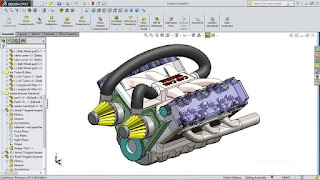
Using tools like SolidWorks, our experienced 3D CAD designers create accurate representations of components, assemblies, and entire systems. This not only reduces costly errors during fabrication but also allows clients to visualise and interact with their product in a virtual environment.
With 3D CAD design at the core, we help clients navigate engineering challenges—from product development to mechanical infrastructure—faster and with greater confidence.
3D Modelling: Bridging Concept and Construction
Closely integrated with CAD design is 3D modelling, which allows designers to create digital prototypes of physical objects. At Hamilton By Design, 3D modelling is used not just for form but also for function. Our models include precise dimensions, material properties, tolerances, and interaction points.
Whether it’s reverse engineering an existing plant structure or designing custom brackets for a conveyor system, our 3D modelling ensures high fidelity and interoperability across platforms.
The Power of 3D Laser Scanning for Engineering Accuracy
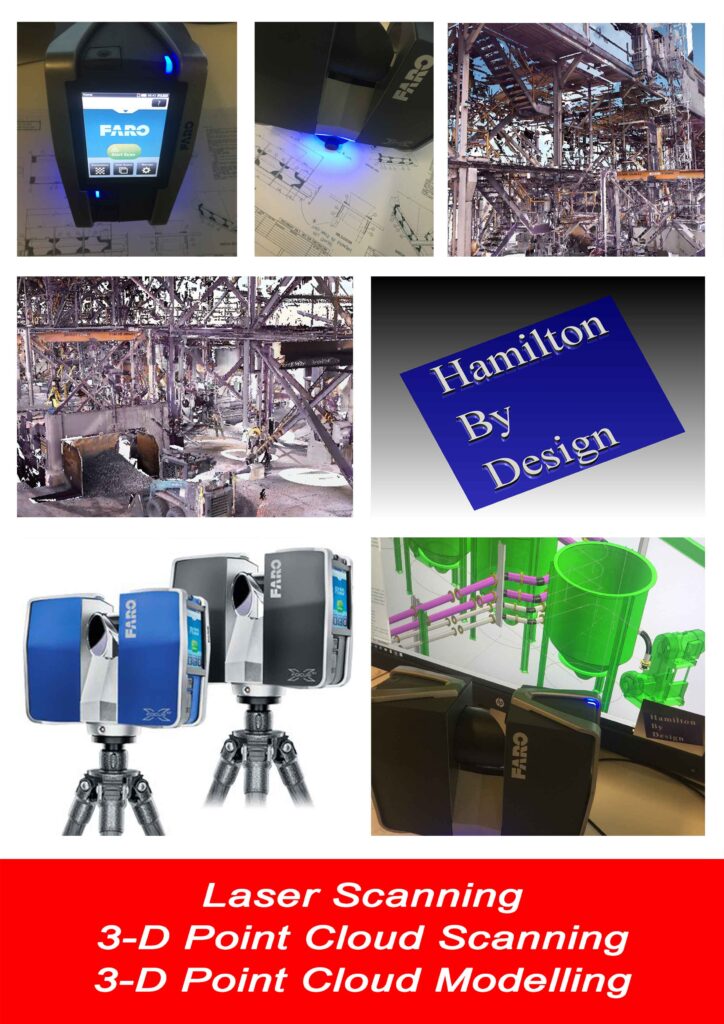
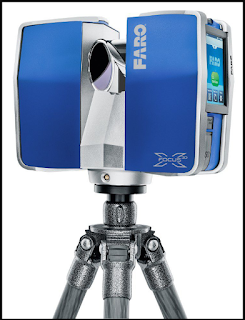
To capture as-built environments with unmatched accuracy, we use 3D laser scan for engineering projects of all sizes. Leveraging Faro scanning technology, we generate detailed point clouds that map real-world environments down to millimetre accuracy.
This Faro scan data is then converted into actionable geometry for further CAD modelling or simulation. It’s particularly valuable in retrofit, maintenance, or upgrade projects, where existing site data is often incomplete or outdated.
Whether you’re updating mechanical systems in a processing plant or ensuring compliance in a structural audit, 3D laser scanning delivers the reliable data you need for precise engineering decisions.
From Scan to Simulation: Enhancing Designs with SolidWorks FEA
After creating a digital model, it’s crucial to understand how it will perform under real-world conditions. That’s where SolidWorks FEA simulation comes in.
SolidWorks Simulation allows our team to perform finite element analysis (FEA) on assemblies, evaluating factors such as stress, strain, fatigue, and thermal distribution. By integrating FEA into the design process, we validate designs before they are fabricated—saving both time and material costs.
This proactive approach is particularly useful in custom steel fabrication, where load-bearing components must meet stringent safety and performance criteria.
CAD Modelling in Custom Steel Fabrication
Custom steel fabrication is both an art and a science. It requires a deep understanding of materials, tolerances, and manufacturing techniques. At Hamilton By Design, we combine advanced CAD modelling with practical fabrication experience to create components that meet your exact requirements.
Whether you need custom brackets, enclosures, chutes, or full-scale structural assemblies, our models are production-ready and tailored to your fabrication process. We provide DXFs, laser-cutting files, and BOMs that integrate seamlessly with your shop floor operations.
Why Choose a 3D CAD Designer?
A skilled 3D CAD designer does more than just draw. They anticipate fitment issues, consider manufacturing constraints, and collaborate across disciplines to create practical, buildable designs.
At Hamilton By Design, our team brings over a decade of experience across heavy industry, defence, mining, and manufacturing. We understand the nuances of real-world engineering and tailor our CAD services to each project’s unique needs.
Integrating Faro Scanning with SolidWorks
One of our key differentiators is the seamless integration of Faro scan data into SolidWorks. This workflow allows us to:
Overlay scanned data onto CAD designs
Identify deviations between as-built and as-designed models
Rapidly develop retrofit solutions with accurate field measurements
Conduct clash detection and ensure proper clearances
This end-to-end capability reduces rework, shortens project timelines, and increases overall design quality.
Applications Across Industry
Our services benefit a broad range of industries, including:
Manufacturing – Tooling, jigs, and production line modifications
Defence – CAD design and simulation for retrofit and upgrade works
Construction – Structural steel design and site validation
Whether you’re fabricating a single part or overseeing a multi-million-dollar infrastructure upgrade, our tools and experience help you deliver with confidence.
The Difference
At Hamilton By Design, we don’t just deliver drawings—we provide engineering certainty. By combining the precision of 3D CAD, the power of SolidWorks simulation, and the real-world accuracy of Faro scanning, we help clients design, assess, and fabricate with confidence.
If you’re looking for an Australian mechanical engineering consultancy that delivers intelligent design, detailed modelling, and practical support for custom steel fabrication projects, we’re ready to help.
Let’s Work Together
Visit www.hamiltonbydesign.com.au to learn more or contact us to discuss how we can support your next engineering challenge.
Title: Harnessing the Power of LiDAR: Revolutionizing Engineering with 3D Scanning & SolidWorks
Introduction
At Hamilton By Design, we are committed to integrating cutting-edge technologies to enhance our engineering processes. One such technology that has transformed the landscape of design and construction is LiDAR (Light Detection and Ranging). This advanced 3D scanning tool offers unparalleled precision and efficiency, enabling us to deliver superior outcomes for our clients.
The Evolution of LiDAR Technology
LiDAR technology has come a long way since its inception in the 1960s. Initially developed for meteorological and atmospheric research, it has evolved into a versatile tool used across various industries, including civil engineering, architecture, and environmental monitoring. The integration of GPS and advancements in laser technology have significantly enhanced LiDAR’s accuracy and applicability.
Advantages of Incorporating LiDAR into Engineering
Exceptional Accuracy and Detail LiDAR systems emit laser pulses to measure distances with remarkable precision, creating high-resolution point clouds that capture intricate details of structures and terrains. This level of accuracy is crucial for tasks such as topographic mapping, structural analysis, and as-built documentation.
Efficiency in Data Collection Traditional surveying methods can be time-consuming and labor-intensive. LiDAR, on the other hand, can rapidly collect vast amounts of data, significantly reduce field time and accelerate project timelines.
Enhanced Safety and Accessibility LiDAR enables remote data collection in hazardous or hard-to-reach areas, minimizing risks to personnel. Whether it’s scanning a deteriorating structure or surveying rugged terrain, LiDAR ensures safety without compromising data quality.
Integration with BIM and Digital Twins The detailed 3D models generated by LiDAR can be seamlessly integrated into Building Information Modeling (BIM) systems, facilitating better design visualization, clash detection, and project coordination. This integration supports the creation of digital twins, allowing for real-time monitoring and maintenance planning.
Cost-Effectiveness By reducing the need for repeated site visits and minimizing errors through accurate data capture, LiDAR contributes to cost savings throughout the project lifecycle. Its efficiency translates into reduced labor costs and optimized resource allocation.
Applications in Engineering Projects
At Hamilton By Design, we’ve leveraged LiDAR technology across various projects:
Infrastructure Development: Accurate terrain modeling for road and bridge design.
Heritage Conservation: Detailed documentation of historical structures for preservation efforts.
Urban Planning: Comprehensive city modeling to inform sustainable development.
Conclusion
The integration of LiDAR 3D scanning tools into our engineering processes has revolutionized the way we approach design and construction. Its precision, efficiency, and versatility align with our commitment to delivering innovative and high-quality solutions.
As technology continues to advance, we remain dedicated to adopting tools like LiDAR that enhance our capabilities and set new standards in engineering excellence.
For more information on how Hamilton By Design utilizes LiDAR technology in our projects, visit our website at www.hamiltonbydesign.com.au.
In the world of modern design and engineering, precision is everything. Hamilton By Design has mastered the art of integrating cutting-edge technology to create seamless, high-quality solutions for their clients. Their approach combines advanced scanning tools with powerful design software to ensure every project is executed with accuracy and efficiency.
Hamilton By Design utilizes state-of-the-art 3D scanning technology to capture detailed measurements of existing structures and components. This process allows them to create highly accurate digital representations of physical objects, ensuring that every design fits perfectly within the intended space. By leveraging this scanning capability, they eliminate guesswork and significantly reduce the margin for error in complex projects.
Seamless Integration with Design Software
Once the scanned data is collected, Hamilton By Design employs industry-leading design software to transform raw point clouds into refined, functional models. This enables them to develop components that integrate flawlessly with existing structures, ensuring a perfect fit every time. Their expertise in working with scanned geometry allows them to streamline workflows, enhance efficiency, and deliver superior results.
Innovation in Every Project
Hamilton By Design’s commitment to precision and innovation sets them apart in the industry. By combining advanced scanning technology with powerful design tools, they create solutions that are not only functional but also optimized for performance and longevity. Their approach ensures that every project meets the highest standards of accuracy and quality, making them a trusted partner for businesses seeking cutting-edge engineering solutions.
Partner with Hamilton By Design
Looking to elevate your next project with unmatched precision and expertise? Hamilton By Design is ready to bring your vision to life. Connect with their team today and discover how their advanced approach can turn your ideas into reality.
In the world of engineering, adhering to standards is more than just a formality; it’s a fundamental aspect of ensuring safety, reliability, and efficiency. One such critical standard is AS 3990, “Mechanical Equipment – Steelwork.” This guideline plays a vital role in the design and construction of steel structures for mechanical systems, providing the framework for materials selection, construction practices, and stress analysis. Ignoring AS 3990 can lead to a host of issues, from structural failures to safety hazards, yet it’s a challenge that some organizations still face. By contrast, companies like Hamilton By Design have built a reputation for excellence by consistently applying these standards in their projects, ensuring optimal outcomes for their clients.
The Risks of Ignoring AS 3990
One of the most alarming consequences of bypassing AS 3990 is the heightened risk of structural failure. Mechanical equipment steelwork is often subjected to extreme stresses and environmental conditions, and without proper design parameters, the results can be catastrophic. Whether it’s the collapse of a support structure or the malfunction of a mechanical component, the cost—both human and financial—is often irreparable.
In addition to physical failures, neglecting AS 3990 invites a host of compliance and legal issues. Regulatory bodies across industries mandate adherence to such standards to protect workers and ensure operational safety. Non-compliance can lead to fines, project delays, or even legal action, tarnishing the reputation of those involved.
The impact doesn’t stop there. Poorly designed steelwork can suffer from premature wear and fatigue, significantly reducing the lifespan of the equipment. This leads to frequent maintenance, unplanned downtime, and increased costs—a scenario no company wants to face. Moreover, these recurring issues not only affect the bottom line but also compromise the safety of workers, posing risks of injury or fatality. Finally, the reputational damage from delivering substandard systems can be devastating, as it erodes client trust and tarnishes an organization’s standing in the industry.
Hamilton By Design: A Commitment to Excellence
Faced with these potential pitfalls, an engineering company like Hamilton By Design offers a reassuring solution. With extensive experience in mechanical design and steelwork, they prioritize adherence to AS 3990 in every project. This commitment translates into tangible benefits for their clients and sets them apart in the industry.
Hamilton By Design approaches every project with structural integrity at the forefront. By leveraging advanced modeling tools and stress analysis techniques, they ensure that every design adheres to the stringent guidelines of AS 3990. Their expertise spans diverse industries, enabling them to tailor solutions that are both robust and reliable.
Compliance is another area where Hamilton By Design excels. The team stays up-to-date with the latest iterations of AS 3990, incorporating these requirements seamlessly into their work. This not only streamlines the approval process but also gives clients the confidence that their projects meet all necessary regulatory standards.
Material selection and durability are cornerstones of the company’s design philosophy. By carefully analyzing the operational stresses and environmental factors that each structure will face, Hamilton By Design creates systems that are built to last. This focus on longevity reduces the need for maintenance and ensures uninterrupted performance, saving clients time and money.
Safety is non-negotiable for Hamilton By Design. Every project undergoes rigorous risk assessments to identify and mitigate potential hazards. By adhering to AS 3990’s safety protocols, the company not only protects workers but also fosters a culture of trust and reliability.
The Advantages of AS 3990 Compliance
The advantages of working with engineers who consult AS 3990 are clear. First and foremost, it ensures structural reliability. Steelwork designed under this standard can handle expected loads and stresses with ease, delivering dependable performance across a range of applications. For Hamilton By Design, this translates into designs that consistently exceed client expectations.
Regulatory compliance is another significant benefit. Projects that adhere to AS 3990 face fewer hurdles during inspections, avoiding costly delays and potential penalties. Hamilton By Design’s meticulous approach to compliance ensures smooth project execution, freeing clients to focus on their core objectives.
Optimized design is yet another hallmark of AS 3990. By balancing safety, functionality, and cost-efficiency, the standard empowers engineers to deliver solutions that are both practical and innovative. Hamilton By Design takes this a step further by using advanced tools and methodologies to craft designs that align perfectly with their clients’ operational goals.
Safety, of course, remains a top priority. AS 3990 includes comprehensive guidelines for risk minimization, creating a safer environment for workers and operators. Hamilton By Design’s adherence to these principles underscores their commitment to safeguarding everyone involved in their projects.
Cost savings and increased equipment lifespan are additional advantages of compliance. Properly designed steelwork not only reduces maintenance needs but also enhances durability, maximizing the return on investment for clients. For Hamilton By Design, these outcomes are the natural result of their dedication to quality and precision.
Real-World Applications
Hamilton By Design’s expertise in applying AS 3990 is evident in their extensive portfolio. For instance, in a mining project involving heavy conveyor systems, the company used AS 3990 to identify critical stress points and optimize the design for dynamic loads. The result was a durable support structure that minimized maintenance and exceeded client expectations.
Similarly, in an industrial manufacturing facility, Hamilton By Design tackled the challenge of custom steelwork for robotic assembly lines. By adhering to AS 3990, they ensured that the structures could withstand repetitive stresses and environmental factors, enhancing both safety and efficiency.
Their experience extends to renewable energy projects as well. In designing steel frameworks for wind turbine foundations, Hamilton By Design accounted for wind loads, fatigue stresses, and environmental conditions, delivering solutions that met stringent safety and performance requirements.
Conclusion
Ignoring AS 3990 is a risk no company should take. The challenges—from structural failures and compliance issues to safety hazards and reputational damage—are simply too great. By contrast, working with experienced engineers who prioritize this standard offers a host of benefits, from enhanced reliability and safety to cost savings and competitive advantage.
Hamilton By Design exemplifies the best practices in applying AS 3990, turning potential challenges into opportunities for innovation and excellence. Their commitment to quality, compliance, and client satisfaction ensures that every project not only meets but exceeds industry standards. For organizations seeking dependable, high-performing mechanical equipment steelwork, Hamilton By Design is the partner of choice.
The Australian Standard AS 3990, “Mechanical Equipment – Steelwork,” is critical for ensuring the design and construction of safe, reliable, and durable steel structures in mechanical systems. It establishes guidelines for materials, construction practices, and stress analysis to meet the demanding requirements of industrial and mechanical applications. Failing to consult AS 3990 can lead to significant challenges for companies and individuals involved in engineering projects. Additionally, an engineering company like Hamilton By Design, with extensive experience in mechanical design and steelwork, can address these challenges effectively by leveraging its expertise and adherence to industry standards.
Our clients:
1. Structural Failures
One of the most severe consequences of not consulting AS 3990 is the risk of structural failures. Steelwork used in mechanical equipment must withstand specific stresses, loads, and environmental conditions. If these factors are not carefully calculated according to the standard, the structure may fail under operational stress, leading to catastrophic consequences.
Hamilton By Design’s Approach: Hamilton By Design ensures structural integrity through rigorous design analysis, leveraging advanced modeling tools and AS 3990 guidelines to predict and mitigate potential failure points. Their experience in various industries allows them to create robust steelwork designs that perform reliably under operational conditions.
2. Compliance and Legal Issues
Regulatory compliance is a cornerstone of modern engineering practices. Many industries, including mining, manufacturing, and construction, mandate adherence to AS 3990 for safety and operational approvals. Ignoring the standard can result in penalties, project delays, or even legal liabilities due to non-compliance.
Hamilton By Design’s Approach: The company prioritizes compliance by integrating AS 3990 requirements into every stage of the project. Their team stays updated with the latest revisions of the standard and ensures all designs meet regulatory expectations, providing clients with peace of mind and streamlined approval processes.
3. Reduced Equipment Longevity
Steel structures that do not conform to AS 3990 may suffer from premature wear, fatigue, or failure. This can lead to frequent repairs, replacements, or unplanned downtime, significantly reducing the lifespan of mechanical equipment.
Hamilton By Design’s Approach: Hamilton By Design employs precise material selection and stress analysis techniques, as prescribed by AS 3990, to optimize the durability and performance of their designs. Their focus on quality engineering ensures long-lasting equipment that minimizes maintenance requirements.
4. Safety Hazards
Non-compliance with AS 3990 poses serious safety risks. Equipment that fails unexpectedly can cause injuries or fatalities, creating an unsafe work environment and potential legal repercussions.
Hamilton By Design’s Approach: Safety is a core value for Hamilton By Design. The company conducts thorough risk assessments and designs steelwork that adheres to AS 3990’s stringent safety standards. Their commitment to safety reduces risks to operators and protects the overall workforce.
5. Increased Maintenance Costs
Improperly designed steelwork often requires frequent maintenance due to unforeseen stress points, material fatigue, or environmental damage. This not only increases operational costs but also disrupts productivity.
Hamilton By Design’s Approach: Hamilton By Design’s adherence to AS 3990 minimizes maintenance needs by delivering designs that perform reliably over extended periods. Their proactive approach to material selection and stress management ensures reduced long-term operational costs for their clients.
6. Loss of Reputation
Companies delivering substandard designs risk damaging their reputation and losing client trust. Poor performance or failure of mechanical equipment reflects negatively on both the engineers and the organization.
Hamilton By Design’s Approach: Hamilton By Design has built a solid reputation by consistently delivering high-quality, compliant designs. Their focus on excellence and attention to detail ensures that their clients receive reliable solutions, strengthening relationships and fostering repeat business.
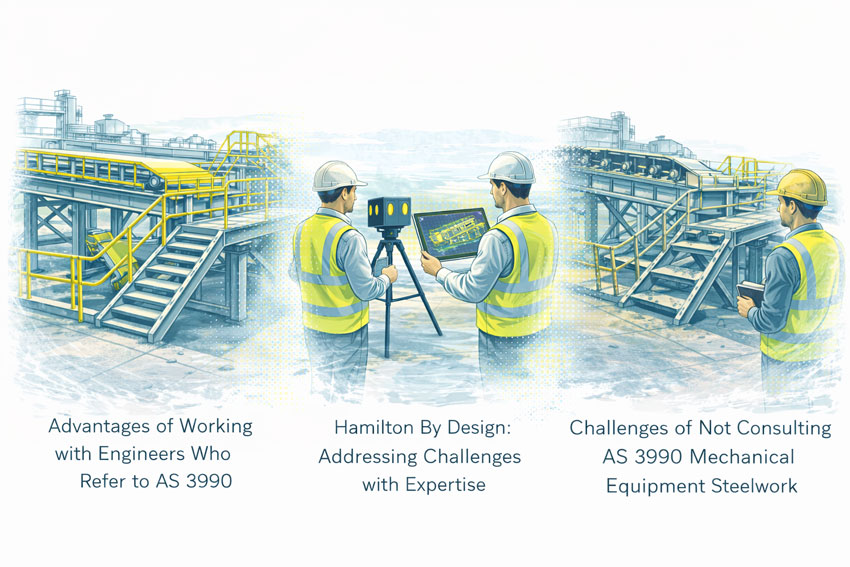
Advantages of Working with Engineers Who Refer to AS 3990
1. Enhanced Structural Reliability
Engineers who follow AS 3990 guidelines ensure that steel structures are designed to handle expected loads and stresses safely. This enhances the overall reliability and performance of mechanical equipment.
Hamilton By Design’s Advantage: Hamilton By Design’s expertise in applying AS 3990 results in robust designs that exceed client expectations. Their thorough understanding of structural dynamics ensures optimal performance and safety.
2. Regulatory Compliance
Adhering to AS 3990 simplifies the process of meeting industry regulations, reducing risks of audits, fines, or project delays.
Hamilton By Design’s Advantage: Hamilton By Design’s commitment to compliance ensures that their projects pass inspections and meet all regulatory requirements, helping clients avoid costly delays and legal issues.
3. Optimized Design
Following AS 3990 enables engineers to create designs that balance safety, functionality, and cost-efficiency.
Hamilton By Design’s Advantage: The company uses advanced engineering tools and methodologies to develop optimized designs that align with clients’ operational goals while maintaining compliance with AS 3990.
4. Improved Safety
AS 3990 includes comprehensive guidelines for minimizing risks, ensuring a safer working environment.
Hamilton By Design’s Advantage: Hamilton By Design’s safety-first approach incorporates AS 3990’s recommendations to deliver solutions that prioritize the well-being of workers and operators.
5. Cost Savings
Properly designed steelwork reduces maintenance, repair, and replacement costs over the equipment’s lifecycle.
Hamilton By Design’s Advantage: By adhering to AS 3990, Hamilton By Design delivers cost-effective solutions that reduce long-term expenses, helping clients maximize their return on investment.
6. Increased Equipment Lifespan
AS 3990-compliant designs are engineered to withstand operational stresses, enhancing the durability of mechanical systems.
Hamilton By Design’s Advantage: Hamilton By Design’s focus on durability and reliability ensures that their designs deliver long-term performance, minimizing disruptions and extending equipment lifespan.
7. Competitive Advantage
Delivering high-quality, compliant systems provides a competitive edge, improving marketability and client trust.
Hamilton By Design’s Advantage: Hamilton By Design’s track record of excellence and adherence to AS 3990 positions them as a trusted partner for engineering projects, helping clients achieve their goals efficiently and effectively.
8. Risk Mitigation
Following AS 3990 minimizes the risk of unexpected failures, accidents, or operational delays.
Hamilton By Design’s Advantage: The company’s comprehensive approach to risk management ensures that their designs perform reliably under real-world conditions, reducing risks for their clients.
Hamilton By Design: Addressing Challenges with Expertise
Hamilton By Design is an engineering firm renowned for its dedication to excellence and adherence to industry standards. Their extensive experience in mechanical equipment and steelwork enables them to address the challenges of non-compliance with AS 3990 effectively. Here are some examples of how Hamilton By Design applies its expertise to deliver superior outcomes:
Case Study 1: Mining Equipment Steelwork
In a project involving heavy mining equipment, Hamilton By Design was tasked with designing a support structure for a conveyor system. By consulting AS 3990, they identified critical stress points and optimized the design to handle dynamic loads. The result was a durable and reliable structure that exceeded client expectations and minimized maintenance costs.
Case Study 2: Industrial Manufacturing Facility
Hamilton By Design worked on a manufacturing facility requiring custom steelwork for robotic assembly lines. By adhering to AS 3990, they ensured the steel structures could withstand repetitive stress and environmental factors, enhancing the safety and efficiency of the facility.
Case Study 3: Renewable Energy Project
In a renewable energy project, Hamilton By Design designed steel frameworks for wind turbine foundations. By following AS 3990, they accounted for wind loads, fatigue stresses, and environmental conditions, delivering a solution that met stringent safety and performance requirements.
Conclusion
Failing to consult AS 3990 can lead to significant challenges, including structural failures, compliance issues, reduced equipment lifespan, safety hazards, increased maintenance costs, and reputational damage. However, working with experienced engineers who prioritize adherence to AS 3990, such as those at Hamilton By Design, provides numerous advantages, including enhanced reliability, regulatory compliance, optimized design, improved safety, cost savings, increased equipment lifespan, and risk mitigation.
Hamilton By Design’s proven track record demonstrates their ability to navigate these challenges effectively, leveraging their expertise and commitment to quality to deliver exceptional results for their clients. By choosing Hamilton By Design, companies can ensure that their mechanical equipment steelwork projects are completed to the highest standards of safety, reliability, and performance.
For more information on the Hamilton By Design Consulting approach, feel free to email info@hamiltonbydesign.com.au
To provide the best experiences, we use technologies like cookies to store and/or access device information. Consenting to these technologies will allow us to process data such as browsing behaviour or unique IDs on this site. Not consenting or withdrawing consent, may adversely affect certain features and functions.
Functional
Always active
The technical storage or access is strictly necessary for the legitimate purpose of enabling the use of a specific service explicitly requested by the subscriber or user, or for the sole purpose of carrying out the transmission of a communication over an electronic communications network.
Preferences
The technical storage or access is necessary for the legitimate purpose of storing preferences that are not requested by the subscriber or user.
Statistics
The technical storage or access that is used exclusively for statistical purposes.The technical storage or access that is used exclusively for anonymous statistical purposes. Without a subpoena, voluntary compliance on the part of your Internet Service Provider, or additional records from a third party, information stored or retrieved for this purpose alone cannot usually be used to identify you.
Marketing
The technical storage or access is required to create user profiles to send advertising, or to track the user on a website or across several websites for similar marketing purposes.