

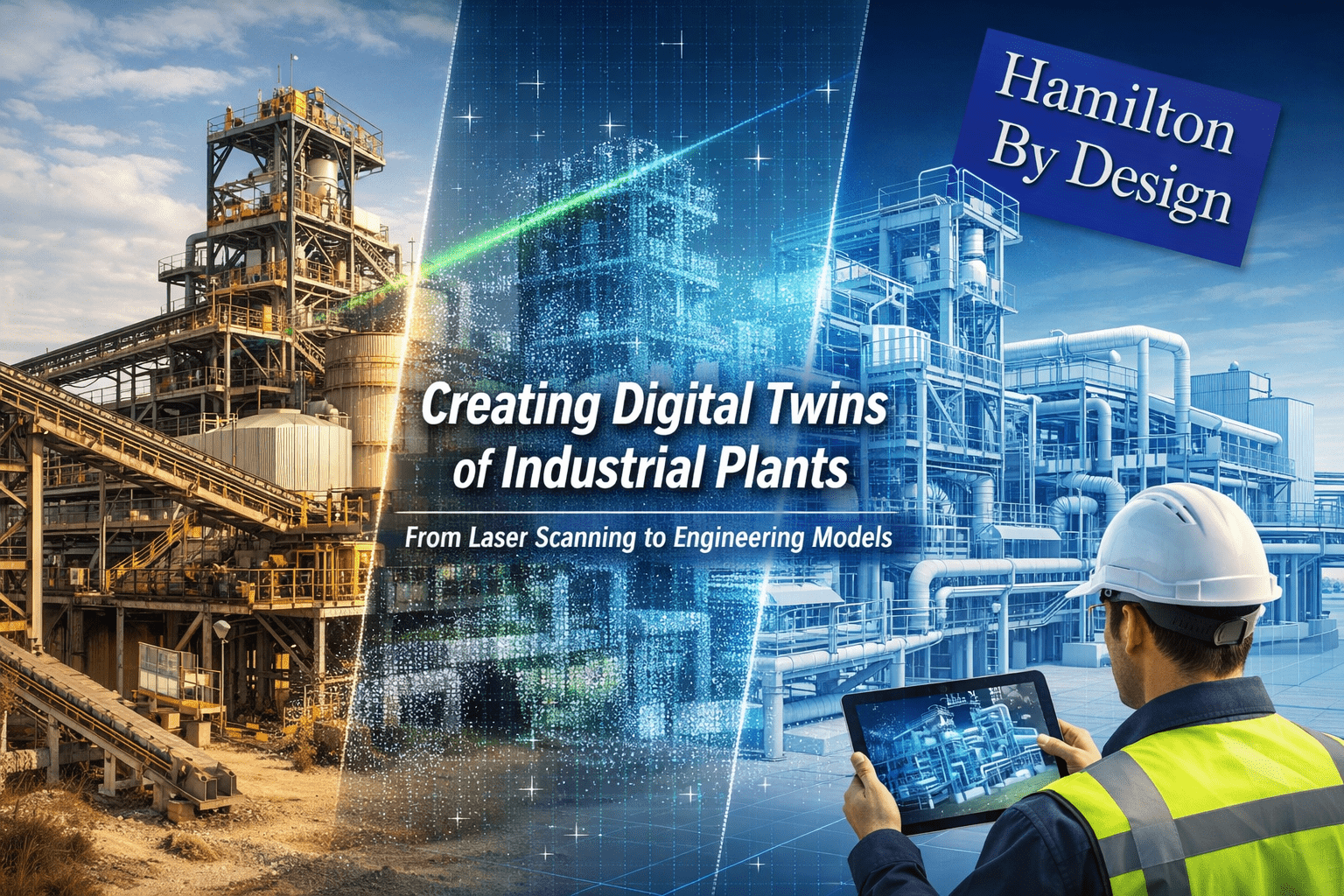
What Is an Industrial Digital Twin?
An industrial digital twin is a highly accurate digital representation of a physical plant, facility, or asset. It combines real-world measurements, engineering models, and operational data into a virtual environment where engineers can analyse, simulate, and plan improvements before making changes in the real world.
For industries such as mining, processing plants, refineries, and manufacturing, digital twins allow engineering teams to visualise complex systems and understand how equipment, structures, and services interact.
At Hamilton By Design, digital twins are typically created by combining engineering-grade 3D laser scanning, point cloud modelling, and CAD engineering workflows.
Why Industrial Plants Are Moving Toward Digital Twins
Industrial sites are often built and modified over decades. Drawings can become outdated, and documentation may not reflect the current state of the plant.
An industrial digital twin solves this problem by providing an accurate digital baseline of the facility.
Key benefits include:
- Improved engineering planning and design accuracy
- Reduced risk during plant upgrades
- Better shutdown planning
- Improved asset management and maintenance planning
- Safer engineering decisions
Before any upgrade or modification, engineers must understand existing conditions. Technologies such as 3D laser scanning allow teams to capture the plant exactly as it exists.
You can learn more about capturing plant conditions here:
https://www.hamiltonbydesign.com.au/capture-existing-conditions-before-plant-upgrades/
How Digital Twins Are Created for Industrial Plants
Creating an industrial digital twin typically follows a structured workflow.
1. Engineering-Grade 3D Laser Scanning
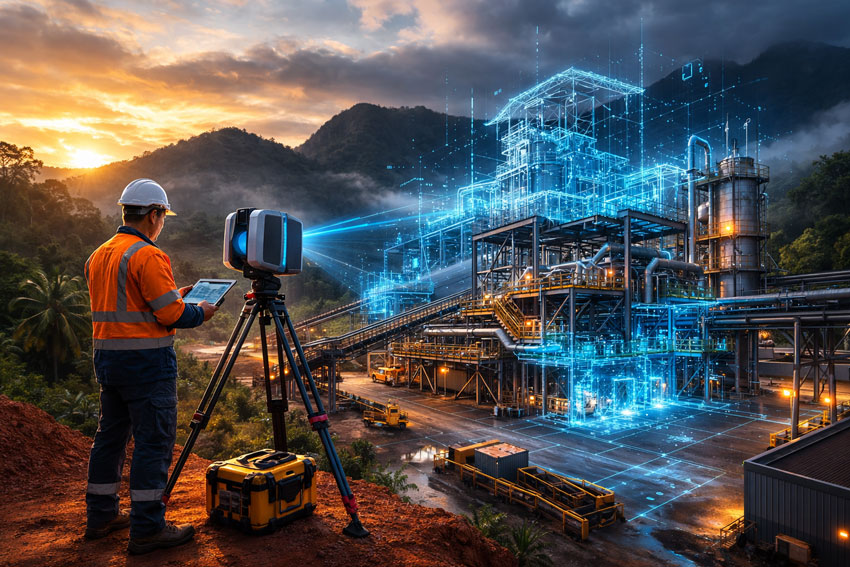
The first step is capturing the plant using high-accuracy LiDAR or laser scanning systems. These scanners collect millions of measurement points, producing a point cloud that represents the physical environment.
Hamilton By Design provides engineering-grade scanning services across mining and industrial sites:
https://www.hamiltonbydesign.com.au/home/engineering-grade-3d-laser-scanning-mining-industrial/
These scans capture:
- Structural steel
- Pipework systems
- Mechanical equipment
- Conveyors and material handling systems
- Pumps and processing equipment
- Access platforms and walkways
The result is a precise digital snapshot of the plant.
2. Point Cloud Processing
Once scanning is complete, the raw scan data is processed into a registered point cloud model.
This step involves:
- Aligning multiple scans
- Cleaning unwanted data
- Verifying spatial accuracy
- Preparing the data for engineering modelling
Hamilton By Design uses this workflow when converting scans into engineering models:
https://www.hamiltonbydesign.com.au/point-cloud-to-engineering-model-workflow/
3. Engineering CAD Modelling
The processed point cloud is then used to develop engineering models in CAD platforms such as SolidWorks.
At this stage engineers can generate:
- Mechanical layouts
- Structural models
- Pipework routing
- Equipment positioning
- Access and maintenance clearances
The digital twin becomes an engineering-ready model, not just a visual scan.
4. Integration With Engineering Projects
Once the digital twin is created, it becomes a core engineering tool used for:
- Plant upgrades
- Shutdown planning
- Clash detection
- Design validation
- Construction planning
Many mining operations now rely on digital twins during major shutdowns and upgrades.
More information on scanning for shutdown projects can be found here:
https://www.hamiltonbydesign.com.au/3d-laser-scanning-mining-shutdowns/
Practical Applications of Industrial Digital Twins
Digital twins are becoming common across mining and heavy industry because they reduce uncertainty in engineering projects.
Common use cases include:
Plant Upgrades
Engineers can design new equipment within the digital model before installation.
Equipment Replacement
Digital twins allow accurate measurement of existing assets when replacing pumps, conveyors, or tanks.
Brownfield Engineering
Older plants often have incomplete drawings. Digital twins provide accurate geometry for redesign.
Safety Planning
Access, maintenance space, and structural modifications can be analysed before construction begins.
Why Accuracy Matters
A digital twin is only useful if it reflects the plant accurately.
Engineering-grade scanning typically achieves millimetre-level accuracy, which allows engineers to confidently design new systems within existing infrastructure.
Without this level of accuracy, design clashes and construction delays become more likely.
Hamilton By Design specialises in high-accuracy scanning for mining and industrial engineering projects across Australia:
https://www.hamiltonbydesign.com.au/home/engineering-services/3d-laser-scanning/3d-laser-scanning-across-australia/
The Future of Industrial Engineering
As industries adopt automation, remote operations, and predictive maintenance, digital twins are becoming central to engineering workflows.
They allow companies to:
- Simulate plant modifications
- Plan maintenance strategies
- Visualise complex infrastructure
- Improve collaboration between engineering teams
For companies managing large industrial assets, an industrial digital twin is quickly becoming a core engineering resource rather than an optional tool.

Learn More About Engineering Digital Workflows
If you are interested in how digital technologies support industrial engineering projects, these resources may be useful:
- Engineering-grade scanning for mining and industry
https://www.hamiltonbydesign.com.au/home/engineering-grade-3d-laser-scanning-mining-industrial/ - Capturing existing plant conditions before upgrades
https://www.hamiltonbydesign.com.au/capture-existing-conditions-before-plant-upgrades/ - Point cloud to engineering model workflow
https://www.hamiltonbydesign.com.au/point-cloud-to-engineering-model-workflow/ - 3D scanning for mining shutdown projects
https://www.hamiltonbydesign.com.au/3d-laser-scanning-mining-shutdowns/