Opinion: What Cutting 50% of Australiaโ€™s Iron Ore Exports to China Would Really Mean


By Anthony Hamilton, Mechanical Engineer and Industry Analyst


Australiaโ€™s relationship with China has always been a balancing act between economic dependence and strategic independence. Nowhere is that tension clearer than in our trade of iron ore โ€” the mineral that built both our national budget and Chinaโ€™s skyline.

Imagine, then, a bold decision: Australia deliberately cuts its iron ore exports to China by half and pivots toward domestic manufacturing โ€” especially green steel and renewable-powered industry. What would that mean for our economy, our global influence, and our future as an industrial nation?

The answer is both disruptive and transformative.


The Shock: Short-Term Pain

Letโ€™s be clear: halving iron ore exports would jolt the economy.

Australia exported about 900 million tonnes of iron ore in 2024โ€“25, worth roughly A$160 billion, with China buying four-fifths of it. Slashing that volume by half would pull A$80โ€“90 billion out of export revenue almost overnight. Even if prices spiked 50% amid global shortages, our GDP would still take a hit of 2โ€“3% in the first years โ€” a deliberate, self-imposed economic slowdown.

Western Australia, which lives and breathes the ore trade, would feel it most: reduced royalties, idle capacity, and strained state budgets. Canberraโ€™s tax intake could drop by A$10โ€“15 billion per year in the early phase.

But these are short-term tremors โ€” not structural decline. The question is whether we can replace raw-ore exports with something better: value-added industrial activity on Australian soil.


The Transition: Turning Rocks into Revenue

If half of that diverted ore were converted into green steel, the economic story changes dramatically.
One tonne of steel is worth four to six times more than the same tonne of ore. Even modest domestic processing could create an A$100 billion green industry within a decade โ€” generating thousands of high-skill jobs across hydrogen, renewables, materials science, and engineering.

Projects in Whyalla, Gladstone, and the Pilbara already point the way. With the right investment โ€” perhaps A$60โ€“100 billion over ten years โ€” Australia could build the capacity to supply its own construction, defence, and transport sectors while exporting carbon-neutral steel to the world.

Thatโ€™s not deglobalisation. Itโ€™s smart industrialisation โ€” keeping the value chain at home instead of shipping our competitive advantage overseas.


The Payoff: Long-Term Strength

By 2035, the payoff could be substantial:

  • GDP grows larger and more balanced, driven by advanced manufacturing.
  • Australia becomes a reliable producer of green steel, battery materials, and hydrogen infrastructure.
  • Dependence on Chinese demand declines, while new trade with India, Japan, Korea, and Europe expands.

In this scenario, Australiaโ€™s GDP could be 2โ€“4% higher than the business-as-usual case โ€” smaller mining exports, but far greater industrial depth. Itโ€™s a shift from volume to value, from being the worldโ€™s quarry to being part of its workshop again.


The Risk: A Test of Political Will

Such a move isnโ€™t without risk. China would almost certainly retaliate โ€” delaying other imports, applying political pressure, and exploiting our internal divisions.
The mining lobby would fight hard to protect its margins. Politicians would face the same question every reformer does: why risk the comfortable present for an uncertain future?

Yet the uncomfortable truth is that comfort has bred complacency.
Australiaโ€™s prosperity is overly reliant on shipping low-value resources to one buyer. Thatโ€™s not economic freedom โ€” its dependency dressed as success.


The Opportunity: Building the Next Holden Moment

Half a century ago, Holden symbolised a confident, self-sufficient industrial Australia. Its closure marked the end of that era.
A green-steel renaissance could be the new Holden moment โ€” a chance to reconnect engineering, manufacturing, and national purpose. It would anchor new jobs, restore industrial pride, and ensure that Australia competes not on cost, but on competence.

Weโ€™d still dig things up โ€” but weโ€™d also make things again.


Conclusion: A Strategic Rebalance, Not an Economic Gamble

Cutting 50% of iron ore exports to China would be a strategic recalibration, not an act of economic self-harm. It would cost us in the short run, but it could redefine us in the long run โ€” from a resource economy to a resilient, innovation-driven nation.

For decades, Australiaโ€™s industrial conversation has ended with one refrain: โ€œWe canโ€™t afford to make things anymore.โ€
Perhaps the truth is the opposite.

We canโ€™t afford not to.


Mechanical Engineering | Structural Engineering

Mechanical Drafting | Structural Drafting

3D CAD Modelling | 3D Scanning

Chute Design

SolidWorks Contractors in Australia
Hamilton By Design โ€“ Blog

Custom Designed – Shipping Containers

Coal Chute Design

Mechanical Engineers in Sydney

Harnessing Opportunity in Australiaโ€™s $1.2โ€ฏB Critical Minerals Push

Australiaโ€™s Federal Government has announced an A$1.2โ€ฏbillion Critical Minerals Strategic Reserve, backed by a $1โ€ฏbillion top-up to its existing Critical Minerals Facility. With implementation set for the second half of 2026, the Reserve aims to secure critical mineralsโ€”lithium, cobalt, nickel, rare earthsโ€”through government offtake agreements and strategic stockpiling miningmonthly.com

Why It Matters for Mechanical Engineers

This isnโ€™t just political positioningโ€”itโ€™s a major call to action for mechanical engineering consultancies:

  • Scale and diversification of processing sites โ€“ More projects will need robust mechanical systems from crushing and conveying to structural and structural integrity assessments, especially for rare earths and heavy metals.
  • Advanced processing technologies โ€“ Selective stockpiling and refining of critical minerals will require high-precision mechanical design, wear management, and optimization of machinery performance.
  • Infrastructure and retrofit demand โ€“ The Reserve extends the Critical Minerals Facilityโ€™s reach to A$5โ€ฏbillion, catalysing greenfield builds and upgradesโ€”areas where Hamilton By Design excels.

Strategic Insights for Hamilton By Design

At Hamilton By Design, our strength lies in supporting projects from feasibility to commissioning, encompassing:

  • Materials handling systems โ€“ conveyors, stockpiles, chutes
  • Structural and fatigue engineering โ€“ ensuring safety and longevity under harsh industrial conditions
  • Wear and reliability optimisation โ€“ extending lifespan and uptime of mechanical assets
  • Digital tools โ€“ such as FEA, 3D scanning, and digital twins to enhance design accuracy and project efficiency

This Government-backed industrial growth is a signal for mining contractors and OEMs to engage expert mechanical consultants earlyโ€”ensuring streamlined, compliant, and future-proofed system integration.

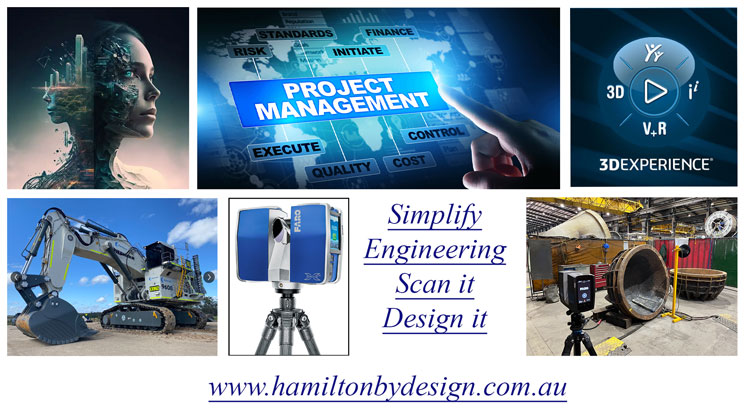
Collage showcasing Hamilton By Designโ€™s engineering and 3D scanning services. Images include a futuristic digital-engineering graphic, a project management interface, the Dassault Systรจmes 3DEXPERIENCE logo, a large excavator, a FARO 3D laser scanner, and an industrial scan setup inside a workshop. In the centre, text reads: โ€˜Simplify Engineering โ€” Scan it, Design it,โ€™ along with the website www.hamiltonbydesign.com.au.

๐Ÿ› ๏ธ How Hamilton By Design Adds Value

What You GetHow It Helps
Proven materials-handling systems designScalable, reliable conveyors and chutes for critical-mineral plants
End-to-end structural assessmentsEnables compliance with WHS, AS/NZS and long-term asset management
Wear analysis & maintenance planningReduces downtime and extends asset lifespan
Integration of digital engineeringImproves commissioning, reduces risk and cost overruns

With major investments planned and a strong industrial trajectory ahead, now is the time for OEMs and mining clients to tap into specialist mechanical consulting support.

Letโ€™s talk about how Hamilton By Design can partner to deliver cuttingโ€‘edge materials handling and structural engineering solutions for your next critical minerals project.

Hamilton By Design | Mechanical Drafting | Structural Drafting | 3-D Lidar Scanning

Shaping the Future of Mining

ย Mechanical Engineering & 3D Lidar Scanning in Mount Isa

Posted by Hamilton By Design | Based in Mount Isa | www.hamiltonbydesign.com.au

๐Ÿ”ง Precision Engineering Meets Digital Innovation in the Mining Sector

In the heart of Australiaโ€™s mining countryโ€”Mount Isaโ€”Hamilton By Design is delivering cutting-edge mechanical engineering solutions powered by 3D Lidar scanning and point cloud modelling.

Whether you’re managing underground infrastructure, fixed plant upgrades, or brownfield expansions, our advanced tools and design expertise help you visualise, optimise, and execute projects with clarity and confidence.


How We Support the Mining Industry

As mechanical engineering consultants, we provide services that reduce project risk, increase design accuracy, and streamline construction workflows. Key areas include:

  • Lidar 3D Scanning of existing plant, pipework, and underground assets

  • Point Cloud Creation for clash detection and design validation

  • Mechanical & Structural Drafting using accurate site data

  • Reverse Engineering of legacy plant or undocumented assets

  • Detailed Design for Modifications & Upgrades

  • Compliance, Auditing, and Risk Reduction

By combining field-tested mechanical engineering with cutting-edge digital capture, we help mining teams make better decisionsโ€”faster.


Why Mount Isa?

Mount Isa is home to some of Australia’s largest and most complex mining operations. From Glencoreโ€™s copper and zinc mines to contracting hubs servicing the broader North West Minerals Province, this region demands precision, speed, and deep mining knowledge.

Hamilton By Design is based locally in Mount Isa, giving us the unique advantage of rapid site access, practical experience in mining environments, and a strong understanding of local challenges.


Why Use Lidar & Point Clouds?

Lidar scanning has transformed how we approach engineering projects in mining:

  • Capture complex environments in minutes, not days

  • Generate ultra-accurate point clouds for design, measurement, and planning

  • Minimise rework by designing to exact, as-built geometry

  • Visualise site constraints in 3D before committing to fabrication or install

  • Integrate scan data with CAD models for seamless design workflows

From underground crushers to surface pipe racks, our Lidar system captures the detailsโ€”so you can design with certainty.


Use Cases in Mining Projects

Some real-world examples of how we apply mechanical engineering + Lidar scanning in mining:

  • Scanning underground pump stations for upgrade design

  • Reverse-engineering chutes and hoppers with no existing drawings

  • Capturing point clouds of processing plants for structural fit-out

  • Laser-accurate data for mobile plant modifications and safety guarding

  • Converting scan data into fabrication-ready models and drawings

Want to see a sample point cloud or project output? Just reach out through our website below.

Who We Work With

  • Mining Operators & Engineers
  • Shutdown Coordinators
  • Project Managers & Fabricators
  • EPCM Contractors
  • Surveyors & Design Teams

If you’re responsible for delivering accurate, efficient, and safe mechanical solutions on siteโ€”Hamilton By Design is your local partner.

Our clients:

Letโ€™s Talk About Your Next Project

๐Ÿ“ Based in Mount Isa, QLD

Website: www.hamiltonbydesign.com.au

Email: info@hamiltonbydesign.com.au

Whether youโ€™re planning a brownfield expansion or simply need a scan-to-CAD model of your plant, weโ€™re here to helpโ€”on site and on time.

Please feel free to connect

Name
Would you like us to arrange a phone consultation for you?
Address