Maximizing Equipment Efficiency with ISO 18436.2 Maintenance Strategies

At Hamilton By Design, we know that keeping your equipment running efficiently isnโ€™t just about quick fixes; itโ€™s about adopting the right maintenance strategies to ensure long-term reliability and performance. With advancements in condition monitoring and diagnostic techniques, the ISO 18436.2 standard has become a cornerstone for effective maintenance practicesโ€”and itโ€™s at the heart of how we help our clients optimize their operations.

In this blog post, weโ€™ll explore the major maintenance strategies aligned with ISO 18436.2 and how they can transform your plantโ€™s productivity.


What is ISO 18436.2?

ISO 18436.2 is an internationally recognized standard that defines the competencies required for personnel performing condition monitoring and diagnostics. It focuses on advanced tools like vibration analysis, helping engineers identify equipment issues before they lead to costly downtime.

At Hamilton By Design, our team is ISO 18436.2-certified, meaning we bring the highest level of expertise to your maintenance needs.


Maintenance Strategies That Deliver Results

ISO 18436.2 aligns with several key maintenance strategies designed to improve reliability, minimize downtime, and optimize equipment performance. Hereโ€™s how they work:

1. Reactive Maintenance

Reactive maintenance is the traditional โ€œrun-to-failureโ€ approach where repairs are made after a breakdown. While not ideal for critical assets, tools like vibration analysis can still play a role by identifying root causes post-failure. This can help inform more proactive strategies in the future.

2. Preventive Maintenance (PM)

Preventive maintenance involves scheduling regular maintenance tasks to prevent failures. While effective to some extent, PM can lead to over-maintenance. By incorporating vibration analysis and other condition monitoring techniques, preventive measures can be more precisely targeted, reducing unnecessary downtime.

3. Condition-Based Maintenance (CBM)

Condition-Based Maintenance uses real-time equipment data to identify issues as they arise. This strategy is central to ISO 18436.2 and includes tools like vibration analysis, thermography, and ultrasonic testing. CBM ensures that maintenance is performed only when necessary, saving time and money.

Benefits:

  • Reduces unplanned downtime.
  • Optimizes maintenance schedules.
  • Extends equipment lifespan.

4. Predictive Maintenance (PdM)

Predictive Maintenance takes CBM a step further, using data trends and analytics to predict when failures are likely to occur. With the expertise of ISO 18436.2-certified personnel, PdM uses advanced tools to detect subtle signs of wear or stress, allowing for intervention before a problem becomes critical.

Key Tools:

  • Vibration analysis for early detection of imbalance or misalignment.
  • Infrared thermography to spot heat anomalies.
  • Ultrasonic testing to identify leaks and material defects.

5. Reliability-Centered Maintenance (RCM)

RCM focuses on understanding the specific failure modes of critical assets and tailoring maintenance strategies accordingly. This approach integrates condition monitoring insights to prioritize tasks that align with operational goals.

Benefits:

  • Aligns maintenance efforts with production priorities.
  • Reduces the risk of unexpected equipment failures.

6. Proactive Maintenance

Proactive maintenance identifies and addresses root causes of recurring issues. By analyzing data from vibration and other diagnostic tools, engineers can resolve underlying problems like misalignment, improper lubrication, or material fatigue.

Impact:

  • Prevents repetitive failures.
  • Improves long-term equipment reliability.

7. Total Productive Maintenance (TPM)

TPM involves a plant-wide effort, from operators to management, to ensure optimal equipment effectiveness. ISO 18436.2-certified personnel can support TPM by providing actionable condition monitoring insights and training operators in basic diagnostic techniques.


How Hamilton By Design Helps

At Hamilton By Design, we bring these strategies to life through tailored maintenance solutions that align with your plantโ€™s needs. Hereโ€™s how we can help:

1. Advanced Condition Monitoring:
Our team uses state-of-the-art tools to monitor equipment health, including vibration analysis, thermography, and ultrasonic testing.

2. Tailored Maintenance Plans:
Every plant is unique. We develop maintenance strategies based on your specific equipment, production goals, and operational priorities.

3. Expert Training and Certification:
We empower your team by offering ISO 18436.2 training, giving them the skills to sustain and enhance maintenance programs.

4. Ongoing Support:
Maintenance is a journey, not a destination. We provide continuous support to refine and optimize your practices as your operations evolve.


The Hamilton By Design Advantage

Adopting advanced maintenance strategies aligned with ISO 18436.2 isnโ€™t just about improving equipment reliabilityโ€”itโ€™s about unlocking greater productivity and profitability for your business.

With our expertise, you can transition from reactive to predictive maintenance, reduce unplanned downtime, and extend the lifespan of your critical assets.

Ready to take your plantโ€™s maintenance strategy to the next level? Contact Hamilton By Design today to find out how we can help.

Visit us at: www.hamiltonbydesign.com.au
Email us: sales@hamiltonbydesign.com.au
Call us: +61 0477 002 249


Hamilton By Design | Transforming Maintenance | Elevating Performance | Mechanical Engineering

Name
Would you like us to arrange a phone consultation for you?
Address

Enhancing Plant Efficiency with Best Maintenance Practices: A White Paper by Hamilton By Design

Hand-drawn infographic titled โ€œPlant Efficiency & Uptime,โ€ showing the key elements that enhance plant performance. Surrounding the central circle are categories including maintenance strategies (PM, PDM, CBM, RCM), people and skills (engineers, technicians, planners, operators), processes and planning (inspections, failure mode analysis, root-cause investigations), and technology and tools (vibration sensors, LiDAR/3D scanning, IoT, training). Benefits highlighted include reduced downtime, lower maintenance costs, extended equipment life, and higher safety and compliance.

ย 

In todayโ€™s competitive industrial landscape, maintaining high levels of Overall Equipment Effectiveness (OEE) is a cornerstone of operational success. Achieving this requires adopting advanced maintenance practices that minimize downtime, reduce operational costs, and extend the lifecycle of critical assets.

This white paper outlines best maintenance practices aligned with the ISO 18436.2 standard and highlights how Hamilton By Design’s team of mechanical engineers can partner with your organization to enhance your plantโ€™s OEE. By leveraging our expertise in condition-based and predictive maintenance, we can optimize equipment performance and drive measurable improvements in productivity and reliability.

The Role of Maintenance in Maximizing OEE

OEE is a comprehensive measure of manufacturing productivity, defined by three critical components:

  1. Availability: Minimizing downtime to maximize operational hours.
  2. Performance: Ensuring equipment runs at optimal speeds.
  3. Quality: Reducing defects and waste during production.

Maintenance strategies are key to influencing these factors. Moving beyond reactive approaches to predictive and condition-based maintenance can significantly enhance equipment reliability and efficiency, ensuring better alignment with OEE goals.


Adopting Best Maintenance Practices

Condition-Based Maintenance (CBM)

CBM involves monitoring the real-time condition of equipment to predict and prevent failures. At Hamilton By Design, we integrate cutting-edge technologies like vibration analysis, thermography, and ultrasonic testing to enable proactive interventions before problems escalate.

How CBM Enhances OEE:
  • Reduces unplanned downtime (Availability).
  • Maintains consistent performance by addressing issues early (Performance).
  • Prevents production disruptions that cause defects (Quality).

Predictive Maintenance (PdM)

Predictive maintenance leverages data analytics to anticipate potential failures. By applying ISO 18436.2-certified practices, we implement advanced diagnostic tools and algorithms to forecast maintenance needs with precision.

Our Approach:
  • Deploy vibration analysis tools managed by certified Level II and III analysts.
  • Use infrared thermography to detect heat anomalies in electrical and mechanical systems.
  • Employ ultrasonic testing to identify leaks and structural weaknesses.
Benefits for OEE:
  • Prolonged equipment lifespan by addressing issues at their inception.
  • Higher productivity with fewer interruptions.
  • Reduced maintenance costs through targeted interventions.

Reliability-Centered Maintenance (RCM)

RCM focuses on optimizing maintenance strategies for each asset, emphasizing a deep understanding of failure modes and effects. Our engineers employ RCM to prioritize maintenance tasks that align with your plant’s specific OEE goals.

Steps We Implement:
  1. Asset Function Analysis: Understanding the purpose and criticality of each asset.
  2. Failure Mode and Effects Analysis (FMEA): Identifying risks and developing mitigation strategies.
  3. Data-Driven Decision Making: Using condition monitoring data to guide maintenance schedules.
Impact on OEE:
  • Ensures maintenance is aligned with production priorities.
  • Reduces waste and rework caused by unexpected equipment malfunctions.

Leveraging ISO 18436.2 Standards

ISO 18436.2 defines the competencies required for condition monitoring personnel, ensuring a standardized approach to predictive maintenance. Hamilton By Designโ€™s mechanical engineers are certified under this standard, offering expertise in:

  • Vibration analysis for detecting unbalance, misalignment, and bearing faults.
  • Developing and managing comprehensive condition monitoring programs.
  • Interpreting and analyzing complex diagnostic data for actionable insights.

How Hamilton By Design Can Assist

Customized Maintenance Solutions

We recognize that every plant has unique operational challenges. Hamilton By Design tailors maintenance strategies to your specific needs, focusing on:

  • Asset Criticality Assessment: Identifying and prioritizing key equipment for monitoring and intervention.
  • Technology Integration: Implementing IoT-enabled sensors, data platforms, and diagnostic tools.
  • Program Development: Designing maintenance schedules aligned with production cycles and OEE targets.

Expert Training and Certification

Our team provides in-depth training for your personnel, ensuring they gain ISO 18436.2 certification and the skills to sustain advanced maintenance programs.

Ongoing Support and Continuous Improvement

Maintenance isnโ€™t static. Hamilton By Design offers ongoing support to refine your maintenance practices, ensuring your plant stays ahead of evolving operational demands.


Case Study: Improving OEE with Hamilton By Design

Challenge: A manufacturing plant experienced frequent equipment failures, leading to a 15% drop in OEE.

Solution: Hamilton By Design implemented a tailored predictive maintenance program:

  • Installed vibration sensors on critical rotating machinery.
  • Trained plant engineers to monitor and analyze data using ISO 18436.2 standards.
  • Provided ongoing diagnostics and recommendations.

Outcome:

  • Downtime was reduced by 40%, significantly improving availability.
  • Equipment performance stabilized, enhancing productivity.
  • Defects decreased by 25%, improving product quality.

Maximizing OEE requires a strategic approach to maintenance that integrates advanced tools, skilled personnel, and data-driven insights. Hamilton By Design’s mechanical engineers, certified under ISO 18436.2, are uniquely equipped to help your plant achieve these goals.

By partnering with us, you can transform your maintenance practices, boost operational efficiency, and secure a competitive edge in your industry. Let Hamilton By Design help you take the first step toward a more reliable and productive future.

WorkTrek โ€“ 8 Ways to Improve Your Plant Maintenance
Practical tips for improving maintenance processes, reducing downtime, and boosting productivity.
https://worktrek.com/blog/how-to-improve-plant-maintenance/

Petrochem Expert โ€“ Best Practices for Plant Maintenance
Explores how proper maintenance planning ensures efficiency, reliability, and safety in plant operations.
https://petrochemexpert.com/best-practices-for-plant-maintenance-ensuring-operational-efficiency-and-safety/

MaintBoard โ€“ Maintenance Planning Strategies
Highlights how scheduling, IoT tools, and predictive approaches improve plant reliability and uptime.
https://maintboard.com/maintenance-planning-strategies

Hamilton By Design โ€“ Mechanical Engineering for Mining & Industry
Showcases engineering solutions designed to reduce downtime, improve reliability, and optimize plant performance.
https://www.hamiltonbydesign.com.au/mechanical-engineering-mining-industry-australia/

Hamilton By Design โ€“ Drafting & LiDAR / Scanning Services
Describes how accurate scanning and drafting streamline retrofits, reducing errors and saving time during plant upgrades.
https://www.hamiltonbydesign.com.au/services-drafting-lidar-scanning/

Hamilton By Design โ€“ Blog: Maximising Uptime at Transfer Points
Focuses on optimising chutes, hoppers, and conveyors to minimise stoppages and keep production flowing.
https://www.hamiltonbydesign.com.au/blog-engineering-insights/

Mechanical Designers

Mechanical Engineers Design

3D Mechanical Engineering

Mechanical Engineering Consultants

3D Laser Scanning

Best Maintenance Practices

For a Smarter More Reliable Future

Keeping machinery running isnโ€™t just about fixing things when they break โ€” itโ€™s about preventing problems before they stop production, cause delays, or create safety risks. In todayโ€™s competitive industrial world, companies are using smarter strategies, better data, and more skilled people to make maintenance a strategic advantage rather than just an expense.

This shift is supported by new research, industry reports, and technology innovations that are changing the way maintenance is done. Letโ€™s explore these best practices, the trends driving them, and how businesses are putting them into action.


Why Smarter Maintenance Matters

Every time a machine unexpectedly breaks down, it costs money โ€” sometimes thousands of dollars per hour โ€” not to mention the lost production and safety risks. This is why businesses are turning to condition monitoring โ€” the practice of keeping an eye on equipment health through vibration data, temperature readings, and other signals.

According to SNS Insider, the market for vibration sensors alone is set to exceed USD 8.19 billion by 2032, driven by demand for predictive maintenance and automation. In other words, smart maintenance is no longer a nice-to-have โ€” itโ€™s becoming the industry standard.


Building a Proactive Maintenance Approach

Continuous Equipment Monitoring

Rather than waiting for something to fail, companies now collect data from equipment in real time. This data reveals whether something is running smoothly or starting to show early signs of trouble โ€” like excessive vibration, heat, or noise.

Recent Cerexio research shows that condition-based maintenance is now a top trend in manufacturing, reducing unnecessary downtime and maintenance costs by focusing resources where they are actually needed.


Smarter Decision-Making

Not every machine needs the same treatment. Reliability-focused strategies look at each asset individually:

  • What is its purpose?
  • How likely is it to fail?
  • What would it cost if it did fail?

This allows businesses to focus on the machines that matter most to production, safety, and quality, instead of spreading resources too thinly across every piece of equipment.


Predicting Failures Before They Happen

Predictive maintenance is the next evolution โ€” using tools like vibration analysis, thermal imaging, and ultrasonic testing to spot problems weeks or months in advance.

Cutting-edge research is making this even more powerful. A 2025 arXiv study proposed robust methods for fault detection and severity estimation, allowing teams to find issues earlier and with greater accuracy. Another study showed how advanced neural networks can run these diagnostics on low-power edge devices, making predictive monitoring cheaper, faster, and more energy-efficient.


People at the Center of Maintenance Success

Even with advanced sensors, AI, and cloud software, the human factor is crucial. Skilled technicians and analysts know how to interpret data, identify root causes, and make the right call on whether to intervene now or keep watching.

The industry faces a global skills gap, with a shortage of qualified maintenance professionals. As WorkTrekโ€™s 2025 trends report points out, investing in training is now one of the most important things companies can do. Well-trained teams ensure that technology investments deliver real-world results.


Common Hurdles and How to Overcome Them

  1. Skill Shortage: Close the gap by training your workforce, hiring certified professionals, and encouraging knowledge sharing inside the organization.
  2. High Upfront Costs: Sensors, training, and software can be expensive, but companies often recover the cost quickly through fewer breakdowns and lower downtime.
  3. Data Overload: More data isnโ€™t always better โ€” use good analytics tools and qualified staff to filter out noise and focus on what matters most.

Where Maintenance Is Headed

The future of maintenance is smarter, faster, and more connected than ever before. MaintWorld forecasts that AI-powered predictive maintenance will grow into a $1.69 billion global market by 2030, and f7i.ai notes that wireless sensors and cloud platforms are rapidly becoming the standard way of doing vibration monitoring.

This means weโ€™ll see:

  • Always-on monitoring: Equipment continuously โ€œtalkingโ€ to maintenance teams
  • Fewer surprises: Early warnings will prevent expensive emergency shutdowns
  • Energy-efficient solutions: Low-power devices will make monitoring cheaper and greener
  • Smarter plants: Integrated systems will combine vibration data with temperature, pressure, and production data to make better decisions automatically

Final Thoughts

The way we maintain equipment is evolving fast. Instead of waiting for machines to break, businesses are using technology, data, and skilled people to stay ahead of problems. The result? Safer operations, fewer unexpected stoppages, and a stronger bottom line.

Maintenance is no longer just a cost โ€” itโ€™s a competitive advantage. Companies that invest in smarter practices today are setting themselves up for a more reliable, efficient future.


Mechanical Engineers Structural Engineers

Mechanical Designers

Mechanical Engineers Design

3D Mechanical Engineering

Mechanical Engineering Consultants

3D Laser Scanning

Mechanical Engineering Consultants in the Mining Industry


The mining industry, particularly in resource-rich countries like Australia, is a cornerstone of economic activity and development. However, it faces an array of complex challenges including technological advancements, process optimization, and regulatory compliance. Mechanical engineering consultants play a crucial role in helping mining companies navigate these challenges, leveraging their expertise to enhance efficiency, sustainability, and profitability. This essay explores the various ways in which mechanical engineering consultants contribute to the mining sector by providing specialized knowledge and solutions in technology, process optimization, and regulatory compliance.

Technological Advancements

Equipment Design and Selection

One of the primary contributions of mechanical engineering consultants to the mining industry is in the area of equipment design and selection. Mining operations rely heavily on specialized machinery, from excavators and drilling rigs to conveyor systems and crushers. Consultants possess the technical knowledge to design custom equipment tailored to specific mining environments and operational requirements.

For instance, in deep mining operations, consultants can design robust and durable machinery capable of withstanding extreme conditions such as high pressure and temperature. They can also recommend the most suitable equipment based on factors like ore type, mining method, and production capacity. This ensures that mining companies invest in machinery that maximizes productivity while minimizing operational costs.

Automation and Robotics

The integration of automation and robotics in mining operations is another area where mechanical engineering consultants add significant value. Automation technologies, such as autonomous haul trucks and robotic drilling systems, can greatly enhance efficiency and safety in mining operations. Consultants help mining companies implement these technologies by designing and programming automated systems, selecting appropriate sensors and control units, and ensuring seamless integration with existing operations.

For example, autonomous vehicles can operate continuously without the need for breaks, significantly increasing productivity. Additionally, automation reduces the risk of accidents and injuries by removing human workers from hazardous environments. Consultants also provide training and support to ensure that mine operators can effectively manage and maintain these advanced systems.

Digitalization and IoT

The adoption of digital technologies and the Internet of Things (IoT) is transforming the mining industry. Mechanical engineering consultants play a pivotal role in this digital transformation by developing and implementing IoT solutions that provide real-time data and analytics. These technologies enable mining companies to monitor equipment performance, track production metrics, and optimize maintenance schedules.

Consultants can design IoT systems that collect data from various sensors installed on mining equipment. This data is then analyzed to identify patterns and predict potential equipment failures before they occur, allowing for proactive maintenance. This approach not only reduces downtime but also extends the lifespan of mining machinery. Furthermore, real-time data analytics enable better decision-making, as managers have access to up-to-date information on all aspects of mining operations.

Process Optimization

Lean Manufacturing Principles

Process optimization is critical for enhancing efficiency and reducing costs in mining operations. Mechanical engineering consultants bring expertise in lean manufacturing principles, which focus on eliminating waste, improving workflow, and maximizing value. By applying these principles, consultants help mining companies streamline their processes and improve overall productivity.

For instance, consultants can conduct value stream mapping to identify bottlenecks and inefficiencies in mining processes. They can then develop strategies to eliminate these bottlenecks, such as reconfiguring workflows, optimizing material handling systems, and improving communication and coordination among different departments. Lean manufacturing techniques also promote continuous improvement, ensuring that mining operations remain efficient and competitive over time.

Energy Efficiency

Energy consumption is a significant cost driver in mining operations. Mechanical engineering consultants can help mining companies improve energy efficiency by conducting energy audits and identifying opportunities for energy savings. This can involve optimizing the operation of energy-intensive equipment, such as grinding mills and pumps, or implementing energy-efficient technologies, such as variable frequency drives and high-efficiency motors.

For example, consultants can recommend the installation of advanced control systems that optimize the operation of grinding mills based on real-time ore characteristics. This ensures that the mills operate at their most efficient point, reducing energy consumption and operating costs. Additionally, consultants can design heat recovery systems that capture and reuse waste heat from mining processes, further enhancing energy efficiency.

Maintenance Optimization

Effective maintenance strategies are essential for ensuring the reliability and longevity of mining equipment. Mechanical engineering consultants can help mining companies develop and implement maintenance optimization programs that maximize equipment availability and minimize downtime. This includes predictive maintenance, which uses data analytics to predict equipment failures before they occur, and preventive maintenance, which involves regularly scheduled maintenance tasks to prevent unexpected breakdowns.

Consultants can design and implement condition monitoring systems that continuously monitor the health of mining equipment. These systems use sensors to collect data on parameters such as vibration, temperature, and pressure, which are then analyzed to detect early signs of wear and tear. By addressing potential issues before they lead to equipment failure, mining companies can avoid costly downtime and extend the lifespan of their machinery.

Regulatory Compliance

Environmental Regulations

Compliance with environmental regulations is a major challenge for mining companies. Mechanical engineering consultants play a crucial role in helping companies meet these requirements by designing and implementing systems that minimize environmental impact. This includes pollution control technologies, waste management systems, and sustainable mining practices.

For example, consultants can design dust control systems that reduce the amount of airborne particulate matter generated by mining operations. These systems can include water sprays, dust suppression chemicals, and ventilation systems that capture and filter dust particles. Consultants can also develop waste management plans that ensure the safe disposal and recycling of mining by-products, such as tailings and slag.

Furthermore, consultants can assist in the design and implementation of sustainable mining practices, such as water conservation and land reclamation. By helping mining companies minimize their environmental footprint, consultants ensure that operations remain compliant with environmental regulations and contribute to sustainable development.

Safety Regulations

Ensuring the safety of workers is paramount in the mining industry, which is subject to strict safety regulations. Mechanical engineering consultants can help mining companies comply with these regulations by designing and implementing safety systems and protocols. This includes the development of risk assessments, safety audits, and emergency response plans.

Consultants can design safety systems that protect workers from hazards such as falling rocks, equipment failures, and exposure to harmful substances. For example, they can design and implement rock fall protection systems, such as mesh nets and rock bolts, that prevent loose rocks from falling in underground mines. They can also develop equipment maintenance protocols that ensure machinery is regularly inspected and maintained to prevent accidents.

In addition to physical safety systems, consultants can provide training and support to ensure that workers are aware of safety protocols and know how to respond in emergency situations. By enhancing safety measures, consultants help mining companies protect their workforce and comply with safety regulations.

Reporting and Documentation

Regulatory compliance requires comprehensive reporting and documentation. Mechanical engineering consultants can assist mining companies in developing and maintaining the necessary records and reports to demonstrate compliance with environmental, safety, and other regulations. This includes the preparation of environmental impact assessments, safety audits, and compliance reports.

Consultants can also implement data management systems that streamline the collection, storage, and retrieval of compliance-related data. These systems ensure that mining companies have access to accurate and up-to-date information needed for regulatory reporting. By managing regulatory documentation, consultants help companies avoid fines and penalties associated with non-compliance.

Case Studies

Automation and Robotics in Mining

One notable example of mechanical engineering consultants aiding mining companies is the implementation of autonomous haul trucks in large mining operations. These trucks, guided by advanced GPS and sensor technologies, operate without human drivers. Mechanical engineering consultants played a pivotal role in designing the automation systems, selecting the appropriate hardware and software, and integrating these technologies with existing mining operations.

The result was a significant increase in productivity and a reduction in operating costs. The autonomous trucks could operate 24/7, without the need for breaks, leading to higher throughput. Additionally, the removal of human drivers from hazardous environments reduced the risk of accidents and injuries, enhancing overall safety.

Energy Efficiency in Grinding Operations

Another case where mechanical engineering consultants made a substantial impact was in improving energy efficiency in grinding operations at a major Australian mining company. Grinding mills are among the most energy-intensive equipment in mining operations. Consultants conducted a comprehensive energy audit and identified opportunities to optimize mill operations.

They recommended the installation of variable frequency drives on the mill motors, which allowed for better control of the grinding process. They also designed an advanced control system that adjusted the mill operation based on real-time ore characteristics. These improvements resulted in a significant reduction in energy consumption, lowering operating costs and reducing the environmental footprint of the mining operation.

Environmental Compliance in Tailings Management

Tailings, the waste materials left after the extraction of valuable minerals, pose significant environmental challenges. A mining company faced regulatory pressure to improve its tailings management practices to prevent environmental contamination. Mechanical engineering consultants were brought in to design a comprehensive tailings management system.

The consultants developed a plan that included the construction of tailings storage facilities with advanced liner systems to prevent leachate contamination. They also designed a water treatment system to treat any water that came into contact with the tailings, ensuring that it met environmental discharge standards. Additionally, the consultants implemented a monitoring system to continuously track the condition of the tailings storage facilities and detect any potential issues.

As a result, the mining company was able to meet regulatory requirements and significantly reduce the environmental impact of its tailings management practices. The comprehensive approach ensured that the company could continue its operations without facing regulatory penalties or damaging its reputation.

Future Trends and Challenges

Advanced Materials and Nanotechnology

As the mining industry continues to evolve, new challenges and opportunities will arise. Advanced materials and nanotechnology are poised to revolutionize mining equipment and processes. Mechanical engineering consultants will play a crucial role in integrating these technologies into mining operations, enhancing efficiency and sustainability.

For instance, nanotechnology can be used to develop stronger and lighter materials for mining equipment, reducing wear and tear and extending the lifespan of machinery. Consultants will need to stay abreast of these technological advancements and provide expertise in selecting and implementing the most promising innovations.

Cybersecurity in Mining

With the increasing reliance on digital technologies and IoT, cybersecurity is becoming a critical concern for the mining industry. Mechanical engineering consultants will need to work closely with cybersecurity experts to ensure that automated and digital systems are protected from cyber threats. This includes designing secure.

To Get in contact with Mechanical Engineering Consultants

Contact Hamilton By Design

Bulk Materials Conveyor Transfer

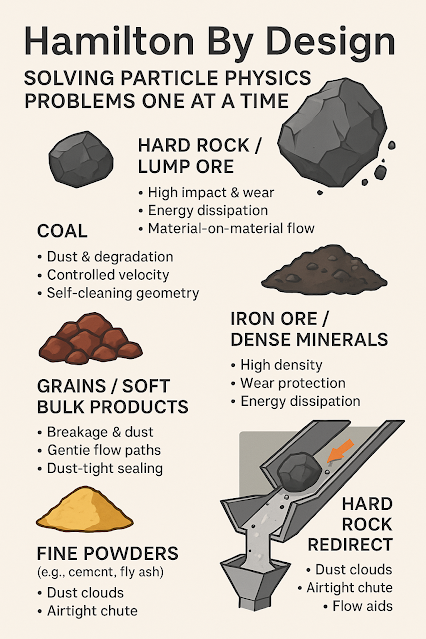
Designing reliable bulk materials conveyor transfer station chutes involves a careful consideration of various principles to ensure efficient material handling, minimize maintenance, and avoid operational issues. Here are the key principles and potential pitfalls to look out for:

Key Principles

Material Flow Dynamics:

  • Controlled Flow: Ensuring that the material flow is controlled and predictable is crucial. This involves designing the chute to guide the material smoothly from one conveyor to the next without creating bottlenecks or excessive turbulence.
  • Optimal Angles: The chute’s angles should be carefully calculated. Angles that are too steep may cause material to accelerate excessively, leading to wear and impact damage, while shallow angles can cause blockages.
  • Trajectory Management: Properly managing the material’s trajectory helps in reducing spillage and wear. The trajectory should be designed to align with the receiving conveyor’s speed and direction.

Wear Resistance:

  • Material Selection: Using wear-resistant materials for the chute construction can significantly extend its lifespan. Materials like AR (abrasion-resistant) steel or liners made from ceramic or rubber are common choices.
  • Strategic Wear Points: Identifying and reinforcing areas that are prone to high wear, such as impact zones and high-friction areas, can prevent premature failure.

Dust and Spillage Control:

  • Sealing: Effective sealing around the chute is essential to prevent dust and material spillage, which can lead to environmental issues and loss of product.
  • Dust Suppression: Incorporating dust suppression systems, such as water sprays or dust extraction, can minimize airborne particles, ensuring a safer and cleaner working environment.

Maintenance and Accessibility:

  • Ease of Access: Designing the chute for easy access allows for routine maintenance and inspection without requiring extensive downtime or complex procedures.
  • Modular Components: Using modular components can simplify the replacement of worn parts, reducing maintenance time and costs.

Structural Integrity:

  • Robust Design: The chute must be structurally robust to withstand the dynamic loads of the bulk materials. This includes ensuring that the support structure is adequately reinforced.
  • Vibration and Impact Resistance: Designing to mitigate vibration and absorb impacts can reduce structural fatigue and extend the life of the chute.

Flow Rate Compatibility:

  • Capacity Matching: Ensuring the chute design matches the flow rate of the conveyor system it serves is vital. Overloading can lead to blockages and spillage, while underloading may indicate inefficient use of the system.

Pitfalls to Avoid

Incorrect Angle of Inclination:

  • Blockages and Spillage: If the chute angle is too steep or too shallow, it can lead to blockages or spillage. A steep angle might cause uncontrolled flow, while a shallow angle might lead to material build-up.

Insufficient Wear Protection:

  • Premature Wear: Failing to use appropriate wear-resistant materials or neglecting high-wear areas can result in frequent maintenance and downtime due to premature wear and tear.

Poorly Designed Transitions:

  • Material Segregation: Abrupt transitions or poorly designed junctions can cause material segregation, uneven flow, and increased wear on the chute and conveyor components.

Inadequate Dust Control:

  • Environmental and Health Issues: Neglecting dust control can lead to significant environmental and health issues, as well as potential regulatory fines and operational inefficiencies.

Maintenance Challenges:

  • Difficult Access: Designing chutes without considering maintenance access can lead to extended downtime and increased labor costs during repairs and inspections.

Ignoring Dynamic Loads:

  • Structural Failures: Not accounting for the dynamic loads and impact forces exerted by the bulk materials can lead to structural failures and hazardous conditions.

Poor Integration with Conveyor System:

  • Operational Inefficiencies: Failing to properly integrate the chute design with the conveyor system can lead to operational inefficiencies, increased wear on conveyor components, and potential system failures.

By adhering to these principles and being mindful of the potential pitfalls, the design of bulk materials conveyor transfer station chutes can be optimized for reliability, efficiency, and longevity.

Mechanical Engineering | Structural Engineering

Mechanical Drafting | Structural Drafting

3D CAD Modelling | 3D Scanning

Hamilton By Design