Design Verification Under AS 4991: What Fabricators Often Miss

Engineer verifying lifting beam design under AS 4991 with FEA stress analysis overlay in fabrication workshop.

In Australiaโ€™s heavy industry and mining sectors, lifting devices are routinely fabricated under AS 4991 โ€“ Lifting Devices.

While most fabricators understand the need for compliance, design verification is the area where projects most commonly fall short.

The result?
Rework, certification delays, client rejection, and exposure to liability.

Letโ€™s look at what is often missed โ€” and how to avoid it.


What AS 4991 Actually Requires

AS 4991 does not simply require a fabricated lifting device to be โ€œstrong enough.โ€ It requires:

  • Engineered design calculations
  • Verification of limit states
  • Weld design compliance
  • Traceable material selection
  • Independent design review (where applicable)
  • Documentation suitable for certification

Fabrication alone does not equal compliance.
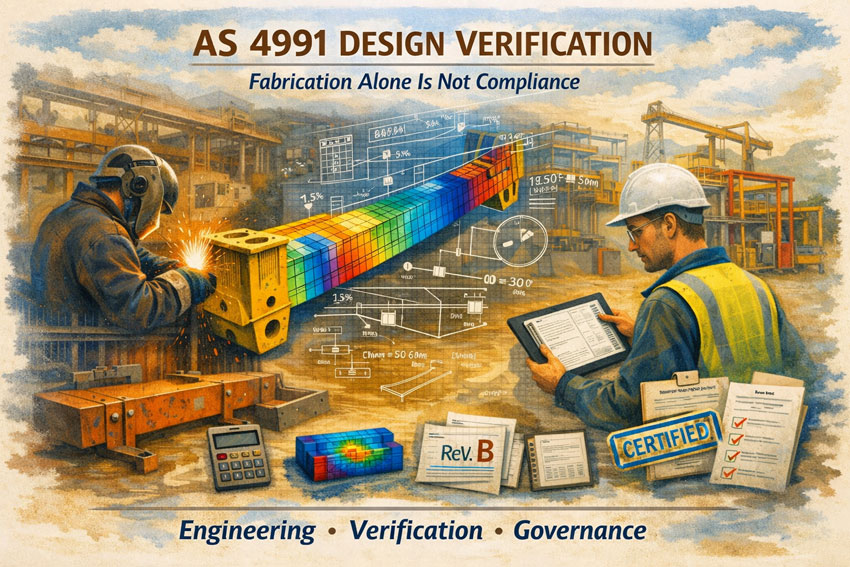

AS 4991 design verification process showing fabrication, engineering analysis and certification workflow.

Engineering Calculations That Donโ€™t Match the Fabrication

One of the most common issues is a disconnect between:

  • The engineered design intent
  • The shop drawings
  • The fabricated outcome

Changes made โ€œon the floorโ€ โ€” such as:

  • Plate thickness substitutions
  • Weld size adjustments
  • Lug geometry tweaks
  • Hole size changes

โ€” can invalidate the original engineering verification.

Without re-verification, certification becomes compromised.


Weld Design is Assumed โ€” Not Verified

Fabricators often focus on structural members but overlook:

  • Fillet weld capacity under combined loading
  • Fatigue considerations
  • Load directionality
  • Throat thickness assumptions

AS 4991 compliance requires welds to be engineered โ€” not assumed.

This is particularly critical in:

  • Spreaders
  • Lifting beams
  • Trunnions
  • Custom lifting frames

No Formal Design Review or Independent Check

The standard requires appropriate verification.

This may include:

  • Independent engineering review
  • Check calculations
  • Formal sign-off by a competent engineer

A workshop โ€œreviewing its own drawingsโ€ does not satisfy independent verification.


Load Cases Are Underestimated

Another common oversight is failure to account for:

  • Dynamic factors
  • Off-centre loading
  • Sling angles
  • Shock loading
  • Environmental factors

Lifting devices rarely operate under perfect static conditions.

Design verification must reflect real-world application.


Documentation Gaps

Even when the engineering is sound, documentation is often incomplete:

  • No clear calculation pack
  • No revision control
  • No traceable material certificates
  • No weld procedure documentation
  • No inspection and test plan

Without structured documentation, clients and auditors may reject otherwise adequate equipment.

This is where governance becomes as important as engineering.


Why This Matters

Failure in lifting devices carries:

  • Serious safety risk
  • Legal liability
  • Project shutdowns
  • Insurance exposure

Under Australian WHS law, the duty of care extends beyond fabrication โ€” it includes engineering adequacy.

AS 4991 is not a box-ticking exercise. It is a risk mitigation framework.


The Hamilton By Design Approach

At Hamilton By Design, we support fabricators by providing:

  • Independent design verification
  • Engineering calculation packages
  • Weld capacity review
  • Load case validation
  • Documentation structured for audit readiness
  • Revision-controlled drawing governance

We work alongside workshops โ€” not against them โ€” ensuring compliance before equipment reaches site.

The cost of early verification is small compared to rework, rejected certification, or liability exposure.


Final Thought

If your lifting device cannot withstand engineering scrutiny on paper, it should not be trusted in the air.

AS 4991 compliance is not about fabrication skill alone โ€” it is about verified engineering intent.

If you would like assistance reviewing your lifting device designs or establishing a verification framework, reach out to the Hamilton By Design team.
Name
Would you like us to arrange a phone consultation for you?
Address

Designing Chutes for Easy Maintenance: The Hamilton by Design Approach

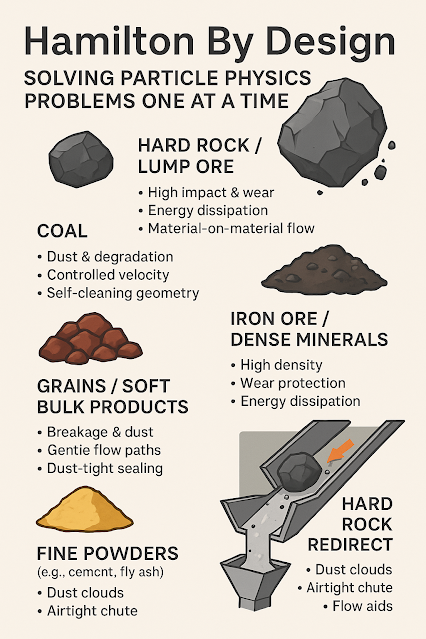
Engineering infographic explaining chute design challenges for coal, iron ore, hard rock, grains, and powders.

In high-wear environments such as mining, minerals processing and bulk material handling, chutes are constantly subject to abrasion, material impact and scraper wear. But too often, chute design prioritises material flow while overlooking how maintenance crews will access, replace, or adjust wear components and scrapers safely and efficiently.

At Hamilton by Design Co., we engineer chutes not only for performanceโ€”but for maintainability. Because downtime, difficult access and costly labour arenโ€™t just inconvenientโ€”they cut straight into your production goals.


Why Maintenance-Friendly Chute Design Matters

Traditional chutes often have one thing in common: theyโ€™re hard to service. Common pain points include:

  • Poor access to internal wear liners
  • Limited clearance for scraper removal/replacement
  • Unsafe confined spaces for maintenance crews
  • Complex disassembly for simple tasks

When maintenance teams struggle to reach components, the outcome is predictable: reduced uptime, increased safety risk and higher long-term operating costs.

A better design not only minimises wearโ€”it facilitates wear replacement.


Infographic titled โ€œHamilton By Design โ€“ Solving Particle Physics Problems One at a Timeโ€ showing material types like coal, hard rock, iron ore, grains, and fine powders with chute design considerations.

Key Principles in Maintainable Chute Design

1. Access Firstโ€”Flow Second

At Hamilton by Design we always ask:
Can a technician reach the wear components safely and efficiently?

Practical solutions we use include:

  • Strategic access doors positioned adjacent to high-wear zones
  • Removable panels with quick-release fasteners
  • Tool-less entry where safe to do so

Simple changes like these reduce maintenance time dramatically.


2. Clearance and Space for Wear Component Removal

Every chute design should consider how a liner panel, scraper blade or skirting board will be removed and replaced. That means:

  • Adequate clearance for lifting gear
  • Doors that open wide enough for component extraction
  • Recessed bolt access to avoid removal obstacles

This forward planning translates directly to lower labor hours and fewer workarounds.


3. Modular Wear Components

Instead of large, welded-in liners that require cut-out replacement, we prefer:

  • Modular liner segments
  • Bolted scraper shoes
  • Replaceable wear strips

Modularity means teams can replace only whatโ€™s wornโ€”without disassembling the whole chute.


4. Scrapers Designed for Easy Swap-Out

Scraper blades are one of the most frequently replaced items in feed and transfer chutes. Good design ensures:

โœ” blades are accessible
โœ” blades can be removed with minimal tools
โœ” adjustment points are visible and reachable

Hamilton by Design uses engineered scraper blocks and mounting systems that:

  • protect the blade from downstream impacts
  • allow quick blade indexing or change-out
  • can be serviced from outside the chute where possible

5. Safety and Compliance Built In

Maintenance isnโ€™t just easierโ€”it must also be safer. Thatโ€™s why our designs include:

๐Ÿ”น lockable access panels
๐Ÿ”น clear entry/egress paths
๐Ÿ”น adequate lighting and fall protection points
๐Ÿ”น confined-space considerations where relevant

Taking safety off the critical path keeps your team productive and compliant.


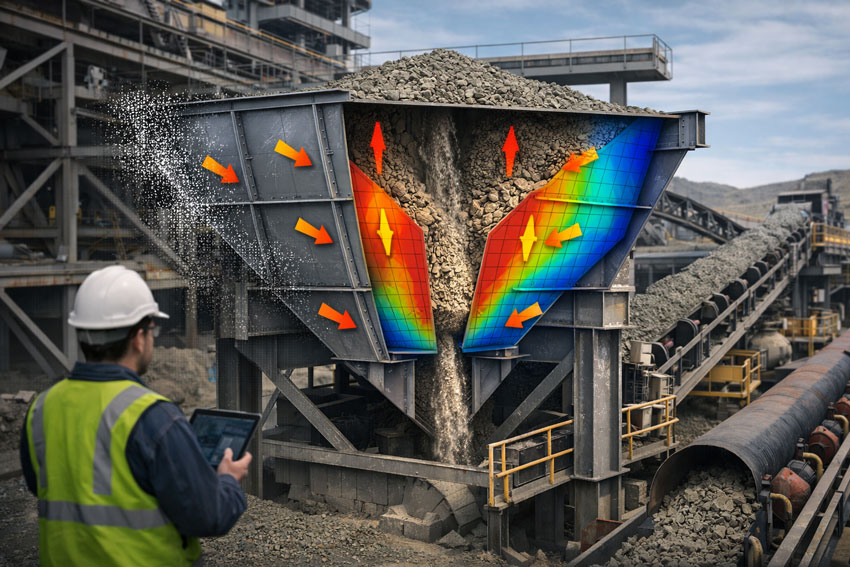
Mining hopper in a transfer station shown in cutaway, illustrating steady-state material flow, structural load distribution, and engineered hopper design.

Putting It All Together: Benefits You Can Measure

When chute design accommodates maintenance needs, the benefits are real:

OutcomeBenefit
Shorter maintenance windowsMore uptime
Easier scraper changesLower labour cost
Modular wear partsReduced inventory waste
Lower safety riskFewer incidents and stoppages
Better flow + maintainabilityHigher throughput

Hamilton by Design: Chutes Built for the People Who Maintain Them

At Hamilton by Design Co., we recognise that chutes donโ€™t just sit thereโ€”they work hard, and your team works hard to keep them running.

Thatโ€™s why our engineers consider:

โœ… material properties
โœ… wear patterns
โœ… maintenance access
โœ… scraper replacement
โœ… safety & ergonomics

all from the earliest design stage.

If your operation is battling hard-to-maintain chutes, or you want chutes that perform and serve your maintenance crews well, weโ€™d love to help.

Contact Hamilton by Design today for a design review or quote.


Name
Would you like us to arrange a phone consultation for you?
Address


From 3D Scanning to Structured Control

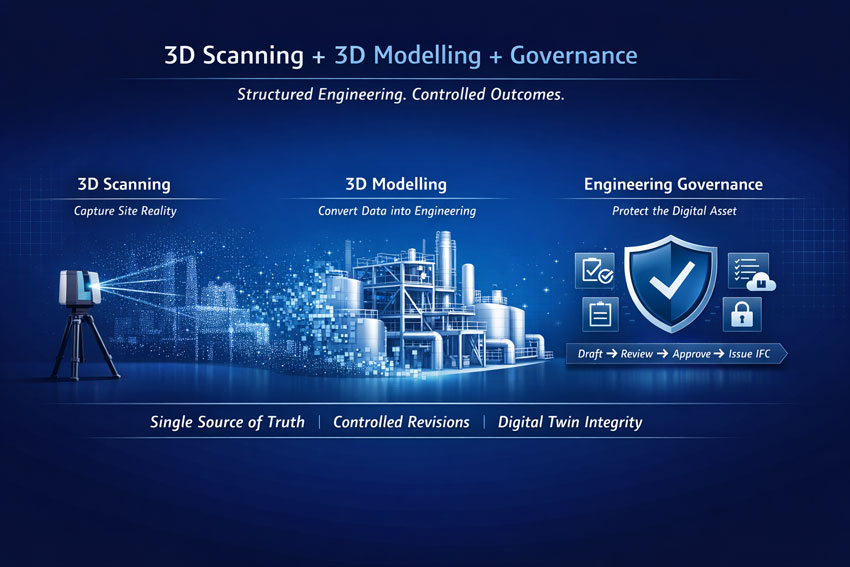
Executive infographic showing 3D scanning, 3D modelling and engineering governance integrated into a structured digital workflow.

Why 3D Modelling Must Be Governed

3D scanning captures reality.

3D modelling interprets reality.

Engineering governance protects reality.

In industrial environments, capturing a site with LiDAR is only the beginning. The real value is unlocked when scan data is structured, validated, controlled and maintained within a governed engineering framework.

At Hamilton By Design, we integrate 3D scanning, 3D modelling and engineering governance into a single structured workflow โ€” ensuring your digital environment becomes a reliable operational asset.


3D Scanning: Capturing the Truth

3D laser scanning creates an accurate representation of existing conditions. In brownfield facilities, this is critical.

It allows organisations to:

  • Understand spatial constraints
  • Identify clashes before construction
  • Reduce rework
  • Improve shutdown planning
  • Establish a baseline for upgrades

However, raw scan data alone does not provide governance.

It provides information โ€” not control.


Corporate engineering graphic illustrating the transition from LiDAR scanning to governed digital twin management.

3D Modelling: Turning Data into Usable Engineering

Once scanning is complete, modelling converts point clouds into structured engineering models.

This includes:

  • Parametric plant models
  • Equipment layouts
  • Structural frameworks
  • Pipe and services modelling
  • As-built verification

But modelling without revision discipline can quickly become fragmented.

If models are updated without control, version tracking is lost. If contractors modify geometry without approval workflows, digital twins become unreliable.

This is where governance becomes essential.


Engineering Governance: Protecting the Digital Asset

Engineering governance ensures that:

  • Scan-derived models follow structured revision control
  • Contractors work within defined digital environments
  • Updates are traceable and auditable
  • Digital twins reflect site-approved configurations
  • Brownfield upgrades do not corrupt master models

Without governance, a digital twin becomes a static snapshot.

With governance, it becomes operational infrastructure.


Why Governance Matters in Brownfield Environments

Live industrial facilities are complex and constantly evolving.

Multiple contractors.
Compressed shutdown windows.
Legacy drawings.
Unrecorded historical modifications.

In these environments, uncontrolled digital updates introduce risk.

Governance provides:

  • Role-based access control
  • Structured approval workflows
  • Defined issue status (IFR / IFA / IFC)
  • Change logs and audit trails
  • Platform-based collaboration

It prevents the common scenario where fabricated equipment arrives on site โ€” only to discover it was built to an outdated model or incorrect drawing revision.


Integrated with the 3DEXPERIENCE Platform

To ensure structured digital continuity, Hamilton By Design aligns scanning and modelling workflows within governed digital environments such as the 3DEXPERIENCE Platform:

https://www.3ds.com/3dexperience/

When properly configured, the platform supports:

  • Controlled document lifecycles
  • Revision management
  • Collaborative review environments
  • Secure cloud access
  • Single source of truth governance

The technology is powerful.

The governance framework ensures it delivers.


The Structured Workflow

Hamilton By Design delivers a disciplined process:

  1. 3D Scan โ€” Capture accurate site conditions
  2. Model Development โ€” Convert data into structured engineering models
  3. Governance Framework โ€” Apply revision control and document lifecycle management
  4. Platform Integration โ€” Align within controlled digital environments
  5. Ongoing Control โ€” Maintain digital twin integrity during upgrades

This transforms 3D data into a governed engineering asset.


More Than Scanning. Structured Engineering Control.

Many providers can scan.

Many can model.

Few provide structured engineering governance across the full lifecycle.

Hamilton By Design delivers the integration of all three โ€” ensuring digital engineering environments remain accurate, controlled and commercially protected.

If your organisation is investing in digital capture, ensure it is supported by governance.

Because a scan without structure is just data.

Governed data becomes infrastructure.

Name
Would you like us to arrange a phone consultation for you?
Address

Engineering Data Governance Consulting

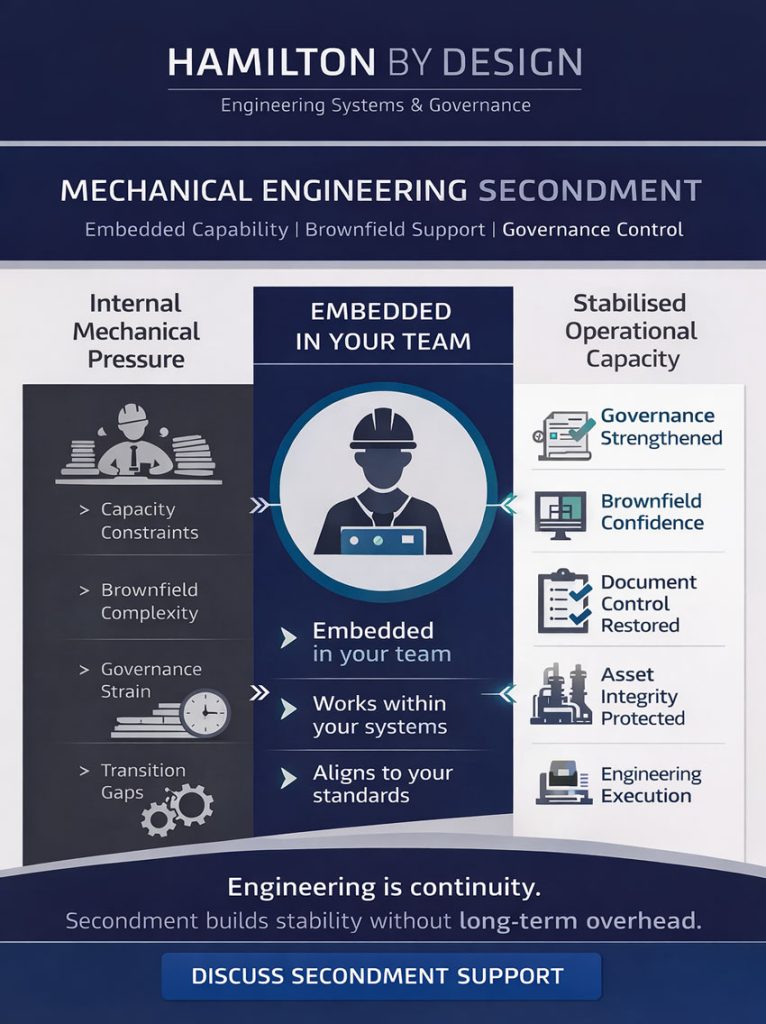
Mechanical engineering secondment infographic showing embedded engineer support, brownfield governance control and operational stability in industrial environments.

Structured Engineering. Controlled Outcomes.

In complex industrial environments, engineering data is not just documentation โ€” it is operational infrastructure.

Without structured governance, drawings drift, revisions lose traceability, contractors work from outdated information, and digital platforms fail to deliver their full value.

At Hamilton By Design, our team brings practical, site-tested experience to help organisations achieve structured, controlled and scalable engineering governance.

We donโ€™t simply manage drawings.

We design the systems that protect them.


Industrial engineering secondment visual showing internal mechanical pressure, embedded team integration and strengthened governance outcomes.

Experience That Understands Operational Reality

Our team has worked across live industrial facilities, brownfield upgrades, manufacturing environments and mining operations. We understand:

  • The pressure of shutdown windows
  • Multi-contractor drawing inputs
  • Legacy documentation environments
  • Compliance and audit requirements
  • The cost of uncontrolled revision cycles

Governance cannot be theoretical.

It must work in real operating conditions.

That is where our experience matters.


The Real Cost of Poor Revision Control

What is the point of ordering fabricated equipment from overseas โ€” only to discover it was manufactured to the wrong drawing revision?

This happens more often than organisations admit.

A contractor downloads an outdated file.
A revision register is not updated.
An IFC drawing is confused with an earlier IFA issue.
Procurement proceeds.
Fabrication begins.

Weeks later โ€” the equipment arrives on site.

And it doesnโ€™t fit.

The result:

  • Rework costs
  • Shipping delays
  • Project schedule impact
  • Shutdown extensions
  • Commercial disputes
  • Loss of trust

The problem is rarely fabrication quality.

The problem is governance.


Engineering Data Governance Consulting

You Sell Intellectual Structure

Engineering Data Governance Consulting is built on intellectual structure โ€” not labour volume.

We assist organisations in designing and implementing governance frameworks that ensure:

  • Data integrity
  • Revision discipline
  • Role-based control
  • Audit traceability
  • Platform alignment

This is about building systems that prevent costly mistakes before they occur.


What Engineering Governance Looks Like in Practice

Our consulting support includes:

CAD Governance Frameworks

Structured standards for file naming, model hierarchy, drawing templates, metadata control and lifecycle management.

Drawing Revision Control Systems

Defined IFR / IFA / IFC workflows, controlled issue registers, structured approval pathways and auditable revision tracking.

ISO-Aligned Document Control Setup

Implementation of document control environments aligned to ISO-based quality management principles, ensuring compliance and traceability.

Digital Twin Governance Models

Establishing rules for how digital representations are maintained, updated, validated and protected during brownfield upgrades and operational changes.

3DEXPERIENCE Platform Configuration Strategy

Strategic configuration of the
3DEXPERIENCE Platform
https://www.3ds.com/products/3dexperience

We assist clients in structuring the platform environment so governance workflows, permissions, document lifecycle control and collaboration processes operate as designed.

The platform is powerful.

Governance ensures it performs.


Governance Is Risk Management

Engineering governance delivers:

  • Reduced procurement errors
  • Controlled contractor integration
  • Clear accountability
  • Improved audit outcomes
  • Protection of digital engineering investments
  • Long-term data continuity

When governance is structured correctly, fabrication errors reduce, procurement confidence increases and digital systems become reliable sources of truth.

Without governance, engineering environments accumulate technical debt.


Hamilton By Design logo displayed on a blue tilted rectangle with a grey gradient background

Structured Engineering. Controlled Growth.

Hamilton By Design provides more than consulting advice.

We partner with organisations to design, implement and maintain structured engineering governance environments that support growth, compliance and operational resilience.

If your organisation is investing in digital engineering platforms, CAD standardisation or digital twin development, governance must come first.

Engineering data is an asset.

Secure it. Structure it. Govern it.

Name
Would you like us to arrange a phone consultation for you?
Address

3D Scanning Sydney with Engineering Governance

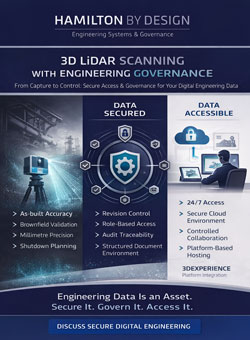
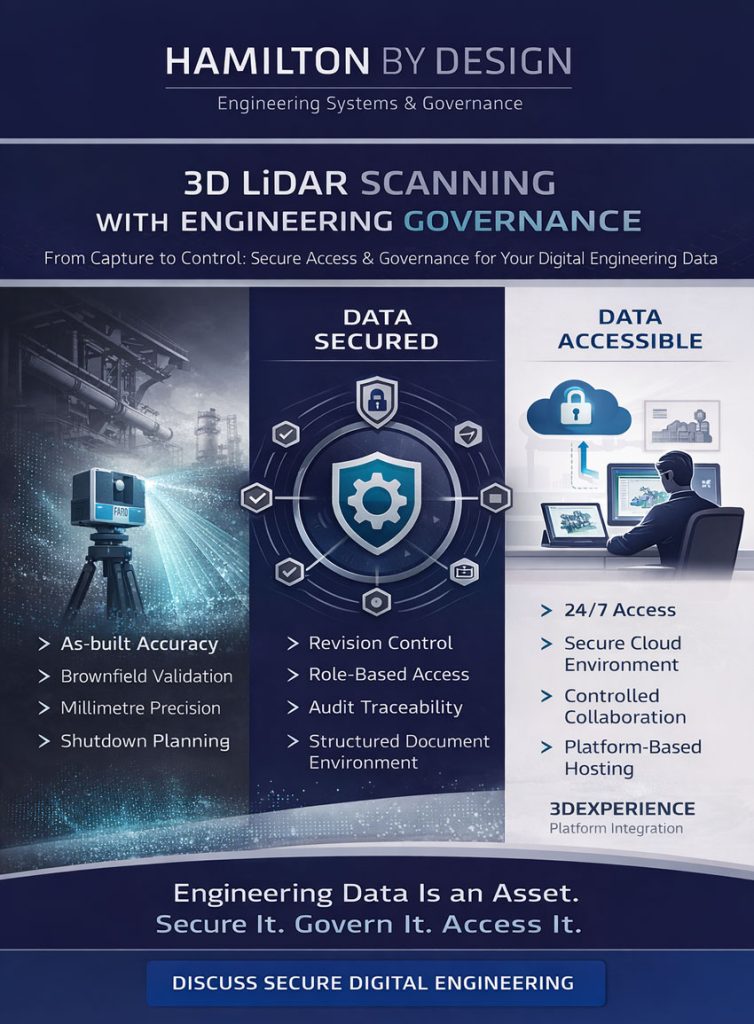
Industrial LiDAR scanning and digital engineering governance model demonstrating secure data capture, revision control and secure platform access.

Reduce Rework. Protect Capital. Deliver Certainty.

In Sydneyโ€™s high-cost construction and industrial market, mistakes are expensive.

With Australian labour rates among the highest in the region โ€” and Sydney operating at premium commercial rates โ€” the cost of rework, design clashes, undocumented variations, and inaccurate site data can quickly exceed the cost of doing things correctly the first time.

Thatโ€™s where 3D scanning combined with engineering governance becomes essential.


Secure digital engineering workflow showing 3D point cloud capture, governance control and cloud-based 24-hour access.

Why Sydney Projects Need Engineering Governance

Sydney projects are:

  • Brownfield upgrades in live facilities
  • Tight commercial refurbishments
  • Infrastructure constrained by existing services
  • Industrial sites with layered legacy modifications

Without a verified โ€œsingle source of truth,โ€ teams rely on outdated drawings, assumptions, or partial information.

That leads to:

  • On-site clashes
  • Fabrication errors
  • Delays waiting for redesign
  • Contractual disputes
  • Escalating labour costs

In a market where skilled labour can exceed $120โ€“$200+ per hour once overheads and compliance are included, one preventable mistake can cost tens of thousands of dollars.

Rework is not just frustrating โ€” itโ€™s financially destructive.


What 3D Scanning Actually Solves

High-accuracy 3D laser scanning captures:

  • Structural steel
  • Services (mechanical, electrical, hydraulic)
  • Plant and equipment
  • Spatial constraints
  • Floor levels and tolerances

Instead of relying on legacy drawings, you design from reality capture data.

But scanning alone is not enough.


The Missing Link: Engineering Governance

Raw point clouds donโ€™t protect your project.

Governance does.

Engineering governance ensures:

โœ” Controlled data access
โœ” Revision management
โœ” Clear drawing issue status (IFR / IFA / IFC)
โœ” Structured documentation
โœ” Auditability and traceability
โœ” Secure collaboration between contractors

When 3D scanning is integrated into a governed digital environment, your project moves from assumption-based to evidence-based engineering.


The Cost of Rework in Sydney

Letโ€™s be clear:

In Australia, rework costs are amplified by:

  • High skilled labour rates
  • Strict compliance requirements
  • Complex subcontractor structures
  • Extended programme impacts
  • Safety and shutdown penalties

A fabrication error might not just mean remaking steel โ€” it can mean:

  • Crane rebooking
  • Night shift penalties
  • Programme delay claims
  • Supervisor time
  • Engineering redesign

In many Sydney industrial environments, a single clash can cost more than the entire 3D scan.

Thatโ€™s why governance-backed scanning is not an expense โ€” itโ€™s risk insurance.


Engineers reviewing BIM documentation while a LiDAR scanner captures a Sydney courthouse with Sydney Harbour and the Harbour Bridge in the background

Sydney Doesnโ€™t Need More Data. It Needs Better Control.

Many projects already collect data.

What they lack is:

  • Structured control
  • Digital discipline
  • Lifecycle governance
  • Clear ownership

3D scanning with engineering governance delivers:

โ€ข A verified existing-conditions model
โ€ข Controlled drawing environments
โ€ข Reduced variation exposure
โ€ข Fewer RFIs
โ€ข Reduced fabrication error
โ€ข Improved contractor coordination


Who Benefits?

  • Industrial facility owners
  • Mining support infrastructure
  • Commercial refurbishments
  • Distribution centres
  • Brownfield automation upgrades
  • Engineering consultancies

If youโ€™re operating in Sydney, where labour is expensive and tolerance for error is low, governance-backed scanning is not optional โ€” itโ€™s strategic.


Hamilton By Design โ€“ Engineering-First Approach

At Hamilton By Design, we donโ€™t just scan.

We:

  • Capture high-accuracy reality data
  • Structure and govern the digital environment
  • Support drawing control and revision management
  • Align engineering documentation with delivery

Because scanning without governance is just a point cloud.

Governed scanning becomes a competitive advantage.


Hamilton By Design logo displayed on a blue tilted rectangle with a grey gradient background

If youโ€™re planning upgrades, expansions, or refurbishment in Sydney โ€”

protect your capital before fabrication begins.

Rework is expensive.

Governed reality capture is predictable.

Name
Would you like us to arrange a phone consultation for you?
Address

Engineering-Grade Labour Hire: Why Governance Matters

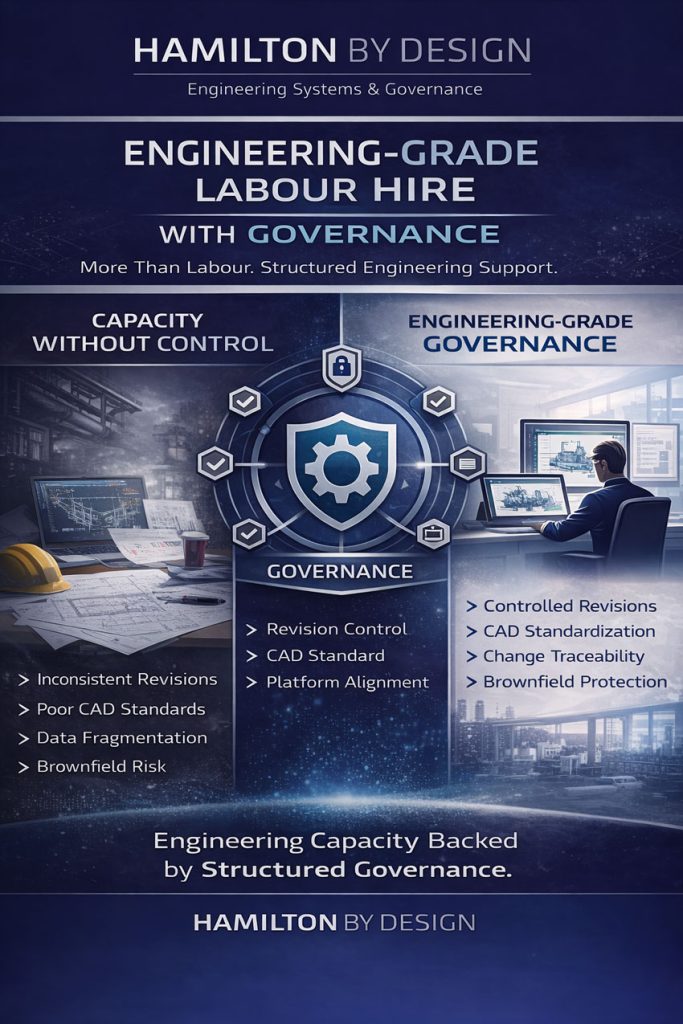
Engineering-grade labour hire with governance infographic showing structured CAD control and revision management.

Engineering-Grade Labour Hire with Governance | Hamilton By Design

In heavy industry, mining, manufacturing and infrastructure, labour hire is common.
But too often, it solves only one problem โ€” short-term capacity.

It does not solve control.

Drawings are produced. Models are updated. Changes are made.
Yet without structured governance, projects quietly lose alignment.

At Hamilton By Design, we approach labour hire differently.
We provide engineering-grade secondment backed by governance discipline.


Hamilton By Design engineering governance model contrasting uncontrolled labour hire with structured engineering oversight.

The Hidden Risk in Traditional Labour Hire

Most labour hire arrangements focus on hours and availability.

What is often overlooked:

  • Inconsistent CAD standards
  • Poor revision control
  • Unclear drawing issue status (IFR / IFA / IFC)
  • Fragmented contractor inputs
  • Brownfield upgrades corrupting master records
  • Loss of traceability during fast-tracked works

The result?

Capacity increases โ€” but risk increases with it.

Engineering environments, especially live operating sites, cannot afford that.


What Does โ€œEngineering Gradeโ€ Actually Mean?

Engineering-grade secondment is not simply providing a drafter or designer.

It means supplying personnel who understand:

  • Configuration control
  • Document lifecycle management
  • Industrial compliance requirements
  • Change management discipline
  • Digital environment structure
  • Risk in operational facilities

It means embedding someone who works within a governance framework โ€” not outside of it.


Governance Is the Difference

Engineering governance ensures:

  • Drawings reflect physical site reality
  • Revisions are auditable
  • Contractors work from approved documentation
  • Brownfield upgrades maintain data integrity
  • Digital models remain a reliable single source of truth
  • Risk is reduced before construction begins

Governance protects capital investment.

Without it, labour hire becomes a short-term patch that creates long-term technical debt.


Brownfield Environments Demand More

Live operating facilities are complex.

They involve:

  • Multi-vendor interfaces
  • Progressive isolation of operational zones
  • Legacy drawings
  • Unknown modifications
  • Production pressure

In these environments, uncontrolled changes can introduce safety, operational and financial risk.

Hamilton By Design brings governance discipline into the labour hire model โ€” ensuring upgrades, modifications and expansions are managed within structured engineering control.


Engineering Secondment with Digital Alignment

Our engineering-grade secondment integrates with structured digital environments, including:

  • Controlled CAD standards
  • Managed drawing registers
  • Platform-based collaboration environments
  • Revision tracking workflows
  • Vendor drawing review protocols

Rather than simply placing a resource on site, we align that resource with a defined governance system.

That alignment protects the project โ€” and the client.


More Than Labour. Structured Engineering Support.

Hamilton By Design delivers:

  • Engineering governance support
  • CAD and drawing control oversight
  • Brownfield upgrade discipline
  • Data integrity protection
  • Digital continuity across project stages

This is labour hire redefined.

It is engineering capacity supported by structure, accountability and technical leadership.


When Is Engineering-Grade Labour Hire Required?

  • Complex brownfield upgrades
  • Live operational facilities
  • Multi-contractor environments
  • Digital transformation programs
  • CAD standardisation projects
  • Projects requiring traceable revision control

If your project needs more than drafting โ€”
if it needs structured engineering control โ€”
Hamilton By Design delivers engineering-grade secondment aligned with governance, compliance and operational continuity.


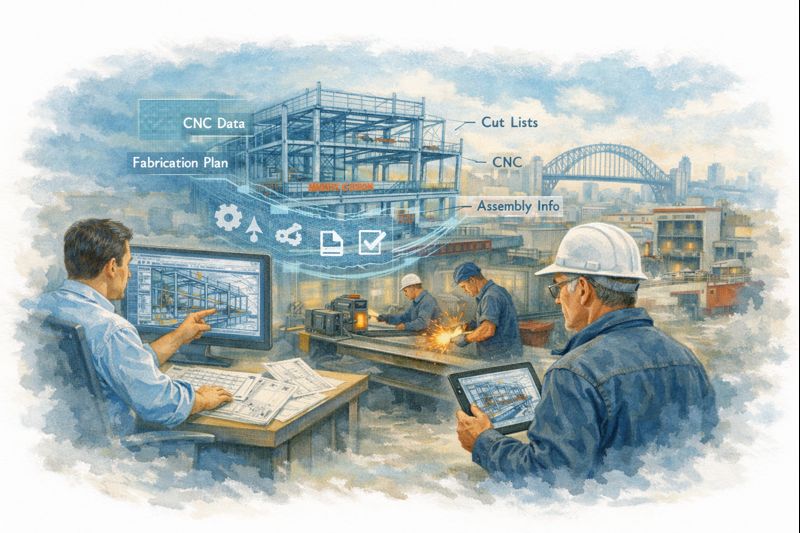
Fabrication Integrated Modelling in a Sydney workshop showing engineers and fabricators using a shared 3D model to drive CNC fabrication and steel assembly.

Protect Your Engineering Environment

Capacity solves workload.

Governance protects investment.

Hamilton By Design provides both.

Name
Would you like us to arrange a phone consultation for you?
Address