As-Built Documentation

As-Built Documentation | Why Accurate Records Matter in Engineering


When drawings don’t reflect what is actually installed on site, projects are exposed to design errors, safety risks, rework, and compliance issues. In industrial, mining, power, and construction environments, relying on outdated or assumed information can quickly lead to costly mistakes.

At Hamilton By Design, as-built documentation is treated as an engineering deliverable, not an administrative afterthought.


What is as-built documentation?

As-built documentation records the true, physical condition of an asset after construction, modification, or installation.

This can include:

  • As-built drawings (plans, sections, elevations)
  • As-built CAD models
  • Verified dimensions and interfaces
  • Documented deviations from original design
  • Digital records suitable for future upgrades and maintenance

Unlike “design intent” drawings, as-built documentation reflects what exists in reality, not what was originally planned.


Why poor as-built documentation causes problems

Many facilities operate with drawings that are:

  • Outdated
  • Incomplete
  • Never updated after modifications
  • Based on assumptions or manual measurements

This creates risk when:

  • Designing upgrades or tie-ins
  • Replacing equipment
  • Assessing compliance with Australian Standards
  • Planning shutdowns or maintenance works

Common outcomes include:

  • Components that don’t fit
  • Unexpected clashes during installation
  • Delays during shutdown windows
  • Increased safety risk during construction and maintenance

How 3D laser scanning improves as-built accuracy

Modern as-built documentation increasingly relies on engineering-grade 3D laser scanning and LiDAR, rather than tape measures or legacy drawings.

3D scanning allows engineers to:

  • Capture accurate geometry of existing assets
  • Verify interfaces, clearances, and alignments
  • Identify undocumented changes and deviations
  • Produce reliable CAD models and drawings

When combined with engineering judgement, scanning provides defensible, fit-for-purpose as-built data suitable for design, fabrication, and compliance.


As-built documentation and Australian Standards

As-built documentation plays a critical role in supporting compliance with:

  • Australian Standards (e.g. access systems, steelwork, structures)
  • The National Construction Code (NCC)
  • Safety-in-design obligations
  • Asset integrity and maintenance requirements

Accurate as-built records enable engineers to:

  • Verify existing conditions against current standards
  • Design compliant upgrades and modifications
  • Demonstrate due diligence if designs or decisions are reviewed

Without reliable as-built data, compliance assessments are often based on assumptions — increasing risk for owners and contractors alike.


Scan-to-CAD: turning reality into usable engineering information

Capturing a point cloud is only the first step.

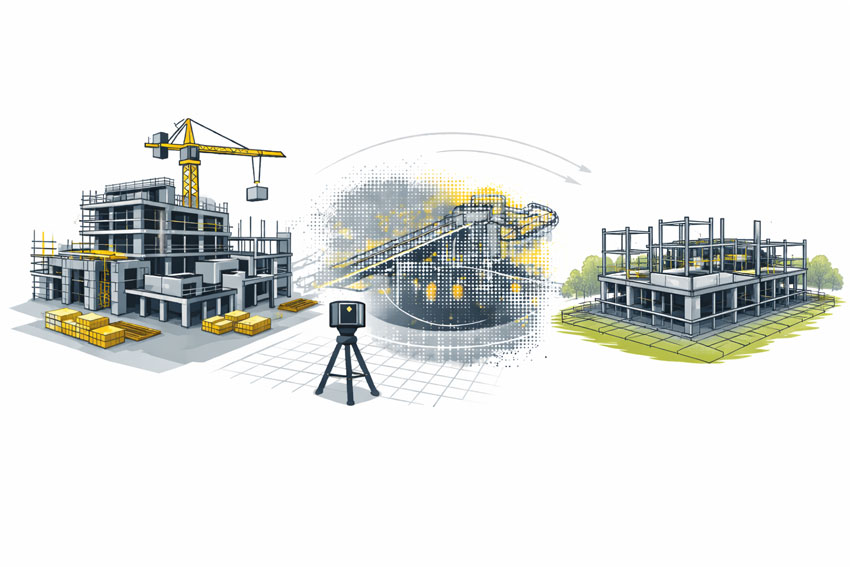
True as-built documentation requires scan-to-CAD workflows, where scan data is converted into:

  • Structured 3D CAD models
  • Clear 2D drawings
  • Fabrication-ready geometry
  • Engineering documentation suitable for construction

This process requires:

  • Controlled datums
  • Appropriate tolerances
  • Engineering interpretation of scan data
  • Understanding of how drawings will be used on site

Poorly modelled scan data can be just as problematic as poor drawings.


Where as-built documentation adds the most value

As-built documentation is particularly valuable for:

  • Brownfield and live-site upgrades
  • Mining and industrial facilities
  • Power generation and utilities
  • Manufacturing plants
  • Existing buildings undergoing refurbishment
  • Assets with long operational life and multiple modifications

In these environments, accurate documentation reduces risk, improves safety, and enables better decision-making across the asset lifecycle.


Engineering-led as-built documentation

At Hamilton By Design, as-built documentation is delivered as part of an integrated engineering workflow, combining:

  • Engineering-grade 3D laser scanning
  • CAD modelling and drafting
  • Mechanical and structural engineering expertise
  • Standards-aware documentation

This ensures as-built records are:

  • Accurate
  • Buildable
  • Defensible
  • Suitable for future engineering use

Our clients:


Final thoughts

As-built documentation is not just about record-keeping — it is about engineering confidence.

Accurate as-built information:

  • Reduces project risk
  • Improves safety
  • Supports compliance
  • Saves time and cost on future works

In complex industrial and construction environments, investing in proper as-built documentation pays for itself many times over.


Hamilton By Design logo displayed on a blue tilted rectangle with a grey gradient background

Need accurate as-built documentation?

If you’re planning upgrades, maintenance, or new works and need engineering-grade as-built documentation, Hamilton By Design can help.

Accurate data today enables better decisions tomorrow.
Name
Would you like us to arrange a phone consultation for you?
Address

3D Construction Scan in Brisbane

Engineering-Grade Reality Capture for Live Construction Environments

Construction projects in Brisbane operate under conditions that place unique pressure on engineers, builders, and asset owners. Subtropical climate, flood-affected sites, reactive soils, dense CBD logistics, and a strong reliance on brownfield upgrades all increase one fundamental risk: designing and constructing from incorrect or outdated site information.

A 3D construction scan in Brisbane provides engineering-grade certainty by capturing what actually exists on site, enabling informed decisions during live construction, refurbishment, and staged delivery projects.


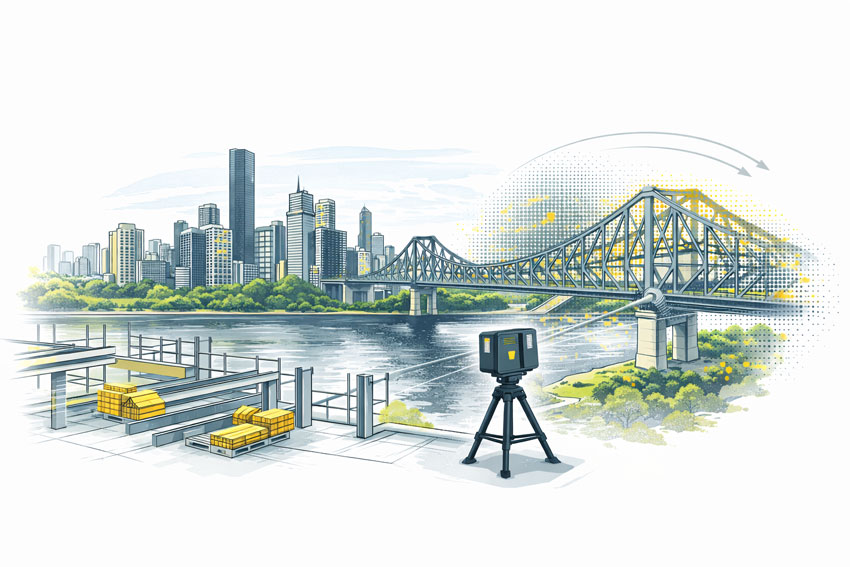
3D construction scanning in Brisbane using a FARO laser scanner at a building site overlooking the Story Bridge and Brisbane River

What Is a 3D Construction Scan?

A 3D construction scan uses high-accuracy LiDAR laser scanning to capture the true as-built condition of a site at a specific point in time. Unlike visual scans or phone-based capture, engineering-grade scanning produces registered point clouds that can be trusted for:

  • Construction coordination
  • Design verification
  • Clash detection
  • Fabrication-ready modelling
  • As-built documentation

Hamilton By Design delivers these outcomes through its engineering-led laser scanning services, where accuracy, downstream use, and construction risk are defined before scanning begins.


https://www.hamiltonbydesign.com.au/laser-scanning-engineering-brisbane-cbd/3d-scanning-brisbane/


Why Brisbane Construction Projects Require a Different Approach

Subtropical Climate & Structural Movement

Brisbane’s humidity and temperature cycles contribute to thermal expansion, contraction, and cumulative movement across steelwork, pipe runs, conveyors, façades, and plant installations.

When construction decisions rely on assumed geometry or legacy drawings, even small movements can result in:

  • Misaligned interfaces
  • Fabrication clashes
  • Installation delays

A 3D construction scan captures the current, in-situ geometry, allowing engineers to design and coordinate based on reality — not historical intent.

Flood-Affected & Modified Assets

Many Brisbane sites — particularly river-adjacent commercial and industrial facilities — have undergone multiple flood recovery and modification cycles. Over time, this results in:

  • Changed floor levels
  • Unrecorded ramps and bunds
  • Altered drainage and gravity-dependent systems

Construction scanning establishes a true datum and elevation baseline, supporting engineering verification of falls, access clearances, and tie-in points.

This capability aligns directly with Hamilton By Design’s broader reality capture and as-built verification workflows.


https://www.hamiltonbydesign.com.au/reality-capture-services/


Brownfield Construction Is the Norm

A significant proportion of Brisbane construction work occurs in live, operational environments, including:

  • Commercial refurbishments
  • Industrial plant upgrades
  • Infrastructure modifications
  • Asset life-extension projects

These sites often contain undocumented steelwork, legacy penetrations, and accumulated modifications. A 3D construction scan enables non-intrusive capture of this complexity, supporting engineering coordination without disrupting operations.

Tight CBD Logistics & Vertical Construction

Brisbane’s CBD presents unique logistical challenges:

  • Limited laydown space
  • Vertical risers and congested services zones
  • Restricted crane and hoist access
  • Staged installation sequencing

In these environments, components must fit first time. Construction scanning supports:

  • Early clash detection
  • Verification before fabrication
  • Confident off-site prefabrication

This process integrates directly with Hamilton By Design’s 3D point cloud modelling and coordination services.

https://www.hamiltonbydesign.com.au/3d-point-cloud-modelling/

Reactive Soils & Differential Settlement

Reactive clay soils common throughout South-East Queensland contribute to long-term differential settlement, particularly where new construction interfaces with older structures. Over time, this can lead to:

  • Misaligned columns and beams
  • Drift in conveyors and pipe racks
  • Geometry that no longer matches design intent

A construction scan captures current condition, enabling engineers to design extensions and upgrades that reflect actual site geometry.


Construction Scanning vs Generic 3D Scanning

Not all scanning is suitable for construction engineering.

AspectGeneric ScanEngineering-Led Construction Scan
AccuracyVisual or indicativeMillimetre-grade
OutputMeshes or imagesRegistered point clouds
Engineering UseLimitedDesign & fabrication
Risk ReductionLowHigh
Construction ReadyNoYes

Hamilton By Design positions construction scanning as part of an integrated engineering workflow, not a standalone data capture exercise.


https://www.hamiltonbydesign.com.au/3d-engineering-services/


How 3D Construction Scans Are Used on Brisbane Projects

Engineering-grade construction scans are routinely used to support:

  • Clash detection across structure and services
  • Verification scans prior to fabrication
  • Construction sequencing and staging
  • As-built documentation for handover
  • Reduced RFIs, rework, and site delays

These outcomes are particularly valuable on commercial and construction projects where access, timing, and accuracy are critical.


https://www.hamiltonbydesign.com.au/commercial-construction-engineering/


3D laser scanning of a commercial building under construction showing as-built capture and coordination before wall closure

The Hamilton By Design Difference

Hamilton By Design delivers engineering-grade 3D construction scanning with a clear focus on constructability and downstream use.

Our approach combines:

  • Engineer-led scanning strategies
  • Defined accuracy requirements
  • Integration with mechanical and structural design
  • Outputs suitable for fabrication and installation

This approach ensures construction teams can rely on scan data with confidence — especially on complex Brisbane projects.


When should a 3D Construction Scan Be Used?

A 3D construction scan in Brisbane is most valuable when:

  • Working in brownfield or live environments
  • Verifying conditions before fabrication
  • Coordinating multiple trades in tight spaces
  • Managing staged refurbishments
  • Reducing construction risk and uncertainty

Hamilton By Design logo displayed on a blue tilted rectangle with a grey gradient background

In Brisbane, construction risk is rarely driven by poor engineering.
It is driven by decisions made using incorrect or outdated information.

A 3D Construction Scan in Brisbane provides one critical advantage:
certainty about what actually exists on site, at the moment decisions are made.

Finite Element Analysis (FEA) engineering simulation button
3D LiDAR scanning and 3D modelling services button
Building and construction services button

Our clients:

Name
Would you like us to arrange a phone consultation for you?
Address

3D Scanning Engineering in Mount Gambier

3D Scanning in Mount Gambier

Mount Gambier is one of South Australia’s most geologically and environmentally distinctive engineering locations. Built on volcanic ground and surrounded by limestone karst systems and abundant groundwater, it is also the heart of the Limestone Coast forestry and timber-processing industry. Engineering in Mount Gambier must carefully balance ground conditions, water sensitivity, and heavy industrial operations.

Hamilton By Design supports projects across Mount Gambier and the wider Limestone Coast with 3D LiDAR laser scanning, engineering, 3D modelling, FEA, and easy-to-build fabrication drawings, helping clients plan, upgrade, and maintain assets with confidence.


Engineering in Mount Gambier: Where Ground and Water Matter

Unlike many regional centres, engineering in Mount Gambier is heavily influenced by what lies beneath the surface.

Projects here often involve:

  • Volcanic soils and variable ground conditions
  • Limestone bedrock with potential voids and groundwater interaction
  • Forestry, timber processing, and associated heavy plant
  • Industrial facilities operating close to environmentally sensitive areas

These factors make accurate site data and conservative, well-verified engineering essential.


3D Laser Scanning for Mount Gambier Projects

High-accuracy 3D LiDAR laser scanning provides a reliable foundation for engineering in Mount Gambier.

Hamilton By Design captures precise as-built data for:

  • Sawmills and timber-processing facilities
  • Conveyors, handling systems, and heavy machinery
  • Industrial buildings, platforms, and access structures
  • Infrastructure located on variable or sensitive ground

3D scanning records the true geometry of existing assets, including misalignment, settlement, and undocumented modifications — all common in older industrial sites and facilities built over complex geology.

This allows projects to move forward with reduced risk, fewer site visits, and greater confidence during construction.

Learn more about our scanning services:
3D Laser Scanning


3D Modelling Built from Real As-Built Conditions

From the point cloud, Hamilton By Design develops accurate 3D CAD models that reflect actual site conditions.

Our 3D modelling services support:

  • Brownfield plant upgrades
  • Modifications to timber-processing equipment
  • Spatial coordination in tight industrial layouts
  • Clash detection and constructability reviews
  • Long-term digital asset records

In Mount Gambier, modelling from real data is especially valuable where ground movement, legacy plant, or limited documentation exists.

Explore our modelling capability:
3D CAD Modelling


FEA for Structural and Mechanical Confidence

Many Mount Gambier assets operate continuously and must perform reliably under changing loads and environmental conditions. Finite Element Analysis (FEA) is used to validate designs and extend asset life.

Hamilton By Design applies FEA to:

  • Assess structural capacity and stiffness
  • Check modifications to existing steelwork
  • Evaluate deflection, fatigue, and buckling
  • Support strengthening or life-extension decisions

By analysing as-built geometry, FEA provides results that better represent real behaviour — particularly important where foundations and ground conditions influence structural performance.

Learn more about our analysis services:
FEA Capabilities


Easy-to-Build Fabrication and Installation Drawings

Clear, practical documentation is essential for regional projects where fabrication and installation teams rely on drawings to get the job done efficiently.

Hamilton By Design produces easy-to-build fabrication drawings, including:

  • General arrangement drawings
  • Fabrication and workshop details
  • Installation and modification layouts
  • As-built documentation

Because drawings are generated directly from scanned data and validated 3D models, they align closely with site conditions, reducing ambiguity and rework.

View our drafting services:
Drafting Services


Hamilton By Design logo displayed on a blue tilted rectangle with a grey gradient background

Why Hamilton By Design in Mount Gambier?

Hamilton By Design delivers an integrated, engineering-led workflow — from site capture through to modelling, analysis, and construction documentation.

For Mount Gambier clients, this means:

  • Better understanding of complex ground and plant conditions
  • Reduced risk when upgrading existing assets
  • Designs that support forestry and industrial operations
  • Fabrication-ready drawings that are practical to build

Whether you are working within timber processing, industrial facilities, or regional infrastructure, Hamilton By Design provides accurate, practical, and build-ready engineering solutions tailored to Mount Gambier’s unique conditions.

If you’re planning a project in Mount Gambier or across the Limestone Coast, we’re ready to help — starting with accurate data and carrying it through to buildable outcomes.

Our clients

Name
Would you like us to arrange a phone consultation for you?
Address

How 3D Laser Scanning Supports As-Built Documentation Under Australian Building Codes & Legal Requirements

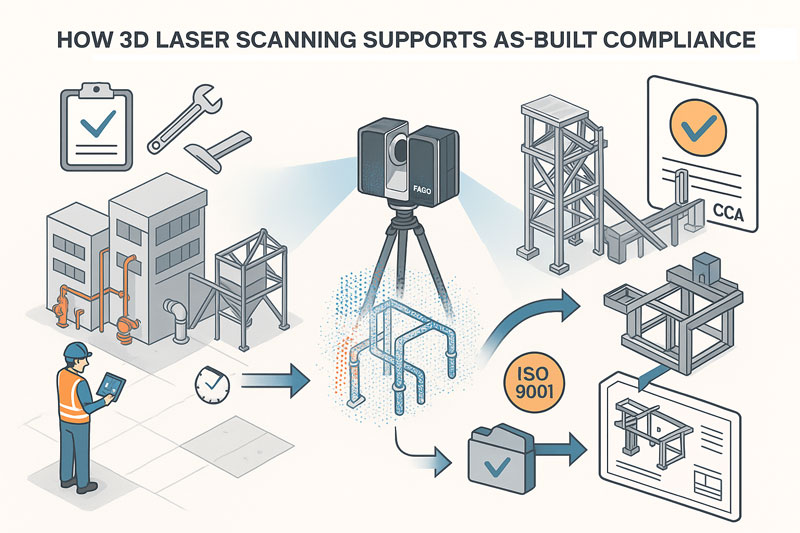
illustration of 3d scanning and building code of australia

1. What the Building Code of Australia (BCA) and Australian Standards Require

While the BCA (part of the National Construction Code – NCC) does not mandate 3D laser scanning, it does mandate that:

You must provide accurate, verifiable as-built documentation, including:

  • As-built drawings reflecting what was actually constructed
  • Evidence that construction aligns with design intent and approvals
  • Documentation for certification, compliance, commissioning and future maintenance

These requirements flow through:

  • NCC Volume 1 – Construction documentation, fire systems, mechanical services
  • AS 1100 – Technical drawing standards
  • AS 5488 – Subsurface utility information
  • AS 9001/ISO 9001 – Quality management documentation
  • State-based WHS / Plant Safety legislation
  • Engineering registration Acts (NSW, QLD, VIC)
  • Client-specific QA frameworks (e.g., TfNSW Digital Engineering, mining compliance standards, government project handover requirements)

These frameworks all emphasise accuracy, traceability, verification and record-keeping.


2. Common Problems with Traditional As-Built Documentation

Most non-compliance issues in handover packages arise because traditional methods rely on:

  • Manual tape measurements
  • Incomplete mark-ups on outdated drawings
  • Limited site access
  • Errors stacking up across multiple trades
  • No accurate record of clashes and deviations
  • No evidence trail for certifiers

This often results in:

  • Disputes between builders, certifiers and subcontractors
  • Rework costs during commissioning
  • Safety risks due to undocumented services or variations
  • Delays in obtaining Occupation Certificates (OC)

3. How 3D Laser Scanning Directly Supports Legal & BCA/NCC Compliance

✔ 3D Scanning Provides “Verified As-Constructed Evidence”

Point clouds record geometry with millimetre–level accuracy, giving:

  • Audit-proof evidence of what exists
  • Time-stamped scanning sessions
  • A defensible digital record for certifiers, engineers and auditors

This is extremely helpful for:

  • Compliance sign-off
  • Dispute resolution
  • Safety compliance
  • Future upgrades or modifications

✔ Produces Accurate As-Built Drawings That Meet AS 1100 Requirements

Laser scanning allows you to generate:

  • Certified 2D as-built drawings
  • 3D models
  • Fabrication-ready details
  • Clash-free spatial coordination drawings

This ensures:

  • Dimensions are correct
  • Penetrations, fall directions, service locations and structural offsets are true to field conditions
  • All documentation aligns with NCC-required accuracy

✔ Eliminates Measurement Errors That Could Breach Compliance

Regulators and certifiers need as-built documents to match constructed work.

Laser scanning:

  • Removes subjective tape measurements
  • Captures difficult/unsafe areas safely
  • Ensures penetrations, ductwork, pipe routes and tolerances match required clearances
  • Supports inspections under NCC (fire, structural, mechanical, accessibility, plant rooms, etc.)

✔ Simplifies BCA Documentation for Fire, Mechanical & Structural Systems

Scanning assists with validating:

Fire Safety Systems

  • Hydrants, hose reels, fire pump rooms
  • Fire damper locations
  • Egress paths and spatial compliance
  • Service penetrations

Mechanical Systems

  • Duct routes
  • Plant room layouts
  • Fan coil units / AHU placement
  • Shaft centre-lines
  • Compliant access paths

Structural Elements

  • Columns
  • Beams
  • Brackets
  • Plant mounts
  • Retrofitted steelwork
  • Tolerance checks

The point cloud provides certifiers with confidence that what was installed does not deviate from approved plans beyond allowable tolerances.


✔ Strengthens ISO 9001 & Government QA Requirements

Most government tenders (TfNSW, Defence, Health Infrastructure, QBuild, etc.) require:

  • Traceable QA
  • As-constructed verification
  • Digital documentation

A 3D scan becomes proof of measurement, improving your QA process by providing:

  • Verifiable dimensional control
  • Pre-fabrication QA
  • Handover packages that exceed minimum compliance

4. How Hamilton By Design Can Position This Service

3D Laser Scanning Enables:

  • NCC-compliant as-built documentation
  • Faster certifier approval
  • Fewer construction disputes
  • Reduced rework during commissioning
  • Better safety compliance
  • Accurate digital twins for maintenance and lifecycle management

You can state (truthfully):

“Our 3D scans provide defensible, audit-ready as-built records that satisfy NCC, engineering, and certification requirements. Certifiers appreciate the precision because it removes ambiguity and reduces approval delays.”


Hamilton By Design logo displayed on a blue tilted rectangle with a grey gradient background

Why Shutdown Parts Don’t Fit

Accuracy of 3D LiDAR Scanning With FARO

Mechanical Engineering | Structural Engineering

Mechanical Drafting | Structural Drafting

3D CAD Modelling | 3D Scanning

Chute Design

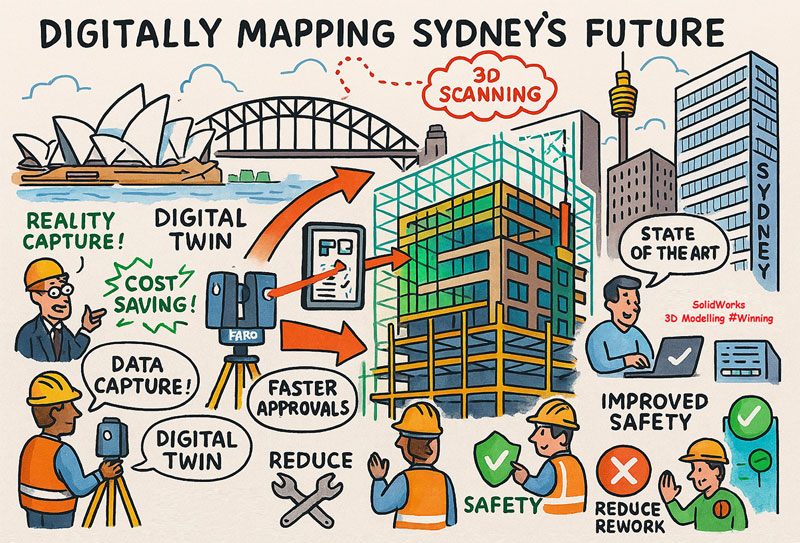
Building Sydney Smarter: How 3D Scanning and LiDAR Are Transforming Construction Accuracy

A New Era of Construction Accuracy in Sydney

Sydney’s construction industry is booming — from commercial towers and infrastructure upgrades to industrial developments and complex refurbishments. But as sites become more congested and designs more complex, achieving perfect alignment between fabricated and installed components has never been more challenging.

That’s where 3D scanning and LiDAR technology come in. At Hamilton By Design, we provide high-precision digital capture and 3D modelling services that ensure every element of your construction project fits seamlessly together, saving time, cost, and effort onsite.


Capturing the Real Site with LiDAR Scanning

Using LiDAR (Light Detection and Ranging) scanners, we capture millions of laser measurements per second to create an exact 3D digital record — known as a point cloud — of your construction site or structure.

This means we can document existing conditions, monitor progress, and verify installations with millimetre-level precision. For Sydney builders, engineers, and contractors, that data eliminates the guesswork and drastically reduces costly clashes and rework later on.


From Point Cloud to 3D Model

Once the LiDAR data is captured, it’s processed into detailed 3D CAD and BIM models compatible with leading design software such as Revit, AutoCAD, SolidWorks, and Navisworks.

These accurate models allow design teams to:

  • Validate and update as-built conditions before fabrication
  • Detect clashes and misalignments before installation
  • Plan modifications and extensions with confidence
  • Coordinate between mechanical, structural, and architectural disciplines

By working from a true digital twin of your Sydney site, you can be sure every part — from prefabricated frames to pipe runs — will fit exactly where it should.


Why Sydney Construction Projects Are Turning to 3D Scanning

  • Reduced Rework: Identify design and fabrication issues before they reach site.
  • Improved Safety: Capture high or restricted areas without scaffolding or shutdowns.
  • Shorter Installation Times: Minimise downtime and delays during fit-up.
  • Precise Documentation: Maintain accurate records for QA and handover.
  • Better Collaboration: Integrate real-world data into your BIM environment.

From commercial fit-outs to infrastructure projects across Greater Sydney, 3D scanning provides a single source of truth for every stakeholder.


Typical Sydney Projects Using LiDAR and 3D Modelling

Hamilton By Design supports a range of construction and engineering clients, including:

  • Commercial and residential developments in the CBD and inner suburbs
  • Industrial plant upgrades across Western Sydney
  • Transport and infrastructure projects under NSW Government programs
  • Refurbishment and brownfield works requiring detailed as-built verification

Each project benefits from faster delivery, greater precision, and stronger communication between designers, builders, and clients.


Partner with Hamilton By Design

If you’re working on a Sydney construction or infrastructure project and need accurate 3D site data, as-built modelling, or fit-up verification, Hamilton By Design can help.

Our experienced mechanical and design specialists combine field scanning with advanced 3D modelling to deliver practical, reliable results that make construction smoother — and smarter.

Mechanical Engineers in Sydney

Mechanical Engineering | Structural Engineering

Hamilton By Design logo displayed on a blue tilted rectangle with a grey gradient background

3D Scanning Sydney

Engineering Services

get in touch

sales@hamiltonbydesign.com.au

Based in Sydney — working across NSW and Australia
info@hamiltonbydesign.com.au
www.hamiltonbydesign.com.au

Capture. Model. Verify. Deliver — precision that builds Sydney better.

Our Clients:

Name
Would you like us to arrange a phone consultation for you?
Address