Engineering Integrity, Failure Evolution, and Energy Transition: A Mechanical Engineerโ€™s Perspective on Australiaโ€™s Ageing Coal Fleet

This paper examines the mechanical degradation, failure mechanisms, and system-level reliability implications of Australiaโ€™s ageing coal-fired power generation assets, focusing on Callide Power Station (Queensland) and Yallourn Power Station (Victoria). Both stations have experienced significant mechanical failures in the past five years, exposing vulnerabilities in maintenance, asset management, and risk governance under conditions of declining reinvestment.
From a mechanical engineering standpoint, these failures illustrate the predictable end-of-life behaviour of large rotating and pressure-bound systems when maintenance expenditure, material renewal, and operational monitoring decline. The paper argues that sustained industrial reliabilityโ€”and thus national energy and employment securityโ€”requires engineering-informed policy that balances decarbonisation with technical integrity management.


Coal-fired power stations are among the most complex mechanical systems ever built in Australia. They integrate high-temperature, high-pressure thermodynamic processes with massive rotating equipment, lubrication systems, and precision alignment tolerances.

From a mechanical engineerโ€™s perspective, their reliability depends on three interlinked pillars:

  1. Structural and material integrity,
  2. Lubrication and vibration control, and
  3. Predictive maintenance and monitoring.

However, as the nation accelerates toward renewable transition targets, investment in these legacy systems has declined. Mechanical failures at Callide and Yallourn are therefore not random accidents but the mechanical manifestation of economic and policy choices.

This analysis seeks to understand those failures in engineering terms, predict future risks, and outline how a re-commitment to industrial infrastructure and jobs requires a concurrent commitment to mechanical reliability.


Technical Overview of Recent Failures

Callide Power Station

Callideโ€™s units span several generations of design and material technology. The C4 explosion (2021) was catastrophic: the failure originated within the turbine hall, leading to structural collapse and large-scale ejection of debris.
Subsequent analysis by CS Energy and external investigators identified battery charger replacement errors, inadequate isolation protocols, and loss of process safety discipline as initiators.

From an engineering integrity perspective, the incident represents a compound failure:

  • Mechanical systems operated under degraded conditions;
  • Electrical and process-control systems failed to detect early anomalies;
  • Organisational maintenance controls were insufficient to interrupt escalation.

Later failures โ€” including the C3 boiler pressure event (2025) and cooling tower collapse (2022) โ€” further confirm that structural materials, corrosion protection, and load-carrying assemblies had entered the fatigueโ€“creep interaction phase of their service life.

Yallourn Power Station

At Yallourn, the August 2025 low-pressure turbine dislodgement occurred after decades of vibration monitoring alarms and bearing wear signals. Earlier (2024) shutdowns for โ€œhigh vibration alarmsโ€ indicated growing rotor dynamic instability.
When the Unit 2 turbine dislodged, the damage pattern suggested bearing wear, misalignment, or bolt relaxation leading to component displacement.

In mechanical engineering terms, this is a classic late-life failure sequence:

  1. Fatigue crack initiation in critical load-carrying components (rotor or coupling bolts),
  2. Progressive loosening and unbalance,
  3. Dynamic amplification under operating RPM,
  4. Catastrophic structural displacement.

The turbineโ€™s dislodgement was therefore an expected end-of-life event, accelerated by reduced overhaul investment and ageing metallurgical properties.


Comparative Engineering Analysis

Engineering DimensionCallideYallournComparison / Insight
Failure TypeExplosion / Pressure Containment BreachTurbine Mechanical DislodgementCallide shows energy-release failure; Yallourn a structural integrity loss.
Root Mechanical CauseOverpressure / process safetyFatigue, unbalance, bearing or bolt failureBoth reflect cumulative degradation.
Indicative Material StateCreep-fatigued pressure shells; corroded supportsThermal-fatigued steel, worn journalsMetallurgical ageing dominates both.
Maintenance CultureProcess-safety erosionReactive, โ€œrun-to-retirementโ€Organisational degradation common factor.
System OutcomeExplosion and total destructionSevere mechanical damage, unit outageBoth reduce grid reliability and reveal systemic neglect.

These failures share a unifying pattern recognised in mechanical reliability theory:

Late-life degradation compounded by maintenance deferral and organisational fatigue produces cascading mechanical failure modes that were once preventable.


Predicting Future Failure Behaviour

Mechanical engineers use reliability-centred maintenance (RCM) models to quantify end-of-life risk.
For rotating equipment, mean time to failure (MTTF) typically decreases exponentially once fatigue propagation exceeds ~70 % of material endurance life.

Data from the National Electricity Market (NEM) indicates:

  • Forced outage frequency has doubled since 2012.
  • Vibration and lubrication alarms are rising in frequency.
  • Unit unavailability correlates strongly (Rยฒ > 0.8) with turbine age and last major overhaul date.

Projected forward, these indicators imply that without major overhauls or component replacements, most Australian coal units will face critical mechanical reliability decline by 2032โ€“2035.


Engineering Economics and Policy Interaction

From an engineering management perspective, the problem is not purely technical โ€” it is thermo-economic.

  • A major turbine retrofit (~A$25โ€“40 million per unit) is uneconomic for plants scheduled for closure in under a decade.
  • Operators thus defer maintenance, accepting rising mechanical risk.
  • The probability of catastrophic failure increases sharply as the cost of prevention declines below the cost of repair.

This is the engineering expression of policy-induced obsolescence: political commitments to retire coal reduce the incentive to sustain its mechanical integrity, even while industries still depend on its output.


Industrial Reliability and the Employment Interface

Reliable baseload power is the foundation for industrial continuity.
From the standpoint of a mechanical engineer, industrial productivity is a function of mechanical uptime: Productivity=f(Power Reliability,Maintenance Efficiency)\text{Productivity} = f(\text{Power Reliability}, \text{Maintenance Efficiency})Productivity=f(Power Reliability,Maintenance Efficiency)

When power generation becomes intermittentโ€”whether from renewable intermittency or coal unreliabilityโ€”industrial operations must compensate with redundancy, backup generation, or load-shedding. These add capital and operational costs that ultimately affect employment.

Regional Implications

  • Queensland retains a stronger firm power horizon (coal + gas + hydro until ~2035), giving industry more operational certainty.
  • Victoria, by contrast, will face a reliability inflection point after Yallourn (2028) and Loy Yang A (2035) closures.

Without firm generation or large-scale storage online, manufacturing regions risk power volatilityโ€”directly translating to production downtime and job insecurity.


Engineering the Transition: Commitment to Jobs and Infrastructure

From a mechanical engineering ethics and systems standpoint, a commitment to industry must be synonymous with a commitment to mechanical reliability.
That requires three converging actions:

Asset Integrity Management:
Continuous structural health monitoring, vibration analysis, and overhaul planning for remaining thermal units.
Even in decline, they must be safely and predictably retired.

Design and Commissioning of Replacement Systems:
Engineers must ensure that renewable generation, storage, and transmission assets meet equivalent reliability and maintainability standards.
This includes redundancy design, grid inertia replacement, and mechanical resilience of large rotating machinery (e.g., pumped hydro, turbines, bearings).

Workforce Transition as Engineering Continuity:
The skills used to maintain turbines, bearings, and boilers are transferable to wind, hydro, and hydrogen equipment.
Protecting those jobs preserves both mechanical capability and national energy security.


Engineering Conclusions

From a mechanical engineerโ€™s viewpoint, the failures at Callide and Yallourn are textbook case studies of end-of-life degradation under policy-driven neglect.
They illustrate that:

  1. Mechanical degradation is predictable โ€” vibration, lubrication, and thermal-stress indicators were present years before failure.
  2. Organisational and policy decisions override engineering recommendations โ€” maintenance deferral was economic, not technical.
  3. Systemic reliability cannot be sustained without mechanical investment โ€” whether in turbines, batteries, or hydro equipment, engineering integrity remains central.
  4. A national commitment to industry equals a commitment to engineering.

If Australia seeks to safeguard its industrial base and employment, it must invest not only in new energy technologies but in the mechanical soundness of the systems that bridge the transition.
Neglecting this will reproduce the same failure patternsโ€”just in new forms of infrastructure.


References (Indicative)

  • CS Energy (2024). Callide C4 Incident Investigation Summary.
  • WattClarity (2025). Analysis of Yallourn Unit 2 Trip and Frequency Response.
  • AEMO (2025). Generator Reliability Performance Report.
  • EnergyAustralia (2025). Yallourn Mechanical Maintenance Overview.
  • IEEFA (2025). Delaying Coal Power Exits: Engineering and Economic Implications.
  • ASME (2023). Guidelines on Turbine Rotor Life Assessment and Remaining Life Prediction.
Robotics and Human Relations: Balancing Innovation with Safety

Robots are no longer the stuff of science fictionโ€”they are embedded in our factories, warehouses, and even food-processing plants. They promise efficiency, speed, and the ability to take on dangerous jobs humans shouldnโ€™t have to do. Yet, as recent headlines show, this promise comes with serious risks. From the lawsuit against Tesla over a robotic arm that allegedly injured a worker to the tragic death of a Wisconsin pizza factory employee crushed by a machine, the conversation about humanโ€“robot relations has never been more urgent.

This blog post explores the promise and peril of robotics in the workplace, drawing lessons from recent incidents and asking: how do we ensure humans and robots can coexist safely?

The Rise of Robotics in Everyday Work

Robotics is spreading quickly across industries. Automotive giants like Tesla rely on robotic arms for precision assembly, while food plants use automated systems to handle packaging and processing. According to the International Federation of Robotics, robot installations worldwide continue to grow year after year. For businesses, itโ€™s a clear win: fewer errors, lower costs, and reduced human exposure to dangerous tasks.

But with robots entering smaller facilitiesโ€”where safety infrastructure may be weakerโ€”the risks grow. A mis calibrated robot, a missed safety step, or a poorly trained operator can turn a productivity tool into a deadly hazard.

When Robots Go Wrong: Lessons from Recent Cases

  • Teslaโ€™s Robotic Arm Lawsuit
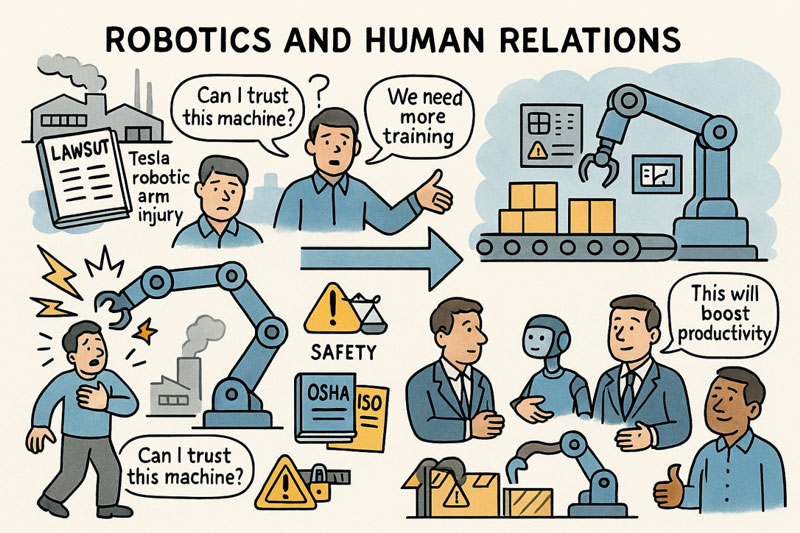
    A former technician at Tesla claims he was struck and knocked unconscious by a robotic arm while performing maintenance. The lawsuit highlights a crucial point: safety procedures like lockout/tagout arenโ€™t optionalโ€”they are lifesaving. When machines are energized during servicing, even a momentary slip can have devastating consequences.
  • Wisconsin Pizza Factory Fatality
    In a smaller manufacturing plant, a worker lost his life after being crushed by a robotic machine. Unlike Tesla, this wasnโ€™t a high-tech car factory but a food facilityโ€”showing that robotics risks extend far beyond Silicon Valley. Smaller plants may lack robust safety training, yet they are increasingly embracing automation.

Both cases are tragic reminders that technology alone canโ€™t guarantee safety. Human oversight, training, and organizational commitment to safety matter just as much.

The Human Side of Robotics

When people think about robots at work, they often picture job displacement. But for many workers, the immediate concern is safety. Studies show that trust plays a huge role: workers who believe robots are reliable tend to perform better. However, misplaced trustโ€”assuming a machine will always stop when neededโ€”can be just as dangerous as fear or mistrust.

Beyond physical risks, robots can also affect morale and mental health. Workers may feel devalued or expendable when machines take over critical tasks. The challenge isnโ€™t just engineering safer robotsโ€”itโ€™s creating workplaces where humans feel respected and protected.

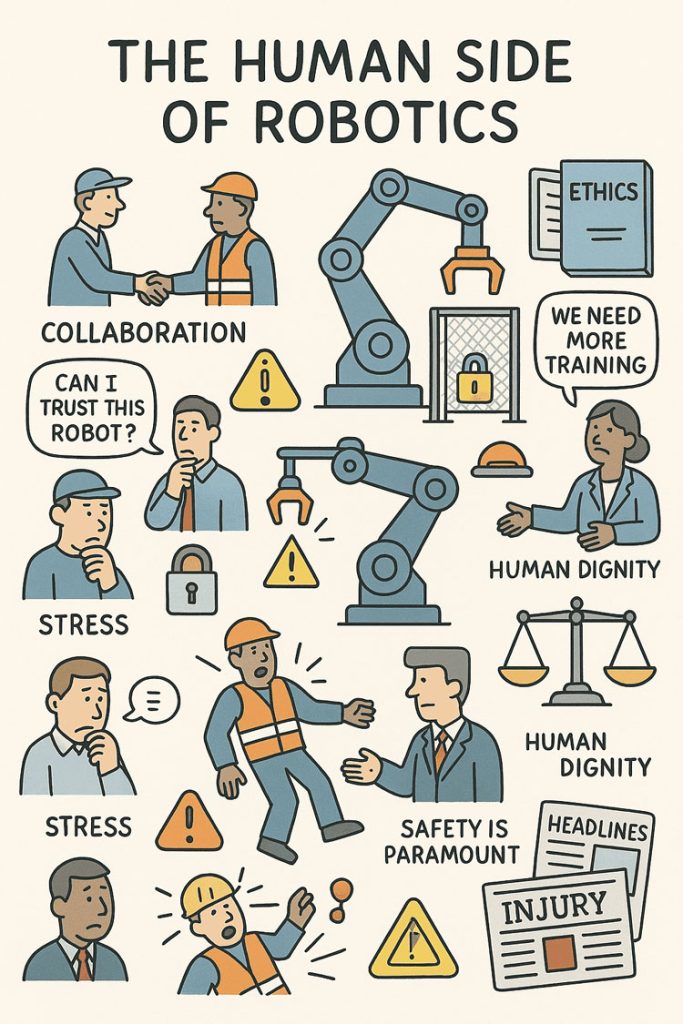
Illustrated infographic titled โ€œThe Human Side of Robotics,โ€ showing workers interacting with industrial robots and highlighting concerns such as collaboration, trust, stress, training needs, ethics, safety, and human dignity. Several people appear worried or stressed, with speech bubbles saying โ€œCan I trust this robot?โ€ and โ€œWe need more training.โ€ Warning symbols, safety locks, scales representing ethics, and a newspaper headline reading โ€œInjuryโ€ emphasize workplace risks. A robotic arm works within a safety cage while workers discuss safety and ethical implications. The overall theme contrasts human concerns with the increasing use of robotics.

Building a Safer Future Together

So how do we strike the right balance between robotics innovation and human well-being? A few key steps stand out:

  1. Design Safety Into the Machine: Emergency stops, advanced sensors, and fail-safes should be standard featuresโ€”not optional add-ons.
  2. Enforce Safety Protocols: OSHAโ€™s lockout/tagout rules exist for a reason. Employers must ensure that servicing robots without proper shutdowns is never allowed.
  3. Invest in Training: Robots are only as safe as the people who interact with them. Ongoing, practical training helps prevent accidents.
  4. Foster a Safety Culture: Workers should feel empowered to report unsafe practices without fear of retaliation.
  5. Update Regulations: As robots spread into more industries, regulators must adapt. International safety standards like ISO 10218 need to be more widely enforced, especially in smaller facilities.
Hamilton By Design logo displayed on a blue tilted rectangle with a grey gradient background

Conclusion

Robotics is here to stay. It has the potential to make our workplaces more efficient, less physically demanding, and even safer. But incidents like those at Tesla and the Wisconsin pizza plant remind us that without proper safeguards, the cost of automation can be measured in human lives.

The future of humanโ€“robot relations doesnโ€™t have to be one of fear or tragedy. With the right mix of engineering, regulation, and workplace culture, robots and humans can work side by sideโ€”not as rivals, but as partners. The question isnโ€™t whether we should embrace robotics, but whether weโ€™ll do so responsibly, putting peopleโ€™s safety and dignity first.


Name
Would you like us to arrange a phone consultation for you?
Address

Choosing the Right 3D Scanner for Construction, Manufacturing, and Mining Projects

At Hamilton By Design, we know that 3D scanning has become an essential tool for modern engineering โ€” from capturing as-built conditions on construction sites to modeling complex processing plants and validating manufacturing layouts. But not all scanners are created equal, and selecting the right technology is crucial to getting reliable data and avoiding costly surprises later in the project.

3D Scanning for Construction Sites

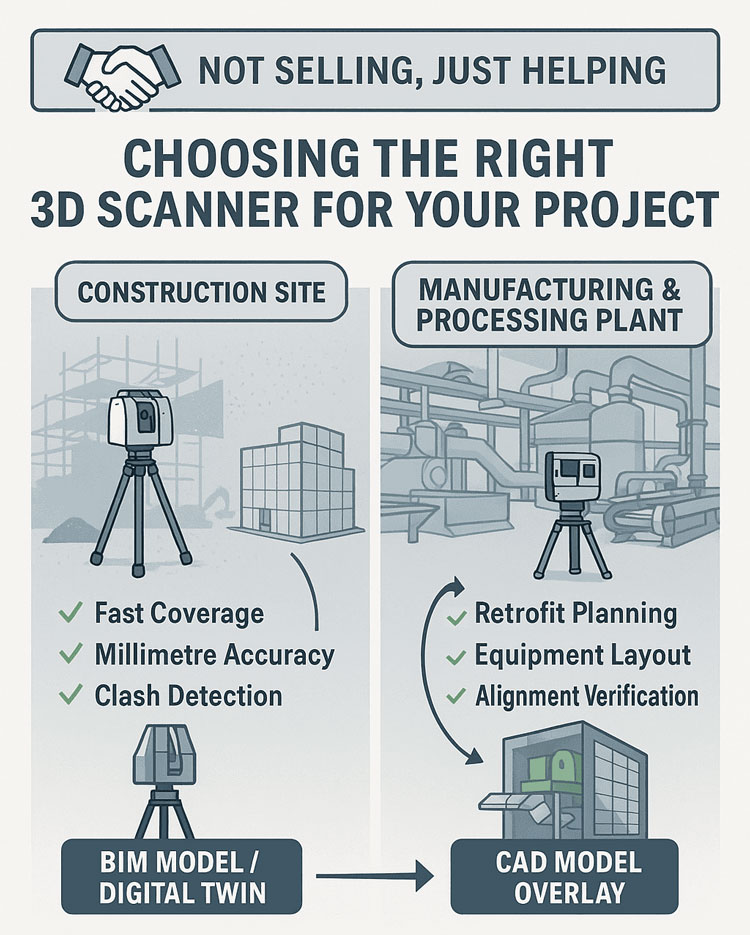
For construction and infrastructure projects, coverage and speed are the top priorities. Terrestrial Laser Scanning (TLS) and LiDAR systems like the FARO Focus S70 are ideal for quickly capturing entire job sites with millimetre-level accuracy. These scanners allow engineers and project managers to:

  • Verify as-built conditions against design models
  • Detect clashes early in the process
  • Support accurate quantity take-offs and progress documentation

TLS works well in tough environments โ€” dust, sunlight, and complex geometry โ€” making it a perfect fit for active building sites.

3D Scanning for Manufacturing & Processing Plants

When it comes to manufacturing facilities and mining processing plants, accuracy and detail matter even more. Scans are often used for:

  • Retrofit planning and clash detection in tight plant rooms
  • Structural steel and conveyor alignment checks
  • Equipment layout for expansion projects

Here, combining TLS with feature-based CAD modeling allows us to deliver data that is usable for engineering design, ensuring that new equipment fits exactly as intended.

Infographic titled โ€˜Choosing the Right 3D Scanner for Your Projectโ€™ with the tagline โ€˜Not Selling, Just Helping.โ€™ The left side shows a construction site with a tripod-mounted 3D scanner and benefits listed: fast coverage, millimetre accuracy, and clash detection, leading to BIM model or digital twin outputs. The right side shows a manufacturing and processing plant with a scanner and benefits: retrofit planning, equipment layout, and alignment verification, leading to CAD model overlay results

Weโ€™re Here to Help

Hamilton By Design doesnโ€™t sell scanners โ€” we focus on providing unbiased, engineering-driven advice. If youโ€™re unsure which scanning approach is right for your project, weโ€™re happy to share our experience and guide you toward the best solution.

Feel free to get in touch to discuss your project needs โ€” whether itโ€™s a construction site, manufacturing facility, or processing plant, we can help you turn accurate scan data into actionable engineering insights.

3D Scanning for Construction Sites |  3D Scanning for Manufacturing | 3D Scanning for Processing Plants

Mechanical Engineering | Structural Engineering

Mechanical Drafting | Structural Drafting

3D CAD Modelling | 3D Scanning

Seeing the Unseen: How LiDAR Scanning is Transforming Mining Process Plants

In modern mining, where uptime is money and safety is non-negotiable, understanding the geometry of your process plant is critical. Every conveyor, chute, pipe rack, and piece of equipment must fit together seamlessly and operate reliably โ€” but plants are messy, dusty, and constantly changing. Manual measurement with a tape or total station is slow, risky, and often incomplete.

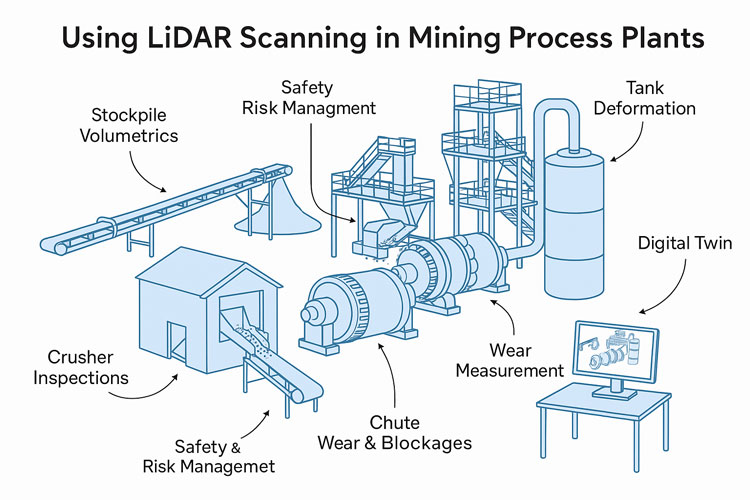
nfographic showing how LiDAR scanning is used in mining process plants, with illustrations of conveyors, crushers, tanks, mills and chutes. Labels highlight applications such as stockpile volumetrics, crusher inspections, safety and risk management, chute wear and blockages, mill wear measurement, tank deformation monitoring and creating digital twins.

This is where LiDAR scanning (Light Detection and Ranging) has become a game-changer. By capturing millions of precise 3D points per second, LiDAR gives engineers, maintenance planners, and operators an exact digital replica of the plant โ€” without climbing scaffolds or shutting down equipment. In this post, weโ€™ll explore how mining companies are using LiDAR scanning to solve real problems in processing plants, improve safety, and unlock operational efficiency.


What Is LiDAR Scanning?

LiDAR is a remote sensing technology that measures distance by firing pulses of laser light and recording the time it takes for them to return. Modern terrestrial and mobile LiDAR scanners can:

  • Capture hundreds of thousands to millions of points per second
  • Reach tens to hundreds of meters, depending on the instrument
  • Achieve millimeter-to-centimeter accuracy
  • Work in GPS-denied environments, such as inside mills, tunnels, or enclosed plants (using SLAM โ€” Simultaneous Localization and Mapping)

The output is a point cloud โ€” a dense 3D dataset representing surfaces, equipment, and structures with stunning accuracy. This point cloud can be used as-is for measurements or converted into CAD models and digital twins.


Why Process Plants Are Perfect for LiDAR

Unlike greenfield mine sites, processing plants are some of the most geometry-rich and access-constrained areas on site. They contain:

  • Complex networks of pipes, conveyors, tanks, and structural steel
  • Moving equipment such as crushers, mills, and feeders
  • Dusty, noisy, and hazardous environments with limited safe access

All these factors make traditional surveying difficult โ€” and sometimes dangerous. LiDAR enables โ€œno-touchโ€ measurement from safe vantage points, even during operation. Multiple scans can be stitched together to create a complete model without shutting down the plant.


Applications of LiDAR in Process Plants

1. Wear Measurement and Maintenance Planning

LiDAR has revolutionized how mines measure and predict wear on critical process equipment:

  • SAG and Ball Mill Liners โ€“ Portable laser scanners can capture the exact wear profile of liners. Comparing scans over time reveals wear rates, helping maintenance teams schedule relines with confidence and avoid premature failures.
  • Crusher Chambers โ€“ Scanning inside primary and secondary crushers is now faster and safer than manual inspections. The resulting 3D model allows engineers to assess liner life and optimize chamber profiles.
  • Chutes and Hoppers โ€“ Internal scans show where material buildup occurs, enabling targeted cleaning and redesign to prevent blockages.

Result: Reduced downtime, safer inspections, and better forecasting of maintenance budgets.


2. Retrofit and Expansion Projects

When modifying a plant โ€” installing a new pump, rerouting a pipe, or adding an entire circuit โ€” having an accurate โ€œas-builtโ€ model is crucial.

  • As-Built Capture โ€“ LiDAR provides an exact snapshot of the existing plant layout, eliminating guesswork.
  • Clash Detection โ€“ Designers can overlay new equipment models onto the point cloud to detect interferences before anything is fabricated.
  • Shutdown Optimization โ€“ With accurate geometry, crews know exactly what to cut, weld, and install โ€” reducing surprise field modifications and shortening shutdown durations.

3. Inventory and Material Flow Monitoring

LiDAR is not just for geometry โ€” itโ€™s also a powerful tool for tracking material:

  • Stockpile Volumetrics โ€“ Mounted scanners on stackers or at fixed points can monitor ore, concentrate, and product stockpiles in real time.
  • Conveyor Load Measurement โ€“ Stationary LiDAR above belts calculates volumetric flow, giving a direct measure of throughput without contact.
  • Blending Control โ€“ Accurate inventory data improves blending plans, ensuring consistent plant feed quality.

4. Safety and Risk Management

Perhaps the most valuable application of LiDAR is keeping people out of harmโ€™s way:

  • Hazardous Floor Areas โ€“ When flooring or gratings fail, robots or drones with LiDAR payloads can enter the area and collect data remotely.
  • Fall-of-Ground Risk โ€“ High walls, bin drawpoints, and ore passes can be scanned for unstable rock or buildup.
  • Escape Route Validation โ€“ Scans verify clearances for egress ladders, walkways, and platforms.

Every scan effectively becomes a permanent digital record โ€” a baseline for monitoring ongoing structural integrity.


5. Digital Twins and Advanced Analytics

A plant-wide LiDAR scan is the foundation of a digital twin โ€” a living, data-rich 3D model connected to operational data:

  • Combine scans with SCADA, IoT, and maintenance systems
  • Visualize live process variables in context (flow rates, temperatures, vibrations)
  • Run โ€œwhat-ifโ€ simulations for debottlenecking or energy optimization

As AI and simulation tools mature, the combination of geometric fidelity and operational data opens new possibilities for predictive maintenance and autonomous plant operations.


Emerging Opportunities

Looking forward, there are several promising areas for LiDAR in mining process plants:

  • Autonomous Scan Missions โ€“ Using quadruped robots (like Spot) or SLAM-enabled drones to perform routine scanning in high-risk zones.
  • Real-Time Change Detection โ€“ Continuous scanning of critical assets with alerts when deformation exceeds thresholds.
  • AI-Driven Point Cloud Analysis โ€“ Automatic object recognition (valves, flanges, motors) to speed up model creation and condition reporting.
  • Integrated Planning Dashboards โ€“ Combining LiDAR scans, work orders, and shutdown schedules in a single interactive 3D environment.

Best Practices for Implementing LiDAR

To maximize the value of LiDAR scanning, consider:

  1. Define the Objective โ€“ Are you measuring wear, planning a retrofit, or building a digital twin? This affects scanner choice and resolution.
  2. Plan Scan Positions โ€“ Minimize occlusions and shadow zones by preplanning vantage points.
  3. Use Proper Registration โ€“ Tie scans to a control network for consistent alignment between surveys.
  4. Mind the Environment โ€“ Dust, fog, and vibration can degrade data; choose scanners with appropriate filters or protective housings.
  5. Invest in Processing Tools โ€“ The raw point cloud is only the start โ€” software for meshing, modeling, and analysis is where value is extracted.
  6. Train Your Team โ€“ Build internal capability for scanning, processing, and interpreting the results to avoid vendor bottlenecks.

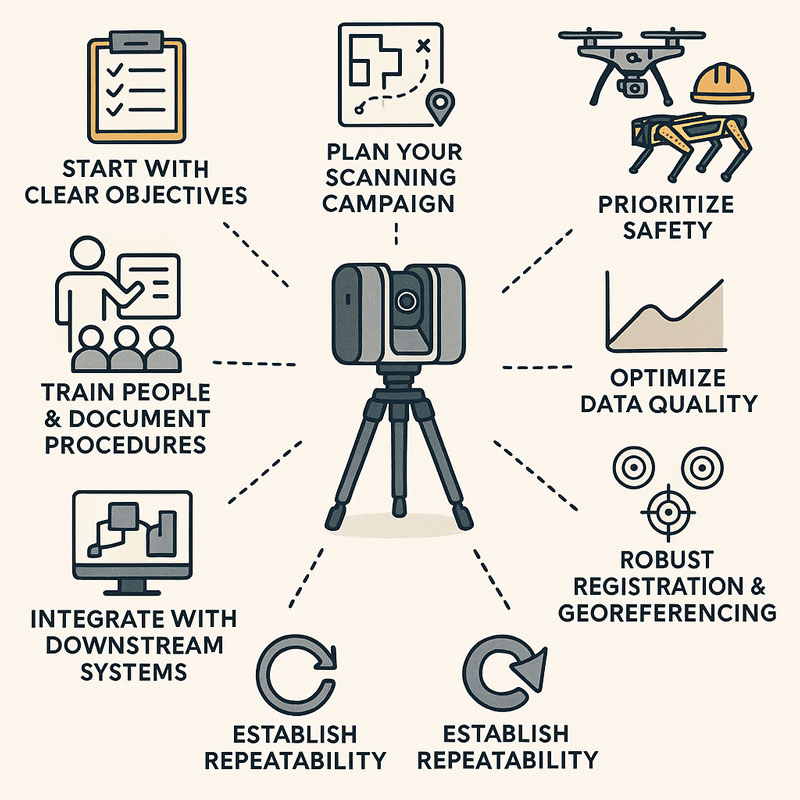
Infographic showing a 3D LiDAR scanner on a tripod surrounded by eight best-practice principles: start with clear objectives, plan your scanning campaign, prioritize safety, optimize data quality, ensure robust registration and georeferencing, establish repeatability, integrate with downstream systems, and train people with documented procedures

LiDAR scanning is no longer a niche technology โ€” it is rapidly becoming a standard tool for mining process plants that want to operate safely, efficiently, and with fewer surprises. From mill liners to stockpiles, from shutdown planning to digital twins, LiDAR provides a clear, measurable view of assets that was impossible a decade ago.

For operations teams under pressure to deliver more with less, the case is compelling: better data leads to better decisions. And in a high-stakes environment like mineral processing, better decisions translate directly to improved uptime, reduced costs, and safer workplaces.

The next time youโ€™re planning a shutdown, a retrofit, or even just trying to understand why a chute is plugging, consider pointing a LiDAR scanner at the problem. You may be surprised at how much more you can see โ€” and how much time and money you can save.

3D Scanning | Mining Surface Ops | 3D Modelling

Mechanical Engineering | Structural Engineering

Mechanical Drafting | Structural Drafting

3D CAD Modelling | 3D Scanning

Chute Design

SolidWorks Contractors in Australia

Hamilton By Design โ€“ Blog

Lessons from a Landmark Case:

The Importance of Robust Structural Design Review

In 2024, SafeWork SA concluded a landmark case involving a spectator-roof collapse during a football club redevelopment project in South Australia. While no life-threatening injuries occurred, the incident highlighted how critical it is for design, review, and certification processes to work together to ensure safety on site.

This was the first successful design-related prosecution under South Australiaโ€™s Work Health and Safety Act, sending a clear signal to the engineering and construction sector: design decisions carry legal and safety obligations, not just technical ones.

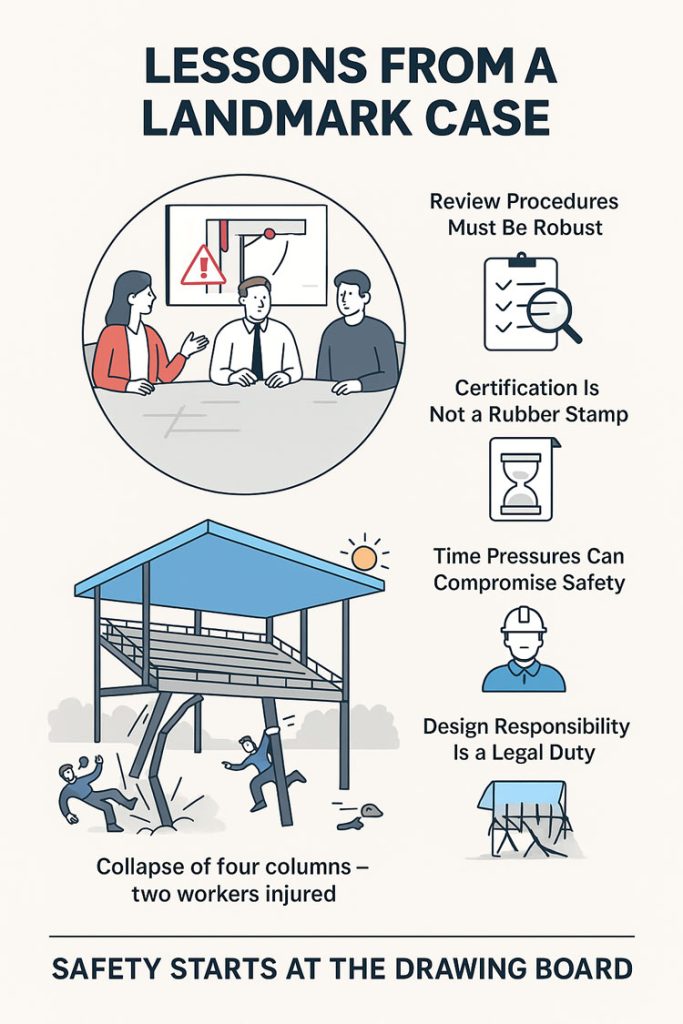
Infographic titled โ€œLessons from a Landmark Case,โ€ showing engineers reviewing a design, icons highlighting robust review procedures, proper certification, time-pressure risks, and legal design responsibilities. The lower illustration depicts a structure collapsing after four column failures with two workers falling, emphasising the message โ€œSafety starts at the drawing board

What Happened (Briefly)

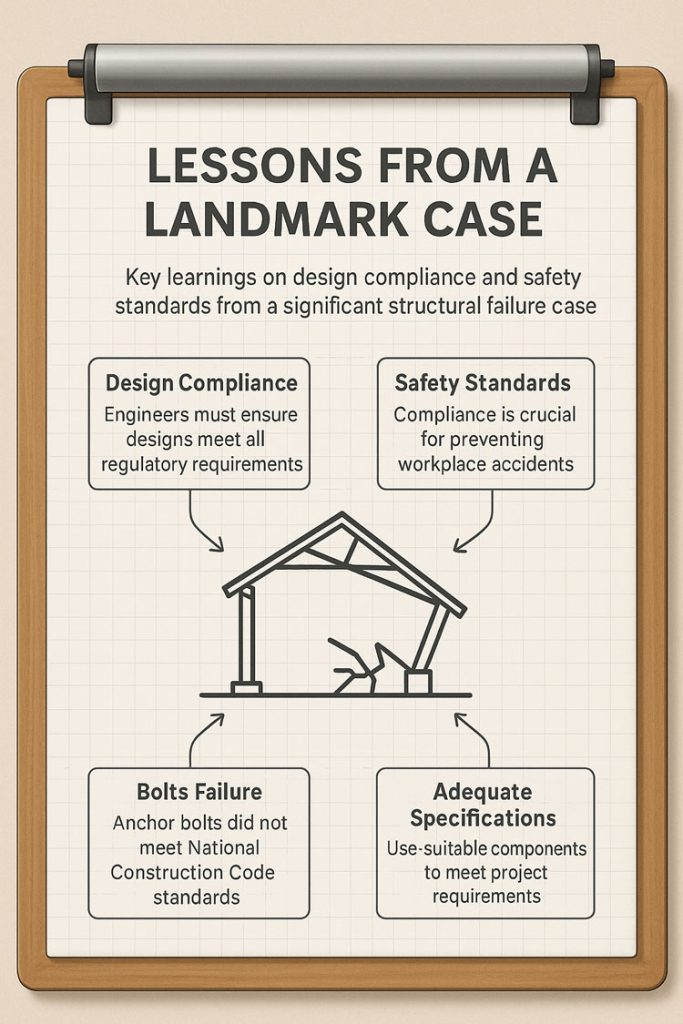
During roof sheeting works in late 2021, four of seven supporting columns of a cantilevered spectator roof failed, causing two apprentices to slide down the roof sheets. SafeWork SAโ€™s investigation found that the anchor bolts specified for the column base plates were inadequate and did not meet the requirements of the National Construction Code (NCC).

An independent compliance review also failed to detect this issue, allowing the error to pass unchecked into construction. The result was a collapse that could have had far more severe consequences had the roof been fully loaded or occupied.

Key Learnings for the Industry

This case underscores several important lessons for engineers, designers, project managers, and certifiers:

1. Design Responsibility Is a WHS Duty

Under the WHS Act, designers have a duty to ensure their work is safe not just in its intended use, but during construction. This means bolts, connections, and base plates must be designed for real-world loads โ€” including wind uplift, combined shear and tension, and concrete breakout limits per NCC and relevant Australian Standards.

2. Review Procedures Must Be Robust โ€” and Followed

Having a documented review procedure is not enough if it isnโ€™t rigorously applied. Independent verification and internal peer review are critical to catching design errors before they reach site.

3. Certification Is Not a Rubber Stamp

Independent certifiers play a key role in safeguarding public safety. They must actively verify that designs meet compliance, rather than simply sign off on documentation.

4. Time Pressures Can Compromise Safety

Compressed project timelines were noted as a factor in missed opportunities to catch the error. Project teams must resist the temptation to shortcut review steps when schedules are tight โ€” safety must remain non-negotiable.

5. Documentation & Traceability Protect Everyone

Maintaining calculation records, checklists, and review signoffs creates a clear audit trail. This helps demonstrate due diligence if something goes wrong.

Infographic titled โ€˜Lessons From a Landmark Caseโ€™ displayed on a clipboard. It highlights key learnings from a structural failure case: design compliance, safety standards, bolts failure, and adequate specifications. At the centre is a simple line drawing of a collapsed structure, with arrows pointing to four labelled boxes describing the importance of regulatory compliance, workplace safety standards, anchor bolt failures, and using suitable components to meet project requirements

Why This Matters

The collapse at Angaston Football Club was a relatively small incident with minor injuries โ€” but it could easily have been catastrophic. By learning from cases like this, the industry can improve its processes and prevent future failures.

As professionals, our role is to design for safety, verify rigorously, and document clearly. Doing so protects workers, end-users, and our own organisations.

Legal & Ethical Considerations

This post is intended as a learning resource, not as an allocation of blame. The case referenced is a matter of public record through SafeWork SA and SAET decisions, and all commentary here focuses on general principles of safe design and compliance.

We recommend that other practitioners review their own QA and certification procedures in light of this case to ensure compliance with the National Construction Code and WHS obligations.

More Information —> The Advertiser / Adelaide Now

Hamilton By Design logo displayed on a blue tilted rectangle with a grey gradient background

Mechanical Engineering | Structural Engineering

Mechanical Drafting | Structural Drafting

3D CAD Modelling | 3D Scanning

Chute Design

SolidWorks Contractors in Australia

Hamilton By Design โ€“ Blog

The Future of Smelting & Steelmaking:

Trends Shaping a Greener, Smarter Industry


Steel has been the backbone of industrial progress for over 150 years. It is the invisible framework behind our skyscrapers, bridges, transport systems, and modern cities. But the industry that gave us the Industrial Revolution is now facing one of the greatest transitions in its history. The combined pressures of climate change, regulatory scrutiny, fluctuating energy costs, and global trade realignments are forcing steelmakers to rethink how steel is made, used, and traded.

Recent news reports show a fascinating picture: a sector in the middle of transformation, experimenting with new technologies like hydrogen-based direct reduction, while still relying on traditional blast furnace smelting to meet soaring demand. In this article, we explore the future direction of the smelting and steelmaking industry, what challenges lie ahead, and where the biggest opportunities are likely to emerge.


The Push for Green Steel

Hydrogen & Direct Reduced Iron (DRI): A Pathway to Decarbonization

Hydrogen-based steel production remains the single most promising pathway for deep decarbonization in the steel sector. Instead of using metallurgical coal and coke to chemically reduce iron ore, hydrogen can be used to produce direct reduced iron (DRI) that can then be melted in an electric arc furnace (EAF). This dramatically cuts COโ‚‚ emissions, especially if the hydrogen is produced using renewable energy.

Projects like Salzgitterโ€™s Salcos program in Germany are leading the way. Salzgitter has been developing one of the most ambitious hydrogen-based steel transformation roadmaps in Europe, gradually phasing in hydrogen reduction units and retiring carbon-intensive blast furnaces. Similarly, Australiaโ€™s NeoSmelt initiative, backed by Rio Tinto and ARENA, is exploring a combination of DRI and electric smelting furnaces to create a pathway that works for Australian ore quality and energy markets.

But this transition is anything but smooth. Salzgitter has recently delayed later stages of its program, citing economic and regulatory headwinds, such as the high cost of hydrogen, uncertain carbon pricing, and the slow rollout of renewable energy infrastructure. This highlights a hard truth: the green transition will not be instant or cheap. The next decade will likely be defined by pilot projects, incremental scale-ups, and careful balancing between economic viability and climate commitments.


The Coal Paradox

Even as green steel makes headlines, metallurgical coal is seeing a surprising resurgence. Demand for coal-based blast furnace production remains robust, especially in China and India, where domestic infrastructure spending continues to grow. In fact, recent research from the Global Energy Monitor shows that coal-based capacity is still expanding, even as global climate targets call for steep reductions in emissions.

This paradox points to the transitional nature of the current era. For the foreseeable future, the world will be living in a dual-track steel economy: one track relying on traditional blast furnaces and coke ovens to meet near-term demand, and another experimenting with hydrogen, electric smelting, and alternative reduction technologies.

For businesses, this means they cannot simply abandon existing capacity overnight. Instead, expect to see retrofit investments to improve the efficiency of blast furnaces, capture more waste heat, and install carbon capture and storage (CCS) where feasible. This โ€œcleaner coalโ€ approach will act as a bridge until low-carbon technologies can compete at scale on cost and availability.


Regional Shifts & Strategic Investments

Australiaโ€™s Green Steel Ambitions

Australia is emerging as a key player in the global conversation on sustainable steelmaking. The country has vast high-grade iron ore resources, growing renewable energy capacity, and a strategic interest in maintaining domestic steelmaking capability.

  • BlueScopeโ€™s $1.15B blast furnace reline at Port Kembla is one of the largest industrial projects in the nationโ€™s history, designed to keep steel production secure for another 20 years. This investment shows that Australia is taking a pragmatic approach โ€” continuing to support blast furnace technology while planning for a green future.
  • The NeoSmelt project, which just secured nearly $20M in government funding, is a potential game-changer. It will explore how to combine renewable-powered hydrogen and electric furnaces to make a commercial-scale green steel process that works with Australian ore.
  • The potential takeover of Whyalla Steelworks by a consortium led by BlueScope could turn the plant into a testbed for low-emissions ironmaking, providing a national blueprint for decarbonizing heavy industry.

Global Trade & Policy Realignment

Meanwhile, trade policy is also shaping the future. The EU and U.S. have resumed talks to revisit steel and aluminium tariffs, with a focus on creating carbon-based trade measures. If implemented, this could reward producers who adopt low-carbon technologies while penalizing those that rely on high-emission processes. For global producers, this will accelerate investment in low-emissions capacity to stay competitive in export markets.


Innovation Beyond Furnaces

The transformation of steelmaking is not just about switching fuels โ€” itโ€™s about reimagining the entire production system.

  • Modular, low-emission smelting plants like those being developed in Western Australia by Metal Logic allow companies to build capacity closer to demand centers, reduce transport emissions, and scale production up or down as needed.
  • Digital twins and AI-driven process control are making smelting more efficient. By modeling every step of the steelmaking process, producers can optimize energy use, reduce material losses, and increase yield โ€” all of which improve profitability and lower emissions simultaneously.
  • Circular economy practices, such as increased use of scrap steel in EAFs, are becoming a central strategy. Recycling steel uses a fraction of the energy required to make virgin steel and fits neatly into the industryโ€™s sustainability narrative.

This convergence of physical and digital innovation will likely create a new generation of steel plants that are smaller, smarter, and cleaner than their 20th-century predecessors.


Where the Industry is Headed

Looking ahead, the future of smelting and steelmaking will be defined by hybridization, regulation, and resilience:

  • Hybrid production systems will dominate for at least the next decade. Expect blast furnaces to operate alongside hydrogen-based DRI units and electric smelters as companies transition gradually.
  • Stricter carbon regulations will push companies to adopt low-carbon pathways faster than market forces alone would dictate. Carbon border adjustment mechanisms (CBAMs) will effectively tax โ€œdirty steelโ€ in major economies, making investment in green capacity a competitive necessity.
  • Domestic capability building will remain critical. The COVID-era supply chain crises reminded governments why domestic production matters. Expect to see policies that support keeping steelmaking onshore, even if that requires subsidies or preferential procurement.
  • Collaborative innovation will become the norm. Mining giants, energy producers, and technology firms are already forming alliances to solve the โ€œgreen steel puzzle.โ€ This cross-industry collaboration will unlock new efficiencies and accelerate commercialization.

Final Thoughts

The smelting and steelmaking industry is standing at the crossroads of history. The coming years will test its ability to balance sustainability with profitability, scale with flexibility, and tradition with innovation.

Companies that embrace this challenge โ€” investing in low-carbon technology, digital transformation, and strategic partnerships โ€” will not just survive the coming disruption but thrive as leaders in a new, greener industrial age. Steel may be one of the oldest materials in human civilization, but its future is being forged right now, and it has never been more exciting.

References

Salzgitter Salcos Project

Global Energy Monitor โ€“ Steel Sector Reports

ARENA NeoSmelt Funding Announcement

Challenges in the Australian Smelting Industry