Building Sydney Smarter: How 3D Scanning and LiDAR Are Transforming Construction Accuracy

A New Era of Construction Accuracy in Sydney

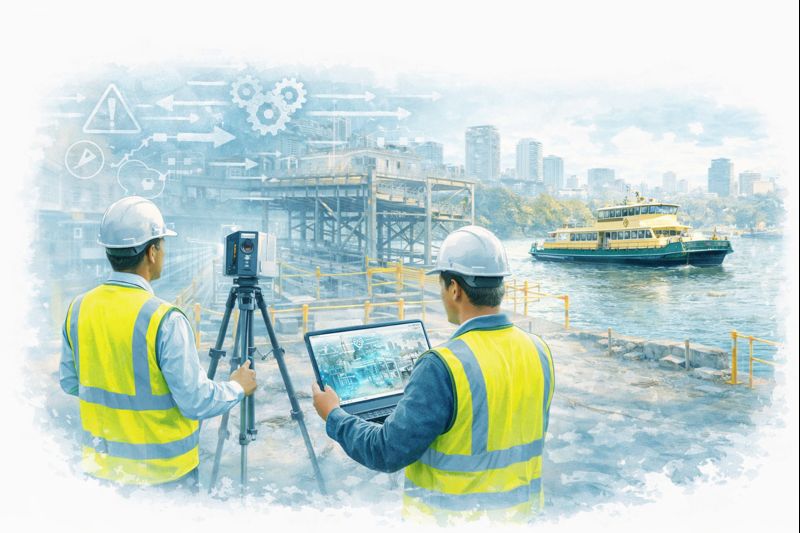
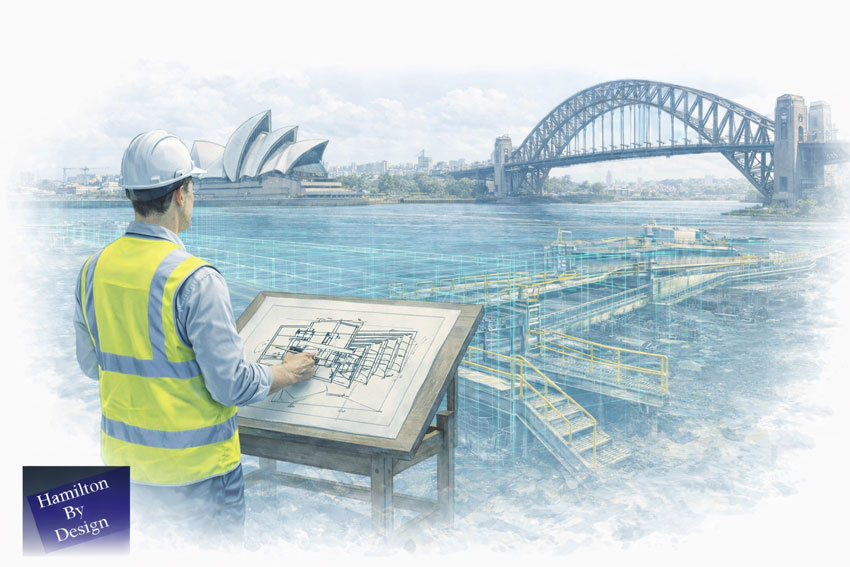
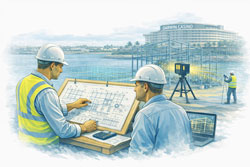
Sydney’s construction industry is booming — from commercial towers and infrastructure upgrades to industrial developments and complex refurbishments. But as sites become more congested and designs more complex, achieving perfect alignment between fabricated and installed components has never been more challenging.

That’s where 3D scanning and LiDAR technology come in. At Hamilton By Design, we provide high-precision digital capture and 3D modelling services that ensure every element of your construction project fits seamlessly together, saving time, cost, and effort onsite.


Capturing the Real Site with LiDAR Scanning

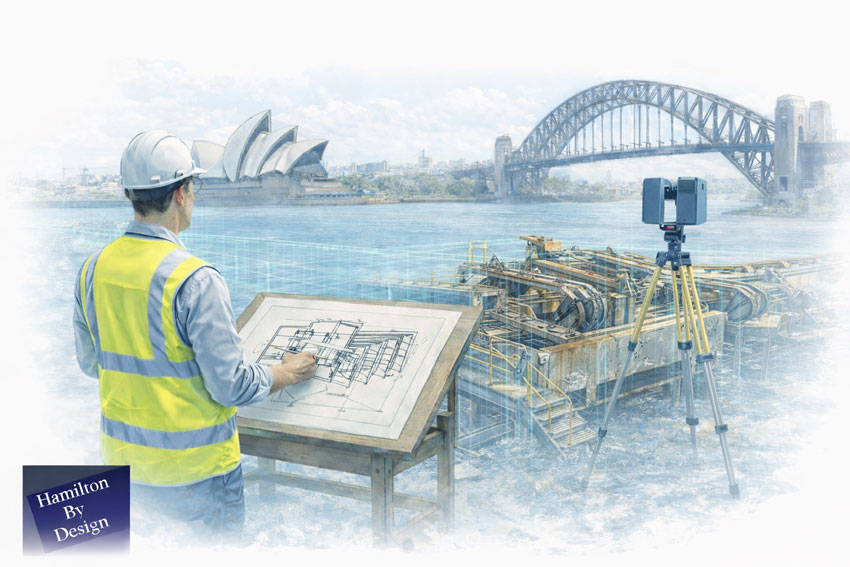
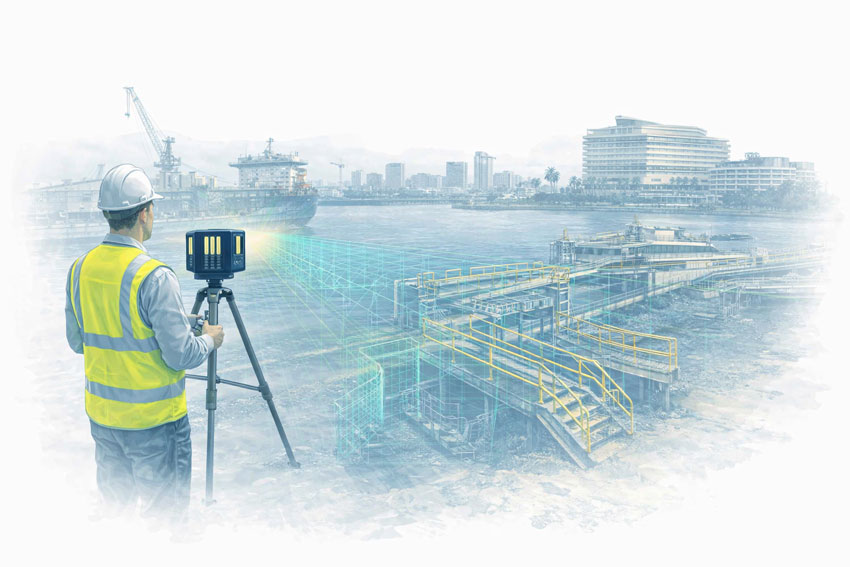
Using LiDAR (Light Detection and Ranging) scanners, we capture millions of laser measurements per second to create an exact 3D digital record — known as a point cloud — of your construction site or structure.

This means we can document existing conditions, monitor progress, and verify installations with millimetre-level precision. For Sydney builders, engineers, and contractors, that data eliminates the guesswork and drastically reduces costly clashes and rework later on.


From Point Cloud to 3D Model

Once the LiDAR data is captured, it’s processed into detailed 3D CAD and BIM models compatible with leading design software such as Revit, AutoCAD, SolidWorks, and Navisworks.

These accurate models allow design teams to:

  • Validate and update as-built conditions before fabrication
  • Detect clashes and misalignments before installation
  • Plan modifications and extensions with confidence
  • Coordinate between mechanical, structural, and architectural disciplines

By working from a true digital twin of your Sydney site, you can be sure every part — from prefabricated frames to pipe runs — will fit exactly where it should.


Why Sydney Construction Projects Are Turning to 3D Scanning

  • Reduced Rework: Identify design and fabrication issues before they reach site.
  • Improved Safety: Capture high or restricted areas without scaffolding or shutdowns.
  • Shorter Installation Times: Minimise downtime and delays during fit-up.
  • Precise Documentation: Maintain accurate records for QA and handover.
  • Better Collaboration: Integrate real-world data into your BIM environment.

From commercial fit-outs to infrastructure projects across Greater Sydney, 3D scanning provides a single source of truth for every stakeholder.


Typical Sydney Projects Using LiDAR and 3D Modelling

Hamilton By Design supports a range of construction and engineering clients, including:

  • Commercial and residential developments in the CBD and inner suburbs
  • Industrial plant upgrades across Western Sydney
  • Transport and infrastructure projects under NSW Government programs
  • Refurbishment and brownfield works requiring detailed as-built verification

Each project benefits from faster delivery, greater precision, and stronger communication between designers, builders, and clients.


Partner with Hamilton By Design

If you’re working on a Sydney construction or infrastructure project and need accurate 3D site data, as-built modelling, or fit-up verification, Hamilton By Design can help.

Our experienced mechanical and design specialists combine field scanning with advanced 3D modelling to deliver practical, reliable results that make construction smoother — and smarter.

Mechanical Engineers in Sydney

Hamilton By Design Logo www.hamiltonbydesign.com.au
Hamilton By Design logo displayed on a blue tilted rectangle with a grey gradient background

Mechanical Engineering | Structural Engineering

3D Scanning Sydney

Engineering Services

get in touch

sales@hamiltonbydesign.com.au

📍 Based in Sydney — working across NSW and Australia
📧 info@hamiltonbydesign.com.au
🌐 www.hamiltonbydesign.com.au

Capture. Model. Verify. Deliver — precision that builds Sydney better.

Why Millimeter Precision Matters

When you’re fabricating or installing mechanical, structural or piping components on site, even a small misalignment of a few millimeters can lead to costly rework, construction delays, and wasted resources.

That’s why “good enough” isn’t good enough. For modern projects — especially in mining, processing, retrofit, or shutdown environments — you need millimeter precision.

At Hamilton By Design, we combine LiDAR 3D scanning, advanced point-cloud processing, and robust 3D modelling to capture the exact as-built conditions of your site — delivering accurate, install-ready digital models that reduce risk and increase confidence.


Illustrated graphic showing millimetre precision in action using 3D scanning and LiDAR to verify a 1.8 mm fit-up, with digital drawings, 3D modelling, reduced rework, cost savings, and improved safety during structural alignment.

What Is LiDAR 3D Scanning — And Why It Gives True Precision

LiDAR (Light Detection and Ranging) uses laser-based scanning to generate detailed, high-density point cloud data that reflects the real-world geometry of your plant, structure or equipment. Traditional surveying and manual measurements can introduce errors and assumptions — but LiDAR captures actual surfaces, edges, and spatial relationships without guesswork. Hamilton By Design+2Measure Australia+2

With a properly calibrated LiDAR system and experienced processing, it’s possible to achieve high repeatability and precision, generating data that forms a reliable foundation for 3D CAD or BIM modelling. Measure Australia+1


From Scan to 3D Model: How We Turn Data into Build-Ready Accuracy

Once the LiDAR scan is complete, Hamilton By Design’s workflow transforms raw point-cloud data into intelligent 3D CAD models:

  • Clean and register the point cloud to remove noise or distortions
  • Rebuild accurate geometry (structural frames, piping, equipment surfaces)
  • Import into major CAD/BIM platforms (e.g. SolidWorks, AutoCAD, Revit, Plant 3D) for seamless integration with your design workflows Hamilton By Design
  • Perform clash detection, alignment checks, and clearance validation before fabrication
  • Generate fabrication-ready drawings and installation documentation

This digital-first workflow delivers confidence that what’s built in the shop will fit perfectly on site — first time.


Key Benefits of Millimeter-Precision LiDAR Scanning & 3D Modelling

  • True-to-site accuracy — Reduce guesswork; measure the real plant geometry. Fibrox 3D+1
  • Less rework, fewer delays — Early clash detection means fewer surprises during installation. Hamilton By Design
  • Faster turnaround — Rapid data capture, even in complex or hard-to-access zones. Fibrox 3D+1
  • Improved safety — Scan from a safe distance; limit time in hazardous environments. Hamilton By Design
  • Better coordination across disciplines — Mechanical, structural, and piping engineers all working from the same accurate model. Hamilton By Design

Who Benefits — Applications That Demand Precision

This level of accuracy is critical for:

  • Mining and mineral-processing plants (brownfield upgrades, retrofit)
  • Oil, gas, and energy facilities
  • Heavy manufacturing and industrial plants
  • Water and wastewater treatment plants
  • Shutdown / maintenance / upgrade projects with tight tolerances

No matter how complex the site or tight the installation requirements, LiDAR-based scanning + precise 3D modelling removes the guesswork. Hamilton By Design


Real-World Outcomes: What Clients Actually See

Clients who adopt our millimeter-precision workflow often report:

  • Up to 50% reduction in on-site rework
  • Faster install times and shorter shutdown windows
  • Smooth cross-discipline collaboration
  • Higher quality fabrication and installation finishes

By identifying spatial conflicts before procurement or fabrication, projects run smoother — saving time, materials, and risk. Hamilton By Design


Why “Millimeter Precision Through LiDAR Scanning” Is More Than Just a Buzzphrase

Some 3D scanning or survey methods capture approximate geometry — fine for rough layout, but insufficient for precision fabrication and fit-up.

With high-quality LiDAR scanning, proper registration, and careful modelling, we deliver real millimeter-level precision — the kind that avoids costly rework, ensures first-fit alignment, and delivers project certainty.

If your project demands this level of accuracy — whether for plant upgrades, mechanical fit-up, pipe spooling, structural retrofits or brownfield refurbishments — you need the reliability that only a LiDAR-based digital workflow can deliver.


Talk to Hamilton By Design: Get Millimeter-Accurate Data That Fits

If your next project needs tight tolerances, retrofit accuracy, or complex mechanical fit-ups, our team can help. Based in Australia but working nationwide — combining cutting-edge scanning tech with real-world engineering know-how.

Email: info@hamiltonbydesign.com.au
Website: www.hamiltonbydesign.com.au

Capture. Model. Design. Deliver — with millimeter precision, every time.

3D CAD Modelling | 3D Scanning

Hamilton By Design Logo www.hamiltonbydesign.com.au

Mechanical Engineering | Structural Engineering

Hamilton By Design

Bridging Reality and Design: How 3D Scanning + 3D Modelling Supercharge Mining Process Plants

In mining and mineral processing environments, small mis-fits, outdated drawings, or inaccurate assumptions can translate into shutdowns, costly rework, or worse, safety incidents. For PMs, superintendents, engineering managers and plants operating under heavy uptime and safety constraints, combining 3D scanning and 3D modelling isn’t just “nice to have” — it’s becoming essential. At Hamilton By Design, we’ve leveraged this combination to deliver greater predictability, lower cost, and improved safety across multiple projects.


What are 3D Scanning and 3D Modelling?

  • 3D Scanning (via LiDAR, laser, terrestrial/mobile scanners): captures the existing geometry of structures, equipment, piping, chutes, supports, tanks, etc., as a dense point cloud. Creates a digital “reality capture” of the plant in its current (often messy) state.
  • 3D Modelling: turning that data (point clouds, mesh) into clean, usable engineering-geometry — CAD models, as-built / retrofit layouts, clash-detection, wear mapping, digital twins, etc.

The power comes when you integrate the two — when the reality captured in scan form feeds directly into your modelling/design workflows rather than being a separate survey activity that’s then “interpreted” or “assumed.”


Why Combine Scanning + Modelling? Key Benefits

Here are the main advantages you get when you deploy both in an integrated workflow:

BenefitWhat it Means for PMs / Engineering / Plant OpsExamples / Impacts
Accuracy & Reality VerificationVerify what’s actually in the plant vs what drawings say. Identify deformations, misalignments, wear, obstructions, or changes that weren’t captured in paper drawings.Mill liner wear profiles; chute/hopper buildup; misaligned conveyors or supports discovered post-scan.
Reduced Risk, Safer AccessScanning can be done with limited or no shutdown, and from safer vantage points. Less need for personnel to enter hazardous or confined spaces.Scanning inside crushers, under conveyors, or at height without scaffolding.
Time & Cost SavingsFaster surveying; fewer repeat field trips; less rework; fewer surprises during shutdowns or retrofit work.Scan once, model many; clashes found in model instead of in the field; pre-fabrication of replacement parts.
Better Shutdown / Retrofit PlanningUse accurate as-built models so new equipment fits, interferences are caught, installation time is optimized.New pipelines routed without conflict; steelwork/supports prefabricated; shutdown windows shortened.
Maintenance & Asset Lifecycle ManagementScan history becomes a baseline for monitoring wear or deformation. Enables predictive maintenance rather than reactive.Comparing scans over time to track wear; scheduling relining of chutes; monitoring structural integrity.
Improved Decision Making & VisualisationEngineers, superintendents, planners can visualise the plant as it is — space constraints, access routes, clearances — before making decisions.Clash-detection between new and existing frames; planning maintenance access; safety audits.
Digital Twin / Integration for Future-Ready PlantOnce you have accurate geometric models you can integrate with IoT, process data, simulation tools, condition monitoring etc.Digital twins that simulate flow, energy use, wear; using scan data to feed CFD or FEA; feeding into operational dashboards.

Challenges & How to Overcome Them

Of course, there are pitfalls. Ensuring scanning + modelling delivers value requires attention to:

  • Planning the scanning campaign (scan positions, control points, resolution) to avoid shadow zones or missing data.
  • Choosing hardware and equipment that can operate under plant conditions (dust, vibration, temperature, restricted access).
  • Processing & registration of point clouds, managing the large data sets, and ensuring clean, usable models.
  • Ensuring modelling workflow aligns with engineering design tools (CAD systems, formats, tolerances) so that the scan data is usable without excessive cleanup.
  • Maintaining the model: when plant layouts or equipment change, keeping the scan or model up to date so your decisions are based on recent reality.

At Hamilton By Design we emphasise these aspects; our scan-to-CAD workflows are built to align with plant engineering needs, and we help clients plan and manage the full lifecycle.


Real World Applications in Mining & Process Plants

Here’s how combined scanning + modelling is applied (and what you might look for in your own facility):

  • Wear & Relining: scanning mill, crusher liners, chutes or hoppers to model wear profiles; predict failures; design replacement parts that fit exactly.
  • Retrofits & Expansions: mapping existing steel, pipe racks, conveyors, etc., creating accurate “as built” model, checking for clashes, optimizing layouts, prefabricating supports.
  • Stockpile / Volumetric Monitoring: using scans or LiDAR to measure stockpile volumes for planning and reporting; integrating with models to monitor material movement and flow.
  • Safety & Clearance Checking: verifying that walkways, egress paths, platforms have maintained their clearances; assess structural changes; check for deformation or damage.
  • Shutdown Planning: using accurate 3D models to plan the scope, access, scaffold/frame erection, pipe removal etc., so shutdown time is minimised.

Why Choose Hamilton By Design

To get full value from the scan + model combination, you need more than just “we’ll scan it” or “we’ll make a model” — you need a partner who understands both the field realities and the engineering rigour. Here’s where Hamilton By Design excels:

  • Strong engineering experience in mining & processing plant settings, so we know what level of detail, what tolerances, and what access constraints matter.
  • Proven tools & workflows: from LiDAR / laser scanner work that captures site conditions even under harsh conditions, to solid CAD modelling/reporting that aligns with your fabrication/installation requirements.
  • Scan-to-CAD workflows: not just raw point clouds, but models that feed directly into design, maintenance, procurement and operations.
  • Focus on accuracy, safety, and reduced downtime: ensuring that field work, design, installation etc., are as efficient and risk-averse as possible.
  • Use of modern digital techniques (digital twins, clash detection etc.) so that data isn’t just stored, but actively used to drive improvements.

Practical Steps to Get Started / Best Practice Tips

If you’re managing a plant or engineering project, here are some steps to adopt scanning + modelling optimally:

  1. Define Clear Objectives: What do you want from this scan + model? Wear profiles, retrofit, layout changes, safety audit etc.
  2. Survey Planning: Decide scan positions, control points, resolution (density) based on the objectives and site constraints. Consider access, safety, shutdown windows.
  3. Use Appropriate Hardware: Choose scanners suited to environment (dust, heat), also ensure regulatory and IP protection etc.
  4. Data Processing & Modelling Tools: Have the capacity/software to register, clean, mesh or extract CAD geometry.
  5. Integrate into Existing Engineering Processes: Ensure the outputs are compatible with your CAD standards, procurement, installation etc.
  6. Iterate & Maintain: Frequent scans over time to track changes; update models when plant changes; feed maintenance, design and operations with new data.

Conclusion

In mining process plants, time, safety, and certainty matter. By combining 3D scanning with sound 3D modelling you don’t just get a snapshot of your plant — you gain a powerful toolset to reduce downtime, avoid rework, improve safety, and enhance decision-making.

If you’re responsible for uptime, capital works, maintenance or process improvements, this integration can reshape how you plan, maintain, and operate. At Hamilton By Design, we’re helping clients in Australia harness this power — turning reality into design confidence, and giving stakeholders peace of mind that the layout, equipment, and safety are aligned not to yesterday’s drawings but to today’s reality.

AutoCAD Is Still in the 1980s — Gasping for Air in a 3D World

In the 1980s, AutoCAD was revolutionary. It replaced drafting boards and sharpened pencils with a digital drawing tool. Architects, engineers, and designers suddenly had a new way to bring ideas to life — faster, cleaner, and more accurate than ever before.

But here’s the problem: it’s 2025 now, and AutoCAD is still trying to breathe the same thin air it did back then.

Illustrated comparison showing traditional mechanical engineering on one side and modern digital engineering on the other, with the Sydney Harbour Bridge and Opera House in the background, highlighting themes of maintenance, safety, reliability, simulation, digital twins, and innovation.

Stuck in 2D While the World Moved On

Today’s engineering isn’t about drawing — it’s about designing.
It’s about simulating real-world forces, visualizing assemblies, testing tolerances, and producing manufacturable parts before a single prototype is built.

AutoCAD, at its core, is still a 2D drafting platform trying to wear a 3D mask. The workflows are fragmented, the feature set feels patched together, and it lacks the intelligence modern teams demand.

By contrast, SOLIDWORKS was built for this century — fully parametric, model-driven, and collaborative. When you make a change to a design in SOLIDWORKS, every part, drawing, and assembly updates instantly. That’s not an upgrade; that’s evolution.


Design Needs Intelligence, Not Layers

AutoCAD still asks you to think in layers and lines — the language of draftsmen.
SOLIDWORKS speaks the language of relationships, assemblies, and constraints — the language of engineers and innovators.

Modern design tools must integrate simulation, visualization, and manufacturability. They must predict behavior, test fit, and optimize before production. AutoCAD just can’t breathe in that environment anymore — it’s stuck flipping between tabs while SOLIDWORKS users are already printing parts.


Collaboration and Data: The New Oxygen

The world doesn’t design in isolation anymore. Teams are global, deadlines are tighter, and innovation cycles are shorter.
AutoCAD’s file-based approach is like passing blueprints across a fax machine.

SOLIDWORKS integrates cloud data management, real-time collaboration, and digital twin technology — letting design teams iterate and innovate in real time, anywhere in the world.


The Future Is 3D — and It’s Already Here

You wouldn’t build an electric vehicle using a typewriter.
So why design modern products with 1980s software?

SOLIDWORKS represents the present and the future — intelligent modeling, simulation-driven design, and integrated manufacturing tools that push boundaries instead of tracing them.

Humorous comparison illustration showing outdated AutoCAD workflows from 1984 versus modern SolidWorks 2025 with smart parametric assembly, simulation, and advanced design automation

Final Thoughts

AutoCAD made history — no one can deny that. But history belongs in the museum, not the manufacturing floor.

If your software is still gasping for air in a 2D world, maybe it’s time to give it a well-earned retirement.
SOLIDWORKS doesn’t imitate innovation — it defines it.

Mechanical Engineers in Sydney

what would the Alternative text for the attached image
www.hamiltonbydesign.com.au

3D Scanning Sydney

Engineering Services

Engineering Confidence: Using FEA to Validate Real-World Designs

Mechanical engineering has always been a balance between creativity and certainty.
Every bracket, frame, chute, or structural support we design must perform under real loads, temperatures, and conditions — often in environments where failure simply isn’t an option.

That’s where Finite Element Analysis (FEA) earns its place as one of the most powerful tools in modern design. It allows engineers to move from assumption to verification — transforming the way we predict, test, and optimise mechanical systems.


What Is FEA — and Why It Matters

FEA divides complex geometry into a network of small, interconnected elements.
By solving the physical equations that govern stress, strain, and displacement across those elements, engineers can predict how a structure behaves under load, vibration, or temperature.

Instead of relying solely on hand calculations or over-built safety factors, FEA provides quantitative insight into performance — letting us see where structures flex, where stress concentrates, and how design choices affect real-world outcomes.

In mechanical engineering, that means fewer prototypes, lower material costs, and far greater design confidence.


1. Static Analysis — The Foundation of Structural Validation

Static linear analysis is the foundation of most FEA work.
It evaluates how a structure responds to steady, time-independent loads such as gravity, pressure, or fixed equipment weight.

Through static analysis, engineers can:

  • Visualise stress and displacement distribution across a part or assembly.
  • Evaluate safety factors under different loading conditions.
  • Check stiffness and material utilisation before fabrication.
  • Identify weak points or stress concentrations early in design.

This baseline validation is the difference between a design that “should” work and one that will.


2. Assembly-Level Simulation — Seeing the Whole System

Few machines fail because a single part breaks.
Most failures happen when components interact under load — bolts shear, brackets twist, or welds experience unplanned tension.

FEA allows engineers to simulate entire assemblies, including:

  • Contact between parts (bonded, sliding, or frictional).
  • Realistic boundary conditions such as bearings, springs, or pinned joints.
  • The influence of welds, fasteners, or gaskets on overall performance.

This system-level view helps mechanical engineers design not only for strength, but also for compatibility and reliability across the full structure.


3. Mesh Control — Accuracy Where It Counts

A simulation is only as good as its mesh.
By controlling element size and density, engineers can capture critical detail in stress-sensitive regions like fillets, bolt holes, and weld toes.

Modern FEA tools use adaptive meshing — refining the model automatically in areas of high stress until the solution converges.
That means precise, efficient results without excessive computation time.


4. Thermal-Structural Interaction — When Heat Becomes a Load

Many mechanical systems face thermal as well as mechanical challenges.
Whether it’s ducting in a process plant or hoppers near heat sources, temperature gradients can cause expansion, distortion, or thermal stress.

FEA allows engineers to:

  • Model steady-state or transient heat transfer through solids.
  • Apply convection, radiation, or temperature boundary conditions.
  • Combine thermal and structural analyses to study thermal expansion and thermal fatigue.

Understanding how heat and load combine helps ensure equipment remains stable, safe, and accurate throughout its lifecycle.


5. Modal and Buckling Analysis — Designing Against Instability

Some risks are invisible until they’re simulated.
Vibration and buckling are two of the most overlooked — yet most common — causes of structural failure.

Modal Analysis

Determines a structure’s natural frequencies and mode shapes, helping designers avoid resonance with operating machinery, fans, or conveyors.

Buckling Analysis

Predicts the critical load at which slender members or thin-walled panels lose stability — allowing engineers to reinforce and optimise designs early.

By identifying these limits before fabrication, engineers can prevent problems that are expensive and dangerous to discover on site.


Design Optimisation — Smarter, Lighter, Stronger

Good design is rarely about adding material; it’s about using it wisely.
FEA supports parametric and goal-based optimisation, enabling engineers to vary geometry, thickness, or material and automatically test multiple configurations.

You can set objectives such as:

  • Minimising weight while maintaining strength.
  • Reducing deflection under fixed loads.
  • Optimising gusset or flange size for stiffness.

This process of “digital lightweighting” drives better performance and cost efficiency — especially valuable in industries where both material and downtime are expensive.


7. Communication and Confidence

FEA isn’t only a calculation tool — it’s a communication tool.
Colour-coded plots, animations, and automated reports make it easier to explain complex mechanical behaviour to project managers, clients, or certifying bodies.

Clear visuals turn stress distributions and displacement fields into a shared language — helping stakeholders understand why certain design choices are made.


Real-World Applications Across Mechanical Engineering

ApplicationType of AnalysisKey Benefit
Chutes & HoppersStatic + BucklingConfirm wall thickness and frame design for structural load and vibration
Conveyor FramesModal + StaticAvoid resonance and ensure adequate stiffness
Pressure EquipmentThermal + StaticEvaluate thermal stress and hoop stress under load
Machine BracketsStatic + OptimisationReduce weight while maintaining rigidity
Platforms & GuardingBucklingValidate stability under safety loading
Welded Frames & SupportsStaticCheck deformation, stress, and weld performance

These examples show how FEA becomes an everyday design partner — embedded in the workflow of mechanical engineers across manufacturing, resources, and infrastructure.


The Engineer’s Advantage: Data Over Assumption

In traditional design, engineers often relied on prototypes and conservative safety factors.
Today, simulation delivers the same assurance — without the waste.

By applying FEA early in the design cycle, mechanical engineers can:

  • Predict failure modes before they occur.
  • Shorten development time.
  • Reduce material usage.
  • Justify design decisions with quantitative proof.

FEA enables engineers to focus less on guesswork and more on innovation — designing structures that are both efficient and dependable.


Engineering Integrity in Practice

At Hamilton By Design, we integrate FEA into every stage of mechanical design and development.
It’s how we ensure that every frame, chute, and mechanical system we deliver performs as intended — safely, efficiently, and reliably.

We use FEA not just to find the limits of materials, but to push the boundaries of design quality — delivering engineering solutions that last in the toughest industrial environments.

Design backed by data isn’t a slogan — it’s how we engineer confidence.


Building a Culture of Verified Design

When FEA becomes part of everyday engineering culture, it changes how teams think.
Designers begin to see structures not just as drawings, but as living systems under real forces.

That shift builds trust — between engineer and client, between concept and reality.
It’s what defines the future of mechanical design: informed, optimised, and proven before the first bolt is tightened.

From 3D Scanning to Digital Twins: The Next Step in Mining Data

Mining is evolving faster than ever.
What was once an industry defined by physical muscle — haul trucks, crushers, conveyors — is now being transformed by data intelligence, digital modelling, and real-time insight.

At the heart of this transformation lies a quiet revolution: 3D scanning.
Once used primarily for design verification or plant modification, scanning is now the gateway technology that feeds the emerging world of digital twins — live, data-driven replicas of mine assets that help engineers predict, plan, and optimise before problems occur.

At Hamilton By Design, we’ve spent years scanning and modelling chutes, hoppers, and material-handling systems across Australia’s mining sector. Each project has shown us one thing clearly:

Scanning isn’t just about geometry — it’s about knowledge.
And digital twins are the next logical step in turning that knowledge into action.


What Exactly Is a Digital Twin?

Think of a digital twin as the digital counterpart of a physical asset — a chute, a conveyor, a processing plant, even an entire mine site.

It’s not a static 3D model; it’s a dynamic, data-linked environment that mirrors the real system in near real time.
Sensors feed performance data into the twin: wear rates, temperature, vibration, flow speed, throughput. The twin then responds, updating its state and allowing engineers to simulate scenarios, forecast failures, and test design changes before touching the physical equipment.

In essence, a digital twin gives you a real-time window into the life of your assets — one that’s predictive, not reactive.


How 3D Scanning Powers the Digital Twin

To create a digital twin, you first need an accurate foundation — and that’s where 3D scanning comes in.
The twin can only be as good as the geometry beneath it.

Laser scanning or LiDAR technology captures millimetre-accurate measurements of chutes, hoppers, crushers, conveyors, and processing structures.
This creates a precise 3D “as-is” model — not what the plant was designed to be, but what it actually is after years of wear, repair, and modification.

That baseline geometry is then aligned with:

  • Operational data from sensors and PLCs (e.g. flow rates, temperatures, vibrations)
  • Material behaviour data from CFD and wear simulations
  • Design intent data from CAD and engineering archives

Once these layers are synchronised, the model becomes a living system — continuously updated, measurable, and comparable to its physical twin.

You can see how we capture and prepare that foundation in our detailed article:
3D Scanning Chutes, Hoppers & Mining


From Reactive Maintenance to Predictive Performance

In most operations today, maintenance still works on a reactive cycle — wait for a fault, shut down, repair, restart.
It’s expensive, unpredictable, and risky.

With digital twins, that model flips.
Instead of waiting for wear to become a failure, the twin uses real-time and historical data to forecast when parts will reach their limits.
The result is predictive maintenance — planning shutdowns based on evidence, not emergency.

Imagine being able to simulate how a chute will behave under new flow conditions, or when a liner will reach its critical wear thickness, before you commit to a shutdown.
That’s not future-speak — it’s what forward-thinking operators are doing right now.

Every hour of avoided downtime can mean tens or even hundreds of thousands of dollars saved.
Even a modest 5 % reduction in unplanned outages can add millions to annual output.


Integrating Scanning, Simulation, and Sensors

A full digital-twin workflow in mining usually includes four steps:

  1. Capture: 3D scanning provides the exact geometry of the asset.
  2. Model: Engineers integrate the geometry with CAD, CFD, and FEA models.
  3. Connect: Real-time data from sensors is linked to the model.
  4. Predict: Algorithms and engineers analyse the twin to predict future performance.

The power lies in connection.
Each new scan or dataset strengthens the model, improving its predictive accuracy. Over time, the digital twin evolves into a decision-support system for engineers, planners, and maintenance teams.


Real-World Applications Across the Mining Value Chain

1. Chute & Hopper Optimisation

Flow issues, blockages, and uneven wear can be modelled digitally before modifications are made.
This reduces trial-and-error shutdowns and improves throughput reliability.

2. Conveyor Alignment

Scanning allows engineers to identify misalignment over kilometres of belting.
A digital twin can then simulate tracking and tension to prevent belt failures.

3. Crusher and Mill Wear

By combining periodic scans with wear sensors, operators can visualise material loss and forecast replacement schedules.

4. Structural Monitoring

3D scanning enables long-term comparison between “as-built” and “as-maintained” geometry, detecting distortion or settlement early.

Each of these applications reinforces a core insight:

The line between mechanical engineering and data engineering is disappearing.


Why Digital Twins Matter for Australia’s Mining Future

Australia’s competitive advantage has always been resource-based.
But the next advantage will be knowledge-based — how well we understand, model, and optimise those resources.

Digital twins represent that shift from raw extraction to engineering intelligence.
They help miners lower costs, reduce emissions, and improve safety, while extending asset life and reliability.

As Australia pushes toward decarbonisation and productivity targets, technologies like scanning and digital twinning will underpin the next generation of sustainable mining design.


The Hamilton By Design Approach

Our philosophy is simple: technology only matters if it serves engineering integrity.
That’s why our process always begins with real-world problems — not software.

  1. Field Capture: We conduct high-resolution 3D scans under live or shutdown conditions.
  2. Engineering Integration: Our designers and mechanical engineers turn that data into usable CAD and FEA models.
  3. Digital Twin Setup: We connect the digital model to operational data, creating a living reference that evolves with the asset.
  4. Continuous Support: We monitor, re-scan, and update as assets change.

This approach ensures every digital twin remains a tool for decision-making, not just a visualisation exercise.


A Connected Knowledge Chain

This article builds on our earlier discussion:


Digital Precision in Mining: How 3D Scanning Transforms Maintenance, Design, and Safety

That piece explored how scanning replaces manual measurement with safe, precise, data-rich modelling.
Digital twins take that same data and carry it forward — connecting it to predictive insights and automated planning.

The flow looks like this:

3D Scan → Model → Digital Twin → Predict → Improve → Re-scan

Each loop makes the operation smarter, safer, and more efficient.


Lessons from Global Mining Leaders

  • Rio Tinto and BHP are already trialling digital twins for rail networks, conveyors, and entire processing plants.
  • Anglo American uses twin models to monitor tailings dam integrity, integrating LiDAR scans with geotechnical sensors.
  • Fortescue has explored twin-based predictive maintenance for haulage and fixed plant systems.

Internationally, countries like Finland and Canada have established digital-twin testbeds for mine ventilation, environmental monitoring, and process control — demonstrating that twinning isn’t a luxury, it’s a competitive necessity.


Looking Forward: The Road to Real-Time Mines

The next decade will see digital twins move from project pilots to enterprise-wide ecosystems.
Future systems will integrate:

  • IoT sensors streaming continuous data
  • AI algorithms identifying anomalies in real time
  • Augmented-reality tools allowing operators to “see” the twin overlaid on the physical plant

Combined, these will make mines safer, cleaner, and more efficient — driven by data instead of downtime.


The Broader Economic Story

The technology’s value doesn’t stop at the mine gate.
As digital twins become standard across energy, infrastructure, and manufacturing, Australia’s engineering capability grows alongside GDP.

Every dollar invested in scanning and twin development creates long-term dividends in productivity and sustainability.
By connecting our data and design skills to resource industries, we strengthen both our domestic economy and our global competitiveness.


Building Smarter, Safer, and More Predictable Mines

Mining will always be a physically demanding industry — but its future will be defined by how intelligently we manage that physicality.

From the first laser scan to the fully connected digital twin, every step tightens the link between information and performance.

At Hamilton By Design, we’re proud to stand at that intersection — where mechanical precision meets digital innovation.
We help our clients not just capture data, but understand it — turning measurements into models, and models into insight.

Because when you can see your mine in full digital clarity, you can shape its future with confidence.

Mechanical Engineering | Structural Engineering

Mechanical Drafting | Structural Drafting

3D CAD Modelling | 3D Scanning

Chute Design

SolidWorks Contractors in Australia

Hamilton By Design – Blog

Custom Designed – Shipping Containers

Coal Chute Design

Mechanical Engineers in Sydney