


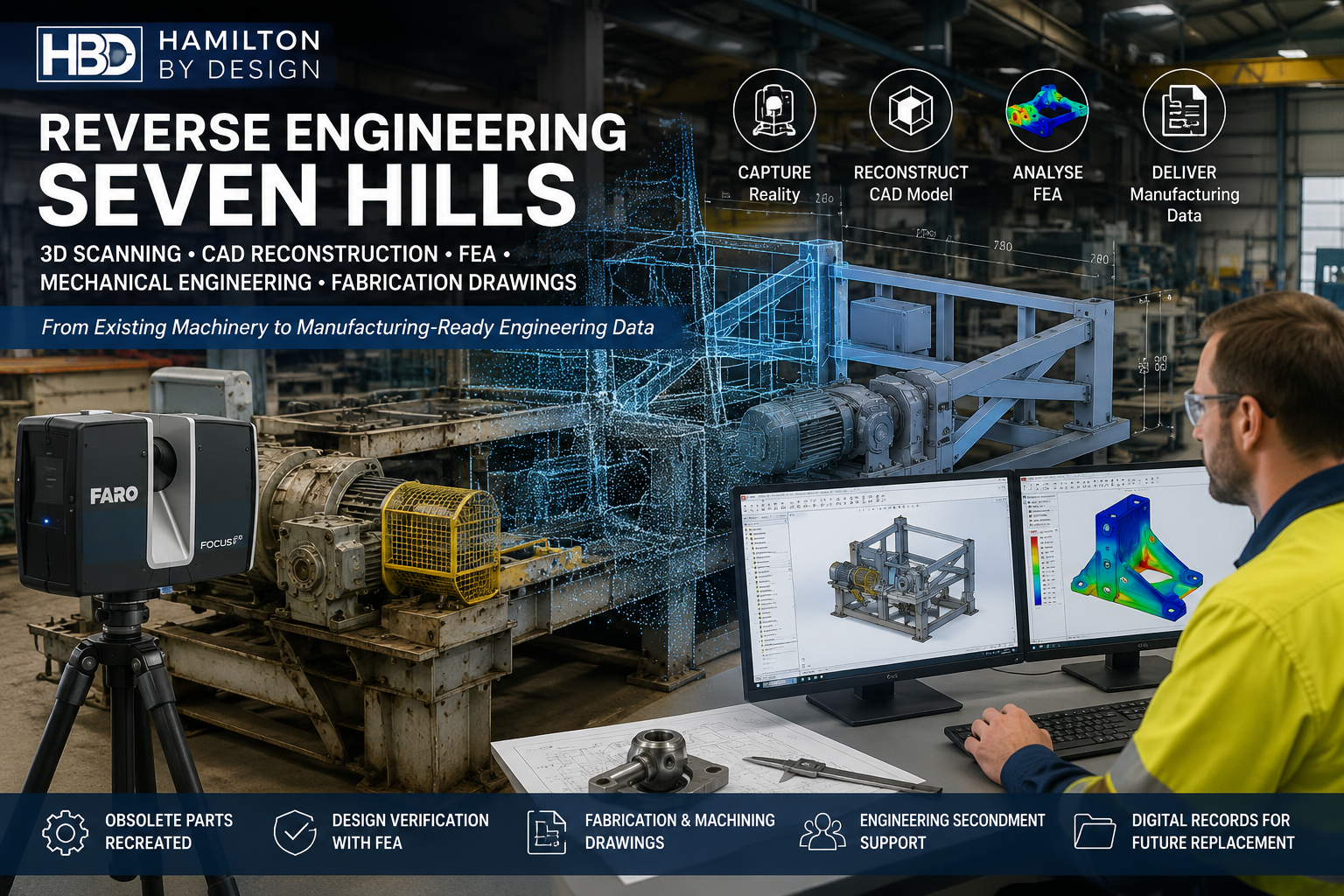

Seven Hills and Kings Park form an established Western Sydney industrial area supporting manufacturing, machinery, plastics, packaging, metal fabrication and industrial equipment businesses. Within these environments, one recurring engineering challenge is older machinery that remains essential to production even though the drawings, CAD models or original equipment manufacturer support are no longer available.
Hamilton By Design provides reverse engineering in Seven Hills and Kings Park, helping manufacturers convert existing machinery and components into practical digital engineering information that can support repair, replacement, modification and future manufacture.
The process can extend well beyond simply scanning a component. Through Reverse Engineer 3D Scanning, mechanical engineering, CAD reconstruction, fabrication drawings and finite element analysis, an undocumented physical asset can be converted into a reusable engineering record.
For manufacturers dealing with obsolete equipment, damaged components or machinery that has been modified over many years, this can provide an important alternative to relying on drawings that may no longer represent the equipment operating on the factory floor.
When the Machine Becomes the Engineering Record
One of the biggest problems with established industrial machinery is that the physical equipment can eventually become the only reliable record of its geometry.
A machine may have been installed 20 or 30 years ago. During its operating life, bearings may have been replaced, frames reinforced, guards modified, motors changed and locally fabricated components introduced. Even where original drawings remain available, the installed machine may now differ substantially from those documents.
This creates uncertainty when a component fails.
A maintenance or engineering team may need to know:
- the original component dimensions;
- critical mounting interfaces;
- shaft and bearing locations;
- hole patterns and centres;
- existing clearances;
- plate thicknesses;
- machinery envelopes;
- material requirements;
- whether a damaged component has distorted or worn;
- whether a proposed replacement should simply copy the existing part or improve upon it.
Hamilton By Design’s 3D Laser Scanning services can assist in capturing existing machinery and its surrounding environment before detailed engineering begins.
Reverse Engineering Machinery and Replacement Components
Reverse engineering involves more than producing a surface mesh.
The objective is to understand the physical component and reconstruct useful engineering geometry from it.
Depending on the project, this may involve a combination of 3D scanning, conventional measurement, inspection of existing drawings and engineering interpretation.
Typical components may include:
- machine frames;
- bearing housings;
- brackets;
- guards;
- shafts;
- fabricated assemblies;
- conveyor equipment;
- machine bases;
- chutes and transfer components;
- covers and enclosures;
- equipment supports;
- obsolete replacement parts.
For larger installed machinery, scanning can also capture neighbouring equipment, structural steel, floors, conveyors, pipework and access systems. This becomes important when a replacement component needs to fit within an existing production environment.
Rather than designing from assumed dimensions, the engineer can work from captured existing-condition information.
From 3D Scan to SolidWorks CAD Model
A scan represents measured surface geometry. For manufacturing and mechanical design, however, the more valuable deliverable is often a reconstructed parametric CAD model.
Hamilton By Design can use the captured information to develop models suitable for subsequent engineering work.
This may include recreating:
- nominal plate geometry;
- machined surfaces;
- shafts and bores;
- bolt patterns;
- fabricated weldments;
- equipment interfaces;
- mounting arrangements;
- assemblies and subassemblies.
The distinction between measured geometry and design intent is particularly important.
For example, if a shaft currently measures slightly below its expected diameter, that does not automatically mean the replacement should reproduce the worn diameter. Likewise, a distorted bracket, elongated hole or worn bearing surface should not necessarily be reproduced exactly as scanned.
Mechanical engineering judgement is required to determine what should be retained, what represents wear and what should be returned to an appropriate nominal condition.
Hamilton By Design’s broader Mechanical Engineering Consulting capability allows reverse engineering to progress from geometry capture into practical equipment design and modification.
FEA Services for Reverse-Engineered Components
This is where reverse engineering can become considerably more valuable than simply copying a part.
If an existing component has cracked, bent, failed repeatedly or is being modified, reproducing the same geometry may simply reproduce the same problem.
Finite element analysis can be incorporated into the engineering workflow to investigate how a component responds to applied loads.
Depending on the equipment and available design information, FEA may be used to consider:
- stress;
- strain;
- displacement;
- factor of safety;
- fatigue behaviour;
- buckling;
- contact behaviour;
- structural stiffness;
- revised plate thicknesses;
- alternative reinforcement arrangements.
A useful engineering sequence may therefore be:
existing component → scan → CAD reconstruction → FEA → design modification → fabrication drawing → replacement component
This is particularly relevant where a client wants to understand whether a redesigned component represents an improvement rather than simply manufacturing another copy of an existing failure.
Hamilton By Design’s FEA services can complement reverse engineering by allowing reconstructed machinery components and proposed modifications to be assessed before fabrication.
For Seven Hills and Kings Park manufacturers, this creates a single engineering pathway from existing-condition capture through to mechanical assessment and manufacturing documentation.
Machinery Modifications and Plant Upgrades
Reverse engineering is equally useful when equipment has not failed but needs to be changed.
Manufacturing businesses continually modify equipment in response to new products, increased throughput, maintenance requirements and changes in production processes.
A project may involve:
- replacing a motor or gearbox;
- modifying a conveyor;
- changing a machine frame;
- installing a new actuator;
- increasing equipment capacity;
- adding sensors;
- modifying product guides;
- introducing new access arrangements;
- redesigning machine guarding.
By capturing the machinery in its actual installed condition, modifications can be developed around the real equipment rather than relying solely on historical drawings.
This can help identify interfaces and potential clashes before components reach the workshop or installation site.
Machine Guarding During Equipment Modifications
Older machinery may also have guarding that has been altered repeatedly throughout its operating life.
When machinery is being reverse engineered or modified, there is an opportunity to consider guarding as part of the broader mechanical design.
This may include fixed guards, belt and pulley guards, coupling guards, rotating-shaft protection, mesh enclosures, perimeter guarding and maintenance-access arrangements.
Integrating guarding into the CAD model allows the relationship between the machine, operator access, maintenance requirements and surrounding equipment to be considered together rather than treating guarding as an afterthought.
Australian Design and Drafting Support
A reverse-engineering project only creates real manufacturing value when the captured information is converted into documentation that a workshop, fabricator or machining contractor can use.
Hamilton By Design’s Australian Design Drafting Services provide a natural continuation of the reverse-engineering process.
Depending on the project, deliverables may include:
- SolidWorks models;
- STEP files;
- Parasolid files;
- fabrication drawings;
- machining drawings;
- assembly drawings;
- bills of materials;
- DXF cutting profiles;
- DWG files;
- PDF drawing packages.
The drafting service can also support machinery modifications, structural steel supports, access platforms and other plant changes associated with the equipment.
For a client, the objective is not merely to obtain an impressive point cloud. It is to receive engineering information that can be used to procure, manufacture, install and maintain equipment.
Engineering Secondment Services for Seven Hills Manufacturers
Not every manufacturing business requires an external consultant to complete an entire engineering project.
Some organisations already have plant engineers, maintenance personnel and project managers but need additional engineering capacity during busy periods.
Hamilton By Design’s Engineering Secondment Services provide another way to support Seven Hills, Kings Park and Western Sydney manufacturers.
Secondment may suit:
- plant upgrades;
- shutdown preparation;
- equipment replacement programs;
- drawing backlogs;
- reverse-engineering programs;
- project engineering workloads;
- site verification;
- CAD modelling requirements;
- fabrication documentation;
- temporary increases in engineering demand.
Support can be integrated with the client’s existing engineering and maintenance team rather than operating as a completely separate project function.
This can be particularly valuable where an organisation has strong internal knowledge of its plant but insufficient resources to complete scanning, modelling, drafting or engineering work within the required project program.
Creating Digital Replacement-Part Records
One of the longer-term benefits of reverse engineering is the opportunity to preserve engineering information after the immediate replacement has been completed.
A component might initially be reverse engineered because it has failed and must be replaced.
However, the resulting information can become part of a digital replacement-parts library containing:
- original component scans;
- registered point clouds;
- meshes;
- SolidWorks models;
- STEP files;
- fabrication drawings;
- machining drawings;
- FEA results;
- material information;
- part numbers;
- drawing revisions;
- replacement histories.
The first failure might therefore require:
inspect → scan → measure → model → engineer → draw → manufacture
A future replacement may instead begin with:
retrieve approved model → verify revision → manufacture.
For plants containing older machinery or difficult-to-source components, building this engineering record gradually can reduce dependence on undocumented knowledge and unavailable OEM information.
Supporting Seven Hills and Kings Park Industry
Hamilton By Design can assist manufacturers, machinery builders, fabricators and industrial operators throughout Seven Hills, Kings Park and surrounding Western Sydney industrial areas.
The combination of reverse engineering, scanning, mechanical engineering, FEA, drafting and secondment allows assistance to be scaled around the actual problem.
A project might involve a single obsolete bracket.
Alternatively, it could involve scanning an entire production machine, reconstructing multiple assemblies, assessing a redesigned component using FEA and producing a complete fabrication package.
The underlying objective remains the same:
turn existing physical machinery into accurate, usable and reusable engineering information.
Frequently Asked Questions
Can you reverse engineer a machinery component when no drawing exists?
Yes. Where suitable access is available, the physical component can be measured or scanned and reconstructed into CAD. Existing photographs, manuals, sketches and historical drawings can also help establish the original design intent.
Can you scan machinery while it remains installed?
For many projects, yes. Terrestrial 3D laser scanning is particularly useful for capturing machinery in situ together with surrounding structures, equipment and access constraints.
Can a worn component be copied accurately?
It can be captured accurately, but reproducing wear is not always the desired engineering outcome. The measured geometry should be interpreted to determine nominal dimensions and distinguish original features from wear, damage or deformation.
Can Hamilton By Design create SolidWorks models from existing machinery?
Yes. Reverse-engineering data can be reconstructed into practical CAD geometry for mechanical design, modification and documentation. Hamilton By Design also provides SolidWorks engineering and CAD modelling services.
Can FEA be completed on a reverse-engineered component?
Yes, where the required design loads, material information and boundary conditions can be reasonably established. FEA can assist with assessing stress, displacement, fatigue, stiffness and proposed design modifications.
Can the component be redesigned rather than simply copied?
Yes. Reverse engineering establishes the existing geometry, after which mechanical design can be used to modify the component for strength, maintenance, manufacture or compatibility with new equipment.
Can you produce fabrication and machining drawings?
Yes. The reverse-engineering workflow can progress into Australian design and drafting services, including fabrication drawings, machining drawings, STEP models, DXF profiles and assembly documentation.
Can Hamilton By Design provide engineers or draftspersons to work with our existing team?
Yes. Engineering Secondment Services can provide additional project capacity for shutdowns, plant upgrades, engineering workloads and drafting requirements.
Can reverse-engineered data be retained for future replacement parts?
Yes. Retaining scans, CAD models, drawings, FEA information and revision records can create a reusable digital replacement-part record, reducing the need to repeat the complete reverse-engineering process when the same component is required again.
What information should we provide to start a reverse-engineering project?
Photographs of the component or machine are useful, together with any existing drawings, approximate dimensions, details of the failure or required modification, material information if known and an explanation of how the component operates within the machine.
Reverse Engineering Seven Hills – Talk to Hamilton By Design
If your Seven Hills or Kings Park facility has machinery that needs to be reproduced, modified or documented, particularly where reliable drawings or CAD files are unavailable, Hamilton By Design can assist from initial site capture through to engineering documentation.
Our capabilities combine 3D laser scanning, reverse engineering, mechanical design, FEA services, Australian drafting services and engineering secondment.
The objective is straightforward: capture the existing asset, understand the engineering problem and create practical information that can support the next repair, modification or replacement.

Contact Us – Talk To Us
Our clients:


















Mechanical Engineering Services
Plant upgrades, machinery modifications, equipment integration and practical mechanical engineering support.
View Service →3D Laser Scanning & Reality Capture
Accurate existing-condition data where drawings are missing, outdated or unreliable.
View Service →Reverse Engineering
Obsolete or undocumented equipment can be reconstructed, modified or reproduced.
View Service →Scan-to-CAD / Point Cloud to CAD
Point-cloud information can be converted into usable CAD models and engineering drawings.
View Service →CAD Design & 3D Modelling
Concepts, sketches or scan data can be developed into detailed manufacturable 3D models.
View Service →Finite Element Analysis – FEA
Stress, deflection, fatigue, buckling, vibration and structural performance can be assessed.
View Service →Machine Guarding Design & Verification
Machinery and conveyor guarding can be designed, modified or engineering-reviewed.
View Service →Manufacturing & Production Engineering
Production lines and machinery can be integrated, modified or upgraded with minimal disruption.
View Service →Secondment Engineering Services
Additional engineering capacity for shutdowns, projects, site work or temporary vacancies.
View Service →Mechanical Drafting
Workshop-ready drawings for manufacturing, installation or plant modification.
View Service →Australian Design Drafting Services
Mechanical, structural and industrial drafting support for engineering and fabrication projects.
View Service →Construction Vibration Monitoring
Independent vibration measurement and documentation near buildings and infrastructure.
View Service →