


Heritage 3D Laser Scanning & Building Protection Services
Accurate Digital Documentation for Heritage Buildings, Structures and Industrial Assets
Heritage buildings and historically significant structures require a different approach to conventional surveying and engineering.
Historic assets often contain irregular geometry, fragile materials, undocumented alterations, ageing structural elements and architectural details that cannot be adequately represented using traditional measurement methods alone.
Hamilton By Design provides engineering-led heritage 3D laser scanning, digital documentation, condition surveys, vibration monitoring and construction protection services for heritage buildings, industrial heritage assets and historically significant structures.
Using terrestrial LiDAR scanning, engineering interpretation, photography and CAD modelling, we can create an accurate digital record of existing conditions before restoration, redevelopment or nearby construction begins.
Our services can support heritage architects, conservation consultants, structural engineers, property owners, local councils, government agencies, museums, universities, developers, builders, infrastructure contractors and heritage asset managers.
Why Hamilton By Design?
Hamilton By Design combines 3D laser scanning with mechanical engineering, drafting, reverse engineering and practical industrial experience.
This means we can do more than simply capture a point cloud.
We can interpret existing geometry and develop it into information that architects, engineers, builders, conservation specialists and asset owners can use.
Our approach is particularly suited to technically complex heritage assets involving:
- buildings and façades
- structural steelwork
- machinery
- industrial equipment
- pipework
- access systems
- historic infrastructure
- difficult and irregular geometry.
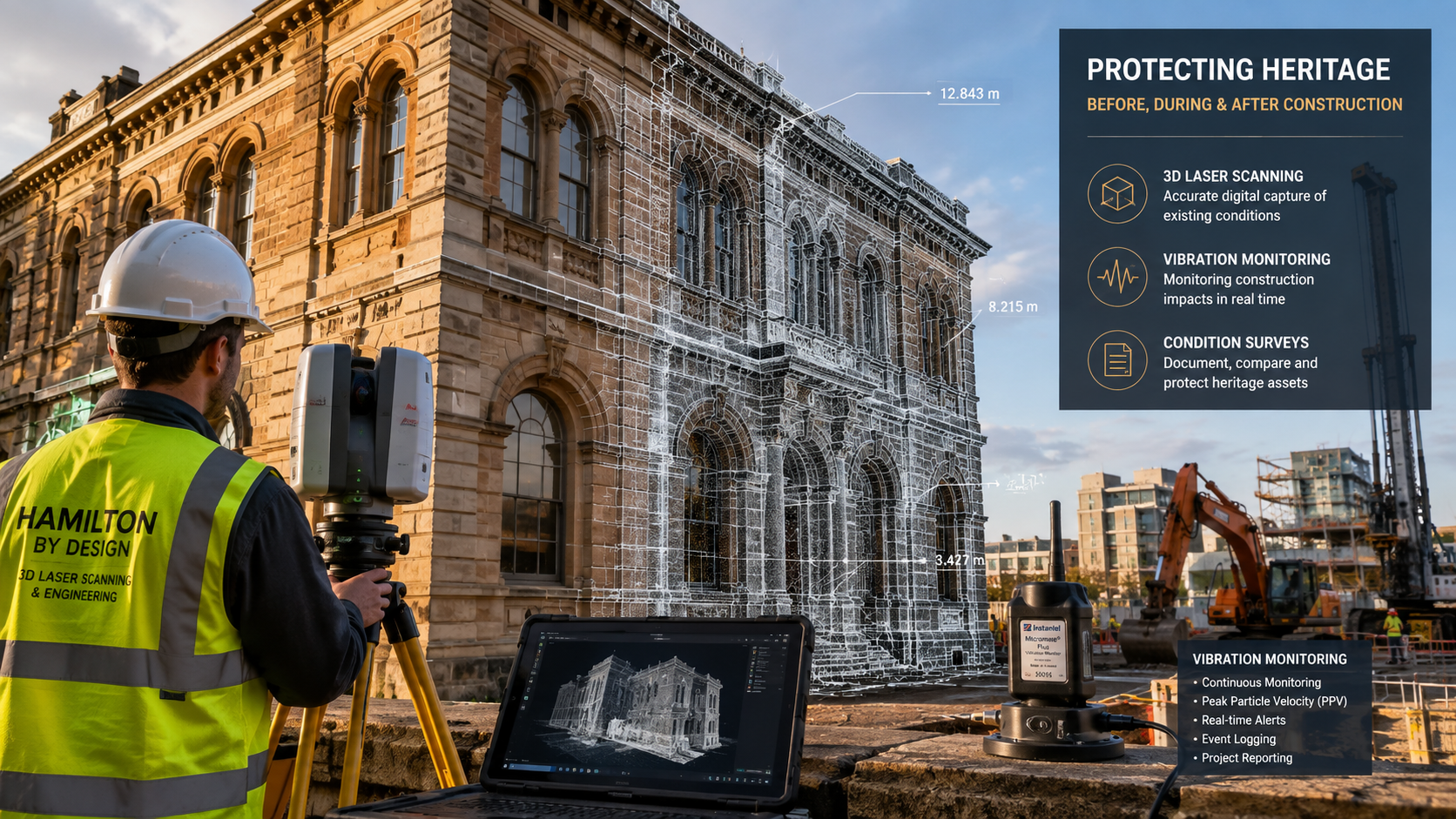
Protecting Heritage Buildings Before, During and After Construction
Construction activity near heritage buildings can create concerns regarding vibration, ground movement, structural movement and damage to fragile building fabric.
Hamilton By Design can support a staged heritage building protection strategy.
Before Construction
3D laser scanning + photography + condition documentation
Before excavation, piling, demolition, compaction or other significant construction activities begin, a baseline survey can establish the existing condition and geometry of the structure.
During Construction
Vibration monitoring + inspections + movement monitoring + targeted repeat scanning
Monitoring during construction provides a documented record of significant vibration events and can assist with identifying emerging changes.
After Construction
Repeat scanning + photographic review + dimensional comparison
A post-construction survey can be compared with the original baseline to identify measurable changes and provide a final documented record.
Combining these methods provides a stronger evidence base than relying on photographs, vibration monitoring or dimensional measurements alone.
Heritage 3D Laser Scanning
3D laser scanning provides a highly detailed spatial record of a heritage structure without requiring extensive physical contact with the building fabric.
Hamilton By Design can capture millions of measurement points across internal and external surfaces to create an accurate three-dimensional point cloud.
The survey can capture:
- walls and façades
- floors and ceilings
- roof structures
- columns and beams
- staircases
- arches
- windows and door openings
- decorative architectural elements
- structural steelwork
- historic machinery
- pipework
- industrial equipment
- complex building geometry.
The resulting point cloud provides a digital snapshot of the structure at the time of the survey.
This information can then be used for documentation, engineering assessment, restoration planning, CAD modelling, asset management and future comparison surveys.
Heritage Condition Surveys
Understanding the existing condition of a heritage structure is important before restoration, redevelopment or nearby construction begins.
Hamilton By Design can undertake detailed existing-condition surveys using a combination of:
- 3D laser scanning
- high-resolution photography
- engineering observations
- dimensional measurement
- point-cloud documentation.
The objective is to establish a reliable baseline record of the structure.
This can be particularly valuable where existing cracking, deformation, settlement or deterioration is already present.
Pre-Construction Heritage Condition Surveys
Before excavation, piling, demolition, compaction, tunnelling or other significant works commence, Hamilton By Design can document neighbouring heritage structures.
A pre-construction heritage condition survey may include:
- full or targeted 3D laser scanning
- façade documentation
- photographic condition recording
- crack identification
- dimensional measurements
- structural geometry capture
- identification of visible deterioration
- point-cloud archiving
- measured drawings.
A baseline survey can help distinguish between pre-existing conditions and changes that may occur during subsequent construction activities.
Post-Construction Heritage Condition Surveys
At the completion of construction, Hamilton By Design can return to the site and repeat the original survey.
The post-construction dataset can then be compared with the baseline information.
This may include:
- repeat 3D laser scanning
- repeat photography
- crack review
- point-cloud comparison
- dimensional assessment
- identification of visible changes
- final documentation.
This can provide asset owners, builders, engineers and heritage consultants with a clear record of the building before and after nearby construction.
Construction Vibration Monitoring
Heritage buildings can be sensitive to vibration generated by nearby construction activity.
Potential vibration sources may include:
- piling
- excavation
- rock breaking
- demolition
- road construction
- compaction
- tunnelling
- heavy vehicle movements
- drilling
- construction machinery.
Hamilton By Design can support construction projects with vibration monitoring focused on protecting heritage and existing structures.
Depending on project requirements, monitoring may include:
- continuous vibration measurement
- Peak Particle Velocity monitoring
- three-axis vibration measurement
- event logging
- project-specific alarm levels
- remote alerts
- periodic reporting
- correlation with construction activities.
Trigger criteria should be established for the particular project in consultation with appropriately qualified engineering and heritage professionals.
Structural Movement and LiDAR Deformation Monitoring
Repeat 3D laser scanning can be used to investigate whether the geometry of a heritage structure is changing.
Scans captured at different stages of a project may be compared to identify potential:
- wall movement
- façade displacement
- column movement
- structural deformation
- settlement-related changes
- distortion
- movement of architectural elements.
This can be particularly useful where conventional measurement is difficult because the structure is large, complex or irregular.
Where existing cracks have been identified, additional monitoring methods may also be incorporated.
Depending on project requirements, these may include:
- crack mapping
- crack gauges
- photographic records
- repeat dimensional measurements
- periodic LiDAR surveys
- engineering review.
Combining these records with vibration monitoring can provide a more complete understanding of how the structure behaves during nearby construction.
Heritage Scan-to-CAD
Point-cloud data can be converted into practical engineering and architectural documentation.
Hamilton By Design can develop:
- floor plans
- elevations
- sections
- façade drawings
- structural layouts
- roof geometry
- steelwork drawings
- equipment layouts
- dimensional drawings
- 3D CAD models.
Existing historic drawings can also be checked against the actual building geometry captured during scanning.
Heritage Scan-to-BIM and HBIM
Historic Building Information Modelling, commonly referred to as HBIM, can provide a structured digital representation of a heritage asset.
Unlike conventional BIM developed from new construction drawings, heritage models often need to accommodate irregular and non-standard geometry.
Laser scanning can provide the geometric foundation from which these models are developed.
A heritage information model may assist with:
- conservation planning
- asset management
- restoration
- maintenance
- redevelopment
- building services coordination
- historical documentation
- future condition surveys.
Heritage Restoration and Reverse Engineering
Accurate survey data can reduce uncertainty when restoration works are being designed.
Hamilton By Design can provide dimensional information to architects, engineers, fabricators and conservation specialists working on existing heritage structures.
This can assist with:
- repair design
- structural strengthening
- replacement components
- restoration planning
- new steelwork
- access structures
- services installation
- fabrication interfaces.
Because the geometry is captured directly from the existing structure, proposed works can be designed around real site conditions rather than relying solely on historic or incomplete drawings.
Reverse Engineering Heritage Components
Historic buildings and industrial heritage sites often contain components for which original drawings no longer exist.
Hamilton By Design can scan existing components and develop new CAD models and manufacturing drawings.
Suitable applications may include:
- brackets
- castings
- machinery components
- structural connections
- balustrades
- handrail components
- stair elements
- mechanical equipment
- pipework
- heritage industrial equipment.
The workflow can include:
3D scanning → point cloud → engineering interpretation → CAD model → fabrication documentation
This can be particularly useful where damaged or obsolete components need to be repaired, reproduced or documented for future conservation.
Industrial Heritage 3D Scanning
Hamilton By Design has particular capability where heritage and engineering overlap.
Industrial heritage assets can include:
- historic mines
- railway workshops
- pumping stations
- power stations
- factories
- mills
- wharves
- shipyards
- cranes
- processing plants
- historic machinery.
These environments often contain complex mechanical and structural systems that require more than architectural measurement alone.
An engineering-led survey can help document how machinery, structures, pipework, access systems and existing building elements relate to one another.
Adaptive Reuse of Heritage Buildings
Many heritage buildings are being converted for new uses while retaining significant parts of the original structure.
Potential projects may include conversion into:
- commercial offices
- hotels
- restaurants
- museums
- apartments
- educational facilities
- community spaces.
3D laser scanning can provide the dimensional foundation required for designing new services and structures within an existing heritage environment.
It can assist designers in coordinating:
- mechanical services
- electrical services
- fire systems
- lifts
- accessibility upgrades
- structural strengthening
- new stairs
- architectural modifications.
Accurate existing-condition data can reduce clashes and help minimise unnecessary disturbance to significant heritage fabric.
Digital Heritage Archiving
A detailed 3D point cloud can become part of the permanent historical record of a significant building, structure or industrial asset.
Digital heritage documentation can preserve information that may otherwise be lost through:
- deterioration
- redevelopment
- fire
- flooding
- structural failure
- accidental damage
- natural disasters
- demolition.
Even where no immediate engineering or restoration work is planned, a comprehensive 3D scan can preserve the geometry of the asset for future reference.
Heritage 3D Visualisation
Point-cloud and model data can also be used to communicate heritage environments to people who may not be able to physically access the structure.
Possible applications include:
- virtual walkthroughs
- educational material
- museum exhibitions
- conservation presentations
- stakeholder consultation
- planning documentation
- remote engineering reviews.
This can be particularly valuable for inaccessible, hazardous or restricted heritage sites.
Typical Heritage Assets
Hamilton By Design can assist with the documentation of:
- heritage buildings
- historic houses
- churches
- railway stations
- railway workshops
- bridges
- sandstone buildings
- government buildings
- industrial heritage assets
- mines
- factories
- pumping stations
- power stations
- museums
- universities
- wharves
- historic machinery
- adaptive reuse projects.
Our Heritage Documentation Workflow
Stage 1 — Site Assessment
Identify the structure, project objectives and areas requiring documentation.
Stage 2 — 3D Laser Scanning
Capture the existing geometry using terrestrial LiDAR scanning.
Stage 3 — Photographic Documentation
Create a supporting visual condition record.
Stage 4 — Point-Cloud Registration
Combine the individual scans into a coordinated project dataset.
Stage 5 — Existing-Condition Documentation
Produce the required plans, sections, elevations, CAD models or engineering information.
Stage 6 — Construction Monitoring
Where required, undertake vibration monitoring, repeat scanning, crack monitoring or structural movement monitoring.
Stage 7 — Post-Construction Verification
Return after construction or restoration and compare the new dataset with the original baseline.
Stage 8 — Digital Archive
Provide a permanent digital record for future asset management, engineering and heritage conservation.
Frequently Asked Questions
Can 3D laser scanning damage a heritage building?
Terrestrial laser scanning is a non-contact measurement technique, making it well suited to documenting fragile, complex and historically significant structures.
Why scan a heritage building before construction begins?
A pre-construction scan establishes an accurate record of the existing geometry before nearby construction activity starts. It can later be compared with repeat scans if movement or damage is suspected.
Can 3D laser scanning detect cracks?
A point cloud may capture larger visible surface features, but detailed crack assessment generally requires complementary photography, inspection and potentially dedicated crack-monitoring equipment.
Can vibration monitoring prevent damage?
Vibration monitoring does not physically prevent vibration. It provides a measured record of vibration levels and can identify when project-specific trigger criteria are approached or exceeded so construction activities can be reviewed.
Can scans taken at different times be compared?
Yes. Repeat surveys can be compared to identify measurable geometric changes, subject to the accuracy, registration methodology and monitoring requirements of the project.
Can historic machinery be scanned?
Yes. Historic machinery is particularly suitable for 3D scanning where drawings are missing or incomplete. Scan data can support documentation, restoration and reverse engineering.
Can heritage scan data be converted to CAD?
Yes. Point-cloud information can be developed into 2D drawings, 3D CAD models and other engineering documentation depending on project requirements.
Can heritage scan data be used for BIM?
Yes. Heritage scan data can provide the geometric foundation for Scan-to-BIM and Historic Building Information Modelling workflows.
Protect the Building. Preserve the Record.
Whether a project involves restoration, redevelopment, nearby construction or long-term conservation, understanding the existing condition of a heritage structure is an important first step.
Hamilton By Design provides engineering-led heritage 3D laser scanning, construction vibration monitoring, condition documentation, Scan-to-CAD, reverse engineering and digital heritage recording to help document and protect significant buildings, structures and industrial assets before, during and after construction.
Contact Hamilton By Design to discuss heritage 3D laser scanning, pre-construction condition surveys, vibration monitoring, structural movement monitoring or digital heritage documentation for your project.

Our clients
























