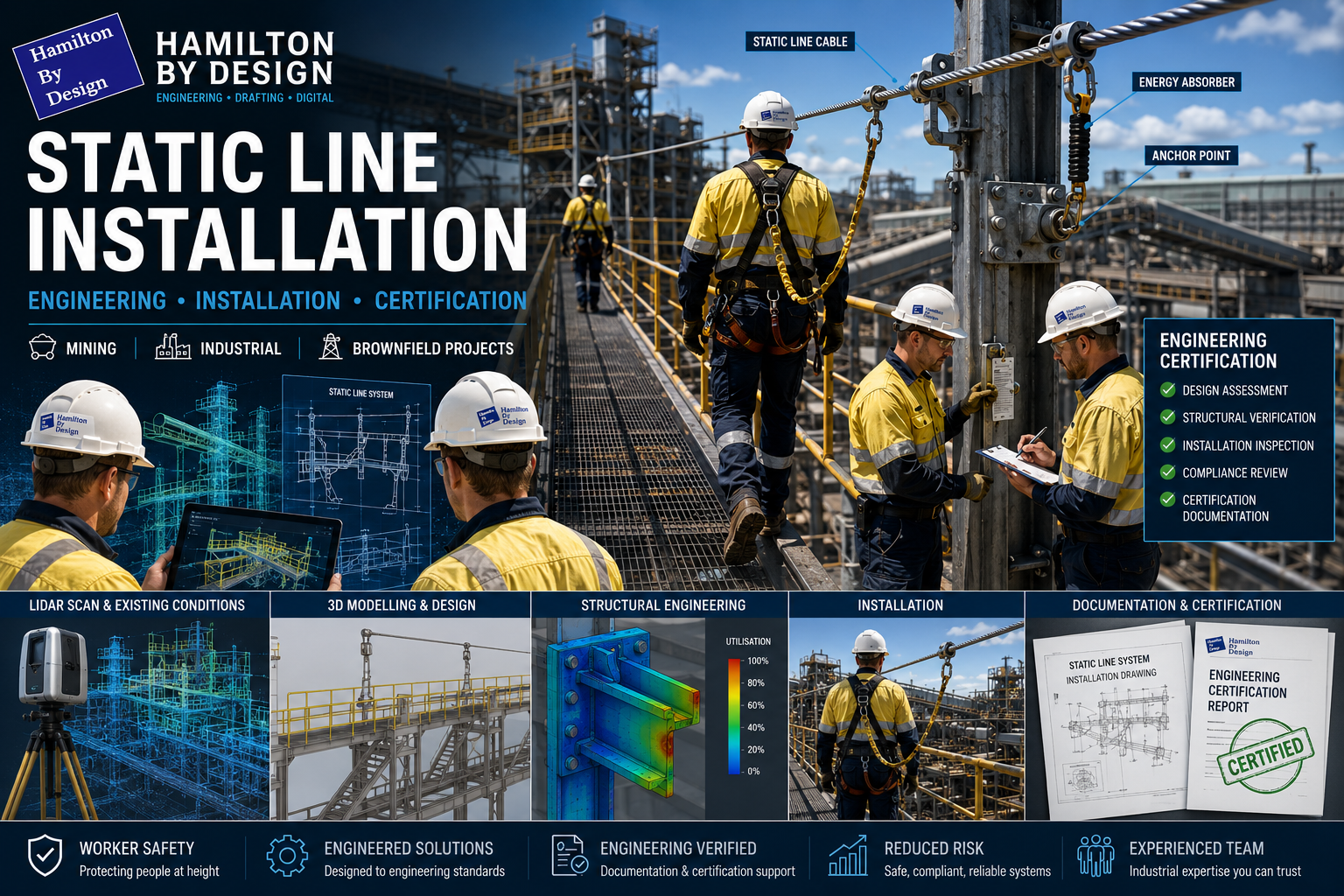
Static line systems play an important role in protecting personnel working at heights across mining, manufacturing, processing plants, smelters and heavy industrial environments. While a static line system may appear simple, effective implementation requires significantly more than installing a cable between two points.
A static line system is an engineered safety system requiring assessment of supporting structures, installation planning, documentation and engineering verification to ensure safe operation throughout its service life.
Why Engineering Assessment Matters
Static line systems can transfer significant loads into supporting structures during operation and potential fall events. Existing platforms, structural steel, roof systems and access structures may not have originally been designed for these additional loading conditions.
Potential risks may include:
- Structural overload
- Excessive cable deflection
- Anchor point failure
- Reduced fall clearance
- Interference with plant infrastructure
- Installation conflicts with existing services
Engineering assessment helps ensure the complete system performs safely and integrates correctly with existing facility infrastructure.
Brownfield Installation Challenges
Many industrial facilities have undergone modifications over many years and existing drawings do not always reflect current site conditions.
Common challenges include:
- Structural changes not reflected in drawings
- Additional pipework and services
- Restricted installation access
- Congested steelwork layouts
- Equipment interferences
- Unknown structural details
Capturing existing conditions before installation can reduce uncertainty and improve design confidence.
Engineering-grade LiDAR scanning and site verification can assist with:
- Existing-condition capture
- Structural geometry verification
- Access assessment
- Clash identification
- As-built modelling
- Installation planning
Typical Static Line Engineering Process
Site Inspection and Existing Asset Review
The process generally begins with:
- Site inspections
- Existing drawing review
- Structural assessment
- Access reviews
- Existing-condition verification
- Asset condition assessment
Structural Engineering Assessment
Supporting structures are assessed for:
- Structural member capacity
- Connection capacity
- Anchor loading requirements
- Dynamic loading conditions
- Multiple-user requirements
- Deflection limits
- Existing loading conditions
- Corrosion and asset condition
Where required, structural modifications or strengthening works may be developed.
Design Documentation
Typical engineering deliverables may include:
- Static line layouts
- General Arrangement (GA) drawings
- Structural details
- Anchor point details
- Installation drawings
- Load calculations
- Fabrication documentation
Clear documentation reduces installation uncertainty and assists construction and maintenance activities.
Installation Verification
Following installation, verification activities may include:
- Anchor inspections
- Fixing verification
- Installation checks
- Dimensional confirmation
- Asset tagging
- Documentation review
Engineering Certification
Engineering certification documentation may include:
- Design calculations
- Compliance documentation
- Inspection records
- Installation drawings
- Certification statements
- Asset schedules
- Maintenance requirements
Certification provides confidence that the installed system aligns with engineering design intent and project requirements.
How Hamilton By Design Can Support Static Line Projects
Hamilton By Design has a team capable of supporting the design, fabrication, installation and engineering certification process for static line systems and working-at-height access solutions for mining and industrial facilities.
Our engineering-led approach may include:
- Existing-condition site inspections
- Engineering-grade LiDAR scanning and verification
- Structural and mechanical assessment
- Static line and anchor layout development
- Fabrication drawings and installation documentation
- Site coordination and construction support
- Engineering review and certification documentation
Whether for new installations or brownfield modifications, our objective is to deliver systems designed and installed to relevant engineering requirements and project standards while integrating with existing infrastructure.
This provides clients with a complete workflow from concept and site capture through to installation support and engineering verification.
Benefits of an Engineered Approach
A structured engineering approach can provide:
- Improved worker safety
- Reduced project risk
- Better installation outcomes
- Reduced rework
- Improved documentation
- Increased confidence in long-term asset performance
- Improved lifecycle management
Final Thoughts
Static line systems are critical safety assets and should be treated as engineered systems rather than standalone products. Proper installation, engineering assessment and certification help ensure systems perform as intended and integrate safely within operating facilities.
For mining and industrial environments, combining engineering assessment with existing-condition verification and structured project documentation can significantly reduce uncertainty and improve installation outcomes.