Experiencing vibration at your home from nearby construction?

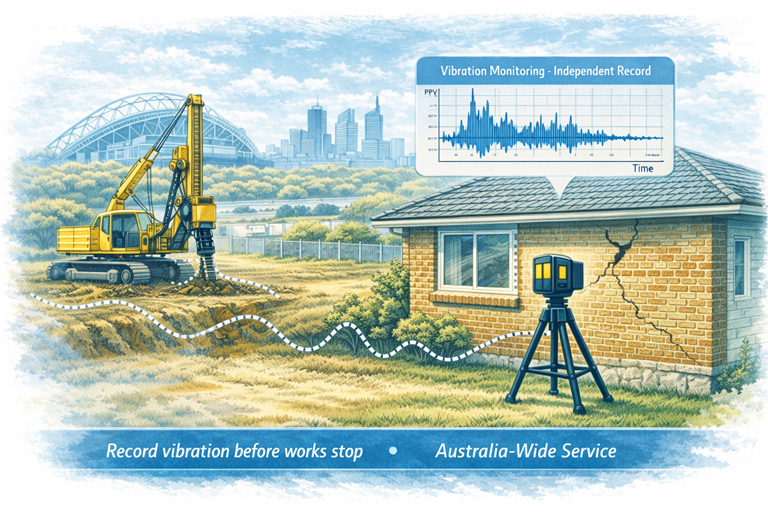
Residential home beside construction works with vibration monitor and recorded vibration graph

Construction activities such as piling, compaction, rock breaking, excavation and heavy vehicle movements can transmit ground vibration well beyond the worksite boundary.
Occupants commonly report rattling windows, shaking floors, or movement felt through walls and ceilings.

This understandably raises a serious concern:

Will this cause damage to my property โ€” and if it does, how will it be proven?

In practice, many property damage disputes are not determined by what occupants experienced, but by what can be objectively demonstrated.
Without measurements taken during the works, it becomes extremely difficult to establish causation later.

Once the construction activity ceases, the opportunity to capture evidence is often permanently lost.
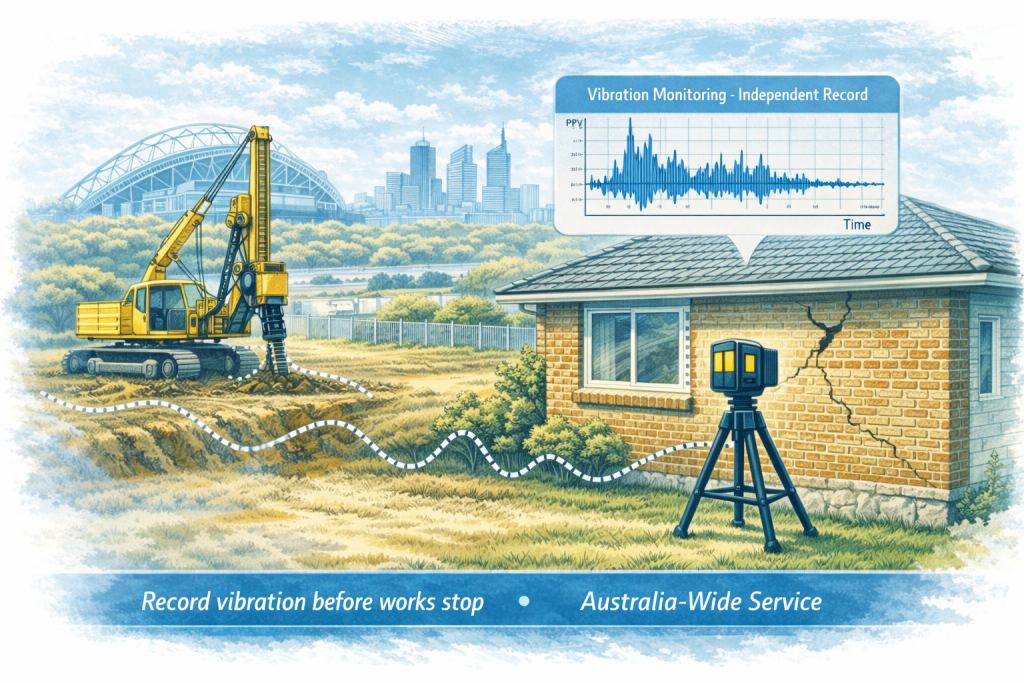

Construction piling rig near a house with cracks and a vibration monitoring device recording ground movement

Why early measurement matters

Vibration is temporary. Structural cracking is permanent.

If vibration is not recorded while it is occurring, later assessments rely heavily on assumption rather than data. In the absence of measured information, the following questions become difficult to answer:

  • Was vibration present at the property?
  • How intense was it?
  • How frequently did it occur?
  • Was it within accepted engineering criteria?
  • Could it reasonably have contributed to observed damage?

By contrast, monitoring performed during the works provides an independent record of actual site conditions at the time events occurred.


Perception vs structural risk

Human perception of vibration does not necessarily correlate with structural damage.

People can feel vibration levels well below those typically associated with building harm.
However, structural response depends on multiple variables:

  • soil type and ground transmission characteristics
  • distance to the works
  • construction methodology and equipment energy
  • building age and condition
  • prior movement or existing cracking
  • structural configuration and materials

Because of these factors, determining risk cannot be based on sensation alone.
It requires measurement and engineering interpretation.


Protecting your position

In many cases, concerns are only raised after visible cracking appears or after works have finished. At that stage, establishing responsibility becomes significantly more complex.

The practical question becomes:

If you do not document the conditions affecting your property while they are occurring โ€” who will?

Contractors monitor works to manage their risk.
Property owners must also protect theirs.

Independent documentation obtained during construction provides a factual reference point for:

  • communication with neighbours or builders
  • engineering review
  • insurance discussion
  • legal or expert assessment if required

Hamilton By Design โ€“ independent vibration monitoring

Hamilton By Design provides independent vibration measurement and documentation for residential and commercial properties affected by nearby construction.

We travel across Australia to install monitoring equipment and record site conditions while works are underway.

Services may include:

  • installation of calibrated vibration monitoring equipment
  • event logging and trend review
  • engineering-grade documentation
  • guidance on next steps based on measured data
  • optional crack mapping or 3D capture where appropriate

Act while the works are active

The reliability of any later assessment depends on evidence captured during the period of activity.

Monitoring after the machinery leaves site cannot reconstruct past conditions โ€” it can only speculate about them.

If construction is occurring near your property and you are concerned about potential damage, early documentation is the most effective way to protect your position.


Contact Hamilton By Design

If your home is experiencing vibration from nearby building activity, contact Hamilton By Design to record site conditions before the construction stops.

3D LiDAR scanning and 3D modelling service button โ€” laser scanner capturing a point cloud for engineering and CAD modelling
Mechanical engineering services

Hamilton By Design Co.
Engineering โ€ข Measurement โ€ข Documentation
Australia-wide service

Name
Would you like us to arrange a phone consultation for you?
Address
3D CAD Modelling Australia service banner for Hamilton By Design
Finite Element Analysis (FEA) engineering simulation button
Mechanical engineering services

AS ISO 10816 / 20816 โ€“ Mechanical Vibration

AS ISO 10816 & 20816 โ€“ Mechanical Vibration | Hamilton By Design

Mechanical vibration is one of the earliest indicators that rotating equipment is developing a fault. Standards such as AS ISO 10816 and AS ISO 20816 provide a consistent framework for measuring, evaluating, and managing vibration in industrial machinery.

At Hamilton By Design, we help clients apply these standards in a practical, engineering-led way by connecting vibration data with mechanical design, asset condition, and real-world site conditions.


What Are AS ISO 10816 and AS ISO 20816?

The AS ISO 10816 / 20816 standards define:

  • How mechanical vibration should be measured on machines
  • How vibration severity should be evaluated
  • What vibration levels are considered acceptable, marginal, or unacceptable

These standards are commonly applied to motors, pumps, gearboxes, compressors, fans, conveyors, and other rotating equipment where vibration provides an early warning of mechanical or structural issues.


Why Mechanical Vibration Standards Matter

Using vibration data without a recognised standard often leads to inconsistent interpretation and delayed action. Applying AS ISO 10816 / 20816 helps organisations to:

  • Identify mechanical problems early
  • Reduce unplanned downtime and breakdowns
  • Prevent secondary damage to bearings, shafts, and foundations
  • Improve overall equipment reliability
  • Support condition-based and predictive maintenance strategies

When vibration is assessed against an accepted standard, maintenance decisions become clearer and more defensible.


The Common Gap: Vibration Data Without Engineering Context

Many sites collect vibration data but struggle to connect it to:

  • As-installed geometry and alignment
  • Structural stiffness and support conditions
  • Design intent versus site reality
  • Maintenance and modification history

Vibration issues are often symptoms of broader mechanical or structural problems. Without engineering context, vibration data alone can be misleading.

This is where vibration assessment benefits from being connected to engineering-grade site information.

Engineering-Grade 3D LiDAR Scanning
https://www.hamiltonbydesign.com.au/home/engineering-services/engineering-grade-lidar-scanning/


How Hamilton By Design Helps

Hamilton By Design connects vibration standards with practical engineering outcomes through a coordinated service offering.

Engineering-Led Vibration Interpretation

We assess vibration results against AS ISO 10816 / 20816 using engineering judgement rather than relying solely on alarm limits. Machine type, operating duty, and site conditions are all considered.

Understanding the Physical Asset

By linking vibration data with mechanical layouts, drawings, and 3D models, we help identify whether vibration is driven by alignment issues, inadequate stiffness, foundation behaviour, or design constraints.

Mechanical Engineering Services
https://www.hamiltonbydesign.com.au/home/mechanical-engineering-consulting/mechanical-engineering/

SolidWorks & Mechanical CAD Services
https://www.hamiltonbydesign.com.au/home/engineering-services/solidworks/

Analysis Where Required

Where vibration levels indicate potential resonance, flexibility, or dynamic response issues, we support deeper investigation using structural and mechanical analysis tools.

SolidWorks FEA & Simulation
https://www.hamiltonbydesign.com.au/home/engineering-services/solidworks/solidworks-fea-simulation/

FEA Capabilities
https://www.hamiltonbydesign.com.au/home/engineering-services/fea-capabilities/

Clear, Usable Reporting

Our reporting focuses on:

  • What the vibration levels indicate
  • Why the issue matters to the asset
  • What actions are recommended

This ensures vibration results directly support maintenance and engineering decisions.


Where This Approach Adds Value

A connected vibration and engineering approach is particularly valuable in:

  • Mining and mineral processing plants
  • Heavy industrial facilities
  • Energy and utilities infrastructure
  • Brownfield upgrades and asset life-extension projects

Vibration issues are frequently linked to steelwork design, support conditions, or historical modifications that were not fully engineered.

Challenges of Not Consulting AS 3990 โ€“ Mechanical Equipment Steelwork
https://www.hamiltonbydesign.com.au/challenges-of-not-consulting-as-3990-mechanical-equipment-steelwork/

AS 1755 โ€“ Conveyor Safety
https://www.hamiltonbydesign.com.au/as-1755-conveyor-safety/


Summary

AS ISO 10816 and AS ISO 20816 provide the benchmark for assessing mechanical vibration.
Hamilton By Design provides the engineering connection that turns those benchmarks into practical action.

By linking vibration data with 3D scanning, mechanical design, and engineering analysis, vibration assessments become clearer, more accurate, and far more useful across the asset lifecycle.


Hamilton By Design logo displayed on a blue tilted rectangle with a grey gradient background
3D LiDAR scanning and 3D modelling service button โ€” laser scanner capturing a point cloud for engineering and CAD modelling
Mechanical engineering services

Related Engineering Services

3D Laser Scanning & Mechanical Design
https://www.hamiltonbydesign.com.au/3d-laser-scanning-mechanical-design-australia/

Mining Engineering Services
https://www.hamiltonbydesign.com.au/home/engineering-services/mining-engineering-services-australia/

3D LiDAR scanning and 3D modelling service button โ€” laser scanner capturing a point cloud for engineering and CAD modelling
Mechanical engineering services
Finite Element Analysis (FEA) engineering simulation button
Mechanical engineering services