Why You Should 3D Scan Your White Van Before a Tradie Fit Out?

LiDAR scanning the interior of a white van beside a fully fitted tradie van outside a workshop

Why 3D Scan Your White Van Before a Tradie Fit-Out?

Customising your van is no different to customising your toolbox.

You wouldnโ€™t buy a toolbox full of drawers and shelves that donโ€™t suit your tools โ€” so why accept a van fit-out that doesnโ€™t suit the way you work?

If youโ€™re paying good money for a van fit-out, 3D scanning your van first ensures you actually get what you want, not a generic solution.
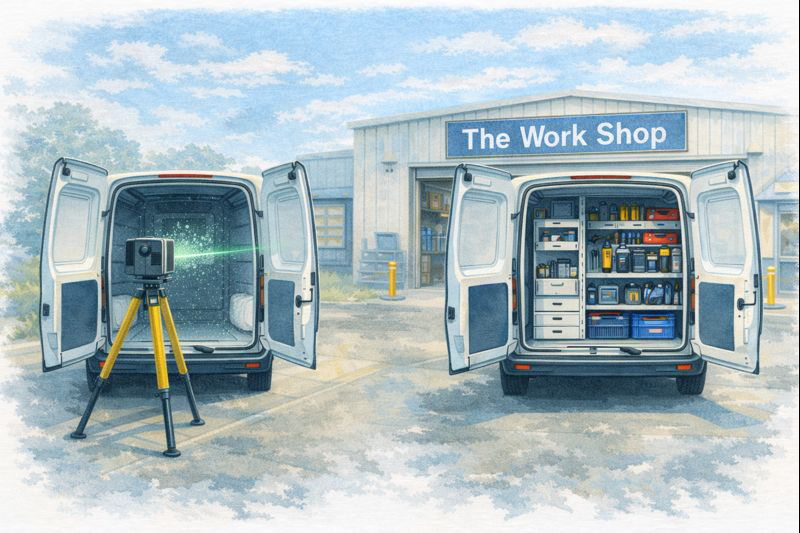

3D scanning a white van before a custom tradie fit-out compared to a completed organised van interior

Your Van Is Your Toolbox

For most tradies, the van is:

  • a mobile workshop
  • a storage system
  • an office
  • and a productivity tool

Every trade works differently, and every van gets used differently.

A 3D scan captures the exact internal geometry of your van, so the fit-out is designed around your vehicle, not assumptions.


Why Guessing Costs You Money

Traditional van fit-outs often rely on:

  • standard templates
  • rough measurements
  • generic layouts

That can lead to:

  • wasted space
  • awkward access
  • tools that donโ€™t fit properly
  • shelves and drawers you donโ€™t actually use

Once itโ€™s built, changing it is expensive.

3D scanning removes the guesswork before anything is built.


What 3D Scanning Does for a Van Fit-Out

A 3D scan creates an accurate digital model of your van interior.

This allows the design team to:

  • optimise every millimetre of space
  • design shelving, drawers, racks, and storage to fit properly
  • check clearances before anything is installed
  • tailor the layout to how you work day-to-day

Youโ€™re paying for a fit-out โ€” this ensures you get value from every dollar.


Trades That Benefit from 3D-Scanned Van Fit-Outs

We regularly assist (but are not limited to):

  • Plumbing vans โ€“ pipe storage, fittings, pumps, and access
  • Electrical vans โ€“ cable drums, test equipment, safe storage
  • Carpentersโ€™ vans โ€“ tool cases, saw storage, materials
  • Fittersโ€™ vans โ€“ precision tools, parts, and fast access
  • Boilermakersโ€™ vans โ€“ heavy tools, welding gear, safe load distribution
  • Delivery vans โ€“ optimised load space and restraint systems
  • HVAC / air conditioning vans โ€“ gas bottles, units, tools
  • Painters / decorators โ€“ organised storage for finishes and equipment
  • Locksmiths / security installers โ€“ fast access, clean layout
  • Handymen / general maintenance โ€“ flexibility and adaptability
  • Camper vans โ€“ beds, storage, kitchens, and utilities that actually fit

Different trades. Same problem.
One-size-fits-all doesnโ€™t work.


Design It Right โ€” Before Itโ€™s Built

With a 3D scan, the design team can:

  • trial different layouts digitally
  • adjust storage heights and access
  • confirm everything fits before fabrication

Traditionally, we assist with fit-out design โ€” but scanning takes it further by giving everyone accurate data to work from.

This reduces:

  • rework
  • compromises
  • frustration

Youโ€™re Paying for a Fit-Out โ€” Get What You Want

A van fit-out is an investment.

So ask yourself:

  • Why accept a generic layout?
  • Why compromise on access or storage?
  • Why redesign later when you can get it right first time?

Scan the van. Design it properly. Build it once.


The Bottom Line

Customising your van is just like customising your toolbox.

The better it suits you, the faster you work, the easier your days are, and the more value you get from it.

If youโ€™re already spending money on a fit-out, 3D scanning your van is the smartest way to make sure you get exactly what you want โ€” not what happens to fit.

Name
Would you like us to arrange a phone consultation for you?
Address

Automotive 3D Scanner Technology: From Cars to Complete Vehicle Digitisation

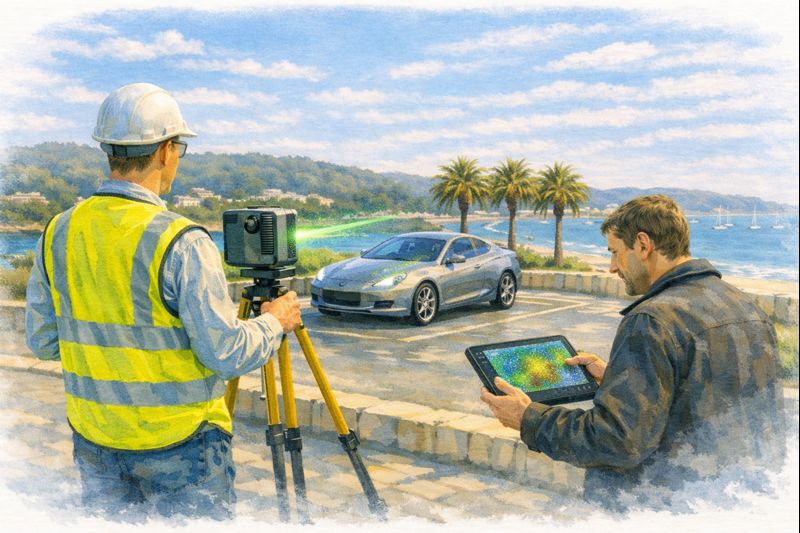
Engineer using an automotive LiDAR scanner to capture 3D vehicle geometry while a client reviews point cloud data

Automotive 3D Scanner Technology | Vehicle & Car Laser Scanning

The automotive industry has always pushed the limits of precision. From body panels and chassis alignment to aftermarket modifications and reverse engineering, accuracy is everything. This is where the automotive 3D scanner has moved from a niche tool to an essential part of modern automotive workflows.

Whether youโ€™re restoring classic vehicles, developing custom components, or validating manufacturing tolerances, 3D scanning of vehicles is now the fastest and most reliable way to capture real-world geometry.


Why Automotive 3D Scanning Matters

Traditional vehicle measurement methods โ€” tape measures, calipers, and manual templates โ€” are slow, subjective, and prone to error. In contrast, vehicle 3D scanning captures millions of data points in minutes, creating a precise digital replica of a car or component.

This digital data can be used for:

  • Reverse engineering parts
  • CAD modelling and redesign
  • Fitment verification
  • Quality control
  • Digital archiving of rare or legacy vehicles

For automotive professionals, accuracy is no longer optional โ€” itโ€™s a competitive advantage.


Engineer and client performing vehicle 3D scanning with a car laser scanner in a coastal car park

What Is a 3D Scanner for Automotive Applications?

A 3D scanner for automotive use is a device that captures the exact shape and dimensions of a vehicle or its components using laser or structured light technology. The result is a highly accurate point cloud or mesh that can be converted into CAD models.

Common scanner types include:

  • Laser-based scanners
  • Structured light scanners
  • Handheld and tripod-mounted systems

For industrial and engineering use, the car laser scanner remains the preferred option due to its accuracy, repeatability, and ability to scan reflective or complex surfaces.


Automotive Use Cases for 3D Scanning

1. 3D Scanning of Vehicle Bodies

Full 3D scanning of vehicle exteriors allows teams to:

  • Capture exact body geometry
  • Design aerodynamic add-ons
  • Validate panel alignment
  • Reproduce damaged or unavailable parts

This is particularly valuable for motorsport, restoration, and custom fabrication projects.


2. 3D Scanner for Cars in Restoration & Classic Vehicles

When original drawings no longer exist, a 3D scanner for cars becomes the only way to accurately reproduce parts.

Applications include:

  • Recreating discontinued components
  • Digitally preserving rare vehicles
  • Designing upgrades without altering originality

3. Automotive Laser Scanning for Manufacturing

In production and fabrication environments, laser scanner automotive systems are used to:

  • Verify tolerances
  • Compare as-built vehicles to CAD
  • Detect deformation or misalignment
  • Reduce rework and scrap

This level of insight is impossible with manual inspection alone.


Choosing the Best 3D Scanner for Automotive Work

Selecting the best 3D scanner for automotive use depends on accuracy requirements, environment, and workflow integration.

Key factors to consider:

  • Accuracy & resolution (sub-millimetre for engineering)
  • Speed of capture
  • Ability to scan reflective surfaces
  • Compatibility with CAD software
  • Portability for workshop or site use

For engineering-grade outcomes, tripod-mounted or hybrid systems often outperform consumer-level handheld devices.


Car Laser Scanner vs Traditional Measurement

A car laser scanner provides several advantages over conventional measurement methods:

Traditional MeasurementAutomotive 3D Scanning
Manual & subjectiveObjective & repeatable
Limited reference pointsMillions of data points
Time-consumingRapid capture
Difficult to archivePermanent digital record

This is why 3D scanning of vehicle geometry is now standard practice in high-value automotive work.


Integrating 3D Scanning Into Automotive Design

Once scanning is complete, the data feeds directly into:

  • CAD design
  • Simulation & analysis
  • Fitment studies
  • Manufacturing workflows

This scan-to-CAD process allows engineers and designers to work from reality, not assumptions.


Automotive 3D Scanning for the Future

As vehicles become more complex โ€” electric drivetrains, lightweight materials, tighter tolerances โ€” vehicle 3D scanning will continue to grow in importance.

Future applications include:

  • Digital twins of vehicles
  • Predictive maintenance modelling
  • AI-driven quality control
  • Automated inspection systems

What was once cutting-edge is now becoming standard practice.


Final Thoughts

An automotive 3D scanner is no longer just a tool for specialists โ€” itโ€™s a foundational technology for modern automotive design, fabrication, and verification.

Whether youโ€™re selecting the best 3D scanner for automotive work, implementing laser scanner automotive systems in production, or using 3D scanning of vehicle geometry for restoration and reverse engineering, the benefits are clear:

  • Higher accuracy
  • Faster workflows
  • Reduced risk
  • Better outcomes

In an industry where millimetres matter, 3D scanning of vehicles delivers confidence โ€” from concept to completion.

Name
Would you like us to arrange a phone consultation for you?
Address