Mechanical Engineering | 3D Scanning | 3D Modelling
Tag: structural verification
Posts focused on structural verification, assessing existing plant and infrastructure structures to confirm load capacity, safety and compliance during upgrades and equipment changes.
Refineries, Heritage Buildings & Industrial Retrofits Done Right
The Inner West of Sydney is home to some of the city’s most complex refurbishment environments. From legacy refinery and industrial sites through to heritage-listed warehouses, factories, and commercial buildings, these assets were never designed with modern codes, loading requirements, or services in mind.
Yet today, they’re being asked to support:
New plant and equipment
Adaptive re-use and change of occupancy
Heavier floor loads
Updated fire, seismic, and structural standards
Modern services routing in very old structures
This is where many refurbishment projects run into trouble — not because the design is poor, but because the starting information is wrong or incomplete.
The Inner West Problem: Old Buildings, New Standards
Much of the Inner West’s industrial and heritage building stock was constructed:
Under superseded Australian Standards
With unknown material properties
Using construction methods no longer permitted
With undocumented modifications over decades of use
What often looks acceptable visually may be:
Structurally marginal under modern load cases
Locally compromised due to corrosion, settlement, or fatigue
Modified in ways that no longer match original drawings
When these issues are discovered late in the design process, the outcome is almost always the same:
Redesign
Strengthening
Programme delays
Budget escalation
Why Waiting Until “Detailed Design” Is Too Late
A common scenario we see in Inner West refurbishments:
Concept design proceeds based on legacy drawings or assumptions
Floor layouts, equipment, and architectural intent are developed
Engineering review begins
Structural checks identify:
Inadequate floor capacity
Unsupported penetrations
Changed load paths
Degraded or altered members
Design is forced to change — often significantly
At this point, the engineer isn’t blocking creativity — they’re responding to reality.
The issue isn’t engineering input. The issue is when the true condition of the structure becomes visible.
Start With a Scan: Let Designers Create With Confidence
Engineering-grade 3D laser scanning at the very beginning of a refurbishment changes the entire dynamic of a project.
Instead of reacting to unknowns later, the project team starts with:
Verified geometry
True floor levels and deflection
Structural alignment and deformation
Accurate column, beam, and slab positions
Measured deviations from original drawings
This gives architects and designers something powerful:
Freedom to design within known constraints — not guessed ones.
Heritage & Industrial Retrofits: Why Scanning Matters Even More
Heritage Buildings
Heritage structures often prohibit invasive investigation early on. 3D scanning allows:
Non-intrusive verification of geometry
Identification of movement or deformation
Assessment of tolerance drift over time
Planning of sympathetic strengthening solutions
Refineries & Legacy Industrial Sites
Inner West refinery and process facilities bring additional challenges:
Tight access
Live plant interfaces
Safety-critical environments
Brownfield congestion
Scanning provides:
Safe remote measurement
Clash-free retrofit design
Confidence before shutdowns
Reduced rework during construction
When Standards Change, Reality Matters
One of the most common late-stage surprises in refurbishments is floor capacity.
Buildings that performed adequately for decades may no longer comply with:
Current live load requirements
Change-of-use provisions
Equipment point loads
Modern safety factors
Without accurate structural geometry and context, engineers are forced to:
Assume worst-case scenarios
Over-design strengthening
Restrict layouts unnecessarily
Early scanning supports informed engineering judgement, often resulting in:
Targeted strengthening instead of blanket solutions
Retention of original fabric where possible
Reduced material and construction costs
From Point Cloud to Engineering Decisions
At Hamilton By Design, scanning is not a standalone service — it’s an engineering tool.
Our process typically supports:
Structural verification of existing buildings
Floor flatness, level, and deflection assessment
Alignment checks of columns and frames
Scan-to-CAD models for design integration
Fit-for-purpose information for refurbishment decisions
This is especially critical in Inner West projects, where:
Every millimetre matters
Access is limited
Heritage considerations are real
Late changes are costly
Design With Knowledge, Not Surprises
Refurbishments don’t fail because buildings are old. They fail because assumptions survive too long.
By starting with an engineering-led scan:
Designers get space to create
Engineers get data they can trust
Asset owners avoid late-stage shocks
Projects move forward with confidence
If you’re planning a refinery upgrade, heritage refurbishment, or adaptive re-use project in Inner West Sydney, the smartest decision you can make is to scan first — before concept becomes constraint.
Thinking about a refurbishment or retrofit in the Inner West?
Engineering-grade 3D scanning at the start gives your project clarity, confidence, and creative freedom — not limitations.
The Australian Standard AS 3990, “Mechanical Equipment – Steelwork,” is critical for ensuring the design and construction of safe, reliable, and durable steel structures in mechanical systems. It establishes guidelines for materials, construction practices, and stress analysis to meet the demanding requirements of industrial and mechanical applications. Failing to consult AS 3990 can lead to significant challenges for companies and individuals involved in engineering projects. Additionally, an engineering company like Hamilton By Design, with extensive experience in mechanical design and steelwork, can address these challenges effectively by leveraging its expertise and adherence to industry standards.
Our clients:
1. Structural Failures
One of the most severe consequences of not consulting AS 3990 is the risk of structural failures. Steelwork used in mechanical equipment must withstand specific stresses, loads, and environmental conditions. If these factors are not carefully calculated according to the standard, the structure may fail under operational stress, leading to catastrophic consequences.
Hamilton By Design’s Approach: Hamilton By Design ensures structural integrity through rigorous design analysis, leveraging advanced modeling tools and AS 3990 guidelines to predict and mitigate potential failure points. Their experience in various industries allows them to create robust steelwork designs that perform reliably under operational conditions.
2. Compliance and Legal Issues
Regulatory compliance is a cornerstone of modern engineering practices. Many industries, including mining, manufacturing, and construction, mandate adherence to AS 3990 for safety and operational approvals. Ignoring the standard can result in penalties, project delays, or even legal liabilities due to non-compliance.
Hamilton By Design’s Approach: The company prioritizes compliance by integrating AS 3990 requirements into every stage of the project. Their team stays updated with the latest revisions of the standard and ensures all designs meet regulatory expectations, providing clients with peace of mind and streamlined approval processes.
3. Reduced Equipment Longevity
Steel structures that do not conform to AS 3990 may suffer from premature wear, fatigue, or failure. This can lead to frequent repairs, replacements, or unplanned downtime, significantly reducing the lifespan of mechanical equipment.
Hamilton By Design’s Approach: Hamilton By Design employs precise material selection and stress analysis techniques, as prescribed by AS 3990, to optimize the durability and performance of their designs. Their focus on quality engineering ensures long-lasting equipment that minimizes maintenance requirements.
4. Safety Hazards
Non-compliance with AS 3990 poses serious safety risks. Equipment that fails unexpectedly can cause injuries or fatalities, creating an unsafe work environment and potential legal repercussions.
Hamilton By Design’s Approach: Safety is a core value for Hamilton By Design. The company conducts thorough risk assessments and designs steelwork that adheres to AS 3990’s stringent safety standards. Their commitment to safety reduces risks to operators and protects the overall workforce.
5. Increased Maintenance Costs
Improperly designed steelwork often requires frequent maintenance due to unforeseen stress points, material fatigue, or environmental damage. This not only increases operational costs but also disrupts productivity.
Hamilton By Design’s Approach: Hamilton By Design’s adherence to AS 3990 minimizes maintenance needs by delivering designs that perform reliably over extended periods. Their proactive approach to material selection and stress management ensures reduced long-term operational costs for their clients.
6. Loss of Reputation
Companies delivering substandard designs risk damaging their reputation and losing client trust. Poor performance or failure of mechanical equipment reflects negatively on both the engineers and the organization.
Hamilton By Design’s Approach: Hamilton By Design has built a solid reputation by consistently delivering high-quality, compliant designs. Their focus on excellence and attention to detail ensures that their clients receive reliable solutions, strengthening relationships and fostering repeat business.
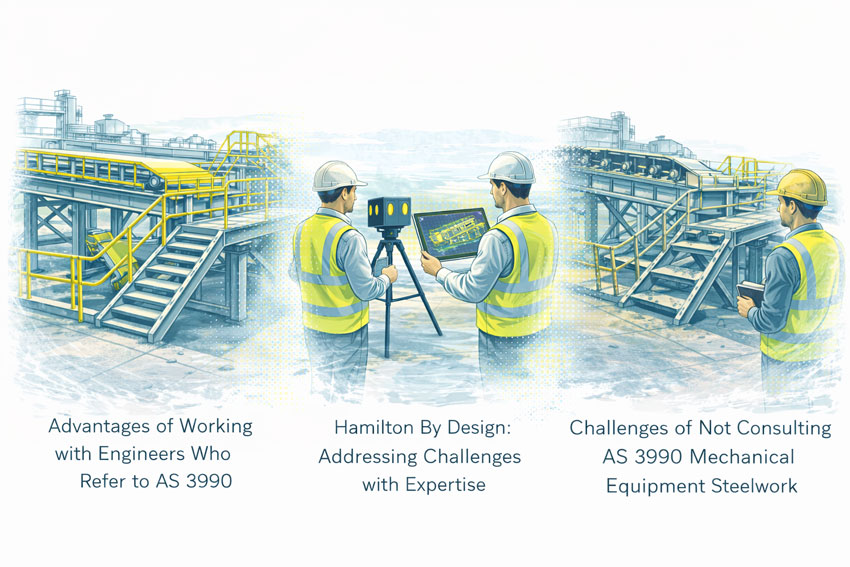
Advantages of Working with Engineers Who Refer to AS 3990
1. Enhanced Structural Reliability
Engineers who follow AS 3990 guidelines ensure that steel structures are designed to handle expected loads and stresses safely. This enhances the overall reliability and performance of mechanical equipment.
Hamilton By Design’s Advantage: Hamilton By Design’s expertise in applying AS 3990 results in robust designs that exceed client expectations. Their thorough understanding of structural dynamics ensures optimal performance and safety.
2. Regulatory Compliance
Adhering to AS 3990 simplifies the process of meeting industry regulations, reducing risks of audits, fines, or project delays.
Hamilton By Design’s Advantage: Hamilton By Design’s commitment to compliance ensures that their projects pass inspections and meet all regulatory requirements, helping clients avoid costly delays and legal issues.
3. Optimized Design
Following AS 3990 enables engineers to create designs that balance safety, functionality, and cost-efficiency.
Hamilton By Design’s Advantage: The company uses advanced engineering tools and methodologies to develop optimized designs that align with clients’ operational goals while maintaining compliance with AS 3990.
4. Improved Safety
AS 3990 includes comprehensive guidelines for minimizing risks, ensuring a safer working environment.
Hamilton By Design’s Advantage: Hamilton By Design’s safety-first approach incorporates AS 3990’s recommendations to deliver solutions that prioritize the well-being of workers and operators.
5. Cost Savings
Properly designed steelwork reduces maintenance, repair, and replacement costs over the equipment’s lifecycle.
Hamilton By Design’s Advantage: By adhering to AS 3990, Hamilton By Design delivers cost-effective solutions that reduce long-term expenses, helping clients maximize their return on investment.
6. Increased Equipment Lifespan
AS 3990-compliant designs are engineered to withstand operational stresses, enhancing the durability of mechanical systems.
Hamilton By Design’s Advantage: Hamilton By Design’s focus on durability and reliability ensures that their designs deliver long-term performance, minimizing disruptions and extending equipment lifespan.
7. Competitive Advantage
Delivering high-quality, compliant systems provides a competitive edge, improving marketability and client trust.
Hamilton By Design’s Advantage: Hamilton By Design’s track record of excellence and adherence to AS 3990 positions them as a trusted partner for engineering projects, helping clients achieve their goals efficiently and effectively.
8. Risk Mitigation
Following AS 3990 minimizes the risk of unexpected failures, accidents, or operational delays.
Hamilton By Design’s Advantage: The company’s comprehensive approach to risk management ensures that their designs perform reliably under real-world conditions, reducing risks for their clients.
Hamilton By Design: Addressing Challenges with Expertise
Hamilton By Design is an engineering firm renowned for its dedication to excellence and adherence to industry standards. Their extensive experience in mechanical equipment and steelwork enables them to address the challenges of non-compliance with AS 3990 effectively. Here are some examples of how Hamilton By Design applies its expertise to deliver superior outcomes:
Case Study 1: Mining Equipment Steelwork
In a project involving heavy mining equipment, Hamilton By Design was tasked with designing a support structure for a conveyor system. By consulting AS 3990, they identified critical stress points and optimized the design to handle dynamic loads. The result was a durable and reliable structure that exceeded client expectations and minimized maintenance costs.
Case Study 2: Industrial Manufacturing Facility
Hamilton By Design worked on a manufacturing facility requiring custom steelwork for robotic assembly lines. By adhering to AS 3990, they ensured the steel structures could withstand repetitive stress and environmental factors, enhancing the safety and efficiency of the facility.
Case Study 3: Renewable Energy Project
In a renewable energy project, Hamilton By Design designed steel frameworks for wind turbine foundations. By following AS 3990, they accounted for wind loads, fatigue stresses, and environmental conditions, delivering a solution that met stringent safety and performance requirements.
Conclusion
Failing to consult AS 3990 can lead to significant challenges, including structural failures, compliance issues, reduced equipment lifespan, safety hazards, increased maintenance costs, and reputational damage. However, working with experienced engineers who prioritize adherence to AS 3990, such as those at Hamilton By Design, provides numerous advantages, including enhanced reliability, regulatory compliance, optimized design, improved safety, cost savings, increased equipment lifespan, and risk mitigation.
Hamilton By Design’s proven track record demonstrates their ability to navigate these challenges effectively, leveraging their expertise and commitment to quality to deliver exceptional results for their clients. By choosing Hamilton By Design, companies can ensure that their mechanical equipment steelwork projects are completed to the highest standards of safety, reliability, and performance.
For more information on the Hamilton By Design Consulting approach, feel free to email info@hamiltonbydesign.com.au
To provide the best experiences, we use technologies like cookies to store and/or access device information. Consenting to these technologies will allow us to process data such as browsing behaviour or unique IDs on this site. Not consenting or withdrawing consent, may adversely affect certain features and functions.
Functional
Always active
The technical storage or access is strictly necessary for the legitimate purpose of enabling the use of a specific service explicitly requested by the subscriber or user, or for the sole purpose of carrying out the transmission of a communication over an electronic communications network.
Preferences
The technical storage or access is necessary for the legitimate purpose of storing preferences that are not requested by the subscriber or user.
Statistics
The technical storage or access that is used exclusively for statistical purposes.The technical storage or access that is used exclusively for anonymous statistical purposes. Without a subpoena, voluntary compliance on the part of your Internet Service Provider, or additional records from a third party, information stored or retrieved for this purpose alone cannot usually be used to identify you.
Marketing
The technical storage or access is required to create user profiles to send advertising, or to track the user on a website or across several websites for similar marketing purposes.