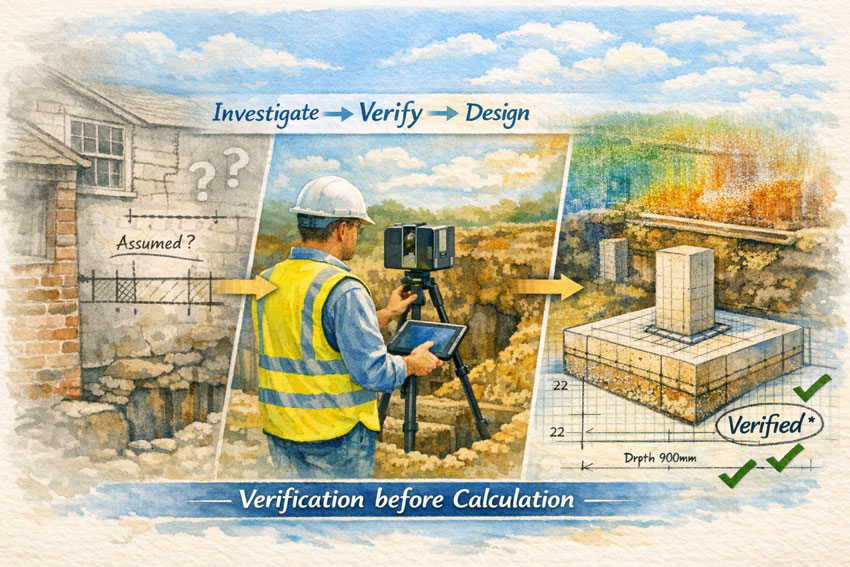
From Reality to Fabrication

From Reality to Fabrication: Engineering-Led 3D Modelling, Structural Verification and Build-Ready Documentation

In industrial and infrastructure projects, success is rarely determined by intent alone. It is determined by how accurately existing conditions are understood, how rigorously designs are validated, and how clearly fabrication information is communicated. At Hamilton By Design, we bridge the gap between site reality and fabrication by combining engineering-led 3D modelling, structural engineering, finite element analysis (FEA), and fabrication-ready documentation into a single, accountable workflow.

This integrated approach ensures that what is designed can be built, fits the first time, and performs as intended in service.

3D Modelling for Fabrication: Designing What Can Actually Be Built

3D modelling for fabrication is not simply about producing visually accurate geometry. It is about creating models that reflect real-world constraints, manufacturing tolerances, installation access, and structural behaviour. Hamilton By Design develops fabrication-grade 3D CAD models that are built around how components will be cut, welded, machined, lifted, and installed.

Our models are typically informed by site measurements, laser scanning, and as-built data to ensure alignment with existing structures and equipment. This is particularly critical in brownfield environments such as processing plants, material handling facilities, and industrial upgrades where assumptions based on legacy drawings are unreliable.

Each model is developed with downstream use in mind. Hole sizes, weld preparations, plate thicknesses, member sizes, and connection details are defined so fabricators can confidently transition from model to manufacture without reinterpretation or rework.

Structural Engineering Embedded in the Modelling Process

Structural engineering at Hamilton By Design is not a separate, downstream exercise. It is embedded directly within the 3D modelling process. Structural load paths, support conditions, connection behaviour, and serviceability requirements are considered as the model evolves, not after geometry is frozen.

This integrated method allows structural considerations to inform design decisions early, reducing late-stage redesigns and cost escalation. It also ensures compliance with relevant Australian Standards and industry-specific requirements, whether the project involves steel structures, plant support frames, access platforms, equipment foundations, or retrofit works.

By developing the structural model in parallel with the fabrication model, we maintain alignment between engineering intent and physical deliverables.

Finite Element Analysis: Verifying Performance, Not Guessing

Finite Element Analysis (FEA) plays a critical role in validating that a design will perform safely and efficiently under real operating conditions. Hamilton By Design applies FEA to assess stresses, deflections, load sharing, vibration response, and fatigue risk across a wide range of industrial applications.

FEA is particularly valuable where traditional hand calculations are insufficient or overly conservative. Complex geometries, dynamic loading, eccentric supports, impact forces, and non-uniform load distributions can all be assessed with greater confidence using simulation-based analysis.

Our FEA workflows are directly linked to the 3D CAD models used for fabrication. This ensures consistency between the analysed geometry and the manufactured outcome. Where analysis identifies areas of concern, design modifications are implemented directly in the model, creating a closed-loop engineering process that improves both safety and constructability.

As-Built Documentation: Capturing What Exists, Not What Was Assumed

Accurate as-built documentation is fundamental to effective engineering decision-making. In many facilities, original drawings are outdated, incomplete, or no longer representative of the installed condition. Hamilton By Design produces engineering-grade as-built documentation that reflects the true geometry and configuration of existing assets.

As-built documentation may include 3D models, general arrangement drawings, sectional views, and measured dimensions that form a reliable baseline for future upgrades, maintenance planning, and compliance assessments. This information reduces uncertainty, supports safer design decisions, and enables more efficient project planning.

For clients managing long-life assets, high-quality as-built data becomes a strategic resource rather than a one-off deliverable.

Fabrication Drawings That Reduce Risk on the Workshop Floor

Fabrication drawings are the point where engineering intent meets manufacturing reality. Poorly defined drawings lead to RFIs, delays, rework, and disputes. Hamilton By Design produces clear, unambiguous fabrication drawings that fabricators can trust.

Our drawings typically include detailed part drawings, assembly drawings, weld symbols, material specifications, tolerances, and notes aligned with the approved engineering model. Because these drawings are derived directly from fabrication-ready 3D models that have been structurally verified, inconsistencies between design and manufacture are minimised.

This approach supports faster fabrication turnaround, improved quality control, and smoother installation on site.

A Single, Accountable Engineering Workflow

One of the key advantages of Hamilton By Designโ€™s approach is single-source accountability. By delivering 3D modelling for fabrication, structural engineering, FEA, as-built documentation, and fabrication drawings within a unified workflow, we remove the handover gaps that often exist between consultants, designers, and fabricators.

Clients benefit from clearer communication, reduced coordination risk, and designs that are technically sound, buildable, and aligned with operational requirements. Fabricators benefit from models and drawings that reflect real conditions and engineering intent. Asset owners benefit from safer, more reliable outcomes delivered with fewer surprises.

Hamilton By Design logo displayed on a blue tilted rectangle with a grey gradient background

Engineering That Stands Up in the Real World

At Hamilton By Design, engineering is not about producing documents in isolation. It is about delivering outcomes that work in the real worldโ€”on site, in fabrication workshops, and over the life of an asset. By integrating 3D modelling for fabrication with structural engineering, finite element analysis, as-built documentation, and fabrication drawings, we provide a robust foundation for successful industrial projects.

This engineer-led, fabrication-focused approach ensures that designs are not only accurate on screen, but reliable, buildable, and fit for purpose in operation.

Our clients:


Name
Would you like us to arrange a phone consultation for you?

3D CAD Modelling | 3D Scanning

Hamilton By Design

Laser Scanning Hunter Valley: Delivering Engineering-Grade Accuracy for Mining, Manufacturing and Industrial Projects

The Hunter Valley remains one of Australiaโ€™s most important industrial regions. With world-class mining operations, CHPP facilities, fabrication workshops, power generation assets and major industrial precincts, the region depends on precision, reliability and efficient project planning. As plants age and infrastructure expands, the challenge of capturing accurate site information becomes increasingly critical.

This is why laser scanning in the Hunter Valley has rapidly become a foundational tool for maintenance, engineering, redesign, shutdown preparation and fabrication accuracy. Organisations across the region are turning to laser scanning because the demands of modern industrial work simply cannot be met with traditional tape measurements or outdated drawings.

Hamilton By Design is proud to deliver engineering-grade laser scanning throughout the Hunter Valley, supporting safer worksites, faster project execution and significantly improved installation outcomes. Below, we explore why laser scanning is essential, how the technology works and how it transforms operations across the region.


Why Laser Scanning Has Become Essential in the Hunter Valley

Across the Hunter, very few sites resemble their original drawings. Over decades, plants evolveโ€”structures deform, temporary fixes become permanent, equipment shifts, and countless undocumented modifications occur.

These realities create a major problem:
Projects that rely on inaccurate measurements inevitably face delays, rework and installation challenges.

The consequences of bad data include:

  • Structural steel not fitting on site
  • Conveyor alignment issues
  • Misaligned chutes or transfer points
  • Inaccurate pipe spool lengths
  • Unexpected clashes in congested areas
  • Extended shutdown duration
  • Significant cost blowouts

By contrast, laser scanning in the Hunter Valley provides a millimetre-accurate digital representation of the real site, eliminating uncertainty and enabling confident engineering decisions.


How Laser Scanning Works

Laser scanningโ€”also known as LiDAR (Light Detection and Ranging)โ€”captures millions of precise data points across a site in seconds. These points create a โ€œpoint cloud,โ€ a detailed 3D representation of the scanned environment.

The Hamilton By Design workflow typically includes:

1. On-Site High-Accuracy Capture

We scan assets such as:

  • Structural frames
  • Conveyors, transfer towers and walkways
  • Chutes, bins, hoppers and material-handling systems
  • Tanks and pipe networks
  • Mechanical equipment
  • Buildings and platforms
  • Processing areas and plant rooms

Scanning is performed safely, quickly and with minimal disruption to operations.

2. Point Cloud Processing

Individual scans are aligned and merged into a single, unified as-built dataset.

3. CAD Modelling

From the point cloud, we create:

  • Accurate 3D models
  • General arrangement drawings
  • Fabrication details
  • DXF files for workshop use
  • Digital templates for pattern development

4. Engineering & Fabrication Support

We run digital checks for:

  • Clearances
  • Misalignments
  • Bolt pattern accuracy
  • Clash detection
  • Fit-up assurance

This ensures all new components, structures and mechanical systems integrate correctly the first time.


Industries in the Hunter Valley Using Laser Scanning

1. Mining & Coal Handling Preparation Plants (CHPPs)

The Hunter Valley is one of Australiaโ€™s largest mining hubs, and laser scanning has become indispensable for:

  • Chute redesign and optimisation
  • Conveyor alignment and pulley checks
  • Structural replacements
  • Screening and crushing system upgrades
  • Transfer tower modifications
  • Bin and hopper geometry capture
  • Shutdown planning and scope definition

In CHPP environmentsโ€”where dust, vibration, wear and deformation are constantโ€”accurate as-built data is essential for safe and efficient upgrades.


2. Local Fabrication Workshops

Fabricators across Singleton, Muswellbrook, Rutherford and Thornton rely on precise digital information to ensure their products fit perfectly in the field. Laser scanning supports:

  • Steel replacement projects
  • Pipe spool fabrication
  • Custom chutes and transfer systems
  • Platform and walkway upgrades
  • Reverse engineering worn components

By basing fabrication on exact site geometry, rework and installation delays are dramatically reduced.


3. Power Stations and Energy Infrastructure

The Hunter Valley contains major energy assets requiring constant maintenance and upgrades. These aging facilities benefit greatly from laser scanning for:

  • Structural integrity assessments
  • Boiler house modifications
  • Pipe rerouting and replacements
  • Access platform upgrades
  • Plant room modelling
  • Compliance documentation

Laser scanning supports safe access, better planning and accurate engineering.


4. Industrial, Manufacturing and Infrastructure Projects

The regionโ€™s industrial footprint is expanding, and many facilities require precise as-built data for:

  • Renovations or expansions
  • Facility mapping
  • Mechanical upgrades
  • Brownfield redevelopment
  • BIM integration

Laser scanning provides the detail needed to plan these works correctly.


Benefits of Laser Scanning in the Hunter Valley

1. Millimetre Accuracy

Unlike manual measurements, laser scanning captures true geometryโ€”not assumptions.

2. Reduced Rework

Digitally verified data ensures that fabrication is correct the first time.

3. Improved Safety

No need for workers to climb, stretch, or enter hazardous areas to measure.

4. Faster Shutdowns

Accurate pre-planning reduces onsite delays.

5. Digital Collaboration

Point clouds allow teams, contractors and engineers to review the site remotely.

6. Enhanced Engineering Confidence

Decisions are made on verified data, improving outcomes across the entire project lifecycle.


The Hamilton By Design Advantage

Hamilton By Design delivers more than just scanningโ€”we combine decades of engineering, drafting and fabrication experience to interpret the data with real-world understanding.

What Sets Us Apart:

Engineering-Driven Approach

We understand the mechanical and structural context behind each scan.

Full Digital Workflow

From scan โ†’ point cloud โ†’ 3D model โ†’ fabrication drawings โ†’ installation, we support your entire project.

Local Knowledge of Hunter Valley Industry

We work routinely with mines, CHPPs, fabricators and industrial facilities across the region.

Fabrication-Ready Outputs

All models and drawings are created with workshop requirements and site constraints in mind.

Confidence Before Installation

We digitally confirm fitment before steel is cutโ€”removing risk.


Applications Where Laser Scanning Delivers Immediate Value

  • Chute replacements
  • Conveyor system upgrades
  • Access platforms and walkways
  • Crusher and screen changes
  • Transfer tower redesign
  • Pipe spool fabrication
  • Structural steel alignment checks
  • Bin, tank and hopper measurement
  • Reverse engineering
  • Brownfield plant expansions

Anywhere accuracy matters, scanning is the superior choice.


Laser Scanning in the Hunter Valley: The New Standard

Across the region, laser scanning is now considered a must-have for safe, efficient and predictable project delivery. As plants age and the complexity of upgrades increases, organisations that invest in accurate data significantly outperform those relying on outdated drawings or manual measuring.

For engineering teams, maintenance planners, workshop fabricators and shutdown coordinators, laser scanning provides the certainty required to deliver work on time and on budget.


Partner with Hamilton By Design

When you choose Hamilton By Design for laser scanning in the Hunter Valley, youโ€™re choosing:

  • Accuracy
  • Safety
  • Engineering reliability
  • Better planning
  • Reduced risk
  • Efficient installation

Weโ€™re ready to support your next shutdown, upgrade, redesign or fabrication project with the digital precision it deserves.

Contact Hamilton By Design today to discuss your site and discover how laser scanning can transform your project outcomes.

Hamilton By Design logo displayed on a blue tilted rectangle with a grey gradient background

Hunter Valley Laser Scanning: Transforming Engineering Accuracy Across Mining, Manufacturing and Infrastructure

3D Laser Scanning in Singleton and the Hunter: Delivering Accuracy for Mining, Manufacturing and Industrial Projects

3D Laser Scanning

3D Scanning in The Hunter Valley

Name
You would like to:

Harnessing the Power of LiDAR: Revolutionizing Engineering with 3D Scanning & SolidWorks

Title: Harnessing the Power of LiDAR: Revolutionizing Engineering with 3D Scanning & SolidWorks

Introduction

At Hamilton By Design, we are committed to integrating cutting-edge technologies to enhance our engineering processes. One such technology that has transformed the landscape of design and construction is LiDAR (Light Detection and Ranging). This advanced 3D scanning tool offers unparalleled precision and efficiency, enabling us to deliver superior outcomes for our clients.

The Evolution of LiDAR Technology

LiDAR technology has come a long way since its inception in the 1960s. Initially developed for meteorological and atmospheric research, it has evolved into a versatile tool used across various industries, including civil engineering, architecture, and environmental monitoring. The integration of GPS and advancements in laser technology have significantly enhanced LiDAR’s accuracy and applicability.

Advantages of Incorporating LiDAR into Engineering

  1. Exceptional Accuracy and Detail LiDAR systems emit laser pulses to measure distances with remarkable precision, creating high-resolution point clouds that capture intricate details of structures and terrains. This level of accuracy is crucial for tasks such as topographic mapping, structural analysis, and as-built documentation.
  2. Efficiency in Data Collection Traditional surveying methods can be time-consuming and labor-intensive. LiDAR, on the other hand, can rapidly collect vast amounts of data, significantly reduce field time and accelerate project timelines.
  3. Enhanced Safety and Accessibility LiDAR enables remote data collection in hazardous or hard-to-reach areas, minimizing risks to personnel. Whether it’s scanning a deteriorating structure or surveying rugged terrain, LiDAR ensures safety without compromising data quality.
  4. Integration with BIM and Digital Twins The detailed 3D models generated by LiDAR can be seamlessly integrated into Building Information Modeling (BIM) systems, facilitating better design visualization, clash detection, and project coordination. This integration supports the creation of digital twins, allowing for real-time monitoring and maintenance planning.
  5. Cost-Effectiveness By reducing the need for repeated site visits and minimizing errors through accurate data capture, LiDAR contributes to cost savings throughout the project lifecycle. Its efficiency translates into reduced labor costs and optimized resource allocation.

Applications in Engineering Projects

At Hamilton By Design, we’ve leveraged LiDAR technology across various projects:

  • Infrastructure Development: Accurate terrain modeling for road and bridge design.
  • Heritage Conservation: Detailed documentation of historical structures for preservation efforts.
  • Urban Planning: Comprehensive city modeling to inform sustainable development.

Conclusion

The integration of LiDAR 3D scanning tools into our engineering processes has revolutionized the way we approach design and construction. Its precision, efficiency, and versatility align with our commitment to delivering innovative and high-quality solutions.

As technology continues to advance, we remain dedicated to adopting tools like LiDAR that enhance our capabilities and set new standards in engineering excellence.

Laser Scan | Hamilton By Design

For more information on how Hamilton By Design utilizes LiDAR technology in our projects, visit our website at www.hamiltonbydesign.com.au.

Mechanical Engineers Structural Engineers

Structural Drafting | Mechanical Drafting | 3D Laser Scanning

Mechanical Engineering

Want to know how 3D Scanning can help your next project?
Get in touch todayย atย sales@hamiltonbydesign.com.au