Secondment for Mechanical Engineers: Strength Without Long-Term Overhead

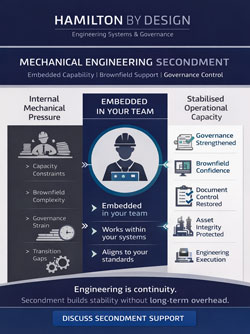
Mechanical engineering secondment infographic showing embedded engineer support, brownfield governance control and operational stability in industrial environments.

Engineering Secondment for Mechanical Teams

Mechanical engineering teams today operate under sustained pressure.

  • Shutdown windows are tighter
  • Brownfield modifications are constant
  • Documentation is often incomplete
  • Internal engineering resources are stretched
  • Capital approval cycles are slow

In this environment, hiring permanent staff is not always the right answer.

A structured engineering secondment provides capability, continuity, and control โ€” without increasing long-term overhead.

At Hamilton By Design, secondment is not labour hire.
It is embedded technical capability.


What Is Engineering Secondment?

Engineering secondment is the temporary placement of an experienced engineering professional into your organisation to operate as part of your internal team.

Unlike traditional consulting:

  • The engineer works within your systems
  • Aligns with your standards
  • Supports your projects directly
  • Reports within your governance structure

The objective is not to deliver a report and leave.

It is to strengthen your mechanical function during periods of load, transition, or change.
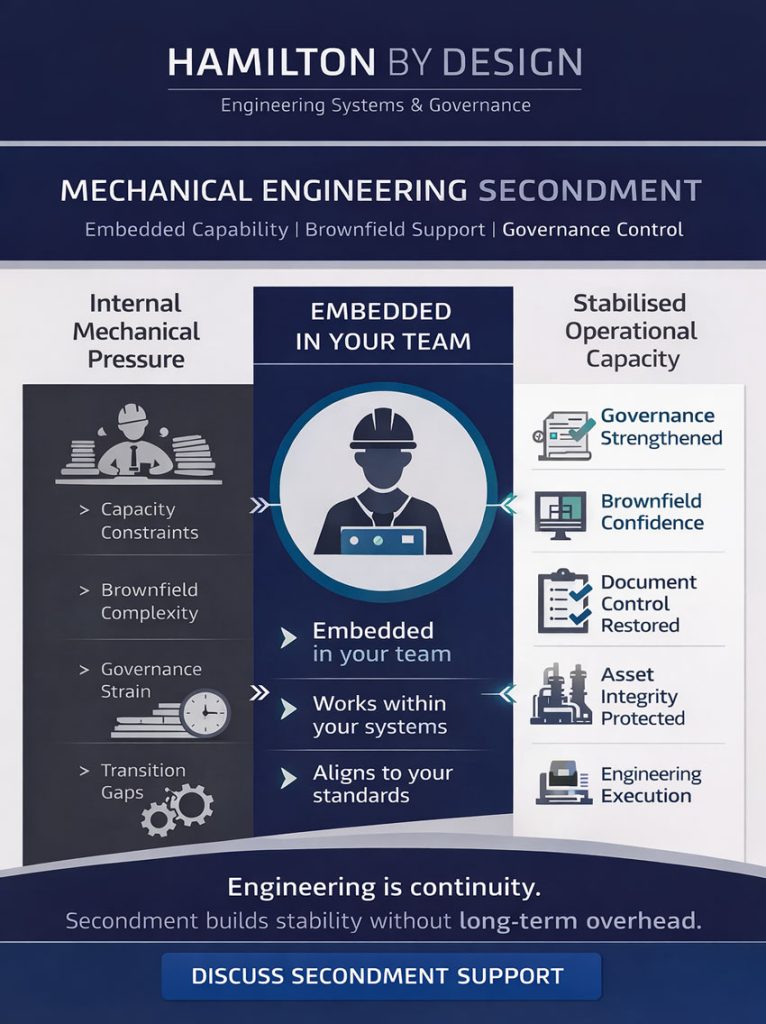

Industrial engineering secondment visual showing internal mechanical pressure, embedded team integration and strengthened governance outcomes.

When Mechanical Teams Benefit Most

Secondment is particularly effective when:

  • A senior engineer has resigned or is on leave
  • A capital upgrade program has accelerated
  • Shutdown preparation requires additional oversight
  • Brownfield redesign is underway
  • Drawing governance needs to be stabilised
  • A 3D scanning and digital validation program is commencing

Instead of recruiting under pressure, secondment provides immediate capability.


1๏ธโƒฃ Stability During Engineering Transitions

Mechanical departments often rely heavily on a small number of experienced engineers.

When one leaves, knowledge gaps appear:

  • Historical plant decisions
  • Modification records
  • Informal workarounds
  • Vendor relationships

A seconded engineer with brownfield experience can:

  • Maintain continuity
  • Support decision-making
  • Preserve governance
  • Prevent reactive engineering

This reduces operational risk during transition periods.


2๏ธโƒฃ Controlled Support During Brownfield Upgrades

Brownfield engineering is rarely straightforward.

Existing conditions rarely match legacy drawings.
Interfaces are complex.
Shutdown timeframes are unforgiving.

A seconded engineer can:

  • Review site conditions alongside your team
  • Validate geometry through 3D scanning integration
  • Support constructability reviews
  • Manage drawing revisions and change control

This is especially valuable when your permanent team is already operating at full capacity.


3๏ธโƒฃ Strengthening Governance Without Growing Headcount

Many mechanical teams struggle with:

  • Drawing revision control
  • Asset record updates
  • Contractor data management
  • Change management tracking
  • Audit readiness

These responsibilities are critical โ€” but often under-resourced.

Secondment allows you to:

  • Embed structured engineering oversight
  • Improve documentation discipline
  • Align digital records with physical assets
  • Stabilise internal processes

All without committing to permanent salary overhead.


4๏ธโƒฃ Integration With Digital Validation & 3D Capture

Hamilton By Design integrates secondment with:

  • 3D Faro scanning capability
  • Digital model validation
  • Controlled data environments
  • Brownfield geometry verification

A seconded engineer who understands both mechanical systems and digital validation ensures that:

  • Design intent matches site conditions
  • Documentation remains current
  • Future modifications start from verified data

This creates long-term engineering value beyond the immediate assignment.


Secondment vs Consulting vs Labour Hire

ModelOutcomeLimitation
ConsultingAdvice & deliverablesLimited internal integration
Labour HireShort-term manpowerLimited governance structure
SecondmentEmbedded engineering capabilityRequires structured scope

Secondment sits between permanent recruitment and external consultancy โ€” providing practical integration with strategic oversight.


The Hamilton By Design Approach

Our secondment model focuses on:

  • Mechanical systems understanding
  • Brownfield engineering discipline
  • Governance and drawing control
  • Shutdown planning support
  • Digital validation integration
  • Asset stewardship

We operate as an extension of your mechanical team โ€” not as an external observer.


Engineering Is Capacity + Control

Mechanical engineering is not only about solving problems.

It is about maintaining system integrity over time.

Secondment provides:

  • Capacity when workload spikes
  • Control when governance weakens
  • Continuity during transition
  • Confidence before capital decisions

For mechanical engineering managers, it is often the most balanced solution between growth and risk.

Hamilton By Design logo displayed on a blue tilted rectangle with a grey gradient background


Hamilton By Design
Supporting mechanical engineers across Australia through structured secondment, digital validation, and engineering governance.

Name
Would you like us to arrange a phone consultation for you?
Address

Mobile 3D LiDAR Scanning Services โ€“ Engineering-Grade Capture Across Melbourne

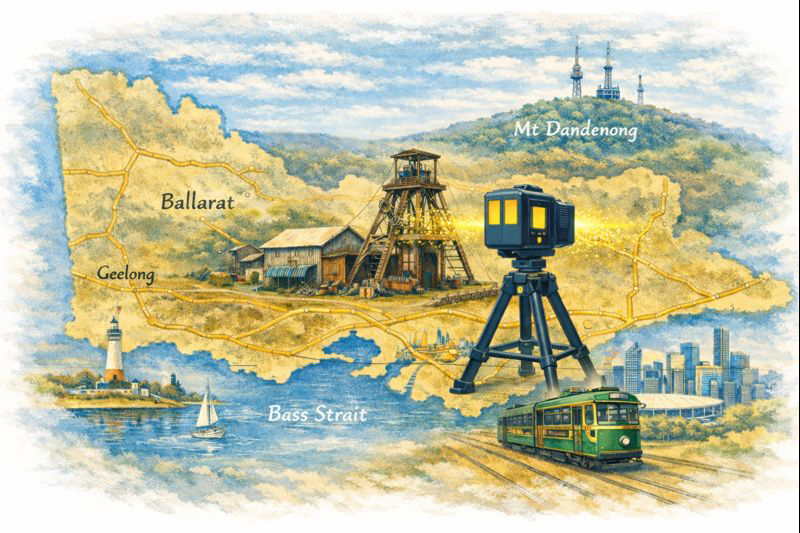
Mobile 3D LiDAR scanning concept across Victoria featuring Ballarat mine, Mount Dandenong towers, city landmarks and tram within a state road map.

Mobile 3D LiDAR Scanning Services Melbourne | Engineering-Grade Capture

Melbourneโ€™s industrial landscape is built on decades of growthโ€”factories expanded in stages, plant modified during shutdowns, and buildings adapted to new processes. The challenge today is that many of these facilities no longer match their original drawings.

Mobile 3D LiDAR scanning services solve that problem by capturing the site exactly as it exists, providing engineers, designers, and fabricators with reliable data to work fromโ€”without guesswork.

At Hamilton By Design we bring engineering-grade reality capture directly to your Melbourne site. Our mobile LiDAR workflows are designed to support real projects: shutdown upgrades, conveyor installations, brownfield modifications, and compliance documentation.


LiDAR scanner capturing a Ballarat mine structure on an illustrated map of Victoria showing major roads, Mount Dandenong TV towers, the MCG and a Melbourne tram.

Capture the Real Site โ€“ Not an Assumption

Traditional measuring methods struggle in complex industrial environments. Pipe bridges, mezzanines, mixed generations of equipment, and tight access areas make manual measurement risky and inaccurate.

Mobile LiDAR scanning delivers:

  • Millimetre-level point clouds of structures and equipment
  • Accurate tie-in points for new installations
  • Clearance checks for conveyors, elevators, and pipework
  • As-built records for compliance and asset management
  • Digital twins ready for design and clash detection

One site visit can capture more information than weeks of manual survey.


A Service Built for Melbourne Industry

From the inner west manufacturing belt to the northern logistics hubs and south-east processing plants, Melbourne projects share common pressures:

  • Short shutdown windows
  • Ageing plant with incomplete drawings
  • Multiple contractors working in the same space
  • Increasing safety and compliance requirements

Our mobile 3D LiDAR scanning services are structured to fit these realities. Most sites can be captured in a single day with minimal disruption to operations. Extra detail is focused around critical interfaces so new equipment fits first time.


Engineering First โ€“ Scanning With Purpose

We are not just data collectors. Hamilton By Design is an engineering business that uses scanning as the foundation for practical outcomes.

From a Melbourne scan we can deliver:

  • Registered point clouds in industry formats
  • AutoCAD & SOLIDWORKS models
  • General arrangement drawings
  • Fabrication-ready models
  • Clash and tolerance reports
  • Documentation for Safe Design reviews

Because the team understands fabrication and installation, the data is captured with the end goal in mindโ€”equipment that bolts in without rework.


Applications Across Melbourne

Mobile LiDAR scanning supports a wide range of sectors:

  • Food & beverage processing
  • Recycling and resource recovery
  • Warehousing and logistics
  • Water & wastewater facilities
  • Manufacturing upgrades
  • Conveyor and bulk handling
  • Heritage building retrofits
  • Vehicle and specialised fit-outs

Whether itโ€™s a small workshop in Dandenong or a complex plant in the western suburbs, the approach is the same: capture once, design with confidence.


Reduce Risk Before You Build

The cost of getting measurements wrong is far higher than the cost of a scan:

  • Delayed shutdowns
  • Steel that doesnโ€™t fit
  • Emergency redesigns
  • Additional crane and labour hire
  • Compromised safety outcomes

Mobile 3D LiDAR scanning removes those uncertainties at the start of the project, giving Melbourne businesses control over time, budget, and risk.


Booking & Delivery

  • One day onsite is typically sufficient for most facilities
  • Registered point cloud delivered promptly
  • CAD outputs tailored to your design platform
  • 50% deposit with purchase order, balance on delivery

Our calendar fills quickly around Melbourne shutdown periodsโ€”early booking ensures your project stays on track.


Hamilton By Design logo displayed on a blue tilted rectangle with a grey gradient background

Talk to an Engineering-Led Scanning Team

If youโ€™re planning an upgrade or need accurate as-builts in Melbourne, letโ€™s capture the site properly before design begins.

Hamilton By Design โ€“ Mobile 3D LiDAR Scanning Services
Engineering-grade capture for real industrial projects.

www.hamiltonbydesign.com.au
info@hamiltonbydesign.com.au
Servicing all Melbourne metro and surrounding regions

Name
Would you like us to arrange a phone consultation for you?
Address

Engineering-Quality 3D Scanning in Papua New Guinea

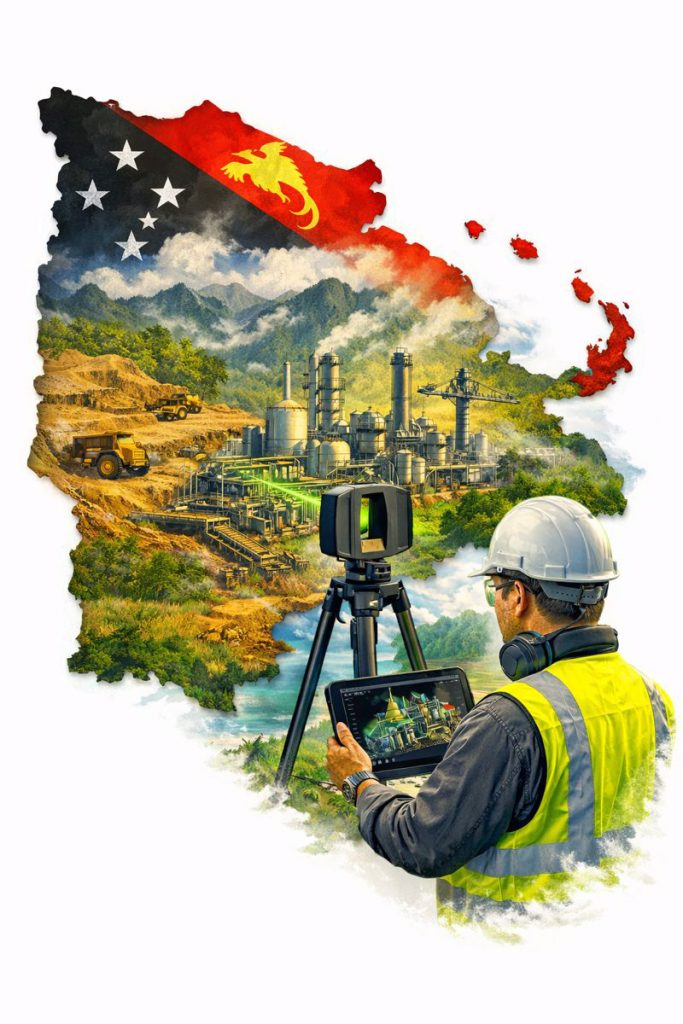
Engineer using LiDAR scanner to capture mining and processing plant within a map of Papua New Guinea for engineering design and plant upgrades.

Reality capture that stands up to design, fabrication and installation in remote industrial environments

Papua New Guinea (PNG) is home to complex, high-value industrial assets โ€” from mining and mineral processing plants through to ports, power generation and remote infrastructure. These projects are often delivered under tight shutdown windows, difficult logistics and challenging environmental conditions.

In these environments, engineering-quality 3D scanning is not a โ€œnice to haveโ€ โ€” itโ€™s a practical tool that reduces risk by capturing accurate as-built conditions and converting them into deliverables engineers can trust.

Hamilton By Design provides engineering-led LiDAR scanning and scan-to-CAD modelling workflows designed for real project outcomes: upgrades that fit, installations that align, and drawings that reflect reality.


Why โ€œEngineering Qualityโ€ Matters in PNG

Remote projects canโ€™t afford rework.

When access is limited and mobilisation costs are high, even a small design error can cause major delays:

  • fabricated components donโ€™t fit
  • tie-ins clash with existing pipework
  • platforms and handrails foul equipment clearances
  • shutdown windows blow out due to unexpected constraints

Engineering-quality reality capture reduces these risks by ensuring design starts from verified geometry โ€” not assumptions or outdated drawings.


Papua New Guinea industrial facility being digitally captured with 3D scanning to create accurate models for remote engineering and shutdown planning.

What Engineering-Quality 3D Scanning Includes

Not all scanning services deliver engineering-grade outcomes. โ€œEngineering qualityโ€ means the capture and deliverables are suitable for mechanical and structural decisions, including fabrication and installation.

Key elements include:

  • Survey control and consistent site referencing (where required)
  • Defined accuracy targets aligned to project tolerances
  • Registration QA and documented checks
  • Clear deliverables (E57/RCP/RCS, CAD models, drawings)
  • Model verification against point cloud prior to issue

The goal is simple: data you can design from.


Typical PNG Use Cases

1) Plant Upgrades and Brownfield Modifications

For conveyors, chutes, pipework, pump skids, structural platforms and access upgrades, scanning provides accurate spatial context for clash-free design.

2) Shutdown Planning and Constructability Reviews

Point clouds help teams plan:

  • access routes and lifting paths
  • installation sequencing
  • workpack scoping and constraints

This is especially valuable when shutdown windows are short and remote support is required.

3) Scan-to-CAD for Fabrication and Fit-Up

When components must be fabricated off-site and installed first time, engineering-grade LiDAR scanning provides the geometry needed for:

  • interface modelling
  • connection detailing
  • fabrication drawings

4) As-Built Documentation and Asset Records

Many sites have incomplete legacy drawings. A scanned dataset can become the โ€œsingle source of truthโ€ for future upgrades and maintenance planning.


Choosing the Right Scanning Tool for PNG Conditions

PNG sites often include large structures, dense plant, tight access and harsh environmental conditions. In these cases, engineering-grade LiDAR is typically required because it provides:

  • long-range capture across large facilities
  • reliable geometry in low-light / indoor areas
  • accuracy suitable for engineering design decisions

Other capture methods (visual scanning or photogrammetry) can be useful for context and surfaces, but if fabrication, tie-ins, and fit-up matter, LiDAR is usually the right choice.


Deliverables That Engineers Actually Use

Engineering-quality reality capture is only valuable if it becomes practical outputs.

Common deliverables include:

  • Registered point clouds (E57 / RCP / RCS)
  • 2D layouts, sections and elevations extracted from scans
  • Scan-to-CAD models (structural, mechanical, piping)
  • Interface models for replacement components
  • Verification snapshots and check notes (QA evidence)

How We Manage Quality on Remote Projects

Remote work demands a higher standard of planning.

An engineering-quality workflow typically includes:

  1. Scope definition (what decisions will rely on the data?)
  2. Accuracy targets set to match the engineering requirement
  3. Capture plan (coverage, control, safe access, shutdown constraints)
  4. Registration + QA checks (repeatability, closure error, spot checks)
  5. Model extraction and verification against point cloud
  6. Issue deliverables in formats aligned to the project team

This approach reduces site revisits and ensures the data is fit for purpose.


Why Engineering-Led Reality Capture Matters

3D scanning becomes far more valuable when itโ€™s integrated with mechanical and structural engineering โ€” because the deliverables are designed to support:

  • design decisions
  • fabrication requirements
  • installation sequencing
  • long-term asset management

Engineering-led reality capture means scanning is not the end product โ€” it is the foundation for a better engineering outcome.


Hamilton By Design logo displayed on a blue tilted rectangle with a grey gradient background

Final Thoughts

For industrial projects in Papua New Guinea, engineering-quality 3D scanning helps teams deliver upgrades with confidence โ€” particularly where logistics are difficult, shutdown time is limited, and โ€œmeasure twiceโ€ is expensive.

If the project depends on fit-up, constructability and accurate as-built conditions, start with reality capture that is designed for engineering โ€” not just visualisation.

Name
Would you like us to arrange a phone consultation for you?
Address

Why Shutdown Parts Donโ€™t Fit โ€” And How 2 mm LiDAR Scanning Stops the Rework

When Parts Donโ€™t Fit, Shutdowns Fail

Every shutdown fitter, maintenance crew member, and supervisor has lived the same nightmare:

A critical part arrives during shutdown.
The old part is removed.
Everyone gathers, ready to install the new one.
Production is waiting.
The pressure is on.

And thenโ€”
the part doesnโ€™t fit.

Not 2 mm out.
Not 10 mm out.
Sometimes 30โ€“50 mm out, wrong angle, wrong bolt pattern, wrong centreline, or wrong geometry altogether.

The job stops.
People get frustrated.
Supervisors argue.
Fitters cop the blame.
The plant misses production.
And someone eventually says the words everyone hates:

โ€œPut the old worn-out chute back on.โ€

This blog is about why shutdowns fall apart like thisโ€ฆ and how 2 mm LiDAR scanning finally gives fitters a system that gets it right the first time.


The Real Reason Parts Donโ€™t Fit

Most shutdown failures have nothing to do with the fitter, nothing to do with the workshop, and nothing to do with the installation crew.

Parts donโ€™t fit because:

  • Wrong measurements
  • Bad drawings
  • Outdated as-builts
  • Guesswork
  • Fabricators โ€œeyeballingโ€ dimensions
  • Cheap non-OEM parts purchased without geometry verification
  • Designers who have never seen the site
  • High staff turnover with no engineering history
  • Wear profiles not checked
  • Intersection points impossible to measure manually

Fitters are then expected to make magic happen with a tape measure and a grinder.

Itโ€™s not fair. Itโ€™s not professional. And itโ€™s completely avoidable.


Shutdown Pressures Make It Even Worse

When a part doesnโ€™t fit during a shutdown:

  • The entire job stalls
  • Crews stand around waiting
  • The supervisor gets hammered
  • The fitter gets the blame
  • Other shutdown tasks cannot start
  • The clock ticks
  • Production loses thousands per hour
  • Everyone becomes stressed and angry

And the worst part?

You were only replacing the part because the existing one was worn out.
Now youโ€™re bolting the worn-out one back on.

This isnโ€™t good enough.
Not in 2025.
Not in heavy industry.
Not when there is technology that eliminates this problem completely.


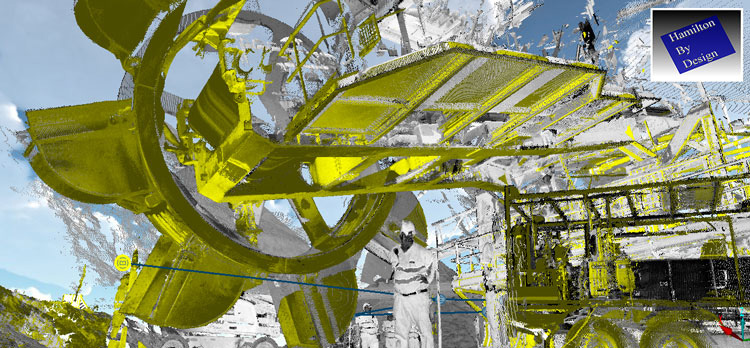
Coloured 3D LiDAR point-cloud scan of industrial CHPP machinery, including a large rotating component and surrounding structures. A worker stands beside the equipment for scale, with the Hamilton By Design logo displayed in the top-right corner.

Why Manual Measurement Fails Every Time

Fitters often get asked to measure:

  • Inside chutes
  • Wear sections
  • Pipe spools with intersection points
  • Tanks too large to measure from one position
  • Walkways too long for tape accuracy
  • Geometry with no records
  • Components 10+ metres above ground
  • Hard-to-reach bolt patterns
  • Angles and centrelines distorted by wear

But some measurements simply cannot be taken safely or accurately by hand.

You canโ€™t hang off an EWP 20 metres up measuring a worn flange angle.
You canโ€™t crawl deep inside a chute trying to measure intersecting surfaces.
You canโ€™t take a 20-metre walkway measurement with a tape measure and hope for precision.

This is not a measurement problem.
This is a method problem.

Manual measurement has hit its limit.
Shutdowns have outgrown tape measures.


This Is Where 2 mm LiDAR Scanning Changes Everything

Hamilton By Design uses 2 mm precision LiDAR scanning to capture the exact geometry of a site โ€” even in areas that are:

  • Too high
  • Too big
  • Too unsafe
  • Too worn
  • Too complex
  • Too tight
  • Too distorted to measure manually

From the ground, up to 30 metres away, we can capture:

  • Wear profiles
  • Flange positions
  • Bolt patterns
  • Pipe centrelines
  • Chute geometry
  • Conveyor interfaces
  • Complex intersections
  • Ductwork transitions
  • Mill inlet/outlet shapes
  • Tank dimensions
  • Walkway alignment
  • Structural deflection
  • Existing inaccuracies

No tape measure. No guesswork. No EWP. No risk.

The result is a perfect 3D point cloud accurate within 2 mm โ€” a digital version of real life.


2 mm Scanning + Fitter-informed Design = Parts That Fit First Time

This is where Hamilton By Design is different.

We donโ€™t just scan and hand the files to a drafter whoโ€™s never set foot on-site.

We scan and your parts are modelled by someone who:

  • Has been a fitter
  • Understands how parts are installed
  • Knows what goes wrong
  • Knows how to design parts that actually fit
  • Knows where shutdowns fail
  • Knows what to check
  • Knows what NOT to trust
  • And most importantly โ€” knows where the real-world problems are hidden

This fitter-informed engineering approach is why our parts fit the first time.

And why shutdown crews trust us.


Digital QA Ensures Fabrication Is Correct Before It Leaves the Workshop

Once the new chute, spool, or component is modelled, we run digital QA:

  • Fit-up simulation
  • Clash detection
  • Tolerance analysis
  • Wear profile compensation
  • Reverse engineering comparison
  • Bolt alignment verification
  • Centreline matching
  • Flange rotation accuracy
  • Structural interface checks

If something is out by even 2โ€“3 mm, we know.

We fix it digitally โ€” before the workshop cuts steel.

This stops rework.
This stops shutdown delays.
This stops blame.
This stops stress.

This is the future of shutdown preparation.


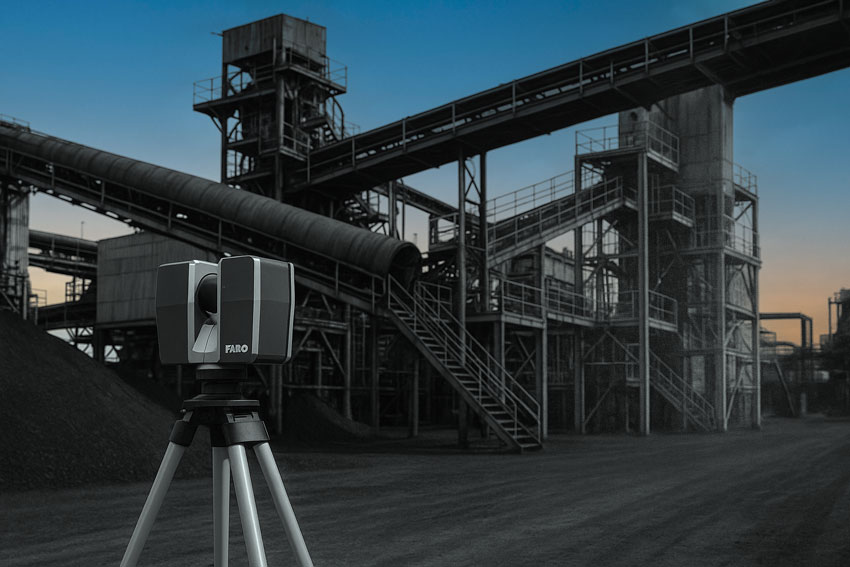
Accuracy of 3D LiDAR Scanning With FARO


When the Part Fits, Everything Runs Smooth

Hereโ€™s what actually happens when a chute or spool fits perfectly the first time:

  • The plant is back online faster
  • No rework
  • No reinstalling old worn-out parts
  • No arguing between fitters and supervisors
  • No unexpected surprises
  • No extra access equipment
  • No late-night stress
  • No grinding or โ€œmaking it fitโ€
  • Other shutdown tasks stay on schedule
  • Everyone looks good
  • Production trusts the maintenance team again

Shutdowns become predictable.
Fitters become heroes, not last-minute problem-solvers.


Shutdown Example (Anonymous but Real)

A major processing plant needed a large chute replaced during a short shutdown window.
Access was limited.
The geometry was distorted.
Measurements were impossible to take safely.
The workshop needed exact dimensions, fast.

Hamilton By Design scanned the entire area from the ground โ€” no EWP, no risk.

We produced:

  • Full 2 mm point cloud
  • As-built 3D model
  • New chute design
  • Digital fit-up validation
  • Workshop-ready drawings

The new chute arrived on site.
The old chute came out.
The new chute went straight in.
Zero rework.
Zero stress.
Plant online early.

The supervisor called it the smoothest shutdown theyโ€™d had in 10 years.


Why Fitters Should Reach Out Directly

Sometimes fitters know more about whatโ€™s really happening on-site than anyone in the office.

Fitters see the problems.
Fitters carry the blame.
Fitters deal with the rework.
Fitters just want parts that fit.

So weโ€™re making this simple:

If youโ€™re tired of fitting parts that donโ€™t fit โ€”
If youโ€™re tired of fixing other peopleโ€™s mistakes โ€”
If youโ€™re tired of shutdown stress โ€”

Call Hamilton By Design.

We scan it.
We model it.
We get it right.
Every time.


Services Featured

Hamilton By Design offers:

  • 3D LiDAR laser scanning (2 mm precision)
  • 3D modelling by a fitter-engineer who understands real-world installation
  • Digital QA before fabrication
  • Reverse engineering of worn components
  • Shutdown planning support
  • Fabrication-ready drawings
  • Fit-up simulation
  • Clash detection between old and new parts

This is how shutdowns run smooth.

Hamilton By Design logo displayed on a blue tilted rectangle with a grey gradient background

Call to Action

Are you a Fitter: tired of parts that donโ€™t fit?

Email or Call Hamilton By Design.

Email โ€“ info@hamiltonbydesign.com.au

Phone – 0477002249


Would you Like to Know more?

Name
Would you like us to arrange a phone consultation for you?
Address

Our clients:

Accuracy of 3D LiDAR Scanning With FARO

Why Shutdown Parts Donโ€™t Fit

Engineering Services

Coal Chute Design

Chute Design

3D CAD Modelling | 3D Scanning