

How 3D Scanning Supports Reverse Engineering in Mining and Industrial Facilities
In many mining and industrial operations, critical equipment often remains in service for decades. Over time, original design drawings may be lost, outdated, or incomplete. When upgrades, repairs, or replacements are required, engineers frequently need to recreate accurate models of existing components.
This is where reverse engineering scanning using 3D laser scanning technology has become an important engineering tool.
By capturing highly accurate measurements of existing equipment and infrastructure, engineers can develop digital models that support redesign, modification, or replication of components used in industrial operations.
At Hamilton By Design, 3D scanning is commonly used to support plant upgrades, equipment refurbishment, and engineering redesign projects across mining and industrial facilities.
Learn more about our scanning services here:
What is Reverse Engineering Using 3D Scanning?
Reverse engineering is the process of analysing an existing component or system in order to recreate its design data.
In industrial environments this often involves:
- worn or obsolete equipment
- legacy plant installations
- components without available drawings
- equipment modifications over time
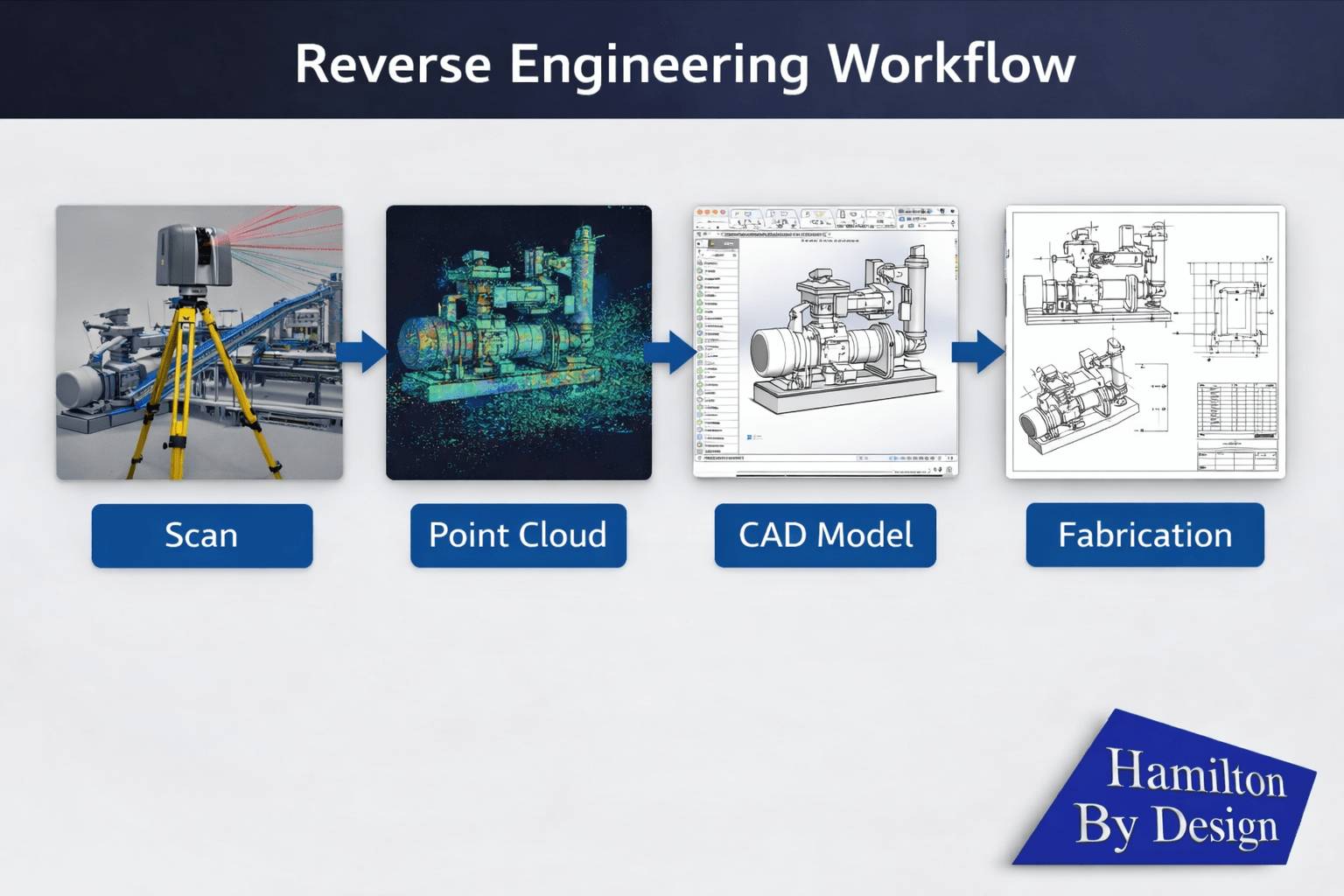
Using 3D laser scanning, engineers can capture millions of measurement points across the surface of a component or installation. These measurements form a point cloud dataset, which can then be converted into a detailed CAD model.
This model can be used to redesign components, manufacture replacements, or integrate upgrades into existing plant infrastructure.
Why Reverse Engineering Is Common in Mining Operations
Mining facilities frequently operate with equipment that may have been installed many years earlier. Over time, modifications are made during shutdowns or maintenance activities, and the documentation of these changes may not always be updated.
When engineering teams plan upgrades, they often encounter situations where:
- original drawings are unavailable
- components have been modified in the field
- replacement parts are no longer manufactured
- installation geometry differs from the original design
In these cases, reverse engineering scanning allows engineers to capture the current condition of the equipment and create accurate digital models for design work.
How 3D Scanning Improves Reverse Engineering Accuracy
Traditional reverse engineering often relied on manual measurements and site sketches. While useful, these methods can introduce uncertainty when modelling complex components.
3D laser scanning improves this process by capturing a highly detailed representation of the equipment geometry.
Benefits include:
- accurate measurement of complex shapes
- capture of worn or distorted components
- reduced manual measurement time
- improved confidence in engineering models
- better integration with existing plant infrastructure
Because scanning captures millions of points, engineers can analyse the exact condition of equipment before beginning redesign work.
Reverse Engineering Workflow Using 3D Scanning
A typical reverse engineering scanning workflow includes several steps.
1. Equipment Scanning
Engineers capture the geometry of the component or installation using a terrestrial laser scanner or handheld scanning system.
2. Point Cloud Processing
The captured scans are registered and processed to create a unified point cloud dataset representing the object.
3. CAD Model Creation
Engineers convert the scan data into engineering models using CAD software such as SolidWorks.
4. Design and Modification
The model can then be used to redesign components, analyse fitment, or prepare fabrication drawings.
You can learn more about this process here:
Applications of Reverse Engineering in Industrial Plants
Reverse engineering scanning is widely used in industrial facilities for many types of engineering work.
Common applications include:
- reverse engineering pump components
- redesigning worn mechanical equipment
- recreating legacy machine parts
- documenting existing plant installations
- designing upgrades for conveyors and materials handling systems
- integrating new equipment into existing plant layouts
These applications allow engineering teams to modernise infrastructure while maintaining compatibility with existing systems.
Reverse Engineering for Plant Upgrade Projects
Plant upgrades often require engineers to integrate new equipment into an existing facility that may have evolved over many years.
Using reverse engineering scanning, engineers can capture accurate geometry of the surrounding infrastructure before beginning design work.
This approach helps reduce risks such as:
- component clashes
- installation issues
- inaccurate fabrication drawings
- extended shutdown durations
Accurate digital models allow engineers to design upgrades with confidence and improve coordination between mechanical, structural, and fabrication teams.
Learn more about capturing existing conditions before plant upgrades here:
Conclusion
Reverse engineering using 3D scanning has become an essential engineering tool for mining and industrial facilities where accurate design data may not always be available.
By capturing precise measurements of existing equipment and infrastructure, engineers can recreate digital models that support repairs, upgrades, and replacement components.
For industries that rely on complex infrastructure and long operational lifecycles, reverse engineering scanning provides a reliable foundation for modern engineering design and plant upgrades.
Hamilton By Design provides engineering-grade 3D scanning services to support reverse engineering and upgrade projects across mining and industrial operations.
Our Clients
























