

Bucket Elevator vs Pan Conveyor Design | Industrial Material Handling Engineering
In bulk material handling industries such as mining, cement production, grain processing, and industrial manufacturing, selecting the right conveying system is critical to reliability, maintenance efficiency, and operating cost. Two commonly used systems are bucket elevators and pan conveyors. While both systems move bulk material efficiently, they are designed for very different operating conditions and material characteristics.
Understanding the difference between the two systems helps engineers select the correct solution for the application.
What is a Bucket Elevator?
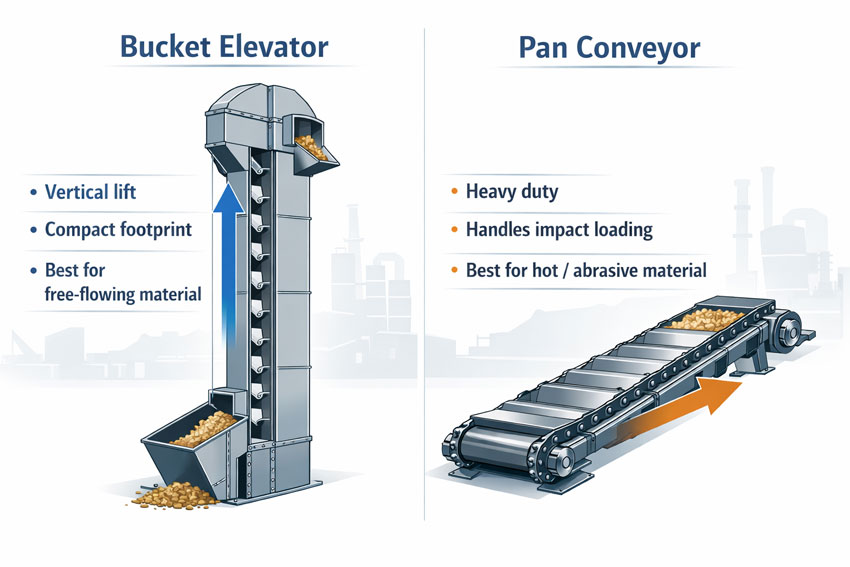
A bucket elevator is a vertical conveying system designed to lift bulk materials using a series of buckets attached to either a belt or chain. The buckets scoop material from the boot section and carry it upward to the discharge point.
Bucket elevators are widely used where material must be lifted vertically in a compact footprint.
Key Components
Buckets (steel, nylon, or HDPE)
Belt or chain drive
Boot section (material inlet)
Head section with drive and discharge
Casing or elevator trunking
Typical Applications
Grain handling
Fertiliser plants
Cement and lime processing
Mining concentrate handling
Sand, ash, or powder transport
Advantages
Efficient vertical lifting
Small plant footprint
High throughput capacity
Energy efficient for vertical transport
Limitations
Not ideal for very abrasive or large lump materials
Sensitive to overloading and blockages
Requires careful alignment and maintenance
What is a Pan Conveyor?
A pan conveyor, often called an apron conveyor, transports material horizontally or on shallow inclines using overlapping steel pans attached to heavy-duty chains.
The pans form a continuous moving surface that carries material along the conveyor frame.
Pan conveyors are commonly used in harsh industrial environments where materials are heavy, hot, or abrasive.
Key Components
Steel pans or plates
Heavy-duty conveyor chains
Sprockets and drive system
Conveyor frame
Impact loading zone
Typical Applications
Clinker transport in cement plants
Mining ore handling
Hot ash handling
Crusher discharge conveyors
Furnace feed systems
Advantages
Handles very heavy and abrasive materials
Suitable for impact loading
Reliable in harsh environments
Can operate at slow controlled speeds
Limitations
Larger footprint
Higher capital cost
More power consumption than bucket elevators
Key Differences Between Bucket Elevators and Pan Conveyors
Bucket Elevator
Vertical conveying system
Best for fine to medium bulk materials
Compact footprint
High energy efficiency for vertical transport
Requires controlled loading
Pan Conveyor
Horizontal or inclined conveying system
Handles heavy, abrasive or hot materials
Larger footprint
More robust construction
Handles high impact loading
When to Choose a Bucket Elevator
A bucket elevator is typically the preferred solution when:
Material must be lifted vertically
Plant space is limited
The material is free-flowing
Throughput is high but impact loading is low
Examples include grain silos, cement plants, fertiliser plants, and powder handling systems.
In these situations, bucket elevators provide a compact and energy-efficient solution.
When to Choose a Pan Conveyor
A pan conveyor is the better choice when:
Material is coarse, hot, or abrasive
There is high impact loading
The conveyor must operate continuously in harsh conditions
Reliability is more important than plant footprint
Examples include crusher discharge conveyors, furnace feed systems, clinker transport, and mining ore handling.
Pan conveyors are designed to survive the harshest bulk material handling environments.
Engineering Design Considerations
When designing either system, engineers must consider the following:
Bulk material characteristics
Lump size distribution
Abrasiveness
Moisture content
Throughput requirements
Loading conditions
Maintenance access
Structural support
Modern projects often integrate 3D laser scanning and point cloud modelling to ensure conveyors fit within existing plants and connect correctly to existing infrastructure. This approach reduces installation risk and helps engineers verify clearances, structural loads, and maintenance access before fabrication.

Engineering Support for Conveyor Design
Hamilton By Design supports industrial projects with:
Mechanical conveyor design
3D laser scanning of existing plants
Conveyor chute and transfer design
Structural steel and support frames
Inspection and maintenance optimisation
Whether designing a bucket elevator for vertical material handling or a heavy-duty pan conveyor for mining operations, selecting the correct system is critical to long-term reliability and operational efficiency.