


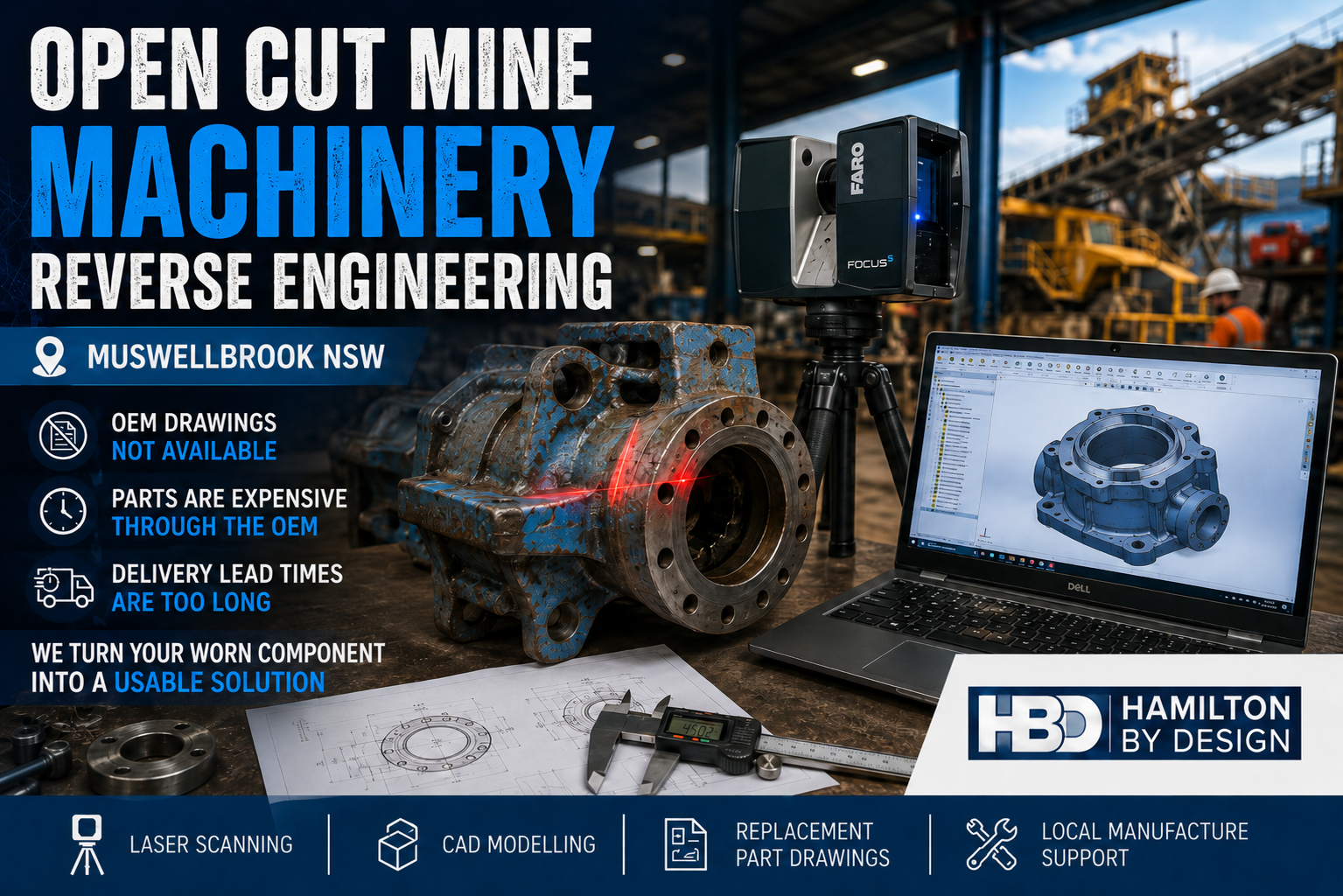
Replacement Parts Without OEM Drawings, Long Lead Times or Excessive OEM Costs
Open cut mining operations around Muswellbrook NSW rely on heavy machinery, fixed plant, conveyors, crushers, feeders, pumps, screens, chutes, hoppers, guards, frames and access systems to keep production moving.
When a critical machinery component wears out, cracks, fails or becomes obsolete, the first option is often to contact the original equipment manufacturer.
But for many mining maintenance teams, that creates a serious problem.
The OEM may not provide detailed drawings.
The replacement part may be expensive.
The delivery lead time may be too long.
The machine may be older, modified or no longer fully supported.
This can leave mine operators, maintenance teams and shutdown planners with limited options when they need a replacement part quickly.
Hamilton By Design supports open cut mining operations, maintenance teams, fabricators and repair workshops with engineering-grade 3D laser scanning and mining plant upgrade support, reverse engineering, CAD modelling and engineering documentation for mine machinery components.
Our focus is not open cut pit scanning or mine survey work. Our focus is machinery, fixed plant, replacement parts and brownfield equipment support.
If a component can be removed, measured, scanned or inspected, it may be possible to develop a 3D CAD model, manufacturing drawing or replacement part design that supports local manufacture, repair or redesign.
The Real Problem: OEM Drawings Are Not Available
For many mining assets, the biggest problem is not always that old site drawings are outdated. The larger problem is that the equipment owner often does not have access to the detailed OEM drawings required to reproduce or repair the part.
The mine may own the machine.
The maintenance team may own the worn component.
The workshop may be able to manufacture a replacement.
But without the correct drawings, dimensions, tolerances, materials and fit-up information, the replacement process becomes difficult.
This is a common problem with:
- Older mining machinery
- Imported equipment
- Obsolete parts
- Proprietary OEM components
- Modified equipment
- Worn mechanical assemblies
- Shutdown-critical replacement parts
- Components with long supply lead times
- Parts that are too expensive through the OEM supply chain
When a part is urgently needed, waiting weeks or months for an imported OEM replacement may not be practical. In some cases, the part cost may also be difficult to justify, especially when a local fabrication or machining solution may be possible.
Reverse engineering provides another pathway.
What Is Mine Machinery Reverse Engineering?
Mine machinery reverse engineering is the process of capturing the geometry, features and function of an existing component so that a usable CAD model, drawing or replacement design can be created.
This may involve laser scanning, manual measurement, inspection, CAD modelling and engineering review.
The aim is to understand the part well enough to support repair, manufacture, fit-up or redesign.
Depending on the component, this may include:
- Measuring critical diameters
- Capturing bolt hole patterns
- Checking shaft, bush and bearing fits
- Modelling flanges, brackets and housings
- Recording wear surfaces
- Capturing complex cast shapes
- Creating 3D CAD models
- Producing 2D manufacturing drawings
- Identifying practical fabrication methods
- Supporting local machining, fabrication or casting
Reverse engineering is especially useful where the original drawings are not available from the OEM, or where the part has been modified during its service life.
Hamilton By Design also provides replacement part reverse engineering where OEM drawings are unavailable, helping asset owners move from a physical component to usable manufacturing information.
Why This Matters for Muswellbrook Mining Operations
Muswellbrook and the surrounding Upper Hunter region support major mining, industrial maintenance and heavy equipment operations. Open cut mine machinery is exposed to harsh operating conditions, heavy loads, vibration, dust, impact, abrasion and constant production pressure.
When machinery components fail, the issue is rarely simple.
A replacement part may be required urgently.
The part may need to fit into an existing machine.
The equipment may be old or modified.
The OEM may have a long delivery time.
The replacement price may be high.
The mine may need a local repair or manufacturing option.
This is where laser scanning and reverse engineering can assist. Instead of relying only on unavailable OEM drawings, the existing component can be captured, measured and converted into usable engineering information.
That information can then support local manufacturing, repair, redesign or future asset documentation.
For mining operators, contractors and industrial clients across the region, Hamilton By Design provides Hunter Valley mining engineering and 3D laser scanning services focused on practical brownfield plant, machinery and materials handling problems.
Common Machinery Parts That May Be Reverse Engineered
Hamilton By Design can assist with reverse engineering and CAD documentation for a range of mine machinery and fixed plant components.
Examples include:
- Pump components
- Bearing housings
- Drive components
- Couplings
- Guards and covers
- Conveyor components
- Chute components
- Hopper parts
- Wear liners
- Brackets and mounts
- Structural frames
- Shafts and sleeves
- Flanges and adaptors
- Fabricated assemblies
- Cast components
- Obsolete machine parts
- Modified equipment parts
Some parts require high-detail measurement. Others require practical engineering judgement to determine which features are critical and which features can be simplified for manufacture.
The goal is not always to create a perfect visual copy of the original part. The goal is to create useful engineering information that allows the replacement part to be manufactured, fitted and used safely.
How Laser Scanning Helps
Laser scanning is useful when a component has complex geometry, difficult-to-measure surfaces or no existing CAD model.
A laser scanner captures the visible surfaces of the part as a point cloud. This data can then be used as a reference for CAD modelling and dimensional checking.
Laser scanning can be especially useful for:
- Castings
- Worn parts
- Complex housings
- Curved surfaces
- Irregular shapes
- Large fabricated items
- Assemblies with multiple interfaces
- Parts where manual measurement alone is slow or difficult
However, laser scanning is only one part of the process.
For machinery reverse engineering, critical dimensions still need to be understood. Bearing fits, shaft fits, bolt holes, machined faces, threads, splines, sealing surfaces and alignment features may require additional measurement and engineering review.
That is why Hamilton By Design combines laser scanning with practical mechanical design and CAD modelling experience.
The Reverse Engineering Workflow
A typical reverse engineering workflow may include the following steps.
1. Identify the Part and the Problem
The first step is to understand what the part does and why it needs to be replaced.
Questions may include:
- Is the part worn, cracked, broken or obsolete?
- Is the part required for a shutdown?
- Is the OEM replacement too expensive?
- Is the lead time too long?
- Is the part being repaired, copied or improved?
- Does the replacement need to match the original exactly?
- Are there known fit-up issues with the existing machine?
Understanding the problem helps determine the correct level of measurement and modelling.
2. Inspect and Measure the Component
The component is inspected and measured. This may include laser scanning, manual measurement, photographs, sketches and notes.
Critical features may include:
- Bolt hole centres
- Mounting faces
- Shaft diameters
- Bearing locations
- Overall envelope size
- Mating faces
- Wear surfaces
- Clearance areas
- Welded or machined details
- Material thicknesses
- Assembly interfaces
Where a part is worn, care is needed. The worn shape may not represent the original working geometry. In these cases, engineering judgement may be required to determine the intended size or fit.
3. Create a 3D CAD Model
The measured data is used to create a 3D CAD model.
This model may be developed in SolidWorks, Inventor or another suitable CAD platform. The model can be used to check geometry, confirm fit-up and prepare manufacturing information.
Depending on the job, the model may represent:
- A single component
- A machined part
- A fabricated assembly
- A casting
- A guard or cover
- A chute section
- A pump component
- A machine frame
- A modified replacement design
Hamilton By Design provides 3D CAD modelling for mining, heavy industry and mechanical plant projects, helping convert site measurements, scans, sketches and physical components into practical engineering models.
The model can also be exported in common formats such as STEP, SAT or Parasolid for use by fabricators, machinists or other engineering teams.
4. Produce Manufacturing Drawings
Once the model is complete, 2D drawings can be created for manufacture.
These drawings may include:
- General dimensions
- Critical fit dimensions
- Hole patterns
- Machined faces
- Material notes
- Weld details
- Fabrication notes
- Assembly details
- Tolerance requirements
- Surface finish requirements where needed
The level of drawing detail should suit the manufacturing process. A fabricated guard does not need the same detail as a machined bearing housing. A cast component may require different information again.
5. Review Fit-Up and Future Use
The replacement part can then be checked against the original component, mating parts or surrounding machine geometry.
Where needed, the CAD data can also be stored for future use. This gives the asset owner better control over future replacement, repair or redesign work.
Once the part has been reverse engineered, the mine is no longer starting from zero the next time that component is required.
Benefits of Reverse Engineering Mine Machinery Parts
Reverse engineering can provide several practical benefits for mine operators, maintenance teams and fabrication workshops.
Reduced Dependence on OEM Drawings
When the OEM will not provide drawings, reverse engineering can create the missing technical information needed to support local manufacture or repair.
Shorter Lead Times
If a local fabricator or machine shop can manufacture the part, the project may avoid long OEM supply delays.
Better Cost Control
OEM replacement parts can be expensive. Reverse engineering can help identify whether local manufacture, repair or redesign is a practical alternative.
Support for Obsolete Equipment
Older machinery may no longer be fully supported. Reverse engineering helps extend the life of useful assets where replacement parts are difficult to obtain.
Improved Shutdown Planning
Having drawings and CAD models ready before a shutdown can reduce uncertainty and improve planning.
Future Asset Control
Once the part is modelled and documented, the mine has better information for future maintenance, procurement and engineering decisions.
Not Every Part Should Be Copied Without Review
Reverse engineering does not mean blindly copying every worn or damaged part.
Some parts are safety critical. Some parts are highly loaded. Some parts may have fatigue, wear, material or heat treatment requirements. Some components may be subject to compliance, certification or OEM warranty considerations.
That means each part should be reviewed properly before manufacture.
In some cases, the best approach may be:
- Direct replacement
- Repair
- Redesign
- Strength improvement
- Material upgrade
- Manufacturing process change
- Additional engineering verification
- FEA or stress review
- Supplier review
- Third-party certification
Hamilton By Design can assist with the engineering documentation and CAD modelling needed to support these decisions.
Tools Used by Hamilton By Design
Hamilton By Design uses a practical mix of scanning, modelling and engineering tools to support machinery reverse engineering projects.
These may include:
- FARO Focus laser scanning
- FARO SCENE point cloud processing
- Manual measurement and inspection
- SolidWorks CAD modelling
- Autodesk Inventor modelling
- AutoCAD drafting
- STEP, SAT and Parasolid export
- 2D manufacturing drawings
- Assembly drawings
- Fabrication drawings
- Design verification
- SolidWorks Simulation or FEA support where required
The right tools depend on the part, the accuracy required and the manufacturing method.
Why Work With Hamilton By Design?
Hamilton By Design combines site measurement, laser scanning, mechanical design, CAD modelling and practical manufacturing experience.
This is important because mine machinery reverse engineering is not just a scanning exercise.
A scan can capture shape.
But the engineering process must also understand fit, function, manufacturing method, tolerances, material selection, access, assembly and maintenance requirements.
Hamilton By Design can support:
- Mine operators
- Maintenance teams
- Shutdown planners
- Reliability engineers
- Fabricators
- Machine shops
- Repair workshops
- Industrial contractors
For Muswellbrook and Upper Hunter mining operations, this service is aimed at machinery and fixed plant problems where the OEM pathway is too slow, too expensive or too restrictive.
Open Cut Mine Machinery Reverse Engineering in Muswellbrook NSW
If your mining operation has a worn, damaged or obsolete machinery component and the OEM will not supply drawings, Hamilton By Design can help create practical engineering information from the existing part.
We can assist with laser scanning, reverse engineering, CAD modelling and manufacturing drawings for mine machinery and fixed plant components.
This can help reduce reliance on OEM supply chains, support local manufacture and improve control over future maintenance.

Need Replacement Part Drawings Without OEM Support?
Hamilton By Design provides reverse engineering and CAD modelling support for mine machinery components in Muswellbrook, the Upper Hunter and across NSW.
If the OEM will not provide drawings, the lead time is too long or the replacement part cost is too high, reverse engineering may provide a practical path forward.
Contact Hamilton By Design to discuss machinery laser scanning, reverse engineering, CAD modelling and replacement part documentation for mining equipment and fixed plant components.
Talk to Us – Contact Us
Our clients:
























