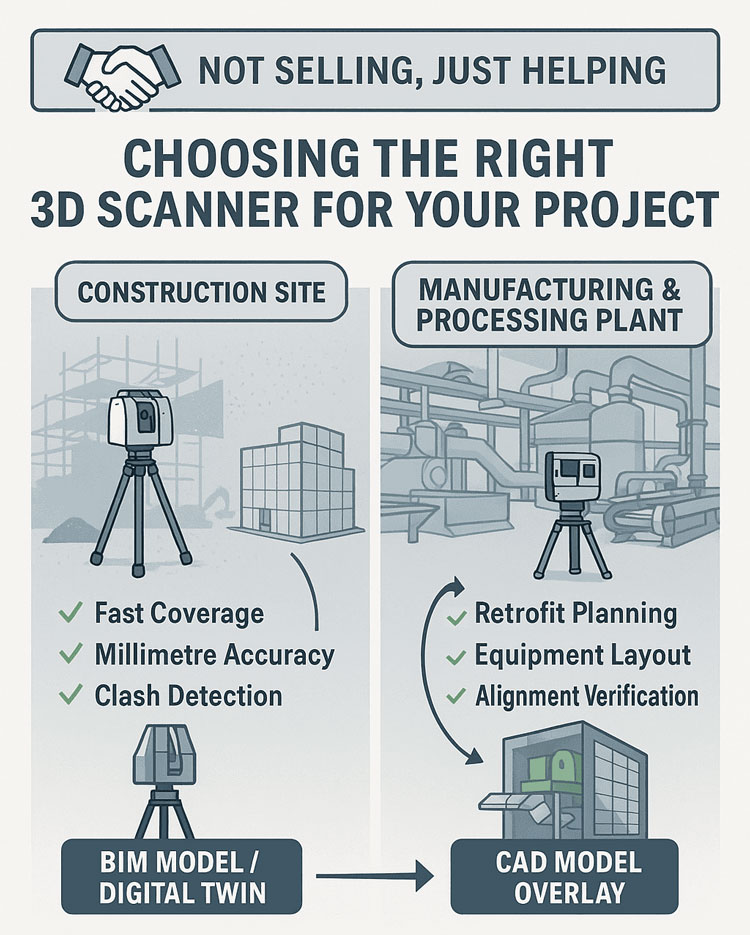
3D LiDAR scanning has rapidly become one of Australia’s most valuable engineering tools — and for good reason. From mining CHPPs to power stations, manufacturing plants, processing facilities, marine infrastructure, and complex brownfield upgrades, LiDAR delivers accuracy, clarity, and reliability that traditional measurement methods simply can’t match.
Across Australia’s most demanding industrial regions — the Hunter Valley, Bowen Basin, Pilbara, Mount Isa, Central Coast, Sydney, Adelaide, and beyond — Hamilton By Design provides engineering-grade 3D LiDAR scanning, mechanical design, and full digital-engineering workflows that help clients minimise shutdown duration, eliminate rework, and make better decisions.
This page explains what 3D LiDAR scanning is, why it matters, and how it delivers real, measurable benefits to Australian mining, industrial, and manufacturing operations.
What Is 3D LiDAR Scanning?
LiDAR (Light Detection and Ranging) uses laser pulses to measure millions of points per second, capturing the exact geometry of equipment, structures, and environments. The result is a high-resolution point cloud that serves as a digital replica of the asset — precise down to the millimetre.
Hamilton By Design uses FARO engineering-grade scanners delivering:
- ±1–2 mm accuracy
- Full-colour point clouds
- Safe, fast external and internal scanning
- High-resolution data suitable for mechanical design and fabrication
This accuracy allows us to model steelwork, chutes, conveyors, piping, tanks, equipment frames, building interiors, structural interfaces, and entire wash plants with confidence.
Why Australian Industries Are Turning to LiDAR
Australia’s mining, energy, and industrial sectors face unique pressures:
tight shutdown windows, ageing infrastructure, safety constraints, limited access, and the constant demand for more accurate data.
LiDAR scanning solves these challenges by offering:
1. Fast, Safe, Non-Contact Measurement
No climbing into hazardous areas.
No lengthy tape measurements.
No assumptions.
LiDAR captures everything from a safe distance — ideal for CHPPs, crushing circuits, transfer towers, power stations, and restricted plant rooms.
2. Zero Guesswork in Brownfield Engineering
Brownfield sites are messy. Nothing is straight, square, or built to the original drawing anymore.
With LiDAR:
- Misalignment is captured
- Deformation is visible
- Corrosion and sag are measurable
- Legacy drawings can be validated or corrected
This drastically reduces design error across upgrades, fabrication, and shutdown works.
3. Millimetre-Accurate 3D Models for Fabrication
After scanning, Hamilton By Design converts the point cloud into:
- SolidWorks 3D models
- GA drawings
- Fabrication drawings
- DXF profiles
- Shop-ready detail packs
Fabricators love it because parts fit the first time, and rework is almost eliminated.
4. Better Shutdown Planning
LiDAR scanning provides clear digital visibility of:
- Access routes
- Lifting paths
- Structural constraints
- Tie-in locations
- Clash points
This leads to safer, faster, more predictable shutdown execution.
5. Digital Twins for Long-Term Asset Management
A structured point cloud becomes a digital baseline for future planning.
Clients use it for:
- Condition monitoring
- Deviation tracking
- Long-term upgrade planning
- Documentation for compliance
It builds engineering resilience into the asset lifecycle.
Industries We Support Across Australia
Hamilton By Design delivers LiDAR scanning and mechanical engineering solutions nationwide, supporting:
Mining & Heavy Industry
- CHPPs
- Coal handling plants
- Hard-rock processing facilities
- Underground & surface operations
- Conveyors, chutes, crushers, screen houses
Energy & Utilities
- Power stations
- Turbine halls
- Boiler houses
- Substations
- Cooling water systems
Manufacturing & Industrial
- Plants and factories
- Production lines
- Warehouses
- Material-handling systems
Data Centres & Infrastructure
- Fit-out scans
- MEP coordination
- Expansion planning
- Brownfield integration
Wherever precision and clarity are required, LiDAR scanning adds value.
Our Digital Engineering Workflow
Hamilton By Design integrates LiDAR scanning into a full project lifecycle:
- On-site LiDAR scan using FARO engineering-grade equipment
- Processing in FARO Scene to create a clean, structured point cloud
- Import into SolidWorks for modelling of required geometry
- 3D modelling & mechanical design
- Clash detection & feasibility checks
- 3DEXPERIENCE reviews with clients
- Fabrication drawings, DXF files, and shop packs
- Handover + digital twin for future works
This ensures absolute clarity from the first scan to the final signed-off drawing.
Benefits for Australian Projects
✔ Parts fit first time
✔ Shutdown durations reduced
✔ Fabricators receive complete, accurate information
✔ Safer site access with fewer high-risk activities
✔ Eliminates rework, delays, and measurement errors
✔ Enhances engineering collaboration
✔ Reduces total project cost
LiDAR scanning isn’t just a measurement method — it’s a competitive advantage.
Why Choose Hamilton By Design
- Over a decade of experience in heavy industry
- Extensive CHPP and mining plant expertise
- SolidWorks Simulation, FEA, and advanced modelling capability
- Fast mobilisation across Australia
- Detailed, fabrication-ready deliverables
- LinkedIn-trusted and industry-proven
- Engineering accuracy at every step
For clients across the Hunter Valley, Bowen Basin, Pilbara, NSW, QLD, WA, and SA — we offer scalable, high-precision digital engineering that delivers reliability and confidence.
Ready to Start Your Project?
Hamilton By Design offers 3D LiDAR scanning anywhere in Australia, from mine sites to manufacturing plants to data centres.
If you’re planning:
- an upgrade
- a shutdown
- a brownfield expansion
- a feasibility study
- or an equipment replacement
…LiDAR scanning is the smartest starting point.
Contact us today to book a site scan or request a proposal.
3D Point Clouds Are a Game-Changer for Your Projects
Your Experts in 3D Laser Scanning & Mechanical Design