Stop Reacting โ€” Start Engineering

Hamilton By Design logo displayed on a blue tilted rectangle with a grey gradient background

How Smart Mechanical Strategies Extend CHPP Life

Every coal wash plant in Australia tells the same story: constant throughput pressure, harsh operating conditions, and the never-ending battle against wear, corrosion, and unplanned downtime. The reality is simple โ€” if you donโ€™t engineer for reliability, youโ€™ll spend your time repairing failure.

At Hamilton By Design, we specialise in mechanical engineering, 3D scanning, and digital modelling for coal handling and preparation plants (CHPPs). Our goal is to help site teams transition from reactive maintenance to a precision, data-driven strategy that keeps production steady and predictable.
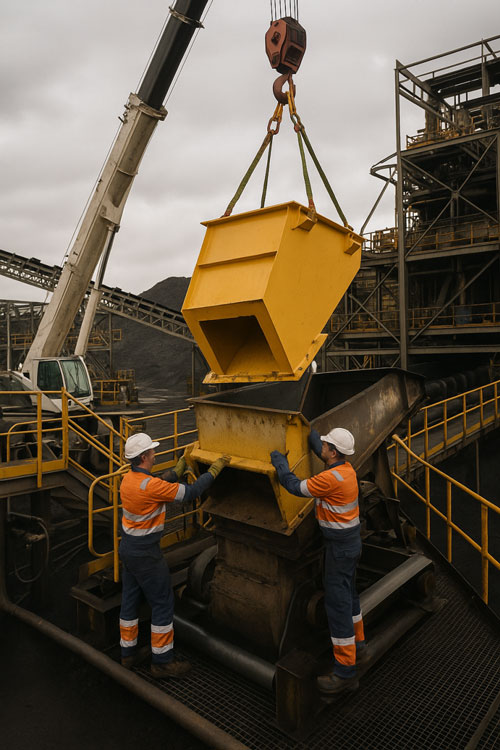
Workers guiding a crane-lifted yellow chute into position at a coal handling and preparation plant, with conveyor infrastructure and safety equipment visible on site

Design for Reliability โ€” Not Reaction

Reliability begins with smart mechanical design. Poor geometry, limited access, and undersized components lead to fatigue and repeated downtime. Instead, modern CHPP maintenance programs start by engineering for fit, lift, and life:

  • Fit: Design components that align with the existing structure โ€” every bolt, flange, and mating face verified digitally before fabrication.
  • Lift: Incorporate certified lifting points that comply with AS 4991 Lifting Devices, and ensure clear access paths for cranes or chain blocks.
  • Life: Select wear materials suited to the physics of the process โ€” quenched and tempered steel for impact, rubber or ceramic for abrasion, and UHMWPE for slurry lines.

Itโ€™s not just about parts; itโ€™s about engineering foresight. A well-designed plant component is safer to install, easier to inspect, and lasts longer between shutdowns.


Scan What You See โ€” Not What You Think You Have

Over time, every wash plant drifts from its original drawings. Field welds, retrofits, and corrosion mean that โ€œas-builtโ€ and โ€œas-existsโ€ are rarely the same thing.

Thatโ€™s where LiDAR scanning transforms maintenance. Using sub-millimetre accuracy, 3D laser scans capture your plant exactly as it stands โ€” every pipe spool, every chute, every bolt hole.

With this data, our engineers can:

  • Overlay new models directly into your point cloud to confirm fit-up before fabrication.
  • Identify alignment errors, corrosion zones, and clearance conflicts before shutdowns.
  • Generate true digital twins that allow for predictive maintenance and simulation.

LiDAR scanning isnโ€™t just a measurement tool; itโ€™s an insurance policy against rework and lost production.
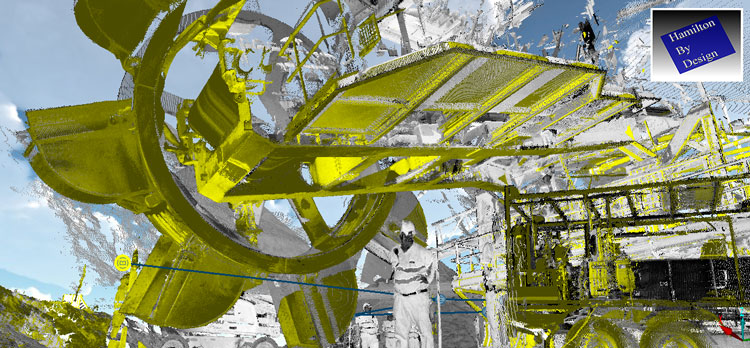
3D LiDAR point cloud of a CHPP plant showing detailed structural geometry, equipment, platforms, and personnel captured during an industrial site scan for engineering and upgrade planning.

Corrosion: The Hidden Killer in Every CHPP

Coal and water donโ€™t just move material โ€” they create acidic environments that eat through untreated or aging steel. In sumps, launders, and under conveyors, corrosion silently compromises strength until a structure is no longer safe to walk on.

Regular inspections are the first line of defence. At Hamilton By Design, we recommend combining:

  • Daily visual checks by operators for surface rust and coating damage.
  • Thickness testing during shutdowns to track wall loss on chutes and pipes.
  • 3D scan comparisons every 6โ€“12 months to quantify deformation and corrosion in critical structures.

With modern tools, you can see corrosion coming long before it becomes a failure.


From Data to Decision: Predictive Maintenance in Action

A coal wash plant produces a river of data โ€” motor loads, vibration levels, pump pressures, liner thickness, and flow rates. The key is turning that data into insight.

By integrating scanning results, maintenance records, and sensor data, plant teams can identify trends that point to future breakdowns. For example:

  • Vibration trending can reveal bearing fatigue weeks before failure.
  • Load monitoring can detect screen blinding or misalignment.
  • Scan data overlays can show sagging supports or displaced chutes.

When you understand what your plant is telling you, you move from reacting to problems to predicting and preventing them.
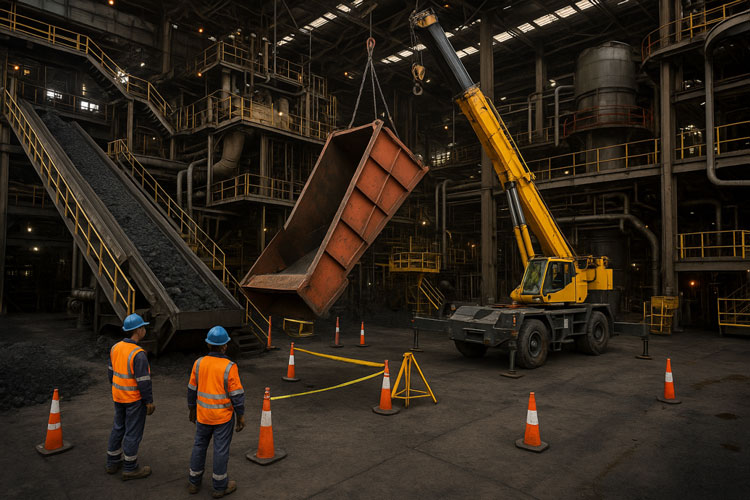

Industrial shutdown scene showing workers monitoring a mobile crane lifting a large steel chute inside a coal processing plant, with safety cones and exclusion zones in place

Shutdowns: Planned, Precise, and Productive

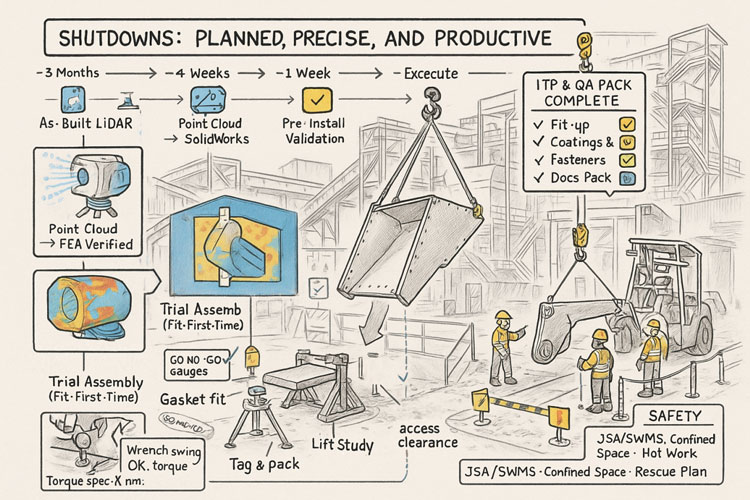
Every shutdown costs money โ€” the real goal is to make every hour count. The best shutdowns start months ahead with validated design data and prefabrication QA.

Before you cut steel or mobilise cranes, every component should be digitally proven to fit. Trial assemblies, lifting studies, and bolt access checks prevent costly surprises once youโ€™re on the clock.

At Hamilton By Design, our process combines:

  • LiDAR scanning to confirm as-built geometry.
  • SolidWorks modelling and FEA for mechanical verification.
  • Pre-installation validation to ensure bolt holes, flanges, and lift paths align on day one.

Thatโ€™s how you replace chutes, spools, and launders in a fraction of the usual time โ€” safely, and with confidence.

Hand-drawn infographic showing the shutdown workflow from LiDAR scanning and FEA verification through SolidWorks modelling, pre-install validation, trial assembly, lift study, and execution, including ITP and QA checks, safety steps, and onsite installation activities

The Payoff: Reliability You Can Measure

The plants that invest in engineering-led maintenance see results that are tangible and repeatable:

Improvement AreaTypical Gain
Reduced unplanned downtime30โ€“40%
Increased liner lifespan25โ€“50%
Shorter shutdown duration10โ€“20%
Fewer fit-up issues and rework60โ€“80%
Improved safety performance20โ€“30%

Reliability isnโ€™t luck โ€” itโ€™s engineered.


Hamilton By Design logo displayed on a blue tilted rectangle with a grey gradient background

Your Next Step: A Confidential Mechanical Assessment

Whether your plant is in the Bowen Basin, Hunter Valley, or Central West NSW, our team can deliver a confidential mechanical and scanning assessment of your wash plant.

Weโ€™ll benchmark your current maintenance strategy, identify high-risk areas, and provide a clear roadmap toward predictive, engineered reliability.

๐Ÿ“ฉ For a confidential assessment of your current wash plant, contact:
info@hamiltonbydesign.com.au

Stop reacting. Start engineering. Build reliability that lasts.

Name
Would you like us to arrange a phone consultation for you?
Address

Our clients:

Mechanical Engineering | Structural Engineering

Mechanical Drafting | Structural Drafting

3D CAD Modelling | 3D Scanning

Chute Design

Maximizing Equipment Efficiency with ISO 18436.2 Maintenance Strategies

At Hamilton By Design, we know that keeping your equipment running efficiently isnโ€™t just about quick fixes; itโ€™s about adopting the right maintenance strategies to ensure long-term reliability and performance. With advancements in condition monitoring and diagnostic techniques, the ISO 18436.2 standard has become a cornerstone for effective maintenance practicesโ€”and itโ€™s at the heart of how we help our clients optimize their operations.

In this blog post, weโ€™ll explore the major maintenance strategies aligned with ISO 18436.2 and how they can transform your plantโ€™s productivity.


What is ISO 18436.2?

ISO 18436.2 is an internationally recognized standard that defines the competencies required for personnel performing condition monitoring and diagnostics. It focuses on advanced tools like vibration analysis, helping engineers identify equipment issues before they lead to costly downtime.

At Hamilton By Design, our team is ISO 18436.2-certified, meaning we bring the highest level of expertise to your maintenance needs.


Maintenance Strategies That Deliver Results

ISO 18436.2 aligns with several key maintenance strategies designed to improve reliability, minimize downtime, and optimize equipment performance. Hereโ€™s how they work:

1. Reactive Maintenance

Reactive maintenance is the traditional โ€œrun-to-failureโ€ approach where repairs are made after a breakdown. While not ideal for critical assets, tools like vibration analysis can still play a role by identifying root causes post-failure. This can help inform more proactive strategies in the future.

2. Preventive Maintenance (PM)

Preventive maintenance involves scheduling regular maintenance tasks to prevent failures. While effective to some extent, PM can lead to over-maintenance. By incorporating vibration analysis and other condition monitoring techniques, preventive measures can be more precisely targeted, reducing unnecessary downtime.

3. Condition-Based Maintenance (CBM)

Condition-Based Maintenance uses real-time equipment data to identify issues as they arise. This strategy is central to ISO 18436.2 and includes tools like vibration analysis, thermography, and ultrasonic testing. CBM ensures that maintenance is performed only when necessary, saving time and money.

Benefits:

  • Reduces unplanned downtime.
  • Optimizes maintenance schedules.
  • Extends equipment lifespan.

4. Predictive Maintenance (PdM)

Predictive Maintenance takes CBM a step further, using data trends and analytics to predict when failures are likely to occur. With the expertise of ISO 18436.2-certified personnel, PdM uses advanced tools to detect subtle signs of wear or stress, allowing for intervention before a problem becomes critical.

Key Tools:

  • Vibration analysis for early detection of imbalance or misalignment.
  • Infrared thermography to spot heat anomalies.
  • Ultrasonic testing to identify leaks and material defects.

5. Reliability-Centered Maintenance (RCM)

RCM focuses on understanding the specific failure modes of critical assets and tailoring maintenance strategies accordingly. This approach integrates condition monitoring insights to prioritize tasks that align with operational goals.

Benefits:

  • Aligns maintenance efforts with production priorities.
  • Reduces the risk of unexpected equipment failures.

6. Proactive Maintenance

Proactive maintenance identifies and addresses root causes of recurring issues. By analyzing data from vibration and other diagnostic tools, engineers can resolve underlying problems like misalignment, improper lubrication, or material fatigue.

Impact:

  • Prevents repetitive failures.
  • Improves long-term equipment reliability.

7. Total Productive Maintenance (TPM)

TPM involves a plant-wide effort, from operators to management, to ensure optimal equipment effectiveness. ISO 18436.2-certified personnel can support TPM by providing actionable condition monitoring insights and training operators in basic diagnostic techniques.


How Hamilton By Design Helps

At Hamilton By Design, we bring these strategies to life through tailored maintenance solutions that align with your plantโ€™s needs. Hereโ€™s how we can help:

1. Advanced Condition Monitoring:
Our team uses state-of-the-art tools to monitor equipment health, including vibration analysis, thermography, and ultrasonic testing.

2. Tailored Maintenance Plans:
Every plant is unique. We develop maintenance strategies based on your specific equipment, production goals, and operational priorities.

3. Expert Training and Certification:
We empower your team by offering ISO 18436.2 training, giving them the skills to sustain and enhance maintenance programs.

4. Ongoing Support:
Maintenance is a journey, not a destination. We provide continuous support to refine and optimize your practices as your operations evolve.


The Hamilton By Design Advantage

Adopting advanced maintenance strategies aligned with ISO 18436.2 isnโ€™t just about improving equipment reliabilityโ€”itโ€™s about unlocking greater productivity and profitability for your business.

With our expertise, you can transition from reactive to predictive maintenance, reduce unplanned downtime, and extend the lifespan of your critical assets.

Ready to take your plantโ€™s maintenance strategy to the next level? Contact Hamilton By Design today to find out how we can help.

Visit us at: www.hamiltonbydesign.com.au
Email us: sales@hamiltonbydesign.com.au
Call us: +61 0477 002 249


Hamilton By Design | Transforming Maintenance | Elevating Performance | Mechanical Engineering

Name
Would you like us to arrange a phone consultation for you?
Address

Maximizing Equipment Efficiency with ISO 18436.2 Maintenance Strategies

At Hamilton By Design, we know that keeping your equipment running efficiently isnโ€™t just about quick fixes; itโ€™s about adopting the right maintenance strategies to ensure long-term reliability and performance. With advancements in condition monitoring and diagnostic techniques, the ISO 18436.2 standard has become a cornerstone for effective maintenance practicesโ€”and itโ€™s at the heart of how we help our clients optimize their operations.

In this blog post, weโ€™ll explore the major maintenance strategies aligned with ISO 18436.2 and how they can transform your plantโ€™s productivity.

Hamilton By Design

What is ISO 18436.2?

ISO 18436.2 is an internationally recognized standard that defines the competencies required for personnel performing condition monitoring and diagnostics. It focuses on advanced tools like vibration analysis, helping engineers identify equipment issues before they lead to costly downtime.

At Hamilton By Design, our team is ISO 18436.2-certified, meaning we bring the highest level of expertise to your maintenance needs.


Maintenance Strategies That Deliver Results

ISO 18436.2 aligns with several key maintenance strategies designed to improve reliability, minimize downtime, and optimize equipment performance. Hereโ€™s how they work:

1. Reactive Maintenance

Reactive maintenance is the traditional โ€œrun-to-failureโ€ approach where repairs are made after a breakdown. While not ideal for critical assets, tools like vibration analysis can still play a role by identifying root causes post-failure. This can help inform more proactive strategies in the future.

2. Preventive Maintenance (PM)

Preventive maintenance involves scheduling regular maintenance tasks to prevent failures. While effective to some extent, PM can lead to over-maintenance. By incorporating vibration analysis and other condition monitoring techniques, preventive measures can be more precisely targeted, reducing unnecessary downtime.

3. Condition-Based Maintenance (CBM)

Condition-Based Maintenance uses real-time equipment data to identify issues as they arise. This strategy is central to ISO 18436.2 and includes tools like vibration analysis, thermography, and ultrasonic testing. CBM ensures that maintenance is performed only when necessary, saving time and money.

Benefits:

  • Reduces unplanned downtime.
  • Optimizes maintenance schedules.
  • Extends equipment lifespan.

4. Predictive Maintenance (PdM)

Predictive Maintenance takes CBM a step further, using data trends and analytics to predict when failures are likely to occur. With the expertise of ISO 18436.2-certified personnel, PdM uses advanced tools to detect subtle signs of wear or stress, allowing for intervention before a problem becomes critical.

Key Tools:

  • Vibration analysis for early detection of imbalance or misalignment.
  • Infrared thermography to spot heat anomalies.
  • Ultrasonic testing to identify leaks and material defects.

5. Reliability-Centered Maintenance (RCM)

RCM focuses on understanding the specific failure modes of critical assets and tailoring maintenance strategies accordingly. This approach integrates condition monitoring insights to prioritize tasks that align with operational goals.

Benefits:

  • Aligns maintenance efforts with production priorities.
  • Reduces the risk of unexpected equipment failures.

6. Proactive Maintenance

Proactive maintenance identifies and addresses root causes of recurring issues. By analyzing data from vibration and other diagnostic tools, engineers can resolve underlying problems like misalignment, improper lubrication, or material fatigue.

Impact:

  • Prevents repetitive failures.
  • Improves long-term equipment reliability.

7. Total Productive Maintenance (TPM)

TPM involves a plant-wide effort, from operators to management, to ensure optimal equipment effectiveness. ISO 18436.2-certified personnel can support TPM by providing actionable condition monitoring insights and training operators in basic diagnostic techniques.


How Hamilton By Design Helps

At Hamilton By Design, we bring these strategies to life through tailored maintenance solutions that align with your plantโ€™s needs. Hereโ€™s how we can help:

1. Advanced Condition Monitoring:
Our team uses state-of-the-art tools to monitor equipment health, including vibration analysis, thermography, and ultrasonic testing.

2. Tailored Maintenance Plans:
Every plant is unique. We develop maintenance strategies based on your specific equipment, production goals, and operational priorities.

3. Expert Training and Certification:
We empower your team by offering ISO 18436.2 training, giving them the skills to sustain and enhance maintenance programs.

4. Ongoing Support:
Maintenance is a journey, not a destination. We provide continuous support to refine and optimize your practices as your operations evolve.


The Hamilton By Design Advantage

Adopting advanced maintenance strategies aligned with ISO 18436.2 isnโ€™t just about improving equipment reliabilityโ€”itโ€™s about unlocking greater productivity and profitability for your business.

With our expertise, you can transition from reactive to predictive maintenance, reduce unplanned downtime, and extend the lifespan of your critical assets.

Ready to take your plantโ€™s maintenance strategy to the next level? Contact Hamilton By Design today to find out how we can help.

Visit us at: www.hamiltonbydesign.com.au
Email us: info@hamiltonbydesign.com.au
Call us: +61 0477 002 249

Hamilton By Design


Hamilton By Design | Transforming Maintenance | Elevating Performance