Industrial Machine Guarding Certification (Fixed Plant) โ€“ Engineering Verification & Guard Design

Industrial fixed plant machine guard with interlocked yellow mesh enclosure and engineering verification checklist.

In industrial and mining environments, machine guarding is not a โ€œnice to haveโ€ โ€” itโ€™s a critical engineering control that protects people, prevents downtime, and demonstrates compliance with Australian WHS expectations.

Hamilton By Design Co. provides engineering-led design consulting and certification-style verification for fixed plant machine guarding, including new guarding systems, upgrades, and retrofit solutions for existing equipment.

Our focus is simple: protect workers, support safe production, and provide clear, defensible engineering documentation.
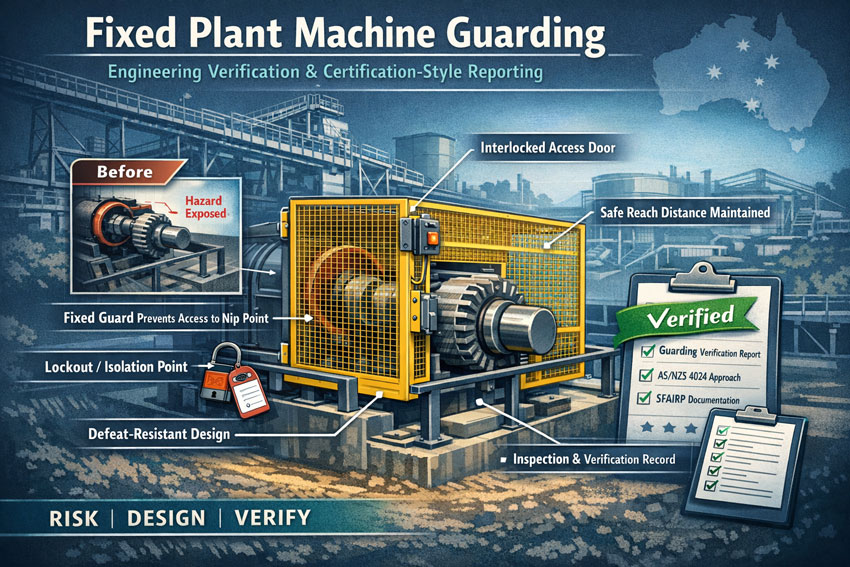

Engineering verification of fixed plant guarding with interlocked guard and inspection report.

What We Mean by โ€œGuarding Certificationโ€

In Australia, machine guarding is not typically certified under a single universal โ€œproduct stamp.โ€ Instead, machine guarding is assessed and verified through:

  • engineering design and risk-based safeguarding
  • alignment to recognised standards and good practice
  • site verification, inspection, and documentation that supports WHS duties

When we certify a guarding design, we provide an engineering verification that the guarding system has been assessed against Australian safety expectations and provides risk reduction so far as reasonably practicable (SFAIRP) for the intended use.


Fixed Plant Machine Guarding Services

We support fixed plant guarding across mining, processing, manufacturing, infrastructure and heavy industry, including:

Guarding Design & Retrofit Engineering

  • Fixed guards, mesh guards and perimeter guarding
  • Access prevention and safe maintenance access planning
  • Retrofit guarding upgrades for brownfields equipment
  • Guard structural design (frames, supports, fixings, corrosion allowance)

Guarding Verification & Certification Reports

  • Guard inspections (site verification and measurements)
  • Guarding compliance review and gap assessments
  • Design verification and risk reduction justification
  • Practical recommendations that balance safety and maintainability

Interlocks & Guarding Systems (Design Support)

  • Guard-associated interlocking concepts
  • Lock-out and isolation integration
  • Practical โ€œdefeat-resistantโ€ guard design principles

(Where functional safety calculations or specialist electrical control validation is required, we can work alongside your controls team or specialist partners.)


What We Deliver

Each project is documented for clarity and defensibility. Typical deliverables include:

  • Guarding risk review (hazards, access points, foreseeable misuse)
  • Design drawings / sketches and installation guidance
  • Verification checklist (inspection points and acceptance criteria)
  • Engineering Verification Report (often used as โ€œcertificationโ€ evidence)
  • Photo record and โ€œas-installedโ€ notes (where applicable)
  • Limitations, assumptions, and maintenance requirements

Standards & Compliance Approach

Our methodology is aligned with widely accepted Australian safeguarding practice, including:

  • AS/NZS 4024 (Safety of Machinery series)
  • Risk-based safeguarding methodology consistent with ISO 12100 principles
  • WHS duty expectations for plant and machinery risk control

We donโ€™t just reference standards โ€” we apply them to real conditions on your site: access, maintenance needs, exposure time, and realistic human behaviour around machines.


Who We Work With

We support:

  • mine sites and processing plants
  • maintenance departments
  • project teams (brownfields upgrades and shutdown work)
  • workshop supervisors and fabrication teams
  • OEMs and equipment suppliers needing Australian verification support

Whether your plant is locally built or imported, the end goal is the same: a safe guarding system that holds up under WHS scrutiny.


Why Hamilton By Design

Hamilton By Design is an engineer-led team that understands operational realities. We design guarding that:

  • protects people without creating unsafe workarounds
  • supports maintainability and inspection access
  • is practical to fabricate and install
  • is backed by professional engineering documentation

If you need a guarding solution that is fit-for-purpose and properly verified, we can support your team from assessment to final sign-off.


Typical Use Cases

  • Imported machinery requiring Australian guarding verification
  • Pre-commissioning guard reviews before handover
  • Incident-driven guarding upgrades
  • Shutdown retrofit packages and fabrication-ready guard designs
  • Periodic plant guarding audits and gap registers

Hamilton By Design logo displayed on a blue tilted rectangle with a grey gradient background

Call to Action

If you need a machine guarding certification-style verification or a complete fixed plant guarding design package, contact the Hamilton By Design team.

Letโ€™s reduce risk, protect your people, and keep your plant operating safely.

Name
Would you like us to arrange a phone consultation for you?
Address

Machine Guarding for Ship Loaders, Stackers & Reclaimers in Bulk Materials Handling

Machine Guarding for Ship Loaders, Stackers & Reclaimers | Bulk Materials Safety

Why guarding matters on large bulk material machines

Ship loaders, stackers and reclaimers combine elements of mobile plant, fixed plant and continuous conveying systems. Their scale, movement and operating envelopes introduce hazards that cannot be managed with ad-hoc or legacy guarding.

Most guarding failures are not caused by a single missing guard, but by brownfield modifications, undocumented changes, and loss of original design intent. This makes engineering-led guarding essential for safety, compliance and uptime.


Australian Standards framework for guarding

AS 4024 โ€“ Safety of Machinery

The AS 4024 series provides the primary principles for machine guarding, including hazard identification, risk assessment, guarding selection, and safe distances. For bulk materials handling equipment, it must be applied in context rather than as a checklist.

AS 1755 โ€“ Conveyors: Safety requirements

AS 1755 governs conveyor-specific hazards common to ship loaders, stackers and reclaimers, including:

  • Nip points and pulleys
  • Transfer and chute interfaces
  • Emergency stop systems
  • Access for inspection and maintenance

Most real-world non-conformances occur at head/tail pulleys, transitions, take-ups and return belts beneath walkways.

AS 1657 โ€“ Fixed access systems

Guarding must coexist with compliant access. AS 1657 covers walkways, stairs, ladders, handrails and edge protection. Poor integration often leads to guards being removed to regain access โ€” undermining safety intent.

AS 4324.1 โ€“ Mobile bulk materials handling equipment

AS 4324.1 recognises ship loaders, stackers and reclaimers as integrated machines, where guarding, access, structure and maintainability must be considered together.


Guarding challenges unique to ship loaders & reclaimers

Scale and movement
These machines include slew, luff and travel motions, requiring guarding to remain effective across all operating positions.

Brownfield evolution
Temporary or reactive guarding solutions often become permanent without verification against standards.

Shutdown constraints
Guarding changes made under shutdown pressure frequently prioritise constructability over defensible engineering.


Engineering-led guarding approach

Effective guarding is based on:

  • Engineering-grade spatial understanding of reach, envelopes and access paths
  • Risk-based selection of fixed, interlocked or removable guarding in line with AS 4024
  • Integration with maintenance and operations, avoiding unsafe workarounds

On large machines, guarding that cannot be safely removed, reinstated or inspected will not survive long-term operation.


Common high-risk interfaces

Guarding assessment typically focuses on:

  • Conveyor head, tail and bend pulleys
  • Transfer points and chutes
  • Slew, luff and drive mechanisms
  • Gearboxes, brakes and take-ups
  • Return belt zones beneath accessways

Each interface must be checked against AS 4024, AS 1755, AS 1657 and AS 4324.1 as a combined framework.


Our clients:


Building toward a bulk materials handling safety framework

This post forms part of a broader technical narrative around safe, maintainable bulk materials handling systems.
Future companion topics may include:

  • Conveyor transfer point guarding
  • Brownfield guarding upgrades during life-extension works
  • Balancing guarding and access on reclaimers
  • Using validated 3D data to de-risk shutdown modifications

Together, these posts naturally support a future Bulk Materials Handling / Stacker & Reclaimer Engineering landing page without forcing a sales message.


Hamilton By Design logo displayed on a blue tilted rectangle with a grey gradient background

Key takeaway

On ship loaders, stackers and reclaimers, guarding must be engineered, spatially validated and operationally practical. When aligned with Australian Standards, guarding becomes an enabler of safe production โ€” not a liability.

Discuss machine safety and guarding for bulk materials handling equipment

If you are reviewing or upgrading ship loaders, stackers, reclaimers or conveyor systems, early engineering input can reduce safety risk, rework and shutdown pressure.

For discussions relating to:

  • Machine guarding and conveyor safety
  • Brownfield compliance with Australian Standards
  • Engineering-led reviews for bulk materials handling equipment

Please connect with us by filling out the form below.

Name
Would you like us to arrange a phone consultation for you?
Address

AS 1755 Conveyor Safety

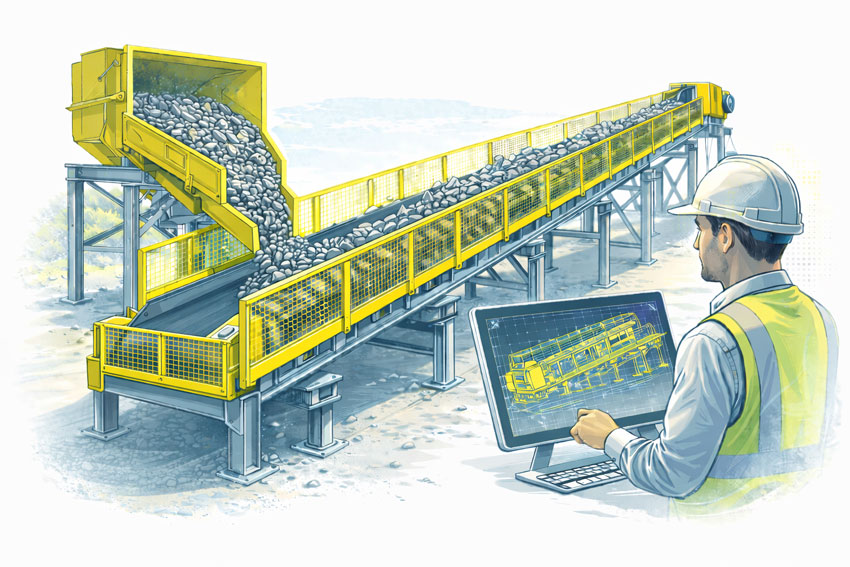
Engineer reviewing a guarded conveyor system with fixed side and nip-point guards designed to prevent access to moving parts.

Designing Conveyor Guarding for Compliance, Safety, and Practical Operation

Conveyors are widely used across processing, manufacturing, and materials-handling environments, but they also present some of the most persistent safety risks in industrial operations. Entrapment, nip points, rotating components, and maintenance access are all recognised hazards that must be managed through proper design and guarding.

In Australia, these risks are addressed through AS 1755 โ€“ Conveyors โ€“ Safety Requirements, which establishes the minimum safety expectations for conveyor systems across their full lifecycle, from design and installation through to operation and maintenance.

This article outlines what AS 1755 requires, why compliant conveyor guarding is critical, and how engineering-led design plays a key role in achieving practical safety outcomes.


Bulk materials conveyor with compliant safety guarding at the hopper, tail end, and along the conveyor, shown with an engineer reviewing guarding design drawings.

What Is AS 1755?

AS 1755 is the Australian Standard that defines safety requirements for belt conveyors and other conveyor systems. It addresses both new and existing installations and applies to conveyors used in industrial, commercial, and processing environments.

Rather than focusing on individual guarding components in isolation, AS 1755 considers the conveyor system as a whole, including how people interact with it during normal operation, inspection, cleaning, and maintenance.

The standard is referenced by regulators, safety professionals, and engineers as the primary benchmark for conveyor safety in Australia.


Key Safety Principles in AS 1755

AS 1755 is built around a number of core safety principles that influence how conveyor guarding should be designed.

These include eliminating hazards where possible, controlling remaining risks through engineering solutions, and ensuring that guarding does not introduce new risks by restricting access or encouraging unsafe behaviour.

In practice, this means that compliant guarding must be effective, durable, and suitable for the operating environment, while still allowing conveyors to be inspected, cleaned, and maintained safely.


Conveyor Guarding Requirements

A major focus of AS 1755 is the control of access to hazardous areas. This includes guarding of:

  • Drive pulleys and tail pulleys
  • Return rollers and idlers
  • Nip points and shear points
  • Rotating shafts and couplings
  • Chain drives, belt drives, and gearboxes

Guarding must be designed so that body parts cannot access hazardous zones, taking into account reach distances, openings, and the position of the conveyor relative to walkways or platforms.

Importantly, AS 1755 recognises that guarding must be fit for purpose. Poorly designed guards that are difficult to remove, inspect, or maintain are often bypassed or removed altogether, creating new safety risks.


Fixed Guards vs Interlocked Guards

AS 1755 allows for different types of guarding depending on the application and risk profile.

Fixed guards are commonly used where access is not required during normal operation. These guards must be securely fixed and require tools for removal.

Interlocked guards may be required where regular access is necessary. These systems ensure that the conveyor cannot operate while the guard is open or removed, reducing the risk of exposure to moving parts.

Selecting the appropriate guarding strategy requires an understanding of how the conveyor is used in practice, not just how it appears on drawings.


Existing Conveyors and Retrofit Challenges

Many conveyors currently in service were installed before the latest versions of AS 1755 were adopted. In these cases, compliance is often achieved through retrofit guarding rather than full replacement.

Retrofitting guarding to existing conveyors introduces additional challenges, including:

  • Limited space around existing equipment
  • Incomplete or outdated drawings
  • Structural constraints
  • Ongoing operation during upgrades

Engineering-led assessment and accurate documentation of existing conditions are critical when designing retrofit guarding solutions that comply with AS 1755 without disrupting operations.


The Role of Engineering in Conveyor Guarding Design

AS 1755 does not provide prescriptive โ€œone-size-fits-allโ€ guard designs. Instead, it sets performance requirements that must be interpreted and applied by competent professionals.

Engineering input is essential to ensure that conveyor guarding:

  • Addresses all relevant hazards
  • Integrates with existing mechanical and structural systems
  • Can be fabricated and installed accurately
  • Supports safe maintenance and inspection activities

Poorly engineered guarding may appear compliant on paper but fail in real-world use.


Documentation, Verification, and Ongoing Safety

Compliance with AS 1755 is not a one-time activity. Conveyor systems evolve over time as layouts change, equipment is upgraded, and operating practices shift.

Clear documentation of guarding design, installation, and assumptions provides a baseline for future modifications and safety reviews. This documentation is also critical when demonstrating due diligence to regulators or during incident investigations.


Why AS 1755 Matters

AS 1755 exists to prevent serious injuries and fatalities associated with conveyor systems. When applied correctly, it provides a structured framework for identifying hazards, implementing effective controls, and maintaining safe operation over the life of the equipment.

Achieving compliance requires more than installing mesh around moving parts. It requires understanding how people interact with conveyors and designing guarding that supports safe behaviour rather than working against it.


Hamilton By Design logo displayed on a blue tilted rectangle with a grey gradient background

Conveyor guarding designed in accordance with AS 1755 is a critical component of safe industrial operations. Engineering-led design, accurate documentation, and practical consideration of maintenance and operation are essential to achieving compliance that works in practice.

When conveyor safety is treated as an engineering problem rather than a checkbox exercise, the result is safer equipment, fewer incidents, and more reliable operations.

Manufacturing and production services button

Our clients


Name
Would you like us to arrange a phone consultation for you?
Address

Machine Guarding in Australia: A Decade of Lessons for Leaders, Asset Owners, and Engineers

ndustrial machine guarding solutions showing a conveyor system, a robotic cell, and a belt drive with fixed guards designed to prevent access to hazardous moving parts.

Machine guarding examples showing a guarded conveyor, enclosed robotic cell, and belt drive with safety covers

Machine guarding remains one of the most persistent and preventable safety risks across Australian industry.
Despite improvements in automation, safety culture, and regulatory oversight, serious injuries and fatalities involving machinery continue to occur every year, particularly in manufacturing, mining, food processing, and materials handling.

Over the past decade, regulators, courts, and insurers have consistently reinforced one message:
machine guarding is not optional, not administrative, and not a โ€œfit-laterโ€ activity โ€” it is a core engineering and governance responsibility.

This article examines:

  • The international and Australian standards framework for machine guarding
  • Accident and injury trends over the past ten years
  • Legal and enforcement signals emerging from prosecutions
  • Why machine guarding must be treated as a strategic asset-risk issue, not just a safety task

The Global Framework: International Standards for Machine Guarding

Machine guarding is governed globally through standards developed by the International Organization for Standardization (ISO).


ISO standards portal
Core International Standards

ISO 12100 Risk assessment

ISO 14120 Guard design

ISO 13857 Safety distances

ISO 13849-1 Interlocks & control systems

These standards establish a risk-based engineering approach, requiring hazards to be:

  1. Identified
  2. Eliminated where possible
  3. Engineered out through guards and control systems
  4. Verified through geometry, distances, and fail-safe logic

This methodology underpins CE marking, global OEM compliance, and multinational EPC project delivery.


The Australian Context: AS 4024 and WHS Expectations

Australia adopts and localises ISO principles through AS 4024 โ€“ Safety of Machinery, referenced extensively by regulators under Work Health and Safety (WHS) legislation.

Standards Australia โ€“ AS 4024 Series
Key Australian Standards

AS 4024.1201 Risk assessment

AS 4024.1601 Guards

AS 4024.1602 Interlocks

AS 4024.1801 Safety distances

AS 4024.1501 Safety control systems

While standards themselves are not legislation, courts and regulators consistently use AS 4024 as the benchmark for determining whether risks have been managed so far as is reasonably practicable.


A Decade of Data: What the Accident Trends Tell Us

Australia does not publish a dedicated โ€œmachine guarding accidentโ€ metric. However, national data from Safe Work Australia clearly shows machinery remains a leading cause of serious harm.

Safe Work Australia โ€“ Key WHS statistics:
National Trends (Approximate โ€“ Last 10 Years)

MetricEvidence Source
~1,850+ traumatic work fatalitiesSafework Australia
~180โ€“200 fatalities per yearSafework Australia
Highest fatality rateMachinery operators & drivers
~130,000โ€“140,000 serious injury claims annuallyAustralian Institute of health and welfare
Common mechanismsTrapped by machinery, struck by moving objects

Machinery operators consistently record:

  • The highest fatality rates of all occupation groups
  • Disproportionate representation in serious injury claims
  • Higher exposure to entanglement, crush, shear, and impact hazards

These mechanisms are directly linked to guarding effectiveness, not worker behaviour alone.


What Hasnโ€™t Changed โ€” and Why It Matters

1. Legacy Plant Remains a Key Risk

Many incidents involve:

  • Older machinery
  • Brownfield modifications
  • Equipment altered without re-engineering guarding

Australian WHS law does not grandfather unsafe plant.


2. Guarding Is Still Added Too Late

Common failures include:

  • Guards designed post-fabrication
  • Inadequate reach distances
  • Interlocks added without validated performance levels

This often leads to bypassing, removal, or unsafe maintenance practices.


3. Lack of Engineering Documentation

Post-incident investigations frequently identify:

  • No formal risk assessment
  • No justification against AS 4024 or ISO standards
  • No evidence that guarding was engineered, tested, or validated

In legal proceedings, absence of documentation is treated as absence of control.


Legal and Enforcement Signals

Australian regulators (WorkSafe NSW, WorkSafe VIC, SafeWork QLD, SafeWork SA) have consistently prosecuted machine-guarding failures, particularly where:

  • Hazards were known
  • Improvement notices were ignored
  • Guards were removed or ineffective

Regulator portals:

Courts have reinforced that:

  • Training does not replace guarding
  • PPE does not replace guarding
  • Signage does not replace guarding

Guarding as a Governance Issue

For executives and boards, machine guarding intersects with:

  • Officer due diligence obligations
  • Asset lifecycle risk
  • Insurance and liability exposure
  • Business continuity and ESG performance

Well-designed guarding:

  • Reduces downtime
  • Enables safer automation
  • Improves workforce confidence
  • Creates defensible compliance positions

The Engineering Reality: Geometry Drives Compliance

Modern compliance relies on:

  • Verified reach distances
  • Measured openings and clearances
  • Validated interlock logic

This is why accurate:

  • As-built capture
  • 3D modelling
  • Engineering-grade spatial data

are increasingly essential for brownfield and high-risk plant.


Looking Ahead: The Next Decade

Trends indicate:

  • Greater scrutiny of legacy machinery
  • Stronger linkage between standards and prosecutions
  • Higher expectations for engineering evidence
  • Increased use of digital engineering to prove compliance

Organisations that integrate guarding early into engineering workflows will be better protected legally, operationally, and reputationally.


Hamilton By Design logo displayed on a blue tilted rectangle with a grey gradient background

Final Thought

Machine guarding is not about mesh and fences.
It is about engineering intent, risk ownership, and accountability.

The last decade of Australian data, prosecutions, and standards alignment is clear:
when guarding fails, the outcomes are predictable โ€” and preventable.

Structural drafting services button
3D LiDAR scanning and 3D modelling services button
Mechanical drafting services button

Our clients:

Name
Would you like us to arrange a phone consultation for you?
Address

#Machine guarding standards Australia #Machinery safety best practices #AS/NZS 4024 machine guarding #Workplace safety machinery #Industrial safety compliance #Machine guarding lessons for engineers