Design Verification Under AS 4991: What Fabricators Often Miss

Engineer verifying lifting beam design under AS 4991 with FEA stress analysis overlay in fabrication workshop.

In Australiaโ€™s heavy industry and mining sectors, lifting devices are routinely fabricated under AS 4991 โ€“ Lifting Devices.

While most fabricators understand the need for compliance, design verification is the area where projects most commonly fall short.

The result?
Rework, certification delays, client rejection, and exposure to liability.

Letโ€™s look at what is often missed โ€” and how to avoid it.


What AS 4991 Actually Requires

AS 4991 does not simply require a fabricated lifting device to be โ€œstrong enough.โ€ It requires:

  • Engineered design calculations
  • Verification of limit states
  • Weld design compliance
  • Traceable material selection
  • Independent design review (where applicable)
  • Documentation suitable for certification

Fabrication alone does not equal compliance.
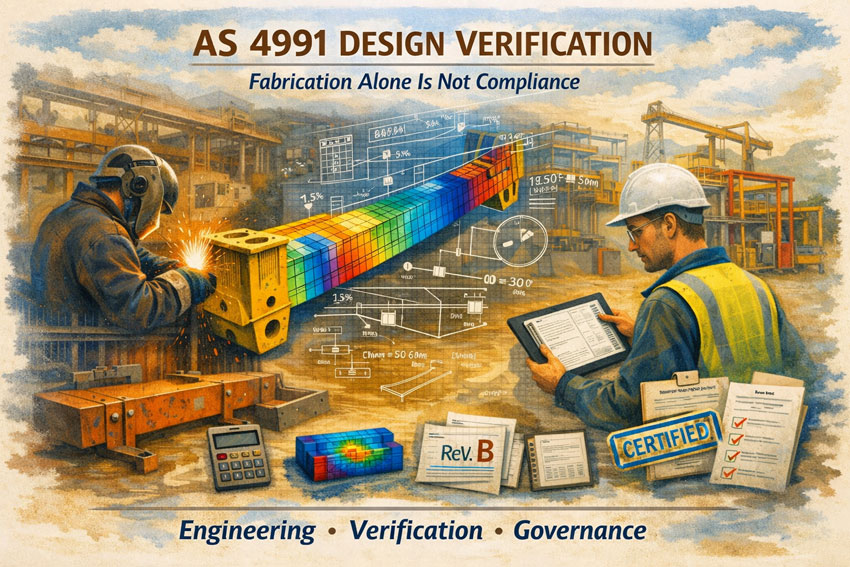

AS 4991 design verification process showing fabrication, engineering analysis and certification workflow.

Engineering Calculations That Donโ€™t Match the Fabrication

One of the most common issues is a disconnect between:

  • The engineered design intent
  • The shop drawings
  • The fabricated outcome

Changes made โ€œon the floorโ€ โ€” such as:

  • Plate thickness substitutions
  • Weld size adjustments
  • Lug geometry tweaks
  • Hole size changes

โ€” can invalidate the original engineering verification.

Without re-verification, certification becomes compromised.


Weld Design is Assumed โ€” Not Verified

Fabricators often focus on structural members but overlook:

  • Fillet weld capacity under combined loading
  • Fatigue considerations
  • Load directionality
  • Throat thickness assumptions

AS 4991 compliance requires welds to be engineered โ€” not assumed.

This is particularly critical in:

  • Spreaders
  • Lifting beams
  • Trunnions
  • Custom lifting frames

No Formal Design Review or Independent Check

The standard requires appropriate verification.

This may include:

  • Independent engineering review
  • Check calculations
  • Formal sign-off by a competent engineer

A workshop โ€œreviewing its own drawingsโ€ does not satisfy independent verification.


Load Cases Are Underestimated

Another common oversight is failure to account for:

  • Dynamic factors
  • Off-centre loading
  • Sling angles
  • Shock loading
  • Environmental factors

Lifting devices rarely operate under perfect static conditions.

Design verification must reflect real-world application.


Documentation Gaps

Even when the engineering is sound, documentation is often incomplete:

  • No clear calculation pack
  • No revision control
  • No traceable material certificates
  • No weld procedure documentation
  • No inspection and test plan

Without structured documentation, clients and auditors may reject otherwise adequate equipment.

This is where governance becomes as important as engineering.


Why This Matters

Failure in lifting devices carries:

  • Serious safety risk
  • Legal liability
  • Project shutdowns
  • Insurance exposure

Under Australian WHS law, the duty of care extends beyond fabrication โ€” it includes engineering adequacy.

AS 4991 is not a box-ticking exercise. It is a risk mitigation framework.


The Hamilton By Design Approach

At Hamilton By Design, we support fabricators by providing:

  • Independent design verification
  • Engineering calculation packages
  • Weld capacity review
  • Load case validation
  • Documentation structured for audit readiness
  • Revision-controlled drawing governance

We work alongside workshops โ€” not against them โ€” ensuring compliance before equipment reaches site.

The cost of early verification is small compared to rework, rejected certification, or liability exposure.


3D LiDAR scanning and 3D modelling service button โ€” laser scanner capturing a point cloud for engineering and CAD modelling
Mechanical engineering services

Final Thought

If your lifting device cannot withstand engineering scrutiny on paper, it should not be trusted in the air.

AS 4991 compliance is not about fabrication skill alone โ€” it is about verified engineering intent.

If you would like assistance reviewing your lifting device designs or establishing a verification framework, reach out to the Hamilton By Design team.


Name
Would you like us to arrange a phone consultation for you?
Address

3D CAD Modelling Australia service banner for Hamilton By Design
Finite Element Analysis (FEA) engineering simulation button
Mechanical engineering services

Mechanical Engineering Lift Sydney: Why Standards Like AS 4991 Matter

Safety and Precision in Mechanical Engineering Lifts

In the fast-paced world of Sydney construction and infrastructure, precision lifting is an everyday necessity. From hoisting prefabricated modules on high-rise towers to positioning steel frameworks and heavy plant components, each lift depends on one critical factor โ€” the integrity of the lifting device.

A mechanical engineering lift is more than just machinery; itโ€™s the result of careful design, analysis, and compliance with national safety standards. The Australian Standard AS 4991: Lifting Devices provides the engineering framework to ensure that every lifting beam, clamp, and spreader frame is designed, tested, and certified for safe performance.

In the dynamic environment of Sydneyโ€™s construction and manufacturing sectors, adhering to AS 4991 is not only a compliance issue โ€” itโ€™s essential to safety, reliability, and professional reputation.

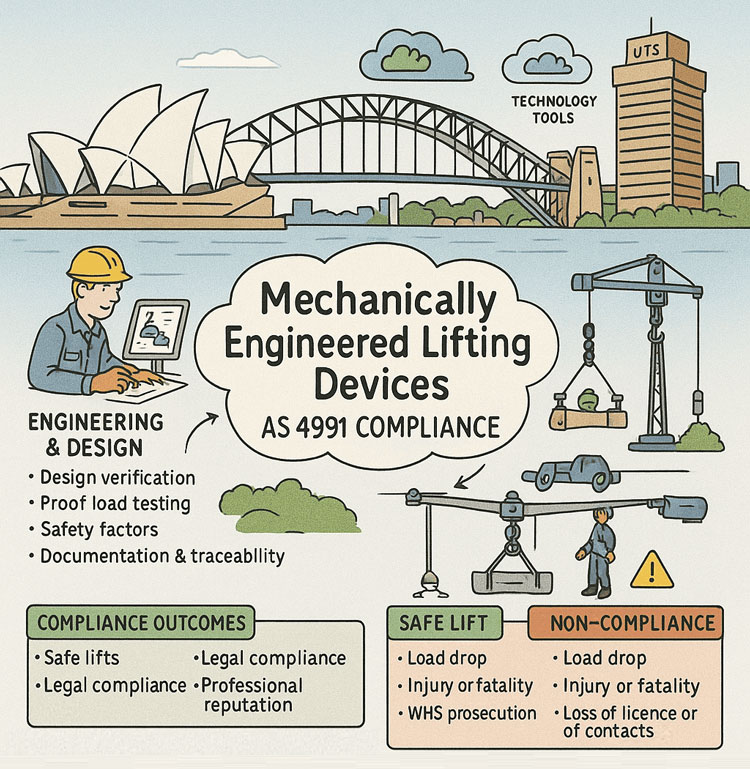
Illustrated infographic explaining AS 4991 mechanically engineered lifting devices, showing engineering design steps, safe lifting practices, compliance outcomes, and non-compliance risks, with Sydney landmarks in the background

3D LiDAR scanning and 3D modelling service button โ€” laser scanner capturing a point cloud for engineering and CAD modelling
Mechanical engineering services

What AS 4991 Means for Mechanical Engineering in Sydney

AS 4991: Lifting Devices is the Australian benchmark for the design, manufacture, proof testing, and maintenance of all mechanically engineered lifting attachments used with cranes and hoists.

It covers:

  • Design verification by qualified engineers
  • Proof load testing (typically 1.5 times the Working Load Limit)
  • Identification markings such as WLL, serial number, and manufacture date
  • Regular inspection and maintenance schedules
  • Documented certification and traceability

For Sydney-based mechanical engineering projects โ€” from Parramattaโ€™s commercial developments to the infrastructure of the Eastern Suburbs โ€” these requirements ensure every lift is carried out with confidence and safety.


The Role of Mechanical Engineers in Safe Lifting

Mechanical engineers play a vital role in ensuring every lifting device performs predictably under real-world conditions. Each lifting beam, frame, or clamp must be:

  • Designed for static and dynamic loading
  • Resistant to fatigue, buckling, and corrosion
  • Built from materials tested for strength and durability
  • Verified through engineering analysis and proof testing

By applying AS 4991, mechanical engineers in Sydney create lifting devices that not only meet technical standards but also withstand the operational demands of construction, mining, and industrial settings across New South Wales.


Why Non-Compliance is Never Worth the Risk

Sydneyโ€™s worksites are under strict safety scrutiny, and incidents involving lifting equipment failures have resulted in serious injuries, fatalities, and prosecutions.

Examples from across Australia include:

  • Unmarked or uncertified lifting beams that failed under load due to poor design.
  • Vacuum lifters that detached unexpectedly after seals deteriorated from lack of inspection.
  • Improvised lifting points on machinery leading to crush injuries and WHS enforcement actions.

These events share a common cause: failure to meet the design, inspection, and documentation requirements of AS 4991.

For any mechanical engineering lift in Sydney, non-compliance risks not just equipment damage but also:

  • Work Health and Safety (WHS) prosecutions
  • Civil negligence claims
  • Loss of accreditation and contracts
  • Damage to professional reputation

Compliance as a Legal and Professional Obligation

While AS 4991 is not legislation, it defines the expected standard of care under Australiaโ€™s WHS laws. Regulators such as SafeWork NSW use compliance with standards like AS 4991 as evidence of due diligence.

For mechanical engineers, fabricators, and construction managers, compliance means:

  • Designs verified by competent engineers
  • Devices tested and certified to meet load requirements
  • Inspection records that prove ongoing safety
  • Training to ensure operators understand correct usage

In Sydneyโ€™s competitive engineering market, adherence to AS 4991 isnโ€™t just about avoiding penalties โ€” itโ€™s about demonstrating leadership in professional safety.


Building a Culture of Inspection and Traceability

A key part of AS 4991 is documentation. Each lifting device should have a design verification report, proof load certificate, and inspection record.
This traceability ensures that every lift on a Sydney site can be traced back to certified engineering.

Companies should maintain:

  • A register of lifting devices with serial numbers and inspection dates
  • Clear tagging systems for quick identification
  • Routine re-certification for high-use environments
  • Operator awareness training on compliance indicators

These processes turn safety standards into practical habits that protect workers and ensure smooth site operations.


Mechanical Engineering Lift Sydney: Innovation Meets Safety

Sydney is a hub of engineering innovation, with advanced tools like 3D scanning, LiDAR, and Finite Element Analysis (FEA) enhancing how lifting devices are designed and validated.

At Hamilton By Design, our mechanical engineers use these technologies to create custom lifting systems for complex sites across Sydney โ€” from tight urban projects in Chatswood and Parramatta to industrial installations in the Inner West.

Yet, even with the latest modelling tools, every design is checked against AS 4991 to guarantee that each lift meets both engineering and safety expectations.


Conclusion: Lifting Sydney Safely

In mechanical engineering, safety begins long before the crane hook rises. It starts with standards โ€” and in Australia, AS 4991 is the foundation.

For every mechanical engineering lift in Sydney, compliance ensures more than safety: it provides reliability, traceability, and peace of mind. By following the standard, engineers not only protect lives but also elevate the quality and professionalism of Sydneyโ€™s construction and manufacturing industries.

At Hamilton By Design, our commitment is simple: lift Sydney safely, lift with engineering excellence, and lift to the standard โ€” AS 4991.


Hamilton By Design logo displayed on a blue tilted rectangle with a grey gradient background

Related Sydney Services

Hamilton By Design provides engineering-led 3D scanning, LiDAR scanning, mechanical engineering and digital engineering services throughout Sydney and Greater Sydney.

Explore our related Sydney services:


  • 3D Scanning Sydney โ€“ Engineering-grade terrestrial laser scanning, as-built surveys and point cloud capture for industrial, infrastructure and commercial projects.
  • Reality Capture Sydney โ€“ High-accuracy reality capture, digital twins, asset documentation and engineering-grade site verification.
  • Scan to CAD Sydney โ€“ Convert point cloud data into AutoCAD, SolidWorks, Inventor and other engineering-ready CAD deliverables.
  • Point Cloud Modelling Sydney โ€“ Engineering-grade point cloud processing, clash detection, as-built verification and 3D modelling.
  • Mechanical Engineering Sydney โ€“ Mechanical design, plant upgrades, materials handling systems, conveyors, chutes, platforms and engineering support.
  • Structural Drafting Sydney โ€“ Structural steel drafting, fabrication drawings, GA drawings, workshop detailing and as-built documentation.

Hamilton By Design supports projects throughout Sydney CBD, Parramatta, Liverpool, Penrith, Blacktown, Chatswood, Alexandria, Mascot, Newcastle and the Central Coast.


Our clients:

Name
Would you like us to arrange a phone consultation for you?
Address
Blue banner graphic displaying the text "Point Cloud to CAD - Australia" in large white lettering, representing point cloud processing, scan-to-CAD conversion and digital engineering services across Australia.
Blue banner graphic displaying the text "Scan to CAD Sydney" in large white lettering, representing engineering-led point cloud to CAD conversion, LiDAR scanning and digital engineering services in Sydney.
Blue banner graphic displaying the text "Reality Capture Sydney - CBD" in large white lettering, representing engineering-led reality capture, LiDAR scanning and digital engineering services within Sydney CBD commercial buildings and infrastructure.