

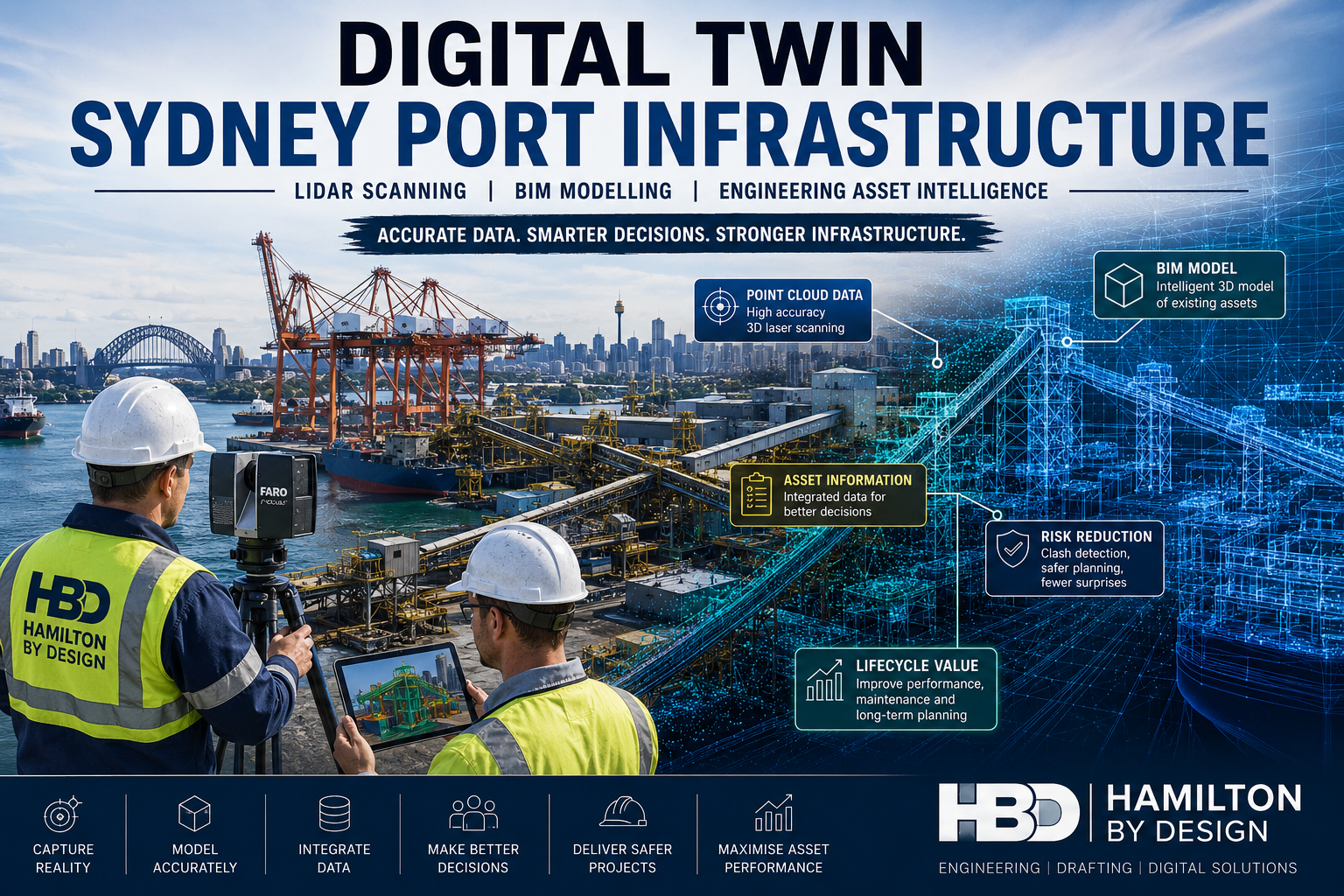
Digital Twin Sydney Port Infrastructure

Digital twin of Sydney port infrastructure showing LiDAR scanning, BIM modelling and engineering asset intelligence used to create accurate digital representations of port facilities for maintenance, upgrades and asset management.

Develop Digital Twins of Sydney Port Infrastructure Using LiDAR Scanning, BIM and Engineering Modelling Workflows
Blue mechanical engineering icon with gear and wrench

Sydney’s ports are among Australia’s most important infrastructure assets, supporting container handling, bulk materials, fuel imports, logistics operations and international trade. As port facilities continue to expand and age, asset owners face increasing challenges managing infrastructure that has often been modified over decades without complete documentation.

Hamilton By Design provides Digital Twin Sydney Port Infrastructure services, combining engineering-grade LiDAR scanning, reality capture, BIM modelling and engineering workflows to create accurate digital representations of existing port assets. These digital twins provide a reliable foundation for maintenance planning, shutdowns, upgrades, asset management and future capital works.

Whether the project involves a container terminal, bulk handling facility, conveyor network, berth structure, ship loader, fuel terminal or rail interface, our team develops accurate digital twins that allow stakeholders to make engineering decisions based on real-world conditions rather than outdated drawings.


What is a Digital Twin?

A digital twin is a detailed digital representation of a physical asset or facility. Unlike traditional CAD drawings, a digital twin combines accurate geometry, engineering information and asset data into a single environment that can be used throughout the asset lifecycle.

For Sydney port operators, a digital twin can include:

  • Existing structural steelwork
  • Conveyors and materials handling systems
  • Ship loaders and unloaders
  • Wharf and berth infrastructure
  • Mechanical equipment
  • Pipework and services
  • Electrical installations
  • Buildings and facilities
  • Road and rail interfaces
  • Underground and above-ground assets

Digital twins allow engineering, maintenance and operations teams to access accurate infrastructure information without needing to physically inspect every asset.


Why Sydney Ports Need Digital Twins

Many port facilities have undergone numerous upgrades, repairs and expansions over several decades. In many cases, original drawings are missing, inaccurate or no longer reflect the actual site conditions.

Common challenges include:

  • Incomplete or outdated as-built documentation
  • Unknown modifications performed during shutdowns
  • Limited visibility of asset condition
  • Difficulty planning future upgrades
  • High costs associated with site rework
  • Engineering clashes during construction
  • Safety risks from inaccurate information
  • Loss of knowledge when personnel retire or move on

Developing a digital twin provides a single source of truth that accurately reflects the current state of the facility.


Engineering-Grade LiDAR Scanning for Port Infrastructure

The foundation of every digital twin is accurate reality capture.

Hamilton By Design uses engineering-grade terrestrial LiDAR scanning technology to capture highly detailed three-dimensional data from existing port infrastructure.

Typical assets scanned include:

  • Container terminals
  • Conveyor systems
  • Transfer towers
  • Bulk handling facilities
  • Storage sheds
  • Fuel infrastructure
  • Structural steelwork
  • Ship loading equipment
  • Wharf structures
  • Marine infrastructure

Using advanced scanning equipment, millions of measurements are collected every second to generate a highly accurate point cloud of the facility.

This point cloud forms the basis of the digital twin development process.


Scan-to-BIM Workflows for Sydney Ports

Once the scanning process is complete, the captured data is processed and registered to create a coordinated digital representation of the facility.

The registered point cloud can then be converted into BIM models using industry-standard software platforms.

Depending on project requirements, digital twin models may include:

  • Structural steel modelling
  • Mechanical equipment modelling
  • Pipework systems
  • Architectural components
  • Electrical infrastructure
  • Access systems and walkways
  • Conveyor systems
  • Material handling equipment

These BIM models provide accurate geometry and can be linked to asset information, maintenance records and operational data.


Supporting Brownfield Port Upgrades

One of the most valuable applications of digital twin technology is supporting brownfield infrastructure upgrades.

Port facilities rarely provide the luxury of starting with an empty site. Most projects must be designed around existing equipment and infrastructure while maintaining operational requirements.

Digital twins help project teams:

  • Identify potential clashes before construction
  • Verify available space
  • Confirm existing dimensions
  • Plan shutdown activities
  • Reduce installation risk
  • Improve fabrication accuracy
  • Minimise site modifications

By working from a verified digital environment, engineers can significantly reduce uncertainty and improve project outcomes.


Improving Shutdown Planning and Execution

Shutdowns represent some of the highest-risk activities undertaken within port environments.

A single delay can impact vessel schedules, cargo handling operations and contractor productivity.

Digital twins support shutdown planning by allowing project teams to:

  • Virtually inspect assets before mobilisation
  • Develop detailed work packages
  • Verify access requirements
  • Confirm lifting clearances
  • Identify construction constraints
  • Plan temporary works
  • Validate installation sequences

This proactive approach helps reduce downtime and improves shutdown efficiency.


Asset Management and Lifecycle Planning

Digital twins also provide substantial long-term value for asset owners.

Instead of relying on scattered drawings and historical records, maintenance teams gain access to an accurate digital representation of their infrastructure.

Benefits include:

  • Improved asset registers
  • Faster maintenance planning
  • Better condition assessments
  • Improved inspection programs
  • Enhanced capital planning
  • Reduced engineering investigation time
  • Improved operational awareness

As infrastructure ages, access to accurate digital information becomes increasingly important for managing risk and maintaining operational reliability.


Typical Digital Twin Development Process

Hamilton By Design follows a structured workflow to ensure high-quality outcomes.

1. Site Assessment

The project begins with a review of existing documentation, operational requirements and access constraints.

2. LiDAR Scanning

Engineering-grade terrestrial laser scanning captures existing infrastructure conditions.

3. Point Cloud Registration

Individual scans are processed and combined into a unified digital dataset.

4. Quality Assurance

Registration accuracy and data coverage are verified to ensure engineering suitability.

5. BIM and Engineering Modelling

The point cloud is converted into intelligent engineering models and BIM environments.

6. Asset Classification

Assets are organised and structured according to project requirements.

7. Digital Twin Development

Engineering information and asset data are integrated into the model environment.

8. Final Delivery

The completed digital twin is delivered in client-specified formats.


Deliverables

Depending on project requirements, Hamilton By Design can provide:

  • Registered E57 point clouds
  • RCP and RCS files
  • Autodesk Revit models
  • Navisworks models
  • AutoCAD drawings
  • General arrangement drawings
  • Structural models
  • Mechanical equipment models
  • Asset registers
  • BIM deliverables
  • Digital twin datasets
  • Engineering reports

Deliverables are tailored to support ongoing operations, maintenance and future engineering projects.


Hamilton By Design logo displayed on a blue tilted rectangle with a grey gradient background

Why Choose Hamilton By Design?

Hamilton By Design combines practical engineering experience with advanced reality capture technology.

Our team understands the challenges associated with operating and upgrading complex industrial facilities, particularly within port and maritime environments.

Our capabilities include:

  • Engineering-led LiDAR scanning
  • Scan-to-BIM services
  • Mechanical engineering
  • Structural engineering support
  • Engineering drafting
  • Brownfield project experience
  • Shutdown planning support
  • Asset capture and verification

We focus on delivering digital twin solutions that provide practical value and support informed decision-making throughout the asset lifecycle.


Digital Twin Services for Sydney Port Infrastructure

If you are planning an upgrade, shutdown, expansion project or asset management initiative, an accurate digital twin can significantly reduce risk and improve project outcomes.

Hamilton By Design provides Digital Twin Sydney Port Infrastructure services throughout Sydney and surrounding regions, helping port operators, engineering teams and asset owners develop accurate digital representations of critical infrastructure.

By combining LiDAR scanning, BIM modelling and engineering expertise, we create digital twins that provide the confidence needed to plan, maintain and upgrade port assets effectively.

Talk to Us – Contact Us

Name
Would you like us to arrange a phone consultation for you?
Address

Our clients:
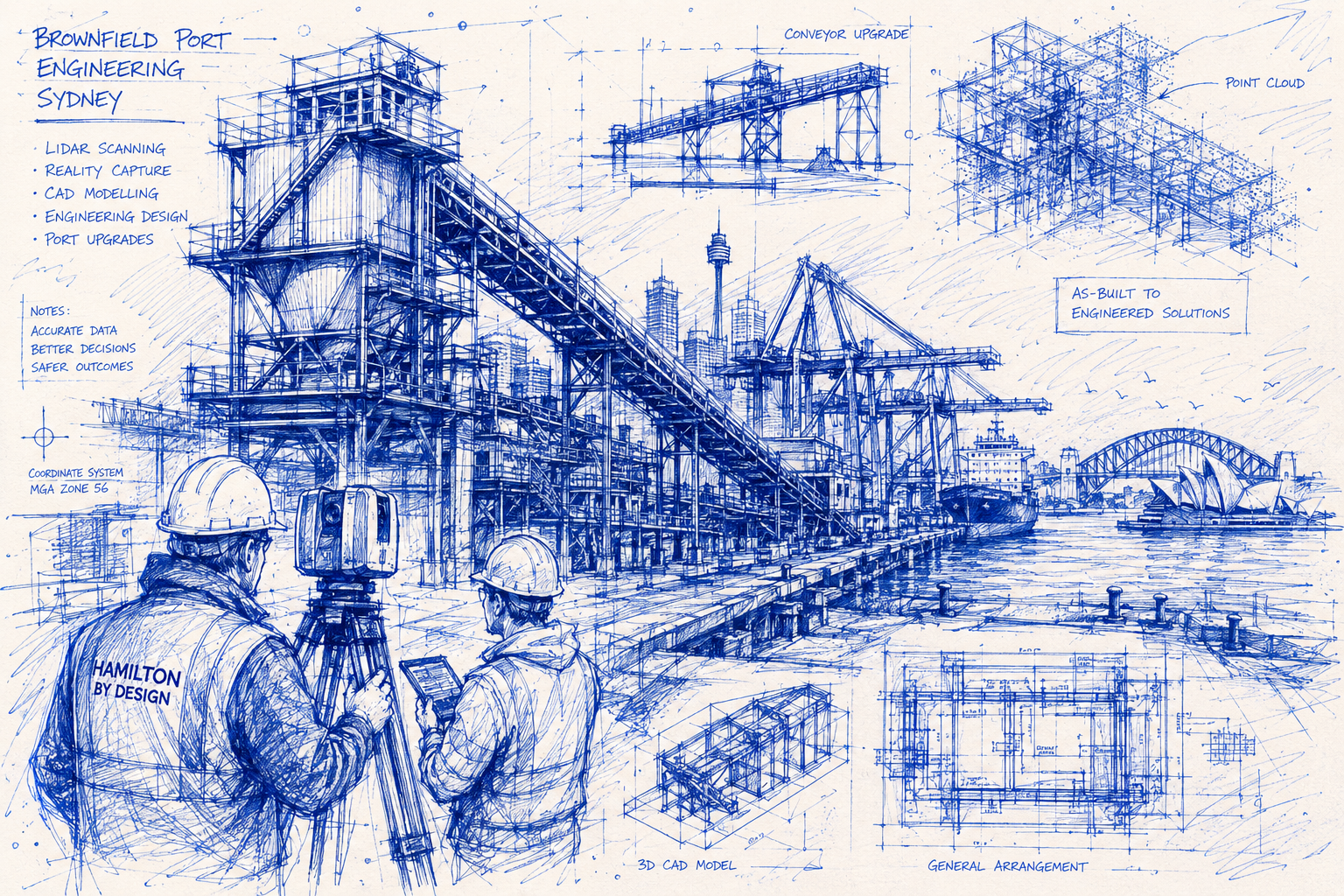


Brownfield Port Engineering Services in Sydney

Blue pen and ink illustration of a Sydney brownfield port engineering project showing LiDAR scanning, point cloud modelling, CAD design and port infrastructure upgrades with conveyors, cranes, wharves and engineering drawings.

Hamilton By Design provides engineering solutions for brownfield port upgrades throughout Sydney using engineering-grade LiDAR scanning, reality capture, CAD modelling, reverse engineering and mechanical design services. We help port operators, engineering consultants, infrastructure owners and contractors accurately capture existing conditions and develop practical engineering solutions for modifications, upgrades and asset management projects.

Brownfield engineering projects differ significantly from greenfield developments because they involve working within existing operational facilities. Existing infrastructure often contains undocumented modifications, outdated drawings, restricted access areas and complex interfaces between new and existing assets. Our engineering-led approach combines 3D laser scanning, CAD modelling and engineering design to reduce project risk and improve project outcomes.

Whether upgrading a conveyor system, replacing mechanical equipment, modifying a ship loader, installing new pipework or documenting existing infrastructure, Hamilton By Design delivers accurate information that supports successful project execution.


Engineering Solutions for Sydney Port Infrastructure

Sydney is home to a wide range of port and maritime infrastructure including:

  • Container terminals
  • Bulk material handling facilities
  • Fuel terminals
  • Storage and logistics facilities
  • Wharf structures
  • Berths and jetties
  • Ship loading facilities
  • Conveyor systems
  • Pump stations
  • Utility infrastructure
  • Mechanical handling equipment

Many of these facilities have evolved over decades and contain multiple generations of modifications. Original engineering drawings are often incomplete, inaccurate or unavailable. This creates significant challenges when planning upgrades, shutdown works and asset replacement projects.

Our brownfield port engineering services provide accurate site information and engineering documentation that enables confident design decisions.


Why Brownfield Port Projects Require Accurate Site Data

One of the biggest risks in any brownfield engineering project is relying on outdated information.

Existing drawings frequently fail to reflect:

  • Structural modifications
  • Equipment replacements
  • Pipework rerouting
  • Utility relocations
  • Maintenance alterations
  • Temporary works that became permanent

When engineering decisions are based on inaccurate information, projects can experience:

  • Design clashes
  • Construction delays
  • Increased costs
  • Installation difficulties
  • Additional shutdown requirements

Hamilton By Design uses terrestrial LiDAR scanning to create highly accurate digital representations of existing facilities, allowing engineering teams to work from verified site conditions rather than assumptions.


LiDAR Scanning for Brownfield Port Engineering Sydney

LiDAR scanning is typically the first stage of a brownfield port engineering project.

Using advanced terrestrial laser scanners, millions of measurements are captured across an operating facility to generate a detailed 3D point cloud.

Typical Sydney port scanning applications include:

  • Conveyor systems
  • Ship loaders and unloaders
  • Transfer stations
  • Structural steelwork
  • Wharf infrastructure
  • Pipework systems
  • Storage facilities
  • Marine mechanical equipment
  • Maintenance access structures
  • Utility corridors

The resulting point cloud becomes a digital twin of the facility that can be used throughout the engineering lifecycle.

Typical LiDAR Deliverables

Clients can receive:

  • E57 point cloud files
  • RCP and RCS files
  • LAS point clouds
  • Registered scan datasets
  • Site measurements
  • Asset verification reports
  • As-built documentation
  • Clash detection models

These deliverables can be integrated directly into engineering workflows.


Scan to CAD Modelling for Existing Port Assets

Once scanning is complete, the point cloud can be converted into engineering-ready CAD models.

This process creates accurate representations of:

  • Mechanical equipment
  • Structural steelwork
  • Pipework systems
  • Conveyors
  • Platforms
  • Access systems
  • Buildings
  • Utility infrastructure

Our engineering team develops models using industry-standard software including:

  • SolidWorks
  • Autodesk Inventor
  • AutoCAD
  • Autodesk ReCap
  • Navisworks

The resulting models provide an accurate foundation for engineering design and project planning.


Engineering Design for Brownfield Port Upgrades

Hamilton By Design supports a wide range of brownfield engineering projects throughout Sydney’s port and maritime sectors.

Mechanical Engineering Design

Mechanical engineering services may include:

  • Conveyor upgrades
  • Chute redesigns
  • Transfer station modifications
  • Equipment replacements
  • Maintenance access improvements
  • Materials handling improvements
  • Mechanical plant modifications
  • Pumping systems

Every design is developed using verified site conditions to minimise risk during installation.

Structural Engineering Support

Structural engineering support may include:

  • Platform design
  • Walkway modifications
  • Handrail systems
  • Equipment support structures
  • Maintenance access systems
  • Structural steel modifications
  • Wharf equipment support frames

Existing structures can be assessed and modelled to support future upgrade works.


Brownfield Port Upgrade Workflow

Hamilton By Design follows a structured workflow that ensures engineering decisions are based on accurate information.

1. Project Review

We review:

  • Existing drawings
  • Asset information
  • Site requirements
  • Operational constraints
  • Project objectives

This ensures the capture scope aligns with project requirements.

2. Site Capture

Engineering-grade LiDAR scanning is completed on site.

Data collection may occur during:

  • Normal operations
  • Maintenance shutdowns
  • Restricted access periods
  • Staged upgrade projects

3. Point Cloud Processing

Captured scan data is registered and processed to create a unified digital representation of the facility.

Quality checks are performed to verify registration accuracy.

4. Existing Conditions Modelling

The point cloud is converted into:

  • As-built CAD models
  • General arrangement drawings
  • Existing condition layouts
  • Structural models
  • Mechanical models

5. Engineering Design

Design concepts are developed directly within the verified digital environment.

This allows engineers to identify potential issues before fabrication begins.

6. Clash Detection and Verification

New equipment and structures are checked against existing infrastructure.

This process helps avoid:

  • Installation clashes
  • Structural conflicts
  • Pipework interference
  • Access restrictions

7. Final Documentation

Project deliverables are prepared for procurement, fabrication and construction activities.


Deliverables for Brownfield Port Engineering Projects

Depending on project requirements, clients may receive:

Reality Capture Deliverables

  • E57 files
  • RCP files
  • RCS files
  • LAS files
  • Registered point clouds

CAD Deliverables

  • DWG drawings
  • DXF drawings
  • 3D CAD models
  • STEP files
  • Parasolid files
  • SAT files

Engineering Documentation

  • General arrangement drawings
  • Fabrication drawings
  • Installation drawings
  • Structural details
  • Mechanical details
  • Engineering reports

These deliverables support engineering, construction and asset management activities.


Industries We Support

Hamilton By Design provides brownfield engineering services to a wide range of industries including:

  • Ports and marine infrastructure
  • Container terminals
  • Bulk materials handling facilities
  • Logistics operations
  • Manufacturing facilities
  • Mining export terminals
  • Fuel handling facilities
  • Water and utility infrastructure
  • Government infrastructure assets

Our experience working within operational industrial environments allows us to deliver practical engineering outcomes with minimal disruption to operations.


Hamilton By Design logo displayed on a blue tilted rectangle with a grey gradient background

Why Choose Hamilton By Design for Brownfield Port Engineering Sydney

Brownfield engineering projects require more than traditional design capabilities. They require accurate site information, a strong understanding of existing infrastructure and practical engineering experience.

Hamilton By Design combines:

  • Engineering-led LiDAR scanning
  • Scan-to-CAD modelling
  • Mechanical engineering expertise
  • Structural drafting support
  • Reverse engineering capabilities
  • Reality capture workflows
  • Industrial project experience

By integrating site capture and engineering design into a single workflow, we help Sydney port operators and infrastructure owners reduce project risk, improve design accuracy and achieve successful upgrade outcomes.

If you are planning a brownfield port upgrade in Sydney and require accurate site capture, CAD modelling or engineering support, Hamilton By Design can provide the engineering-grade information needed to move your project forward with confidence.


Talk to Us – Contact Us

Name
Would you like us to arrange a phone consultation for you?
Address

Our clients:























