


Automotive 3D Scanner Technology | Vehicle & Car Laser Scanning
The automotive industry has always pushed the limits of precision. From body panels and chassis alignment to aftermarket modifications and reverse engineering, accuracy is everything. This is where the automotive 3D scanner has moved from a niche tool to an essential part of modern automotive workflows.
Whether you’re restoring classic vehicles, developing custom components, or validating manufacturing tolerances, 3D scanning of vehicles is now the fastest and most reliable way to capture real-world geometry.
Why Automotive 3D Scanning Matters
Traditional vehicle measurement methods — tape measures, calipers, and manual templates — are slow, subjective, and prone to error. In contrast, vehicle 3D scanning captures millions of data points in minutes, creating a precise digital replica of a car or component.
This digital data can be used for:
- Reverse engineering parts
- CAD modelling and redesign
- Fitment verification
- Quality control
- Digital archiving of rare or legacy vehicles
For automotive professionals, accuracy is no longer optional — it’s a competitive advantage.
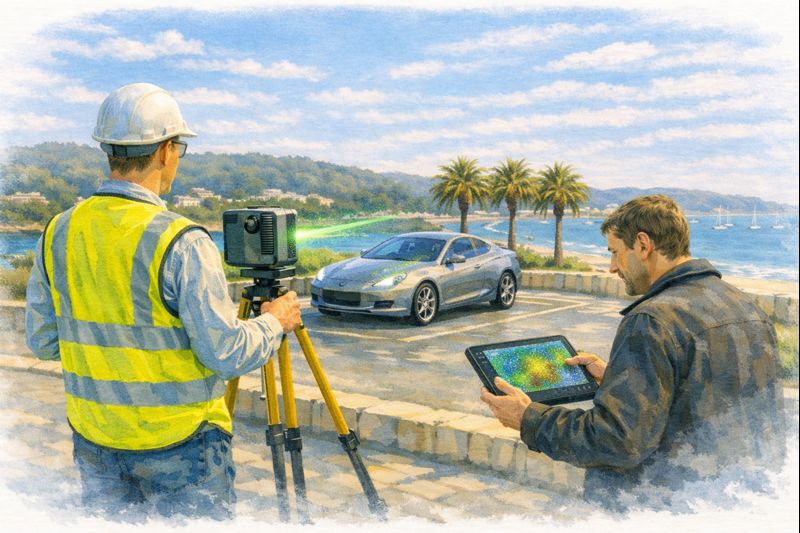
What Is a 3D Scanner for Automotive Applications?
A 3D scanner for automotive use is a device that captures the exact shape and dimensions of a vehicle or its components using laser or structured light technology. The result is a highly accurate point cloud or mesh that can be converted into CAD models.
Common scanner types include:
- Laser-based scanners
- Structured light scanners
- Handheld and tripod-mounted systems
For industrial and engineering use, the car laser scanner remains the preferred option due to its accuracy, repeatability, and ability to scan reflective or complex surfaces.
Automotive Use Cases for 3D Scanning
1. 3D Scanning of Vehicle Bodies
Full 3D scanning of vehicle exteriors allows teams to:
- Capture exact body geometry
- Design aerodynamic add-ons
- Validate panel alignment
- Reproduce damaged or unavailable parts
This is particularly valuable for motorsport, restoration, and custom fabrication projects.
2. 3D Scanner for Cars in Restoration & Classic Vehicles
When original drawings no longer exist, a 3D scanner for cars becomes the only way to accurately reproduce parts.
Applications include:
- Recreating discontinued components
- Digitally preserving rare vehicles
- Designing upgrades without altering originality
3. Automotive Laser Scanning for Manufacturing
In production and fabrication environments, laser scanner automotive systems are used to:
- Verify tolerances
- Compare as-built vehicles to CAD
- Detect deformation or misalignment
- Reduce rework and scrap
This level of insight is impossible with manual inspection alone.
Choosing the Best 3D Scanner for Automotive Work
Selecting the best 3D scanner for automotive use depends on accuracy requirements, environment, and workflow integration.
Key factors to consider:
- Accuracy & resolution (sub-millimetre for engineering)
- Speed of capture
- Ability to scan reflective surfaces
- Compatibility with CAD software
- Portability for workshop or site use
For engineering-grade outcomes, tripod-mounted or hybrid systems often outperform consumer-level handheld devices.
Car Laser Scanner vs Traditional Measurement
A car laser scanner provides several advantages over conventional measurement methods:
| Traditional Measurement | Automotive 3D Scanning |
|---|---|
| Manual & subjective | Objective & repeatable |
| Limited reference points | Millions of data points |
| Time-consuming | Rapid capture |
| Difficult to archive | Permanent digital record |
This is why 3D scanning of vehicle geometry is now standard practice in high-value automotive work.
Integrating 3D Scanning Into Automotive Design
Once scanning is complete, the data feeds directly into:
- CAD design
- Simulation & analysis
- Fitment studies
- Manufacturing workflows
This scan-to-CAD process allows engineers and designers to work from reality, not assumptions.
Automotive 3D Scanning for the Future
As vehicles become more complex — electric drivetrains, lightweight materials, tighter tolerances — vehicle 3D scanning will continue to grow in importance.
Future applications include:
- Digital twins of vehicles
- Predictive maintenance modelling
- AI-driven quality control
- Automated inspection systems
What was once cutting-edge is now becoming standard practice.
Final Thoughts
An automotive 3D scanner is no longer just a tool for specialists — it’s a foundational technology for modern automotive design, fabrication, and verification.
Whether you’re selecting the best 3D scanner for automotive work, implementing laser scanner automotive systems in production, or using 3D scanning of vehicle geometry for restoration and reverse engineering, the benefits are clear:
- Higher accuracy
- Faster workflows
- Reduced risk
- Better outcomes
In an industry where millimetres matter, 3D scanning of vehicles delivers confidence — from concept to completion.