Mechanical Engineering Services for Newcastle and the Hunter Valley

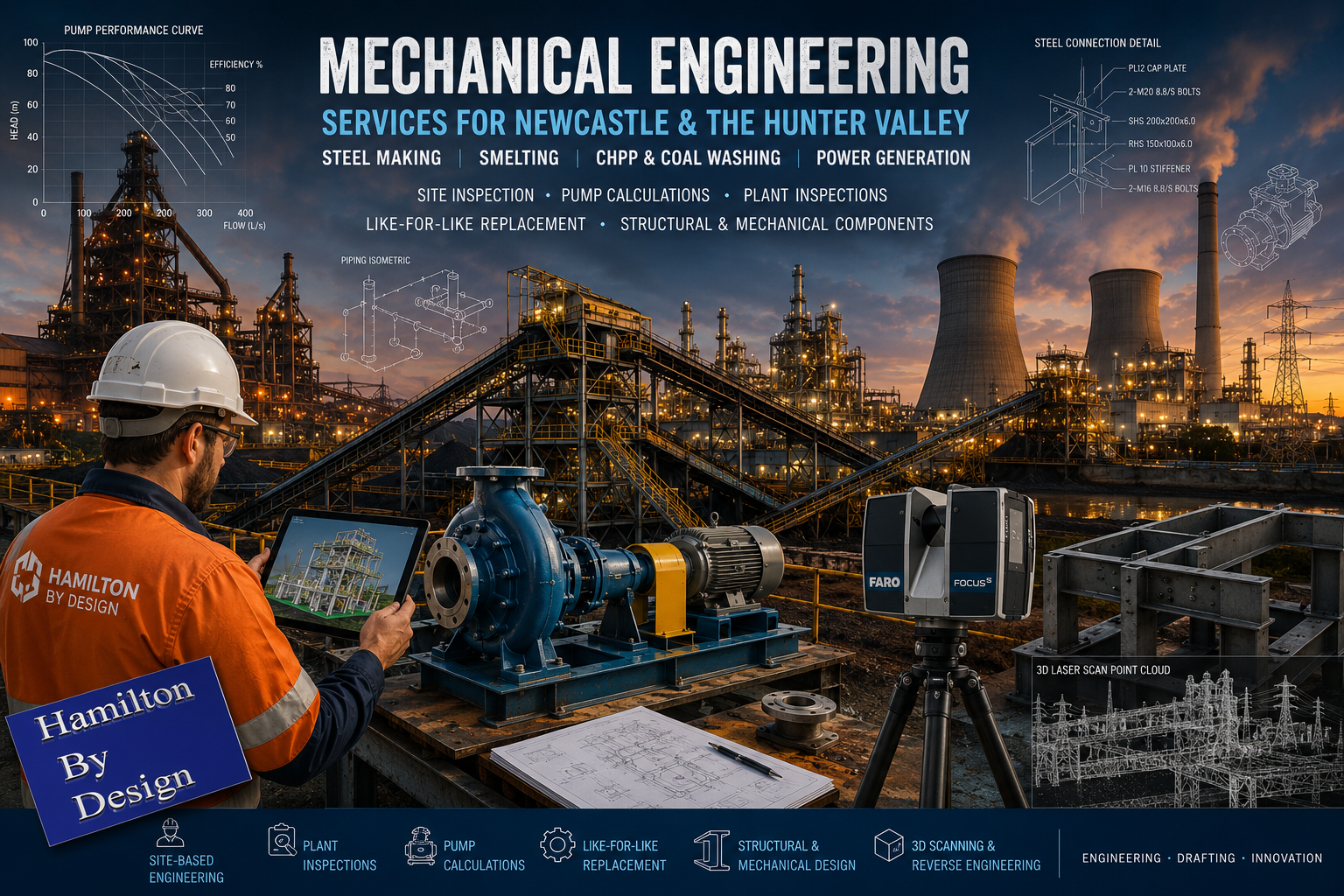
Mechanical engineer performing plant inspection at a Newcastle industrial facility with pumps, conveyors, steel making infrastructure, CHPP operations and power generation assets across the Hunter Valley.

Site-Based Mechanical Engineering for Heavy Industry, Mining and Power Generation

Blue Gear and Spanner icon

Hamilton By Design provides mechanical engineering support for industrial plants across Newcastle, the Hunter Valley and surrounding regions.

We support sites involved in steel making, smelting, coal handling and preparation plants, coal washing, power generation, bulk materials handling and heavy industrial maintenance.

The Hunter region has a long history in coal, power generation and steel-related industry, with coal mining, CHPP operations, power stations and export infrastructure continuing to play a major role in the regionโ€™s industrial base.

Mechanical Engineering Support for Operating Plants

Industrial sites require practical mechanical engineering that understands plant availability, shutdown windows, maintenance constraints and the reality of working around existing equipment.

Hamilton By Design can assist with:

  • Site-based mechanical engineering support
  • Mechanical plant inspections
  • Pump calculations and pump system reviews
  • Like-for-like replacement of mechanical components
  • Structural and mechanical component replacement
  • Conveyor, chute and transfer point reviews
  • CHPP and coal washing plant mechanical support
  • Smelting and steel plant mechanical support
  • Power station mechanical and structural support
  • Reverse engineering of worn or obsolete parts
  • Engineering drawings for fabrication and replacement
  • 3D laser scanning for existing plant and brownfield works

Mechanical Engineering for CHPP and Coal Washing Plants

Coal Handling and Preparation Plants operate under demanding conditions. Pumps, pipework, screens, launders, conveyors, chutes, guards and structural supports are exposed to wear, vibration, corrosion and material build-up.

Hamilton By Design can assist with inspection, measurement, design and documentation for:

  • Slurry pumps and process water systems
  • Pump baseplates and drive arrangements
  • Pipe supports and replacement pipework
  • Chutes, launders and transfer points
  • Conveyor structures and guarding
  • Access platforms, walkways and maintenance areas
  • Wear plate replacement and component redesign
  • Like-for-like replacement where production risk must be controlled

Where components are worn, damaged or no longer supported by the original supplier, we can use site measurement, 3D laser scanning and reverse engineering to develop fabrication drawings and replacement geometry.

Mechanical Engineering for Steel Making and Smelting Plants

Steel making, smelting and high-temperature processing plants require mechanical engineering that considers heat, wear, access, material selection and maintenance practicality.

Hamilton By Design can support mechanical and structural works around:

  • Furnace and smelting support equipment
  • Ducting, hoppers, bins and chutes
  • Cooling water and process pipework
  • Platforms, access steel and maintenance structures
  • Pump skids and mechanical drive systems
  • Heavy fabrication replacement items
  • Site inspection and defect reporting
  • Drafting and engineering documentation for fabrication

Our approach is practical and site-focused. We understand that industrial drawings need to be useful for fabrication, installation and maintenance โ€” not just theoretical design.

Mechanical Engineering for Power Generation Sites

Power generation sites across the Hunter region continue to require engineering support for maintenance, transition works, decommissioning, replacement equipment and brownfield upgrades. The region includes long-standing coal-fired power infrastructure, with Bayswater continuing to operate and Liddell now retired.

Hamilton By Design can assist with:

  • Mechanical inspection of existing plant
  • Pump and pipework calculations
  • Cooling water and process systems
  • Replacement steelwork and mechanical supports
  • Access platforms and maintenance structures
  • Brownfield scanning and as-built modelling
  • Fabrication drawings for replacement components
  • Shutdown planning support and site verification

Pump Calculations and Mechanical Reviews

Pumps are critical across CHPPs, smelters, steel plants and power generation sites. Incorrect pump selection, worn components or poor pipework arrangements can lead to reliability issues, cavitation, vibration and reduced plant availability.

Hamilton By Design can assist with:

  • Pump duty review
  • Flow and head calculations
  • Pipework pressure loss checks
  • Pump baseplate and support review
  • Like-for-like replacement checks
  • Reverse engineering of pump components
  • Wear assessment and replacement drawings
  • Arrangement drawings for maintenance and installation

Plant Inspection and Like-for-Like Replacement

Many industrial sites require replacement of existing structural or mechanical components without changing the function of the plant. In these cases, accuracy and practical site understanding are critical.

We can attend site to inspect, measure and document existing components, then develop drawings for:

  • Replacement frames
  • Platforms and access steel
  • Guards and brackets
  • Pump skids and bases
  • Chutes and liners
  • Pipe supports
  • Structural and mechanical interfaces
  • Worn or obsolete machine components

Where required, 3D laser scanning can be used to capture existing conditions and reduce the risk of fabrication or installation errors.

Why Hamilton By Design

Hamilton By Design is engineer-led. We combine mechanical engineering, drafting, 3D laser scanning, reverse engineering and fabrication-aware design.

This means we can support clients from site inspection through to practical engineering drawings suitable for review, fabrication and installation.

For Newcastle and Hunter Valley industrial sites, we provide mechanical engineering support that understands heavy industry, maintenance realities, shutdown risk and the need for clear, accurate deliverables.
3D LiDAR Scanning Hunter & Newcastle banner with white text on a blue background promoting engineering-grade laser scanning services for industrial, mining and infrastructure projects across the Hunter Valley and Newcastle region.
Mechanical Engineering Hunter & Newcastle banner promoting mechanical engineering services for mining, industrial plants, power generation, manufacturing and heavy industry throughout the Hunter Valley and Newcastle region.
Structural Drafting Hunter & Newcastle banner promoting structural drafting services for mining, industrial plants, power generation, manufacturing and infrastructure projects across the Hunter Valley and Newcastle region.

Contact Hamilton By Design

If your site requires mechanical engineering support for a CHPP, coal washing plant, smelter, steel plant, power generation facility or heavy industrial operation, Hamilton By Design can assist with site inspection, calculations, scanning, drafting and replacement component design.

Hamilton By Design logo displayed on a blue tilted rectangle with a grey gradient background

Name
Would you like us to arrange a phone consultation for you?
Address

Our Clients:
3D CAD Modelling Australia service banner for Hamilton By Design
CHPP Engineering title graphic featuring bold white text reading "CHPP Engineering" centred on a blue rounded rectangle background.
Pipework Drafting title graphic featuring bold white text reading "Pipework Drafting" centred on a blue rounded rectangle background.
3D LiDAR Scanning for Engineering Projects title graphic featuring bold white text on a blue rounded rectangle background.
Mechanical engineering services
Australian Drafting logo featuring bold white text reading "Australian Drafting" centred on a blue rounded rectangle background.

Engineering Preparation for Coal Plant Shutdowns

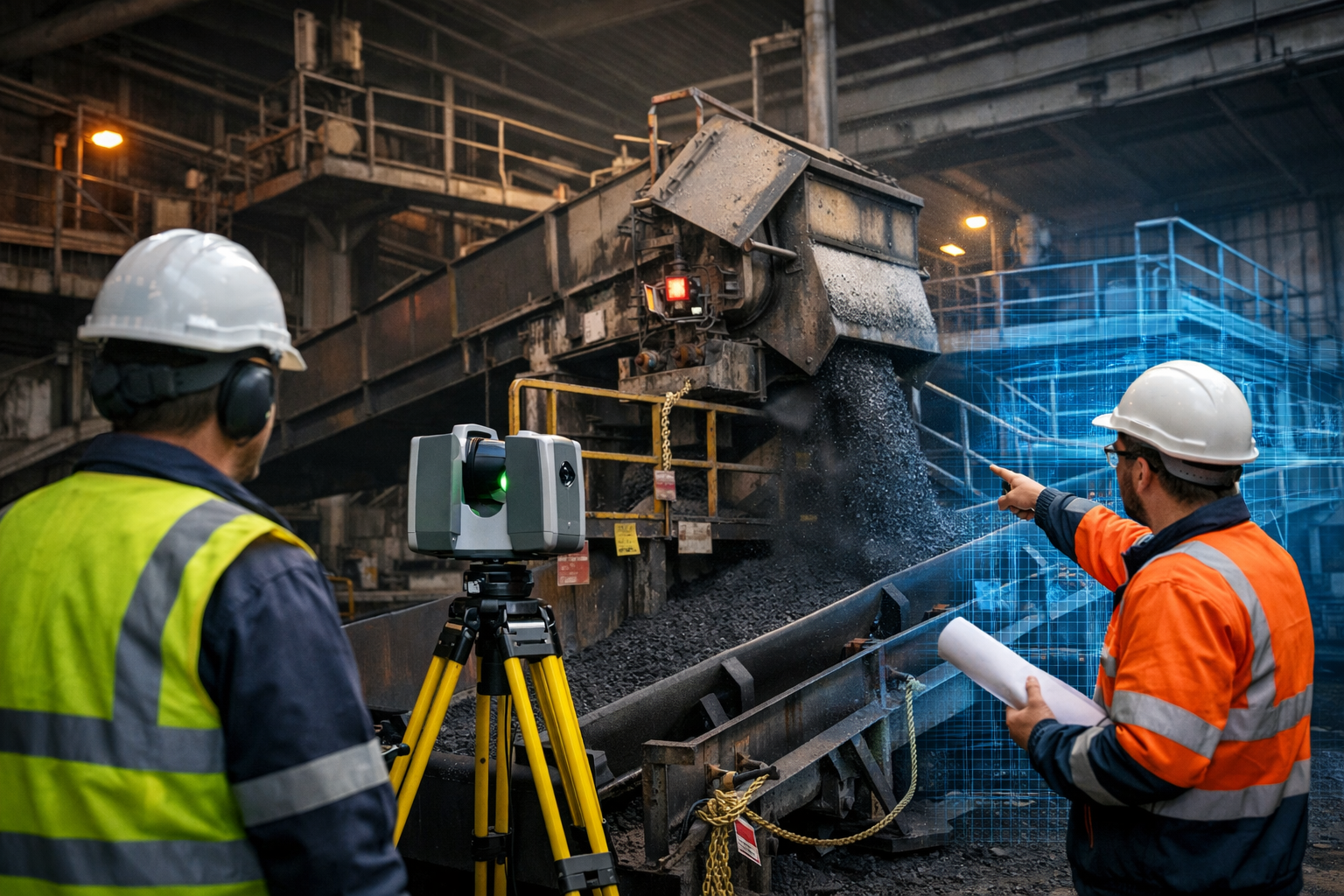
Coal plant shutdown engineering using a 3D laser scanner to capture conveyor and transfer chute infrastructure.

Coal Plant Shutdown Engineering | Preparation for Mining & Industrial Shutdowns

Planned shutdowns are a critical part of maintaining reliability in coal handling plants, port infrastructure, and large industrial facilities. During these scheduled outages, engineers must inspect, upgrade, or replace equipment across complex mechanical systems including conveyors, transfer chutes, crushers, and structural infrastructure.

Effective coal plant shutdown engineering focuses on preparation before the shutdown begins. Accurate plant data, detailed engineering models, and well-planned maintenance activities allow shutdown teams to complete work safely and within tight time windows.

Shutdown planning is essential because many maintenance activities must be performed while equipment is offline, often under strict time constraints with multiple trades working simultaneously. Without careful planning, shutdowns can quickly become unsafe, inefficient, or costly.


Why Engineering Preparation Matters

Coal processing plants operate continuously for long periods. Over time equipment is modified, upgraded, or repaired during multiple shutdown cycles. As a result, the original plant drawings often no longer represent the true layout of the facility.

Before a shutdown begins, engineering teams must confirm:

  • Existing conveyor alignments
  • Transfer chute geometry
  • Structural steel clearances
  • Access platforms and walkways
  • Equipment interfaces and installation areas

Modern engineering teams increasingly rely on laser scanning and digital modelling to capture the exact geometry of existing infrastructure. This produces a high-resolution point cloud of the plant that can be used to develop accurate engineering models before modifications begin.

These models allow engineers to validate equipment installations and reduce risk during the shutdown window.


The Role of Engineering Scanning Services

Engineering scanning services are now widely used across mining and industrial sectors to support shutdown planning.

Laser scanning technology can capture millions of measurement points across a facility, creating a detailed digital model of conveyors, chutes, structural steel and equipment installations.

Typical shutdown engineering scanning applications include:

  • Coal handling plant conveyors and transfer stations
  • Ship loader infrastructure at export terminals
  • Port stockpile systems and stacker reclaimers
  • Manufacturing production lines
  • Industrial processing plants

These digital datasets can then be converted into engineering-grade CAD models, enabling detailed design work to be completed before the shutdown occurs.

This approach significantly reduces installation risk and allows fabrication work to begin before the plant outage.

For a deeper explanation of shutdown preparation workflows see:


Coal Handling Plant Infrastructure Challenges

Coal plants contain some of the most complex materials handling systems in heavy industry. Conveyors move thousands of tonnes of material per hour through crushers, screens, transfer chutes, and stockpiles.

Common shutdown engineering tasks include:

  • Transfer chute redesign
  • Conveyor upgrades
  • Structural steel modifications
  • Dust control improvements
  • Maintenance access upgrades

These areas are typically congested with equipment and structural supports. Engineering teams must therefore confirm clearances and installation access before shutdown work begins.

Laser scanning and digital modelling allow engineers to identify clashes and installation constraints early in the design phase.

Learn more about mechanical engineering support for these systems:


Transfer Chute Design During Shutdowns

Transfer chutes are often a major focus of shutdown engineering work. Poorly designed chutes can cause:

  • Conveyor belt wear
  • Blockages and carryback
  • Excessive dust generation
  • Reduced throughput

Because chutes are located at conveyor transfer points, modifications must often be installed during shutdown windows when conveyors are offline.

Engineering models developed from site scans allow designers to develop improved chute geometries that optimise material flow and reduce maintenance issues.

Further design guidance can be found here:
https://www.hamiltonbydesign.com.au/coal-chute-design/

You may also find additional engineering insights in this technical article:
https://chutesandtransferstations.blogspot.com/2025/07/designing-for-durability-chutes.html


Shutdown Engineering Across Industrial Facilities

Although coal handling plants are a major focus, the same engineering preparation methods apply across many industries.

Shutdown engineering scanning is increasingly used in:

  • Mining processing plants
  • Bulk material handling facilities
  • Manufacturing plants
  • Power stations
  • Port infrastructure
  • Industrial processing facilities

By developing accurate digital models before shutdowns occur, engineering teams can plan work packages, confirm installation sequences, and minimise delays during the outage period.

Proper shutdown planning improves safety, reduces downtime, and helps ensure maintenance projects are completed efficiently.


The Future of Shutdown Engineering

As mining and industrial infrastructure becomes more complex, shutdown preparation is increasingly relying on digital engineering workflows.

Technologies such as:

  • 3D laser scanning
  • point cloud modelling
  • digital twins
  • engineering simulation

are transforming the way shutdowns are planned and executed.

For operators of coal plants, ports, and manufacturing facilities, investing in accurate engineering data before a shutdown begins is one of the most effective ways to reduce project risk and improve plant reliability.

Hamilton By Design logo displayed on a blue tilted rectangle with a grey gradient background

3D LiDAR scanning and 3D modelling service button โ€” laser scanner capturing a point cloud for engineering and CAD modelling
Mechanical engineering services
Name
Would you like us to arrange a phone consultation for you?
Address
CHPP Engineering title graphic featuring bold white text reading "CHPP Engineering" centred on a blue rounded rectangle background.
Pipework Drafting title graphic featuring bold white text reading "Pipework Drafting" centred on a blue rounded rectangle background.
3D LiDAR Scanning for Engineering Projects title graphic featuring bold white text on a blue rounded rectangle background.

3D CAD Modelling Australia service banner for Hamilton By Design

Supporting Australian Coal โ€“ Engineering-Led 3D Scanning for CHPP & Coal Wash Plants

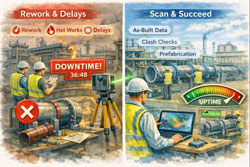
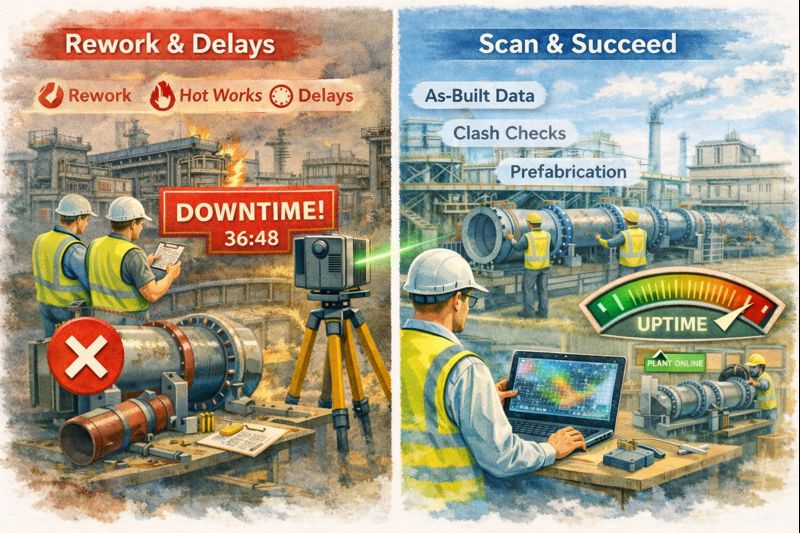
CHPP wash plant illustration comparing shutdown rework with LiDAR scanning and prefabrication success.

3D Scanning Services for CHPP โ€“ Reduce Rework, Maximise Uptime

Australian coal operations depend on reliable Coal Handling & Preparation Plants (CHPP), wash facilities, conveyors and mechanical systems. Every shutdown, upgrade and modification must be delivered quickly and safely to protect production. The most effective way to achieve this is through engineering-led 3D scanning services that capture real site conditions before a single component is fabricated.

Hamilton By Design specialises in FARO LiDAR and structured-light 3D scanning for the coal sector, turning complex brownfield sites into accurate digital models that drive practical engineering outcomes. Our focus is simple: maximise plant uptime by reducing rework.


Why Shutdowns Need Better Information

Coal wash plants are dynamic environments. Over decades of modifications:

  • drawings no longer match reality
  • structures move under load
  • pipe routes are altered
  • access becomes restricted

Relying on tape measures and sketches during a shutdown invites risk. A bracket that is 20 mm wrong or a spool that fouls an existing service can cost days of lost production. Accurate 3D scanning before the outage removes those unknowns.


Coal wash plant shutdown workflow from delays to scan-led success using LiDAR.

Hamilton By Design 3D Scanning Services

Our scanning services are built specifically for industrial and mining applications:

FARO LiDAR As-Built Capture

  • full plant and conveyor surveys
  • transfer stations, bins and pump boxes
  • structural steel and foundations
  • tie-in points for new pipework
  • clearance verification for maintenance

Structured-Light Scanning (EinScan)

  • motors, gearboxes and legacy parts
  • guards, covers and small assemblies
  • reverse engineering for obsolete components
  • detailed capture for first-time-fit design

Point Cloud to CAD Workflows

  • modelling in SolidWorks & Fusion
  • fabrication drawings for local workshops
  • clash detection and installation planning
  • digital twins for ongoing maintenance

These services ensure that design decisions are based on measured reality, not assumptions.


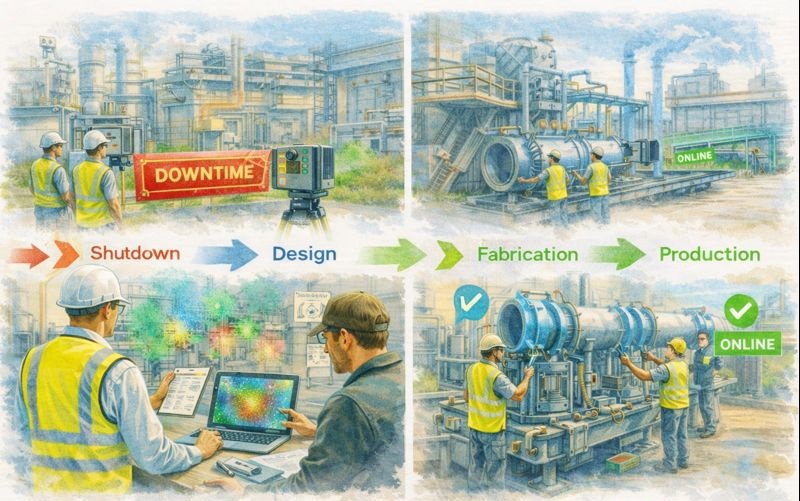
Engineering-led LiDAR scanning sequence from downtime to online restart.

FARO LiDAR for CHPP As-Builts

Terrestrial LiDAR creates a high-density point cloud of the entire coal wash facility. Engineers can:

  • design new chutes and spools directly over site geometry
  • confirm conveyor alignments
  • plan access platforms and walkways
  • test installation sequences digitally

By linking scanning to engineering, components arrive on site ready to install โ€” protecting uptime and reducing rework during critical shutdown windows.


Practical Outcomes for Coal Plants

Conveyor & Transfer Upgrades

  • accurate chute replacements
  • skirt and belt line verification
  • drive and pulley modifications
  • minimal site adjustments

Pump Boxes & Pipework

  • prefabricated spools that fit first time
  • reverse engineering of worn equipment
  • safe tie-ins without surprises

Structural & Access Works

  • platform and handrail retrofits
  • screen support modifications
  • crane and lifting planning

Every task is driven by 3D scan data so workshops fabricate with confidence.


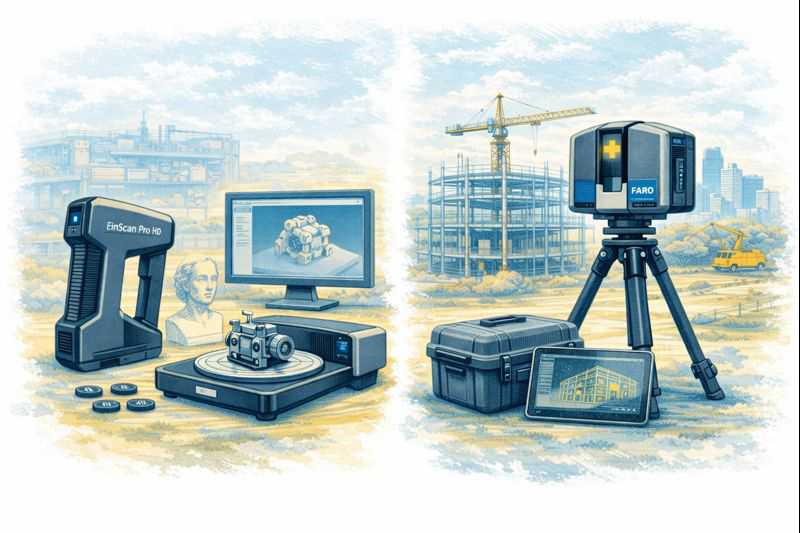
Visual comparison of EinScan object scanner and LiDAR terrestrial laser scanner in matching sketch style.

Engineering-Led, Not Just Surveying

Hamilton By Design treats scanning as part of the engineering process:

  1. 3D capture of the live plant
  2. engineering review of critical datums
  3. point cloud modelling in parametric CAD
  4. fabrication drawings for Australian workshops
  5. shutdown planning to ensure first-time fit

This approach directly supports the goal of maximum plant uptime.


Supporting Australian Capability

Scan-driven design keeps work local. Regional fabricators receive accurate models and drawings that reflect the real CHPP environment, enabling:

  • faster workshop production
  • fewer site variations
  • safer installations
  • reduced dependence on imported components

Committed to the Coal Sector

Hamilton By Design supports coal operations across NSW, the Central Coast, Sydney and regional Queensland including Mount Isa. Our 3D scanning services enhance every stage of shutdown planning and brownfield upgrades by eliminating guesswork and cutting rework.


Hamilton By Design logo displayed on a blue tilted rectangle with a grey gradient background
3D LiDAR scanning and 3D modelling service button โ€” laser scanner capturing a point cloud for engineering and CAD modelling
Mechanical engineering services

Our Services

  • FARO LiDAR scanning for CHPP as-builts
  • EinScan component capture
  • Point cloud to CAD modelling
  • Fabrication drawings & DXF outputs
  • Clash detection and digital twin support

Maximise your plant uptime by reducing rework โ€” talk to us before your next shutdown.

Name
Would you like us to arrange a phone consultation for you?
Address

3D CAD Modelling Australia service banner for Hamilton By Design
Finite Element Analysis (FEA) engineering simulation button
Mechanical engineering services

Mechanical Engineering | Structural Engineering


AS 1657 Access Compliance | Fixed Platforms, Walkways, Stairs & Ladders

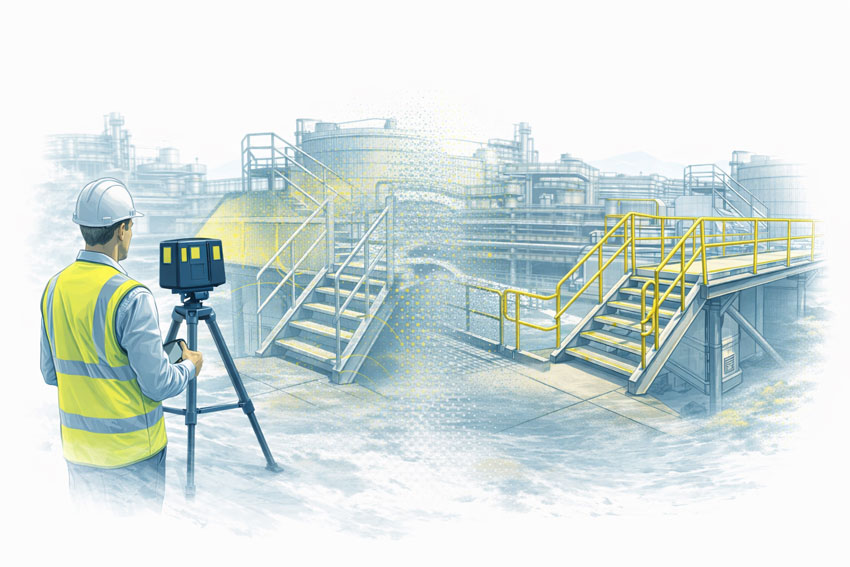
Engineer using LiDAR scanner to assess a stairway with missing handrails, transitioning to AS 1657-compliant walkways and stairs in an operating plant

AS 1657 โ€“ Fixed Platforms, Walkways, Stairways & Ladders

One of the Most Enforced Standards on Mine Sites

Safe access is fundamental to operating plant. If people are required to inspect, operate, isolate, maintain, or repair equipment, they must be able to access it safely. This is why AS 1657 โ€“ Fixed platforms, walkways, stairways & ladders is one of the most actively enforced Australian Standards across mine sites, processing plants, and heavy industry.

Unlike many structural standards, AS 1657 compliance is highly visible, directly linked to injury risk, and simple for regulators to assess during inspections. As a result, access systems are often one of the first areas reviewed following incidents, audits, or site modifications.

Hamilton By Design supports asset owners by converting real as-built access steelwork into verified, engineering-grade digital records that can be assessed, upgraded, and documented with confidence.


Why AS 1657 Is Enforced So Frequently

AS 1657 governs how people physically move around plant. Regulators do not need detailed calculations to identify non-compliance โ€” they can see it immediately.

AS 1657 enforcement is commonly driven by:

  • Slips, trips and falls remaining a leading cause of mine-site injuries
  • Direct links to working-at-heights risk
  • Clear dimensional and geometric requirements
  • Strong alignment with WHS duty-of-care obligations

In practice, AS 1657 is enforced not because it is complex, but because non-compliance is visible and consequential.


LiDAR scanning of industrial stair and walkway access showing non-compliant handrails and the upgraded AS 1657-compliant access solution

Where AS 1657 Compliance Breaks Down in Operating Plant

Most access systems are originally designed with good intent. Problems develop over time as plant is modified, upgraded, or repurposed โ€” while access arrangements are not re-verified.

Common real-world scenarios include:

  • Walkways designed for inspection now used for routine maintenance
  • Increased personnel traffic driven by reliability or production demands
  • Temporary access becoming permanent
  • New guarding, chutes, pipework or services reducing clearances
  • Access steelwork modified during shutdowns with no formal review

The standard did not change โ€” the way the plant is used did.


Common AS 1657 Non-Conformances on Mine Sites

Across brownfield assets, the same access issues appear repeatedly:

  • Walkways narrower than required for the task being performed
  • Missing, incomplete, or inconsistent handrails and toe boards
  • Stairways outside allowable pitch or geometry limits
  • Inconsistent riser heights and tread depths
  • Ladders used where stairs should be provided
  • Unsafe access around conveyors, tanks, hoppers, and transfer stations
  • Ad-hoc access steelwork added without drawings or verification

Individually these issues may appear minor. Collectively, they represent a significant safety, compliance, and governance risk.


โ€œLooks Safeโ€ Is Not the Same as Compliant

A common industry assumption is that if access appears safe, it must be compliant. In reality:

  • Dimensional non-compliance is often subtle
  • Incremental changes hide cumulative risk
  • Visual acceptability does not equal compliance
  • Documentation is frequently missing or outdated

Most access systems do not fail catastrophically.
They fail audits, inspections, and incident reviews.


AS 1657 Interfaces with Other Standards

AS 1657 rarely exists in isolation on mine sites. It typically interfaces with:

  • AS 3990 โ€“ Mechanical equipment steelwork supporting access systems
  • AS 1755 โ€“ Conveyors and associated access and guarding
  • AS 4100 โ€“ Steel structures
  • WHS legislation โ€“ Enforcement and duty-holder accountability

Many compliance gaps occur at the interfaces between standards rather than within a single document.


The Documentation Gap in Access Compliance

A recurring challenge on older or modified sites is not necessarily unsafe access โ€” it is unverified access.

Common documentation gaps include:

  • Missing or obsolete access drawings
  • Handrails, stairs, and platforms never updated in CAD
  • Legacy drawings that no longer reflect site conditions
  • Inability to demonstrate compliance during audits

If you cannot prove what exists, it becomes difficult to prove compliance, fitness-for-purpose, or due diligence.


The Role of LiDAR Scanning in AS 1657 Compliance

Engineering-grade 3D LiDAR scanning provides a practical solution to access compliance challenges by capturing accurate as-built geometry.

LiDAR scanning allows asset owners to:

  • Measure real walkway widths, clearances, stair geometry and ladder access
  • Verify existing access systems against AS 1657 requirements
  • Identify non-compliances before audits or incidents
  • Design access upgrades that fit existing plant first time
  • Create reliable digital records for governance and lifecycle management

This approach replaces assumptions with measured reality.

Related service:
https://www.hamiltonbydesign.com.au/3d-laser-scanning/


AS 1657 in Brownfield Upgrades and Shutdowns

Access compliance is most commonly compromised during:

  • Tight shutdown windows
  • Conveyor and guarding upgrades
  • Debottlenecking and plant modifications
  • โ€œLike-for-likeโ€ replacements that repeat legacy issues

Without accurate as-built data, access upgrades risk fabrication rework, site clashes, and reinstating non-compliant geometry. Digital verification prior to fabrication significantly reduces these risks.


Our clients:

AS 1657 as a Due Diligence Issue for Asset Owners

For officers and senior leaders, AS 1657 compliance is not just an engineering detail โ€” it is a governance and due-diligence issue.

Demonstrating due diligence increasingly requires:
  • Evidence-based decision making
  • Documented verification of access systems
  • Clear linkage between identified risks and controls
  • Audit-ready engineering records

AS 1657 compliance is often one of the most visible indicators of how seriously an organisation treats safety and asset stewardship.


Practical Triggers to Review AS 1657 Compliance

An AS 1657 review should be considered when:
  • A near-miss or fall incident occurs
  • Maintenance frequency increases
  • New guarding or conveyors are installed
  • Access is modified during shutdowns
  • An audit or regulator inspection is upcoming
  • Assets are being sold, leased, or handed over

Early verification is significantly more cost-effective than reactive remediation.


Hamilton By Design logo displayed on a blue tilted rectangle with a grey gradient background
3D LiDAR scanning and 3D modelling service button โ€” laser scanner capturing a point cloud for engineering and CAD modelling
Mechanical engineering services

How Hamilton By Design Supports AS 1657 Compliance

Hamilton By Design supports access compliance by combining:

  • Engineering-grade LiDAR scanning
  • Accurate as-built CAD models
  • Practical upgrade and retrofit design
  • Fabrication-ready documentation

This enables asset owners to move from assumed compliance to verified compliance, with confidence in safety, constructability, and governance.

Name
Would you like us to arrange a phone consultation for you?
Address
Finite Element Analysis (FEA) engineering simulation button
Mechanical engineering services