Brownfield Costโ€“Benefit: Engineering Design vs Continuous Navisworks Model Maintenance

Executive Summary

In brownfield projects, the highest return comes from applying engineering design effort at the point of change, supported by accurate point cloud data, rather than continuously updating a federated model.

The practical reality is:

Invest in engineering decisions, not in maintaining a model that becomes outdated faster than the plant changes.


3D LiDAR scanning and 3D modelling service button โ€” laser scanner capturing a point cloud for engineering and CAD modelling
Mechanical engineering services

Two Approaches

1. Model Maintenanceโ€“Centric (Navisworks)

Using Autodesk Navisworks Manage as an ongoing platform:

  • Maintain a full federated model
  • Update after every site change
  • Re-run coordination and clash detection
  • Manage model alignment across disciplines

2. Engineering-Driven (Point Cloud + Targeted CAD)

Using:

  • FARO SCENE
  • SOLIDWORKS eDrawings
  • Capture and retain point cloud data as the primary asset
  • Model only what is being modified
  • Use CAD and drawings for fabrication and communication

Cost Drivers

Navisworks Model Maintenance

  • Initial model creation and federation
  • Continuous updates after modifications
  • Data conversion and reprocessing
  • Coordination meetings and clash resolution
  • Ongoing QA and model validation

Additional hidden costs include:

  • Model drift corrections
  • Rework due to mismatch with site conditions
  • Reliance on a limited number of trained users

Engineering-Driven Workflow

  • Targeted scanning where required
  • Point cloud processing and validation
  • Engineering design effort for modifications
  • Drawing and component model production

Additional benefits include:

  • Reusable scan data
  • No requirement to maintain a full plant model
  • Faster response to site-driven changes
3D CAD Modelling Australia service banner for Hamilton By Design

Benefit Comparison

Navisworks model maintenance offers strong upfront coordination, particularly in greenfield projects, but suffers from degradation over time and high ongoing cost.

Engineering-driven workflows using point cloud data provide higher long-term accuracy, faster turnaround for small changes, and better alignment with real site conditions.


Line-of-Sight Reality

Point cloud data is inherently line-of-sight dependent. This means:

  • Only visible surfaces are captured
  • Occlusions result in gaps in the dataset

This limitation exists regardless of software platform.

Importing a point cloud into Navisworks does not improve data completeness or accuracy โ€” it simply presents the same data in a different environment.


Practical Example

For a minor electrical upgrade:

Navisworks Approach

  • Update the federated model
  • Re-run coordination
  • Issue revised model
  • Proceed with installation

This introduces significant overhead for a simple task.


Engineering Approach

  • Review point cloud or site conditions
  • Confirm clearances
  • Design locally
  • Install
  • Update drawings if required

This approach is faster, lower cost, and aligned with how work is actually executed.


Where Navisworks Adds Value

Navisworks remains effective when:

  • Multiple disciplines are designing simultaneously
  • Large-scale coordination is required
  • Clash detection is critical

This typically applies to:

  • Greenfield projects
  • Major brownfield upgrades

It should be treated as a project-phase coordination tool, not a long-term data management system.


Recommended Strategy

  • Use point cloud data as the primary reference
  • Maintain raw and registered datasets (e.g. E57)
  • Model only critical interfaces and new work
  • Use drawings for formal deliverables
  • Apply Navisworks selectively where coordination is required

Final Position

In brownfield environments, value is created through engineering design and decision-making, not through continuous model maintenance.


One-Line Summary

Design what youโ€™re changing. Scan what youโ€™re keeping. Donโ€™t model what you wonโ€™t maintain.

Our clients

Talk to Us – Contact Us

Name
Would you like us to arrange a phone consultation for you?
Address
CHPP Engineering title graphic featuring bold white text reading "CHPP Engineering" centred on a blue rounded rectangle background.
Pipework Drafting title graphic featuring bold white text reading "Pipework Drafting" centred on a blue rounded rectangle background.
3D LiDAR Scanning for Engineering Projects title graphic featuring bold white text on a blue rounded rectangle background.

The Hidden Problem in Most Workshops

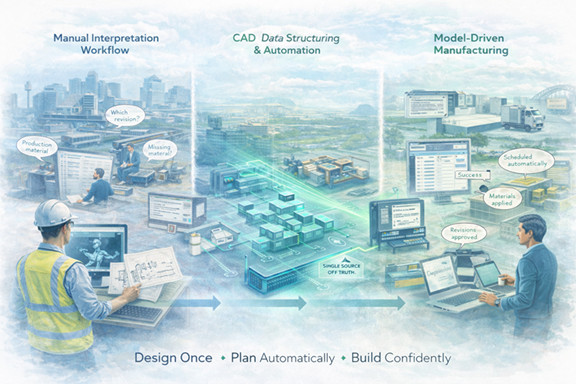
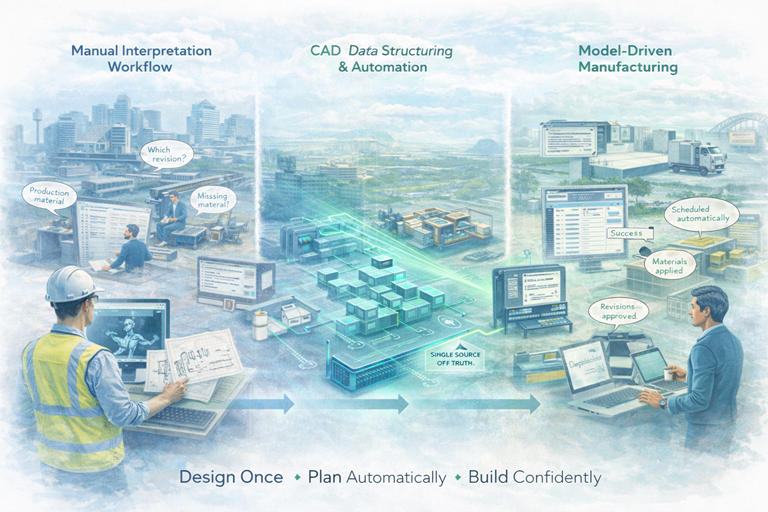
Illustration showing CAD models automatically generating manufacturing orders in a digital factory workflow.

Many manufacturers invest heavily in CAD modelling, yet the moment a drawing is finished someone still has to manually re-enter the same information into purchasing, inventory, or scheduling systems.

That means:

  • Part numbers typed again
  • Quantities re-counted
  • Materials guessed or re-checked
  • Work orders manually created

Every manual step introduces delay and risk.
The drawing may be correct โ€” but the data isnโ€™t trusted.

At Hamilton By Design, we specialise in converting engineering design information into operational manufacturing data so your workshop runs from a single source of truth.


Engineering workflow transforming design drawings into live MRP production data.

What We Mean by โ€œRaw CAD Dataโ€

Raw CAD data typically contains far more intelligence than most businesses actually use:

  • Assembly structures
  • Component relationships
  • Material specifications
  • Mass & geometry
  • Fasteners & hardware
  • Configuration variations

Yet in many businesses, this intelligence is flattened into a PDF before production ever sees it.

The result?
Your ERP/MRP system becomes an administrative burden rather than an automation tool.


Turning CAD into Live MRP

We implement a workflow where the model drives the factory โ€” not paperwork.

Step 1 โ€” Data Structuring

We prepare your CAD models so every component carries meaningful manufacturing information:

  • Standardised naming conventions
  • Manufacturing classifications
  • Purchasing categories
  • Stock vs made items

Step 2 โ€” Bill of Materials Extraction

Instead of manually writing BOMs, they are generated directly from the model.

No re-typing.
No missed fasteners.
No version confusion.

Step 3 โ€” Live MRP Integration

The structured data feeds directly into your MRP system to automatically create:

  • Work orders
  • Material requirements
  • Purchase orders
  • Scheduling demand
  • Inventory reservations

Now your planning team works with live engineering data โ€” not interpreted drawings.


What This Changes Inside Your Business

Once CAD and MRP talk to each other, the workflow shifts dramatically.

Traditional WorkflowIntegrated Workflow
Draw โ†’ Print โ†’ Interpret โ†’ Re-enterModel โ†’ Validate โ†’ Manufacture
Planner guesses requirementsSystem calculates requirements
Revisions cause chaosRevisions update automatically
Production waits on adminProduction follows live data

The Real Value โ€” Engineering Becomes Operational

Your CAD system stops being a documentation tool and becomes the control system of the workshop.

This delivers measurable outcomes:

  • Reduced purchasing mistakes
  • Faster quoting
  • Accurate scheduling
  • Live material forecasting
  • Reliable cost tracking
  • Scalable production

Most importantly โ€” your team stops double handling information.


How Hamilton By Design Helps

We donโ€™t sell software โ€” we implement workflows.

Our team works between engineering and operations to:

  • Audit your current drawing workflow
  • Structure your CAD standards
  • Build automated BOM generation
  • Integrate with your MRP platform
  • Train staff in daily use
  • Support ongoing improvements

The goal is simple:
Design once. Manufacture confidently.


Hamilton By Design logo displayed on a blue tilted rectangle with a grey gradient background

3D LiDAR scanning and 3D modelling service button โ€” laser scanner capturing a point cloud for engineering and CAD modelling
Mechanical engineering services

Ready to Turn Drawings into Production?

If your workshop is still manually converting drawings into orders, the problem isnโ€™t your people โ€” itโ€™s the data flow.

Hamilton By Design helps manufacturers move from documents to systems.

Contact us to discuss turning your raw CAD data into live MRP data.

Name
Would you like us to arrange a phone consultation for you?
Address

3D LiDAR scanning and 3D modelling service button โ€” laser scanner capturing a point cloud for engineering and CAD modelling
Mechanical engineering services
Finite Element Analysis (FEA) engineering simulation button
Mechanical engineering services