

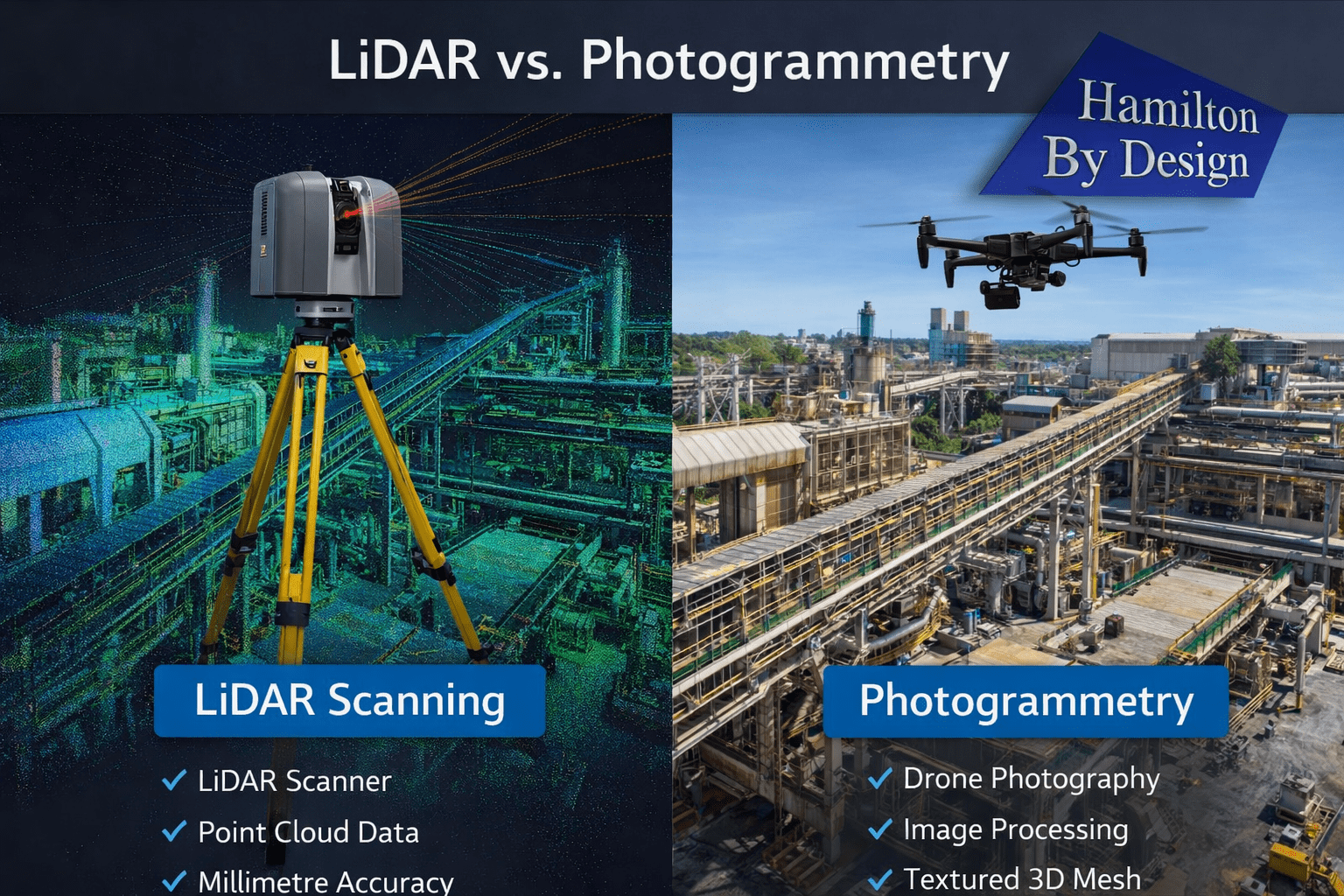
Understanding the Difference Between LiDAR and Photogrammetry
When engineers need to capture accurate measurements of industrial infrastructure, two technologies are commonly considered: LiDAR scanning and photogrammetry.
Both methods allow engineers to create 3D digital models of real-world environments. However, when comparing LiDAR vs photogrammetry, each technology has different strengths depending on the type of engineering project.
For industries such as mining, processing plants, and heavy industrial facilities, choosing the right technology can significantly affect the accuracy, speed, and reliability of engineering design work.
At Hamilton By Design, LiDAR scanning is frequently used to capture existing conditions in complex industrial environments where precision is critical.
Learn more about engineering-grade scanning here:
https://www.hamiltonbydesign.com.au/home/engineering-grade-3d-laser-scanning-mining-industrial/
What is LiDAR Scanning?
LiDAR (Light Detection and Ranging) uses laser pulses to measure the distance between the scanner and surrounding surfaces. A terrestrial laser scanner emits millions of laser pulses per second and records the returned signal to calculate precise spatial coordinates.
The result is a dense 3D point cloud representing the scanned environment.
Engineering-grade LiDAR scanners commonly achieve millimetre-level accuracy, making them well suited for capturing industrial infrastructure such as:
- pipework systems
- structural steel
- conveyors
- tanks and vessels
- pump stations
- processing equipment
LiDAR scanning is widely used for plant upgrades, shutdown planning, and mechanical design where accurate site data is essential.
More information on LiDAR scanning services:
https://www.hamiltonbydesign.com.au/home/engineering-services/3d-laser-scanning/
What is Photogrammetry?
Photogrammetry is a technique that creates 3D models using photographs captured from multiple angles. Specialised software analyses overlapping images and reconstructs a three-dimensional model of the scene.
Photogrammetry is commonly used in:
- aerial mapping
- surveying large land areas
- construction progress monitoring
- environmental mapping
- drone-based inspections
Because the technique relies on photographs rather than laser measurements, the accuracy of photogrammetry depends on factors such as image quality, lighting conditions, and camera calibration.
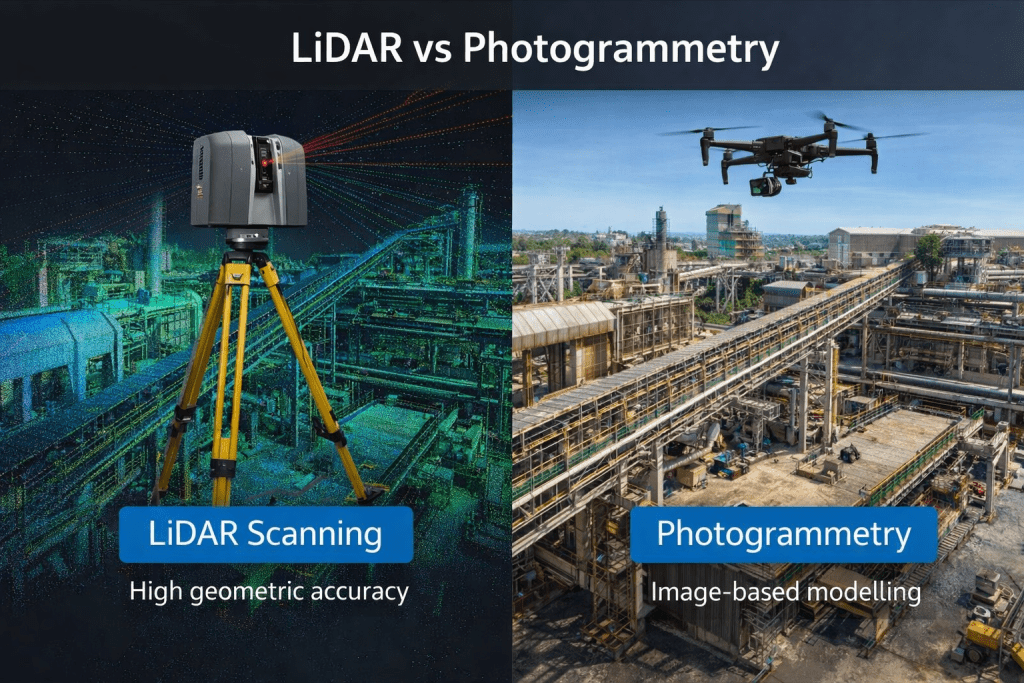
LiDAR vs Photogrammetry: Key Differences
When comparing LiDAR vs photogrammetry, the main differences relate to measurement accuracy, speed of data capture, and suitability for complex environments.
| Feature | LiDAR Scanning | Photogrammetry |
|---|---|---|
| Measurement Method | Laser distance measurement | Image-based reconstruction |
| Typical Accuracy | Millimetre-level | Centimetre-level (depending on conditions) |
| Performance in Low Light | Excellent | Limited |
| Surface Detail | High geometric accuracy | High visual detail |
| Performance in Complex Plant | Very strong | More challenging |
| Data Capture Speed | Very fast | Moderate |
For industrial engineering projects, LiDAR scanning typically provides more reliable geometric data, especially when scanning dense plant environments.
When LiDAR is Preferred in Industrial Engineering
LiDAR scanning is often the preferred technology for projects involving complex infrastructure.
Common engineering applications include:
- plant upgrades and retrofits
- pipework modifications
- structural steel design
- conveyor and materials handling systems
- pump installations
- shutdown planning
In these environments, millimetre-level accuracy is required to ensure new components fit correctly within existing structures.
LiDAR scanning is also effective in environments with limited lighting or reflective metal surfaces, which are common in industrial facilities.
You can read more about how engineers capture existing conditions before plant upgrades here:
https://www.hamiltonbydesign.com.au/capture-existing-conditions-before-plant-upgrades/
When Photogrammetry is Useful
Photogrammetry remains a valuable tool for certain types of projects, particularly where large areas must be captured quickly.
Typical applications include:
- drone-based terrain mapping
- stockpile measurement
- topographic surveys
- construction progress documentation
- infrastructure inspections
In these situations, photogrammetry provides an efficient method of capturing large datasets using aerial imagery.
However, for detailed industrial modelling, additional processing may be required to achieve the level of precision needed for engineering design.
Combining LiDAR and Photogrammetry
In some projects, engineers combine LiDAR scanning with photogrammetry to capture both accurate geometry and high-quality visual textures.
This approach can be useful when:
- documenting heritage structures
- visualising infrastructure for presentations
- creating digital twins of facilities
However, for most industrial engineering applications, LiDAR scanning remains the primary technology used for accurate measurement.
From Scan Data to Engineering Models
Regardless of the capture method used, the final goal in engineering projects is often to convert the captured data into usable CAD models.
The typical workflow includes:
- Site data capture
- Data processing and alignment
- Point cloud generation
- Engineering modelling in CAD software
- Design and fabrication documentation
You can learn more about this process here:

Conclusion
When comparing LiDAR vs photogrammetry, both technologies offer valuable tools for capturing real-world environments.
However, for most industrial engineering applications where accuracy and reliability are critical, LiDAR scanning typically provides the best results.
For mining, processing plants, and heavy industrial facilities, engineering-grade LiDAR scanning allows project teams to work from highly accurate digital models of existing infrastructure.
This improves design confidence, reduces installation risk, and helps ensure that new components integrate successfully with existing plant systems.
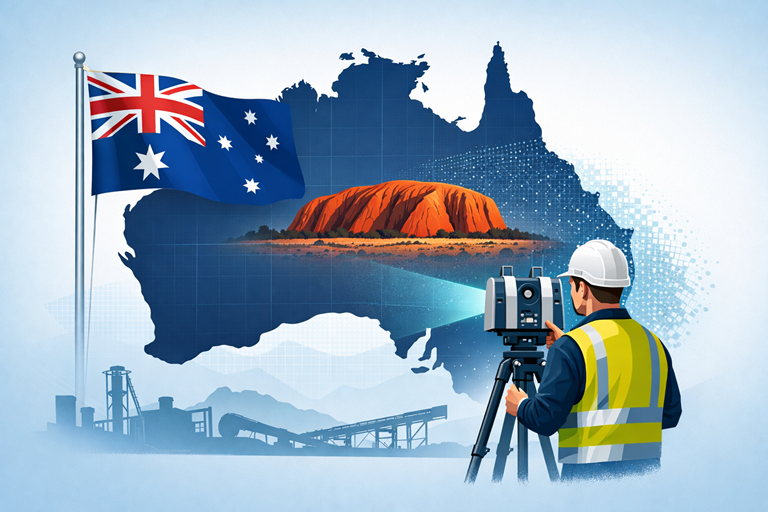
Hamilton By Design provides engineering-grade LiDAR scanning services to support industrial engineering projects across Australia.