


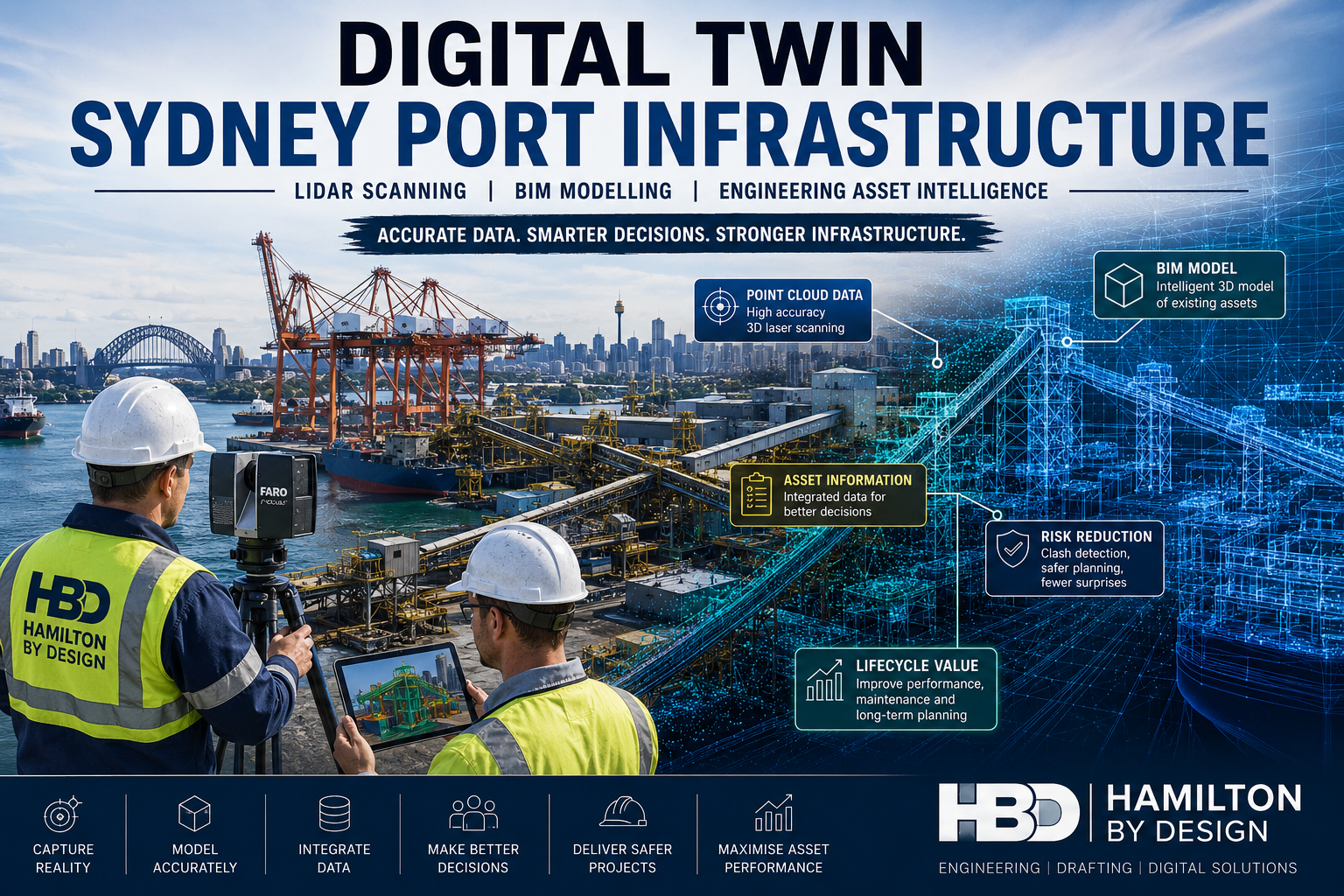
Develop Digital Twins of Sydney Port Infrastructure Using LiDAR Scanning, BIM and Engineering Modelling Workflows
Sydney’s ports are among Australia’s most important infrastructure assets, supporting container handling, bulk materials, fuel imports, logistics operations and international trade. As port facilities continue to expand and age, asset owners face increasing challenges managing infrastructure that has often been modified over decades without complete documentation.
Hamilton By Design provides Digital Twin Sydney Port Infrastructure services, combining engineering-grade LiDAR scanning, reality capture, BIM modelling and engineering workflows to create accurate digital representations of existing port assets. These digital twins provide a reliable foundation for maintenance planning, shutdowns, upgrades, asset management and future capital works.
Whether the project involves a container terminal, bulk handling facility, conveyor network, berth structure, ship loader, fuel terminal or rail interface, our team develops accurate digital twins that allow stakeholders to make engineering decisions based on real-world conditions rather than outdated drawings.
What is a Digital Twin?
A digital twin is a detailed digital representation of a physical asset or facility. Unlike traditional CAD drawings, a digital twin combines accurate geometry, engineering information and asset data into a single environment that can be used throughout the asset lifecycle.
For Sydney port operators, a digital twin can include:
- Existing structural steelwork
- Conveyors and materials handling systems
- Ship loaders and unloaders
- Wharf and berth infrastructure
- Mechanical equipment
- Pipework and services
- Electrical installations
- Buildings and facilities
- Road and rail interfaces
- Underground and above-ground assets
Digital twins allow engineering, maintenance and operations teams to access accurate infrastructure information without needing to physically inspect every asset.
Why Sydney Ports Need Digital Twins
Many port facilities have undergone numerous upgrades, repairs and expansions over several decades. In many cases, original drawings are missing, inaccurate or no longer reflect the actual site conditions.
Common challenges include:
- Incomplete or outdated as-built documentation
- Unknown modifications performed during shutdowns
- Limited visibility of asset condition
- Difficulty planning future upgrades
- High costs associated with site rework
- Engineering clashes during construction
- Safety risks from inaccurate information
- Loss of knowledge when personnel retire or move on
Developing a digital twin provides a single source of truth that accurately reflects the current state of the facility.
Engineering-Grade LiDAR Scanning for Port Infrastructure
The foundation of every digital twin is accurate reality capture.
Hamilton By Design uses engineering-grade terrestrial LiDAR scanning technology to capture highly detailed three-dimensional data from existing port infrastructure.
Typical assets scanned include:
- Container terminals
- Conveyor systems
- Transfer towers
- Bulk handling facilities
- Storage sheds
- Fuel infrastructure
- Structural steelwork
- Ship loading equipment
- Wharf structures
- Marine infrastructure
Using advanced scanning equipment, millions of measurements are collected every second to generate a highly accurate point cloud of the facility.
This point cloud forms the basis of the digital twin development process.
Scan-to-BIM Workflows for Sydney Ports
Once the scanning process is complete, the captured data is processed and registered to create a coordinated digital representation of the facility.
The registered point cloud can then be converted into BIM models using industry-standard software platforms.
Depending on project requirements, digital twin models may include:
- Structural steel modelling
- Mechanical equipment modelling
- Pipework systems
- Architectural components
- Electrical infrastructure
- Access systems and walkways
- Conveyor systems
- Material handling equipment
These BIM models provide accurate geometry and can be linked to asset information, maintenance records and operational data.
Supporting Brownfield Port Upgrades
One of the most valuable applications of digital twin technology is supporting brownfield infrastructure upgrades.
Port facilities rarely provide the luxury of starting with an empty site. Most projects must be designed around existing equipment and infrastructure while maintaining operational requirements.
Digital twins help project teams:
- Identify potential clashes before construction
- Verify available space
- Confirm existing dimensions
- Plan shutdown activities
- Reduce installation risk
- Improve fabrication accuracy
- Minimise site modifications
By working from a verified digital environment, engineers can significantly reduce uncertainty and improve project outcomes.
Improving Shutdown Planning and Execution
Shutdowns represent some of the highest-risk activities undertaken within port environments.
A single delay can impact vessel schedules, cargo handling operations and contractor productivity.
Digital twins support shutdown planning by allowing project teams to:
- Virtually inspect assets before mobilisation
- Develop detailed work packages
- Verify access requirements
- Confirm lifting clearances
- Identify construction constraints
- Plan temporary works
- Validate installation sequences
This proactive approach helps reduce downtime and improves shutdown efficiency.
Asset Management and Lifecycle Planning
Digital twins also provide substantial long-term value for asset owners.
Instead of relying on scattered drawings and historical records, maintenance teams gain access to an accurate digital representation of their infrastructure.
Benefits include:
- Improved asset registers
- Faster maintenance planning
- Better condition assessments
- Improved inspection programs
- Enhanced capital planning
- Reduced engineering investigation time
- Improved operational awareness
As infrastructure ages, access to accurate digital information becomes increasingly important for managing risk and maintaining operational reliability.
Typical Digital Twin Development Process
Hamilton By Design follows a structured workflow to ensure high-quality outcomes.
1. Site Assessment
The project begins with a review of existing documentation, operational requirements and access constraints.
2. LiDAR Scanning
Engineering-grade terrestrial laser scanning captures existing infrastructure conditions.
3. Point Cloud Registration
Individual scans are processed and combined into a unified digital dataset.
4. Quality Assurance
Registration accuracy and data coverage are verified to ensure engineering suitability.
5. BIM and Engineering Modelling
The point cloud is converted into intelligent engineering models and BIM environments.
6. Asset Classification
Assets are organised and structured according to project requirements.
7. Digital Twin Development
Engineering information and asset data are integrated into the model environment.
8. Final Delivery
The completed digital twin is delivered in client-specified formats.
Deliverables
Depending on project requirements, Hamilton By Design can provide:
- Registered E57 point clouds
- RCP and RCS files
- Autodesk Revit models
- Navisworks models
- AutoCAD drawings
- General arrangement drawings
- Structural models
- Mechanical equipment models
- Asset registers
- BIM deliverables
- Digital twin datasets
- Engineering reports
Deliverables are tailored to support ongoing operations, maintenance and future engineering projects.

Why Choose Hamilton By Design?
Hamilton By Design combines practical engineering experience with advanced reality capture technology.
Our team understands the challenges associated with operating and upgrading complex industrial facilities, particularly within port and maritime environments.
Our capabilities include:
- Engineering-led LiDAR scanning
- Scan-to-BIM services
- Mechanical engineering
- Structural engineering support
- Engineering drafting
- Brownfield project experience
- Shutdown planning support
- Asset capture and verification
We focus on delivering digital twin solutions that provide practical value and support informed decision-making throughout the asset lifecycle.
Digital Twin Services for Sydney Port Infrastructure
If you are planning an upgrade, shutdown, expansion project or asset management initiative, an accurate digital twin can significantly reduce risk and improve project outcomes.
Hamilton By Design provides Digital Twin Sydney Port Infrastructure services throughout Sydney and surrounding regions, helping port operators, engineering teams and asset owners develop accurate digital representations of critical infrastructure.
By combining LiDAR scanning, BIM modelling and engineering expertise, we create digital twins that provide the confidence needed to plan, maintain and upgrade port assets effectively.
Talk to Us – Contact Us
Our clients:
























